
Will a Car Seat Fit in My Car? 7 Checks Before You Buy or Borrow One
Quick Answer
Will a car seat fit in my car? Most car seats fit most cars, but not every seat fits every seating position. A car seat fits when it installs tightly, reaches its required recline, leaves the front seats usable, and follows both manuals. Measure first, then test the real install before you buy. Check car seat compatibility with your vehicle step by step if you want the full manual check.
The 5-minute fit check
- Measure width: Measure the flat part of the rear seat where the car seat will sit.
- Measure depth: Measure from the seatback to the front edge of the cushion.
- Check front space: Sit in front with the car seat reclined to its required angle.
- Find the anchors: Confirm lower anchors or a locking seat belt in that position.
- Test the install: Install it, then check for less than one inch of movement at the belt path.
If it does not fit
- Try another approved rear seating position first, then a more compact seat model.
- Never force a seat, cut a cushion, or use an unapproved spacer to make it fit.
I have tried car seats in a small sedan, a family SUV, and a pickup, and the same seat behaved differently in each one. The sedan gave me a tight squeeze, the SUV gave me room to breathe, and the truck made me rethink the whole seating plan.
If you are wondering will a car seat fit in my car, the answer depends on your car, your seat, your child, and the exact seating position you choose.
In This Guide
- What Does “Fit” Actually Mean for a Car Seat?
- How Do You Measure Your Car for a Car Seat?
- Will a Rear-Facing Car Seat Fit in a Small Car?
- Will a Car Seat Fit in Different Types of Vehicles?
- How Do You Test the Fit Before You Buy or Drive?
- What Should You Do If a Car Seat Does Not Fit in Your Car?
- Frequently Asked Questions
What Does “Fit” Actually Mean for a Car Seat?
A car seat fits when it can be installed correctly in one approved seating position in your car. It also has to fit your child, not just the vehicle.
That sounds obvious, but many parents stop at the first part. They check whether the seat slides between the doors, and they miss the recline, the belt path, and the front-seat problem.
Definition: A car seat fits your car when it installs tightly in an approved position, reaches its required recline, leaves enough room for the driver and front passenger, and follows both the car seat manual and the vehicle manual.
Fit is about the seat, the car, and the child
Think of fit as a three-way match. The car seat has a size, a shape, and a set of install rules.
Your car has a seat shape, anchor locations, and its own limits. Your child has a height, weight, and stage that sets the direction and harness position.
- Car seat size: Width, depth, and height in rear-facing and forward-facing mode.
- Car shape: Rear seat width, cushion slope, bolsters, and door opening.
- Install method: Lower anchors, seat belt, top tether, and load leg, if your seat has one.
- Child fit: Harness slots, headrest height, and weight and height limits.
Why a “universal fit” claim is not enough
No car seat fits every car in every position. Brands test many vehicles, but they cannot test every model year and trim.
A fit list can narrow your search, and it can save time. It cannot replace a real install in your exact car.
How car seats are installed explains the install methods you will be testing, so read it alongside the steps below.
Section takeaway: Fit means a tight install, correct recline, usable front seats, and both manuals agreeing, not just a seat that slides into the back.
How Do You Measure Your Car for a Car Seat?
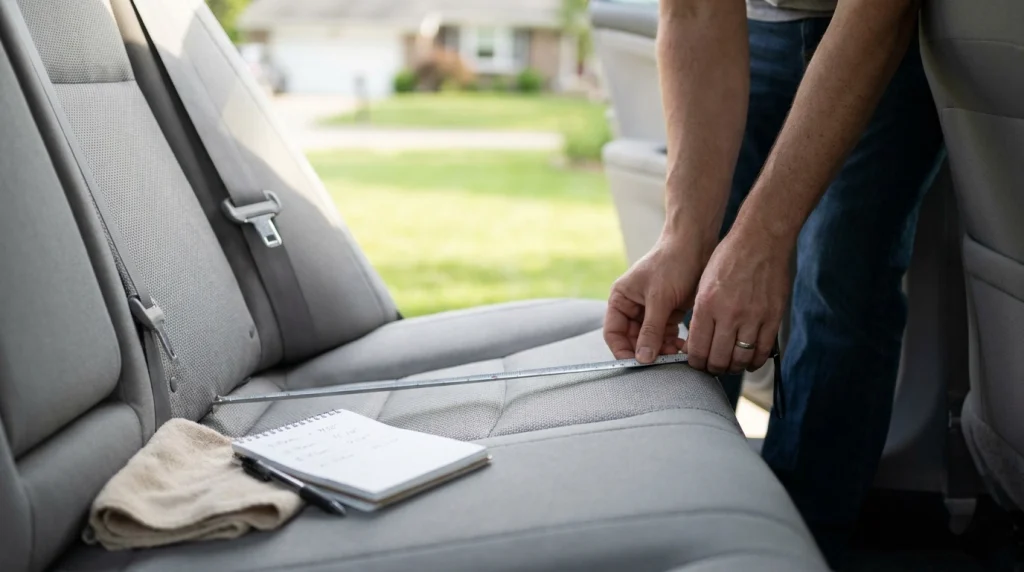
Measurements will not prove a fit on their own. They will tell you quickly which seats are worth trying and which ones are almost certain to fail.
Grab a tape measure and a notepad before you shop. Ten minutes in the driveway beats a return trip to the store.
Measure the rear seat width
Measure the flat seating area, not the full bench from door to door. Start where the cushion is flat enough to support the base.
Skip raised bolsters and armrests in your number. A car seat base needs flat support under it, and a bolster can tilt it sideways.
- Outboard width: Measure each side seat separately, from the center hump to the door side.
- Center width: Measure the center flat area, and note any hump or raised cushion.
- Usable width: Write down the narrowest flat width, not the widest point.
Measure front-to-back space
Front-to-back space is the part most parents miss. Rear-facing seats need a lot of it, and a tall driver makes it worse.
Set the front seat where the driver or passenger actually sits. Measure from the back of that front seat to the rear seatback.
Then check the car seat manual for its front-to-back length in rear-facing mode. If the manual number is longer than your space, the front seat will have to move forward, or the seat will not recline correctly.
Measure cushion depth and seat shape
Measure from the rear seatback to the front edge of the cushion. A short cushion can leave the base hanging over the edge.
Some seats allow a small amount of overhang, and some allow none. Follow your exact car seat manual, not a general rule you read online.
Check the door opening and access
Fit is not only about the install. You also have to get the seat in, get the child in, and buckle the harness without a struggle.
Open the rear door fully and check the opening height and width. A tall convertible can be hard to lift through a small sedan door, even if it installs fine once inside.
Pro tip: Take photos of your tape measurements and anchor locations before you shop. A store assistant or a certified technician can spot a problem from those photos faster than from a guess.
Section takeaway: Measure flat width, front-to-back space, cushion depth, and door access, then compare those numbers with the exact car seat manual.
Will a Rear-Facing Car Seat Fit in a Small Car?
Yes, in many small cars, but not in every seating position and not with every model. Rear-facing fit is the hardest test, so start there.
A rear-facing seat needs recline and front-to-back length. A newborn needs a more reclined angle, and that angle pushes the top of the seat toward the front seats.
Why rear-facing takes the most room
Rear-facing seats sit at an angle, not upright. The base sits low, the back rises toward the front seat, and the carrier or shell extends forward.
That shape eats legroom fast in a compact sedan. A tall driver may have to move the seat forward more than feels safe, and that is a sign to try another position or seat.
What to try first in a small car
Try the seat behind the shorter front passenger first. That side often gives you more room than the driver side.
Try a more compact convertible or infant seat if your first choice is too long. Some seats are built with a shorter shell for small cars, and the manual will list the front-to-back length.
Check whether the car seat allows a more upright angle for an older baby. Newborns need more recline, but older babies can often use a slightly more upright setting, if the manual allows it.
- Move the front seat: Slide it forward until the driver or passenger still sits safely, with knees bent and feet flat.
- Try outboard first: The center can be tighter in small cars, even though it is often the safest spot.
- Check the headrest: Remove or adjust a rear headrest only if both manuals allow it.
- Watch the door: Make sure you can still lift the child in without hitting the door frame.
Can you install a car seat in the middle seat if the center is the position you hoped to use, because center fit has its own rules on anchors and cushion shape.
Section takeaway: Rear-facing fit is hardest in small cars, so test behind the shorter front passenger, check the level, and do not accept a front seat pushed too far forward.
Will a Car Seat Fit in Different Types of Vehicles?
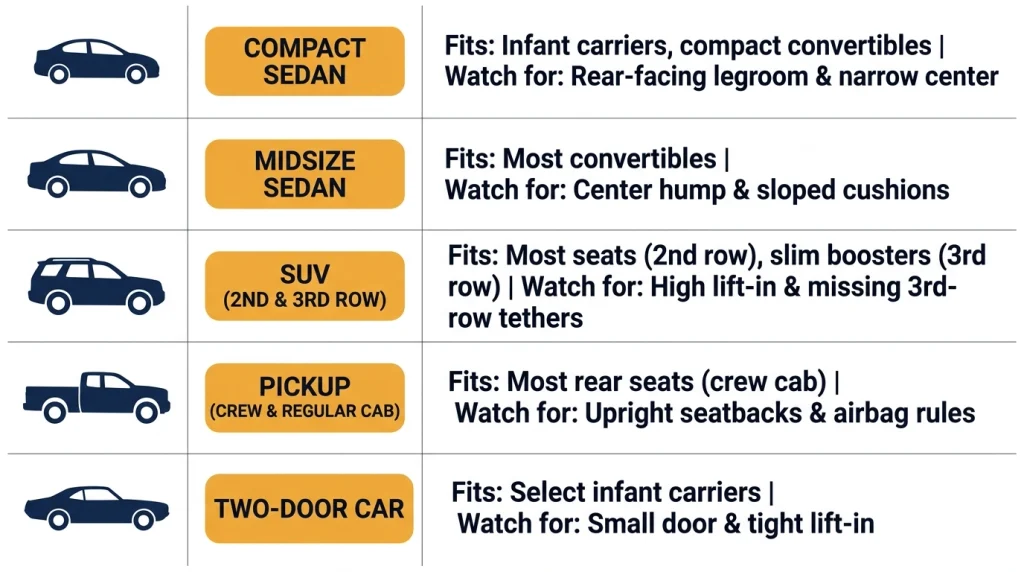
Vehicle type changes the fit question more than brand does. A sedan, an SUV, and a truck each hide a different problem.
Use the table below as a starting point. Your exact model year still wins over any general pattern.
| Vehicle type | Usually fits well | Common fit problem |
|---|---|---|
| Compact sedan | Infant carriers, compact convertibles | Rear-facing legroom, narrow center, small door opening |
| Midsize sedan | Most convertibles, one or two seats across | Center hump, sloped cushion, tight three-across |
| SUV, second row | Most seats, including larger convertibles | Captain chairs spacing, third-row access, high lift-in height |
| SUV, third row | Slim boosters, some forward-facing seats | Missing tether anchors, short cushion, hard access |
| Pickup, crew cab | Most rear seats, with room to install | Upright rear seatback, tether anchor location, center bench shape |
| Pickup, regular cab | Few seats, only where the manual allows | No rear row, front airbag rules, very tight space |
| Two-door car | Some infant carriers, with patience | Small door, hard lift-in, limited rear legroom |
Does vehicle size predict fit?
Size helps, but it does not guarantee fit. I have seen a large SUV with a deep bucket seat that fought every install, and a small hatchback with a flat bench that took a seat in minutes.
Check Edmunds for your exact model year if you want rear-seat dimensions and anchor notes before you visit a store.
What about two-door cars and trucks?
Two-door cars can work, but the daily lift-in is the real test. You will lean in, twist, and lift a heavy carrier through a narrow opening, day after day.
Can you install a car seat in a two-door car covers the door and access checks in more detail.
Section takeaway: SUV room helps, but flat seats and clear anchors matter more, and trucks and two-door cars need their own access and airbag checks.
How Do You Test the Fit Before You Buy or Drive?
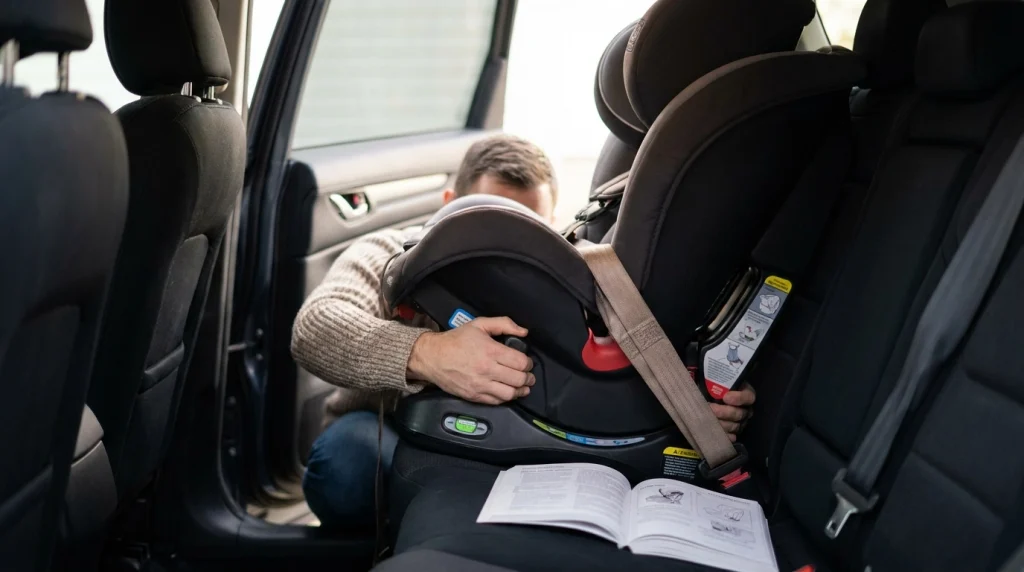
Measurements narrow the list, but only a real install proves fit. Do the test in your car, in the position you will actually use.
Ask the store about its return policy before you open the box. Some stores allow a car test with tags on, and some do not, so confirm that first.
Step 1: Read both manuals
Read the vehicle manual section on child restraints and the car seat manual section on install. Both must allow the position, direction, and method you plan to use.
Look for anchor weight limits, center-position rules, and headrest notes. If either manual forbids it, that position does not fit, even if the seat looks snug.
Step 2: Place the seat and set the recline
Place the seat in the approved position and set the recline for your child’s age. Use the level indicator, not your eye, to check the angle.
Step 3: Install with one method only
Use lower anchors or the seat belt, not both at once, unless the manual specifically allows both. Route the strap or belt through the correct belt path for rear-facing or forward-facing use.
Tighten by pressing down into the seat and pulling the slack out. The install should feel firm, not springy.
Step 4: Check movement, tether, and front space
Grab the seat at the belt path and push side to side and front to back. Movement should be less than one inch in any direction at that spot.
Attach the top tether for a forward-facing harnessed seat, using the correct anchor for that position. Check the front seat again, and sit in it the way you would drive.
Pro tip: For a free second check, use NHTSA to find a car seat inspection station near you, and bring both manuals with you.
Section takeaway: Read both manuals, install with one method, check for less than one inch of movement, and sit in the front seat before you decide.
What Should You Do If a Car Seat Does Not Fit in Your Car?
A failed fit is not a failure on your part. It is useful information, and it usually has a fix that does not involve forcing the seat.
Work through the options in order, from the simplest change to the biggest one. Most parents find a fix in the first two steps.
Try another approved seating position
Move the seat to the other outboard position, or to the center if both manuals allow it. A different cushion shape can change everything.
Do not borrow lower anchors from two outboard seats to make a center install. That trick is allowed only when both manuals explicitly permit it.
Try a different install method
Try the seat belt if lower anchors did not work, or try lower anchors if the belt did not work. One method often fits a cushion shape better than the other.
Try a more compact seat model
A narrower or shorter seat can solve a width or legroom problem. Infant carriers and compact convertibles often fit where a large all-in-one will not.
How to fit three car seats in one vehicle is useful here too, because its narrow-seat and independent-install tips apply even with one or two seats.
Ask a certified technician before you give up
A certified child passenger safety technician has seen hundreds of installs in cars like yours. They can spot a cushion trick or an anchor detail you missed.
Book a check before you buy a second seat. That visit can save you a return, and it can confirm a fit you were unsure about.
What to do when a car seat does not fit in your vehicle lists the next steps if a new position, a new method, and a compact model still do not work.
Check Consumer Reports for independent car seat fit and safety notes if you want a second source before you choose a replacement model.
Section takeaway: Try another position, try the other install method, try a compact model, and get a technician check before you force a seat or buy blind.
Frequently Asked Questions
Will a car seat fit in my car if it fits my friend’s car?
No. A seat must match your car, your seating position, and your child. Always test the install in your exact car before you rely on a general fit claim.
How do I know if a car seat will fit my car before I buy it?
Measure your rear seat width and front-to-back space, check the car seat manual dimensions, and test the install in your car. A fit list helps, but the install test is the proof.
Will a rear-facing car seat fit in a small sedan?
Often yes, behind the shorter front passenger, with a compact model. Test the recline and front-seat space, and try another position if the driver seat has to move too far forward.
Can I fit three car seats in my car?
Sometimes, with narrow seats and the right rear bench. Each seat must install independently and stay tight after the next seat goes in, so test all three together.
What if my car seat touches the front seat?
Check both manuals. Some allow light contact, and some forbid it. Never assume contact is safe, and try another position if either manual says no.
Should I buy a car seat online without testing it in my car?
You can, but only if the return policy lets you test it in your car first. Keep the tags and box intact until the install, recline, and front-seat checks all pass.
So, will a car seat fit in my car? Measure first, test the real install, and trust the manuals over a fit claim.
That order saves time, money, and a stressful return.
Start with your rear seat measurements tonight, then test your top choice in the car before you commit to it.

Daniel Brooks is an automotive writer and product researcher focused on car accessories, car tech, maintenance, and practical driving guides. At Plug-in Car World, he helps drivers make smarter automotive decisions through honest reviews and research-driven content.
