
Can Car Seats Go in Captain’s Chairs? 7 Fit Checks Every Parent Should Do First
Quick Answer
Yes, car seats can go in captain’s chairs in most SUVs and minivans. A captain’s chair is a single second-row seat, and it works like any other rear seat when it has a seat belt, lower anchors, and enough room for the car seat. Always check your vehicle manual and your car seat manual first, because the exact rules change by model. If you are weighing the centre spot instead, read this guide to installing a car seat in the middle seat before you decide.
The short version
- Yes, in most cases: Most captain’s chairs accept rear-facing, forward-facing, and booster seats.
- Check the anchors: Most have lower anchors and a top tether anchor, but some do not.
- Watch the width: Wide car seats can press against the armrests or the centre gap.
- Test the fit: The seat must move less than one inch at the belt path.
- Mind the recline: Rear-facing seats need the angle shown on the seat’s level indicator.
Do this first
- Try the install in your own vehicle before a long trip, not in a parking lot five minutes before you leave.
I’ve helped friends fit car seats into more second rows than I can count, and captain’s chairs always spark the same question. They look different from a bench seat, so parents ask: can car seats go in captain’s chairs?
Can car seats go in captain’s chairs? Yes, in most cases. A captain’s chair is still a rear seat, and the same safety checks still apply.
This guide covers what these seats are, how to install each type, and what to do when the fit feels wrong.
In This Guide
- What Are Captain’s Chairs, Exactly?
- Can Car Seats Go in Captain’s Chairs?
- How Do You Install a Rear-Facing Car Seat in a Captain’s Chair?
- How Do You Install a Forward-Facing Seat or Booster in a Captain’s Chair?
- What If the Car Seat Does Not Fit in a Captain’s Chair?
- Captain’s Chairs vs. Bench Seats: Which Is Better for Car Seats?
- Common Mistakes to Avoid With Car Seats in Captain’s Chairs
- Frequently Asked Questions
What Are Captain’s Chairs, Exactly?
A captain’s chair is a single, individual seat in the second row. It has its own back, cushion, and armrests, and it sits apart from the seat next to it.
You’ll find them in many three-row SUVs and minivans. Honda Odyssey, Toyota Sienna, Kia Carnival, Chrysler Pacifica, and many large SUVs offer them as an option or as standard kit.
The gap between the two chairs is the key difference. That aisle lets passengers walk to the third row without folding a seat forward.
It also changes how a car seat sits, because there is no bench cushion on either side to brace against.
Pro tip: check your vehicle owner’s manual for the exact seating positions, anchor locations, and any car seat restrictions for your model year.
Do captain’s chairs have LATCH anchors?
LATCH stands for Lower Anchors and Tethers for Children. It is the system of lower anchors in the seat bight plus a top tether anchor for forward-facing seats.
Most captain’s chairs have a full set of lower anchors. Most also have a top tether anchor behind or below the seat.
Some older or base-trim models may have anchors in only one second-row chair, so do not assume both sides match.
Look for the small anchor symbols on the seat back or in the bight, which is the crack where the seat cushion meets the seat back. Your manual will show the exact spots with a diagram.
If your chair has no lower anchors, you can still install with the vehicle seat belt. A correct seat belt install is just as safe.
Section Takeaway: A captain’s chair is a single second-row seat with a gap beside it, and most have LATCH anchors, but always confirm the anchors and armrest clearance for your exact vehicle.
Can Car Seats Go in Captain’s Chairs?
Yes, car seats can go in captain’s chairs. Rear-facing infant carriers, rear-facing convertibles, forward-facing convertibles, combination seats, and boosters can all work there when the chair allows it.
The question is not whether the seat type is allowed. The question is whether your specific car seat fits your specific captain’s chair, and whether you can get a tight, correct install.
Start with the two manuals. Your vehicle manual lists which seating positions allow car seats and whether any position is banned.
Your car seat manual lists the install methods, the recline range, and any width or vehicle limits.
Then test the three checks that matter most. First, the car seat base or shell must sit flat enough to hold the correct recline angle.
Second, the install must move less than one inch side to side or front to back at the belt path. Third, the harness must fit your child snugly.
For a step-by-step check on whether your vehicle and car seat work together, see this guide on how to check car seat compatibility with your vehicle.
Section Takeaway: Yes, car seats belong in captain’s chairs in most vehicles, but the install still has to pass the same tightness, angle, and harness checks as any other rear seat.
How Do You Install a Rear-Facing Car Seat in a Captain’s Chair?
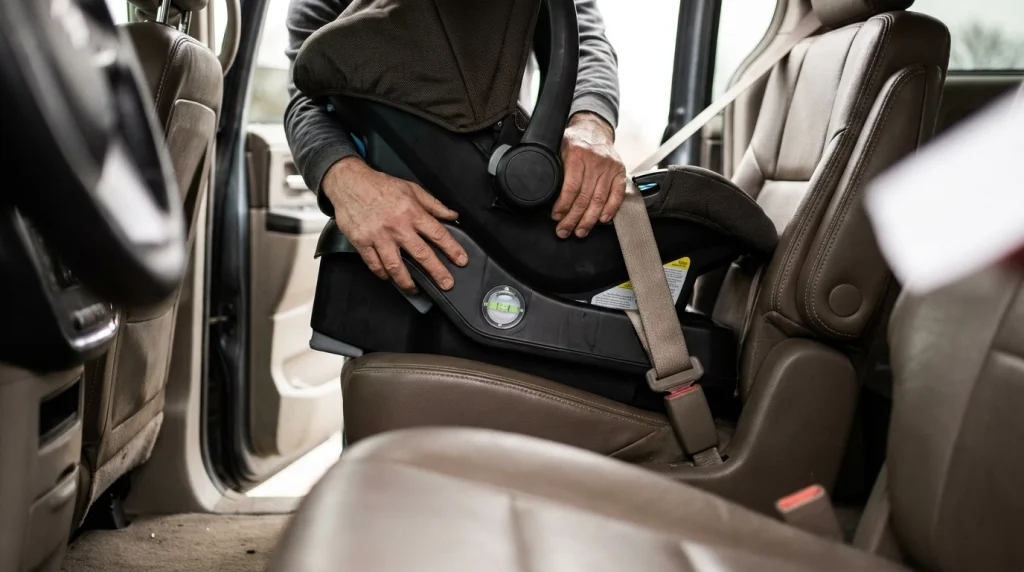
Rear-facing seats need more room than forward-facing seats. They sit at a recline angle, and they take up space between the captain’s chair and the front seat.
Start by sliding the captain’s chair back and setting its backrest upright. Then place the carrier base or convertible seat in the chair and check the level indicator.
Most rear-facing seats need an angle between 30 and 45 degrees, depending on the child’s age and the seat’s instructions. Newborns need the more reclined end of that range so their head does not flop forward.
Next, install with LATCH or the seat belt. Pick one method, not both, unless both manuals clearly allow it.
Route the belt or LATCH strap through the rear-facing belt path, then press down firmly while you tighten.
Test the install at the belt path, not at the top of the seat. Grab the seat where the belt goes through and push it side to side and front to back.
It should move less than one inch in any direction.
Then place your child in the seat and check the harness. The straps should sit at or below the shoulders for a rear-facing child.
The chest clip goes at armpit level, and the harness should pass the pinch test at the collarbone.
I learned this in a neighbour’s Odyssey. The base looked tight, but the chair had slid forward a notch and changed the angle.
Now I lock the chair position first and check it again at the end.
For the full rear-facing steps, see how to install a rear-facing car seat.
Section Takeaway: Set the captain’s chair position first, get the recline angle right, install with one method only, and recheck the one-inch test before every trip.
How Do You Install a Forward-Facing Seat or Booster in a Captain’s Chair?
Forward-facing seats are simpler to fit in a captain’s chair. They sit more upright, so they need less legroom and less recline adjustment.
Install with LATCH or the seat belt through the forward-facing belt path. Then attach the top tether, every time, for every forward-facing harnessed seat.
The tether limits how far the seat tips forward in a crash.
Find the tether anchor in your manual first. In many SUVs it sits on the back of the captain’s chair, on the floor behind it, or on the ceiling.
Route the tether strap over the seat back as the manual shows, then tighten it after the main install is tight.
Check the harness height for a forward-facing child. The straps should sit at or above the shoulders.
The chest clip still goes at armpit level, and the harness should still pass the pinch test.
Boosters work differently. A booster does not use LATCH to hold the child, though some boosters use LATCH just to keep the empty booster from sliding around.
The vehicle seat belt does the real work.
Place the booster flat on the captain’s chair and check that it does not tip or overhang the front edge. Then route the lap belt low on the hips and the shoulder belt across the centre of the chest and shoulder.
The belt must not sit on the stomach or the neck.
For the LATCH steps in detail, see how to install a car seat using the LATCH system safely and tightly.
Section Takeaway: Forward-facing seats need a top tether every time, and boosters need a flat seat plus a lap belt low on the hips and a shoulder belt across the chest.
What If the Car Seat Does Not Fit in a Captain’s Chair?
A poor fit usually shows up in one of four ways. The base rocks side to side, the shell hits an armrest, the seat overhangs the cushion, or the front seat has to move too far forward.
Start with the simplest fix. Slide the captain’s chair back, move its backrest upright, and flip an armrest up if your model allows it.
Then reinstall from scratch and test again.
Try a different install method. If LATCH feels loose or the connectors sit at a bad angle, try the seat belt instead.
A seat belt install often gives a tighter fit on a bucketed captain’s chair.
Check the car seat’s footprint against the chair. A car seat should not overhang the front edge of the vehicle seat by more than the manual allows.
Many manuals set a limit, and some allow no overhang at all.
If three car seats are the goal, captain’s chairs change the maths. Two chairs give you two second-row spots, so the third goes in the third row, reached through the aisle.
For more on that layout, see how to fit three car seats in one vehicle.
If nothing works, do not force it. A seat that cannot pass the one-inch test in that chair is not a safe install, even if it looks close.
Can car seats go in captain’s chairs after a failed fit? Yes, just not in that chair with that seat.
Try a narrower car seat, a different seating position, or a check with a certified Child Passenger Safety Technician.
For more options when a seat will not fit, see what to do when a car seat does not fit in your vehicle.
Section Takeaway: Adjust the chair, try the other side, try the seat belt instead of LATCH, and if the seat still fails the one-inch test, move it or get a professional check.
Captain’s Chairs vs. Bench Seats: Which Is Better for Car Seats?
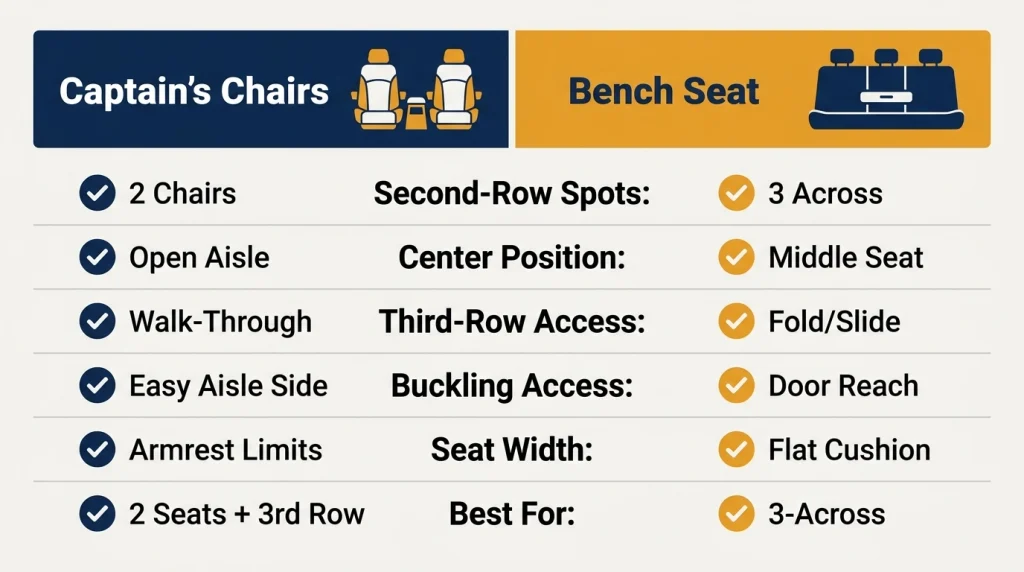
Neither layout wins for every family. The better choice depends on how many car seats you carry, how old your kids are, and how often you use the third row.
Captain’s chairs give each second-row child their own space. Buckling is easier from the aisle, and kids are less likely to kick or crowd each other.
The aisle also makes third-row access simple.
Bench seats give you a centre position. That middle spot is farther from both doors, and many parents prefer it for a single rear-facing seat.
A bench also gives you three second-row spots when you need them.
Use the table below to compare the two layouts on the points that matter most for car seats.
| Feature | Captain’s Chairs | Bench Seat |
|---|---|---|
| Second-row car seat spots | Two, one per chair | Three, including the centre |
| Centre position | No centre seat; open aisle instead | Centre seat available in most models |
| Third-row access | Walk through the aisle | Fold or slide a seat forward |
| Buckling access | Easy from the aisle side | Lean in from the door or climb in |
| Wide car seats | Armrests can limit width | Flat cushion gives more width |
| Best for | Two car seats plus third-row use | Three car seats in one row |
If you carry two car seats and use the third row often, captain’s chairs make life easier. If you carry three car seats in the second row, a bench is the simpler fit.
There is no safety ranking that says one layout is always safer. The safest layout is the one that lets you install each seat correctly and buckle each child correctly, every time.
For guidance on the safest seating positions overall, check the NHTSA car seat pages and your vehicle manual.
Section Takeaway: Captain’s chairs win on access and third-row space, benches win on a centre spot and three-across room, and the right choice is the one that gives every seat a correct install.
Common Mistakes to Avoid With Car Seats in Captain’s Chairs
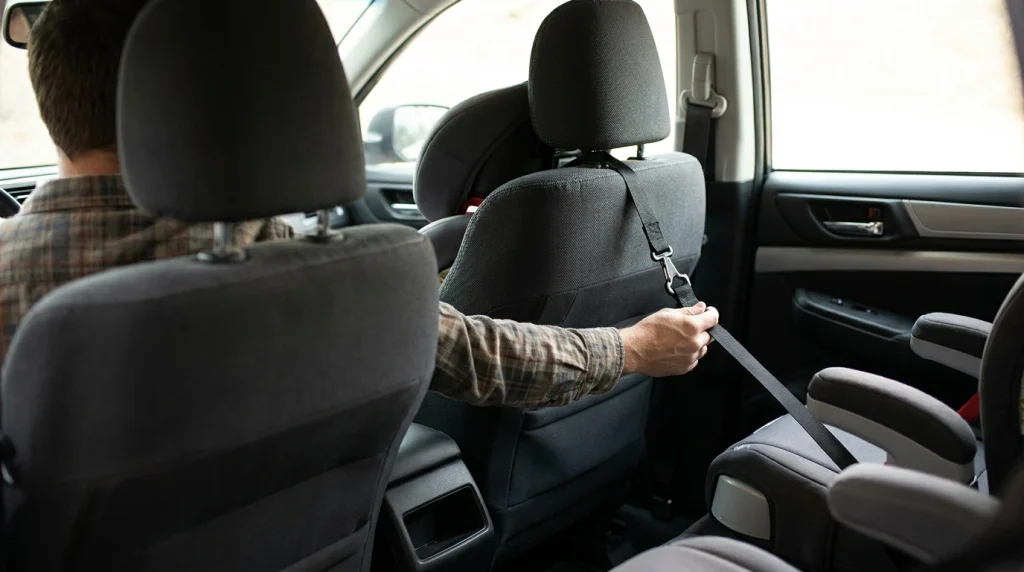
The most common mistake is moving the chair after the install. A captain’s chair that slides or reclines can change the angle and loosen the fit.
Lock the chair in place first, then install, then check it again.
Another mistake is skipping the top tether. Forward-facing harnessed seats need it, and the anchor can be hard to find behind a captain’s chair.
Check the manual diagram before you start, not after the seat is already tight.
Using LATCH and the seat belt together is another trap. Most seats allow one method only, and using both can change how the seat moves in a crash.
Follow both manuals on this point.
Loose harness straps cause trouble too. A bulky coat, a twisted strap, or a chest clip sitting too low can all leave slack.
Remove bulky coats, flatten the straps, and set the clip at armpit level.
- Chair moved after install: Recheck the angle and tightness after anyone adjusts the seat.
- Tether skipped: Attach the top tether for every forward-facing harnessed seat.
- Both install methods used: Use LATCH or the seat belt, not both, unless both manuals allow it.
- Loose harness: Do the pinch test at the collarbone after buckling.
- Armrest pressure: Make sure the armrest is not holding the seat in place.
If you are unsure after checking these points, get a free check from a certified Child Passenger Safety Technician. Many fire stations, hospitals, and inspection stations offer them, and the Consumer Reports car seat guides explain what a good check covers.
Pro tip: if your vehicle has a recall or a car seat has a recall, check the NHTSA recall lookup before your next trip.
Section Takeaway: Lock the chair first, use the tether, pick one install method, and recheck the harness and the one-inch test after every adjustment.
Frequently Asked Questions
Can you put a rear-facing car seat in a captain’s chair?
Yes, in most vehicles. Set the chair upright and locked, get the recline angle right for your child’s age, install with LATCH or the seat belt, and test for less than one inch of movement at the belt path. That is the same check behind the question: can car seats go in captain’s chairs?
Do captain’s chairs have LATCH anchors?
Most do, but not all. Many captain’s chairs have lower anchors and a top tether anchor, while some base trims have anchors on only one side.
Check your vehicle manual for the exact anchor locations.
Can you fit three car seats with captain’s chairs?
Not in the second row alone, because two chairs give you two spots. The third car seat goes in the third row, and the aisle between the chairs makes that row easier to reach.
Is the middle seat safer than a captain’s chair?
The centre of a bench is farther from the doors, which many parents prefer for one child. A captain’s chair is an outboard seat, so a correct install and a snug harness matter just as much there.
Can a booster go in a captain’s chair?
Yes, when the booster sits flat and the belt fits correctly. The lap belt must sit low on the hips and the shoulder belt across the chest.
Check that the armrests do not push the belt up.
Can you install a car seat in a captain’s chair without LATCH?
Yes. Use the vehicle seat belt through the correct belt path and lock it as the manuals show.
A correct seat belt install is as safe as a correct LATCH install.
Captain’s chairs work well for car seats when the fit is checked properly. Pick the chair that gives the tightest install, lock its position, use the tether for forward-facing seats, and recheck the harness every ride.
If the fit still feels off, try the other chair or get a professional check before your next trip. See the Edmunds and Car and Driver guides for more, as of 2026.

Daniel Brooks is an automotive writer and product researcher focused on car accessories, car tech, maintenance, and practical driving guides. At Plug-in Car World, he helps drivers make smarter automotive decisions through honest reviews and research-driven content.
