
Can You Install a Car Seat in a Two-Door Car? Safety and Fit Guide
Quick Answer
Yes, you can install a car seat in a two-door car if the vehicle has an approved seating position and the child restraint fits and installs correctly. A two-door coupe can safely carry a child in an appropriate rear-seat restraint, although limited access and legroom create challenges. Follow the manufacturer’s instructions and the NHTSA car seat safety guidelines.
Five things to check first
- Approved seating position: Confirm that your vehicle allows a child restraint in the chosen rear seat.
- Correct installation: The car seat should move no more than 1 inch at its belt path.
- Secure attachment: Use an approved seat belt or lower-anchor installation method.
- Front-seat clearance: Ensure the front seats can remain safely positioned and locked.
- Safe child access: Make sure you can buckle and remove your child correctly every time.
Important safety warning
- Never place a rear-facing car seat in front of an active passenger airbag. The back seat is the recommended location for children younger than 13.
Wondering whether you can install a car seat in a two-door car? The good news is that having only two doors doesn’t automatically make a vehicle unsuitable for children.
The challenge is finding a secure fit while keeping everyday loading and unloading manageable. I’ll explain how to check compatibility, install different car seat types, and avoid common mistakes in compact coupes.
In This Guide
Is It Safe to Install a Car Seat in a Two-Door Car?
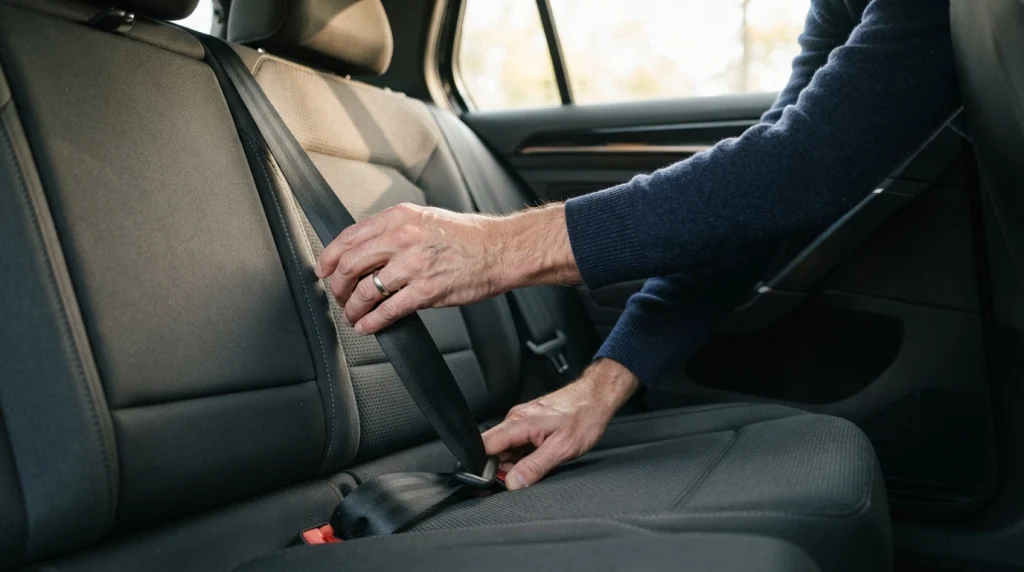
Yes, a properly installed child car seat can be used in a two-door vehicle with an approved rear seating position. The number of doors matters less than the seat’s compatibility, installation quality, and correct use.
Two-door cars present practical challenges because their rear seating areas often have limited space. However, a secure installation is possible in many coupes and hatchbacks.
Why two-door cars can be more challenging
Unlike four-door sedans, two-door vehicles require passengers to access the rear seats through a front doorway. This can make installing a child restraint and fastening a harness awkward.
Common challenges include:
- Limited rear legroom: Rear-facing seats may need more front-to-back space than the vehicle provides.
- Restricted doorway access: Adults may struggle to reach the harness and buckle.
- Sloping rooflines: Low headroom can make loading a child difficult.
- Small rear cushions: Some child restraints may not meet their manufacturer’s support requirements.
- Unusual anchor locations: Lower anchors and top tether points can be difficult to reach.
NHTSA specifically identifies two-door vehicles as potentially challenging for child restraint installation. The right solution is to test the actual seat in the actual vehicle.
Which rear seating position is safest?
The center rear seat can be a good location when it permits a correct installation. However, many two-door vehicles have narrow center cushions or no designated center seating position.
A secure outboard rear installation is preferable to an unstable center installation. Never assume that a rear center position has approved lower anchors.
I would prioritize the seating position that meets every installation requirement over one that merely looks more convenient.
Are car seats legal in two-door cars?
In the United States, a two-door body style does not automatically prohibit child restraint use. Child passenger safety laws vary by state, including applicable age, size, and seating requirements.
Your car must also provide a seating position approved for the child restraint. Check your local laws and vehicle instructions before deciding where your child can ride.
Pro tip: Consult your vehicle owner’s manual and a certified Child Passenger Safety Technician when the approved seating positions are unclear.
Section Takeaway: A two-door car can accommodate a child restraint safely, but the chosen seat must fit the vehicle and child correctly.
What Should You Check Before Installing a Car Seat in a Two-Door Car?
Before buying or installing a seat, check the rear seat dimensions, restraint attachment options, and front-seat clearance. These factors help determine whether a particular child restraint will work.
Check the vehicle and car seat manuals
Your vehicle manual identifies which seating positions support child restraints. The car seat manual specifies installation methods, positioning rules, and child size limits.
Look for the following information:
- Approved child restraint seating positions
- Vehicle seat belt locking instructions
- Lower-anchor locations and weight limits
- Top tether anchor locations
- Restrictions involving rear headrests and seat cushions
- Rules about contact between the car seat and front seats
If the manuals conflict or leave an important question unanswered, contact the manufacturers. Don’t improvise a mounting method.
Understand seat belts, LATCH, and tether anchors
LATCH stands for Lower Anchors and Tethers for Children. This system provides designated attachment points for compatible child restraints.
Most car seats can use either the vehicle seat belt or approved lower anchors for installation. Follow the manufacturer’s instructions and do not combine both installation methods unless both manufacturers expressly permit it.
A top tether serves a different purpose from lower anchors. It limits forward movement of a forward-facing child restraint during a crash.
Consult NHTSA’s explanation of car seat attachment systems if you’re unfamiliar with the hardware.
Measure available space before buying
Advertised car seat width doesn’t tell the whole story. Rear-facing seats also need enough front-to-back room for the required recline angle.
Check these measurements:
- Rear cushion width: Available space across the seating position
- Front-to-back clearance: Distance from the rear seat to the front seat
- Seat cushion depth: Support available beneath the child restraint
- Door opening: Working room for positioning and securing the seat
- Headroom: Space needed to place your child into the seat
Compare your measurements with the car seat’s published dimensions and installation requirements. Whenever possible, arrange a real-world fit check before purchasing.
Test the front seats
Move the front passenger seat into a realistic riding position before assessing fit. The driver must also maintain proper steering, pedal control, and airbag clearance.
Check whether the front seat can lock securely after moving forward for rear access. Make sure its movement doesn’t disturb the child restraint.
Section Takeaway: Measure the space, read both manuals, and verify front-seat operation before deciding that a car seat fits.
How Do You Install a Rear-Facing Car Seat in a Two-Door Car?
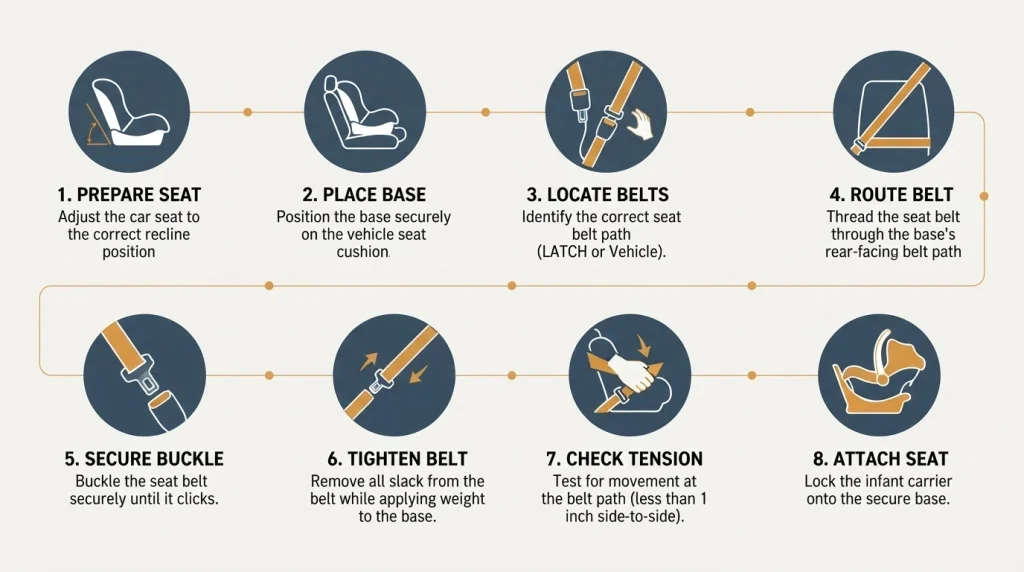
Install a rear-facing seat in an approved rear position using the manufacturer’s specified belt path and attachment method. The installation must remain tight and maintain the correct recline angle.
Rear-facing travel offers important protection for babies and toddlers. Keep children rear-facing until they reach their seat’s maximum rear-facing height or weight limit.
Step-by-step rear-facing installation
- Read both manuals. Confirm that the selected rear position permits a rear-facing car seat.
- Prepare the doorway. Move the front seat forward to create enough working room.
- Position the restraint. Place the car seat or infant base on the rear cushion as directed.
- Select one installation method. Use the approved rear-facing belt path with the vehicle seat belt or compatible lower anchors.
- Secure the attachment. Lock the seat belt or tighten the lower-anchor strap according to the instructions.
- Check installation tightness. Grip the restraint at its belt path and test for side-to-side and front-to-back movement.
- Verify the recline. Use the car seat’s built-in angle indicator or manufacturer-approved adjustment method.
- Restore the front seat. Confirm that it locks and maintains all required clearances without shifting the child restraint.
The installed seat should move no more than 1 inch at the belt path. Movement at the top of a rear-facing car seat can be normal and is not the correct place for this test.
These steps summarize the process, but they don’t replace model-specific instructions. NHTSA provides additional rear-facing installation instructions.
What if the rear-facing seat touches the front seat?
Some car seat manufacturers permit specific types of contact with the front seat. Others require a clearance gap or prohibit pressure against the restraint.
The vehicle manufacturer may also restrict contact because of front-seat sensors or airbag systems. Check both manuals rather than assuming contact is safe.
If the required front-seat position creates a conflict, try another compatible car seat. Do not force the front seat against the child restraint.
How do you buckle a baby through a two-door opening?
Loading a baby often takes more planning than the installation itself. An infant carrier may simplify access if its base stays secured in the vehicle.
Follow this routine:
- Park where the door can open fully and safely.
- Move the access seat forward using its intended release.
- Position the infant carrier or place the child into the installed seat.
- Secure the harness with flat straps at or below the shoulders.
- Tighten until excess harness webbing cannot be pinched at the shoulder.
- Place the chest clip at armpit level if the seat uses one.
- Return and lock the front seat before driving.
Never use bulky coats beneath the harness. Extra padding or aftermarket inserts should only be used when the car seat manufacturer approves them.
Pro tip: Check the car seat’s recline indicator with the vehicle parked on level ground, following the manufacturer’s instructions.
Section Takeaway: A secure rear-facing installation must satisfy the belt-path movement test, recline requirements, and front-seat clearance rules.
How Do You Install a Forward-Facing Car Seat in a Two-Door Car?
A forward-facing child restraint uses an approved seat belt or lower-anchor attachment and a top tether. Its installation can be easier in some compact cars because it generally requires less rear-facing clearance.
Only change to forward-facing after your child outgrows the rear-facing limits of an appropriate seat.
Step-by-step forward-facing installation
- Choose an approved rear seat. Confirm that the position supports the selected child restraint.
- Locate the tether anchor. Use the vehicle manual to identify the correct anchor for that seating position.
- Position the car seat. Set the restraint against the rear vehicle seat according to its manual.
- Secure the lower attachment. Use the forward-facing belt path with a locked seat belt or permitted lower anchors.
- Tighten the installation. Check that movement at the belt path does not exceed 1 inch.
- Connect the top tether. Route and tighten it according to the car seat and vehicle instructions.
- Check the harness. Position harness straps at or above the child’s shoulders and adjust them snugly.
Why is the top tether so important?
The top tether helps limit the forward motion of a child’s head during a crash. It’s an essential feature of proper forward-facing harnessed seat installation.
Tether anchors may appear behind the rear seatback, on a rear parcel shelf, or in another manufacturer-designated location. A two-door body style doesn’t guarantee a particular anchor arrangement.
Never attach a tether to an ordinary cargo hook or unapproved metal fitting. A part that looks strong may not serve as a certified tether anchor.
Can you use the seat belt instead of LATCH?
Yes, a properly secured vehicle seat belt is an accepted installation method when both manufacturers allow it. Lower anchors are not automatically safer than a correctly installed seat belt.
Lower-anchor attachments also have weight limits. Once those limits are reached, switch to the approved seat belt method while continuing to use the top tether.
Check the NHTSA car seat installation tips for the main checks that apply to both attachment methods.
Pro tip: Never substitute a cargo tie-down for the designated tether anchor. Ask a certified technician if the anchor cannot be identified.
Section Takeaway: Forward-facing seats need a secure lower attachment and the designated top tether, with installation instructions followed carefully.
Which Types of Car Seats Fit Best in a Two-Door Car?
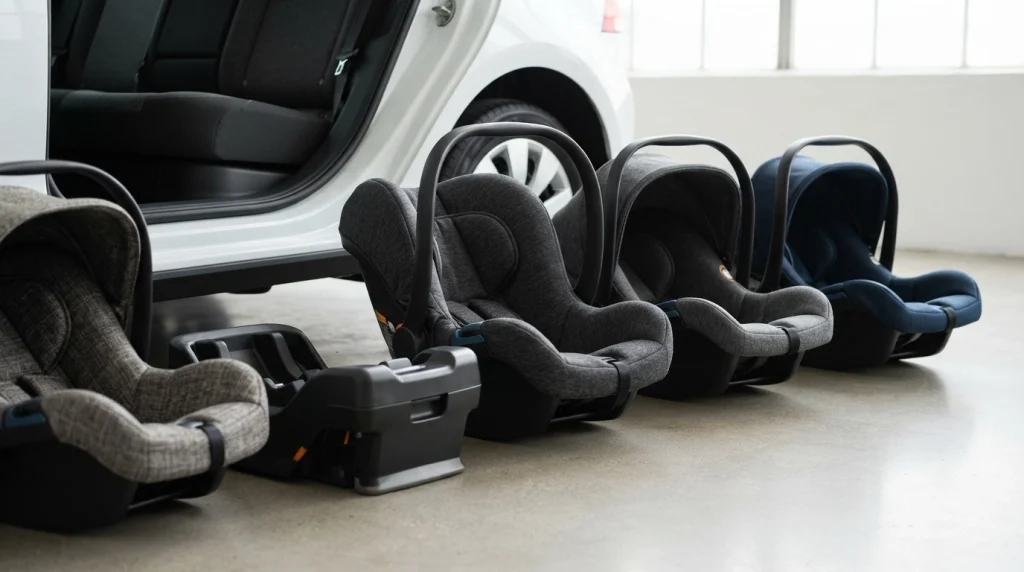
Compact child restraints can make a two-door vehicle easier to use, but size alone doesn’t determine compatibility. The best option fits your child, installs correctly, and allows practical daily access.
Different restraint designs create different space and handling requirements.
Car seat type comparison
| Car Seat Type | Main Benefit | Two-Door Challenge | What to Check |
|---|---|---|---|
| Rear-facing infant carrier | Removable carrier with compatible base | Carrying it through a narrow doorway | Base fit, handle clearance, carrier access |
| Compact convertible | Rear-facing and later forward-facing use | Reaching the harness while installed | Front-to-back fit and recline angle |
| All-in-one car seat | Multiple restraint stages | Potentially bulky shell and base | Width, height, and installation rules |
| Belt-positioning booster | Positions the vehicle belt for an older child | Reaching the buckle beside the booster | Lap-shoulder belt fit and buckle access |
Are compact convertible seats better for coupes?
A compact convertible seat is worth considering when rear legroom is limited. Its shape may permit the required rear-facing angle without forcing the front passenger into an unsafe position.
However, compact dimensions don’t guarantee compatibility. Some small-looking seats need considerable clearance when fully reclined.
Always compare the manufacturer’s dimensions and installation rules with your actual rear seating area.
What about rotating car seats?
Rotating car seats may help caregivers turn a child toward the doorway during loading. However, many designs have substantial bases and specific operating restrictions.
A narrow two-door opening may prevent the rotation feature from being useful. Test the seat’s approved positions and operation before buying one.
Do boosters work in two-door cars?
Yes, a booster can work when the seating position, belt geometry, and booster instructions permit it. Boosters are for children who have outgrown their forward-facing harnessed seats.
A belt-positioning booster requires a properly routed lap-and-shoulder belt. Check that your child can buckle it without displacing the booster.
CDC guidance recommends continuing booster use until the vehicle seat belt fits correctly. You can review its child passenger safety recommendations.
Section Takeaway: Prioritize verified compatibility, suitable child size limits, and usable access rather than choosing a car seat solely because it is small.
What Common Car Seat Installation Problems Should You Avoid?
Most two-door installation problems involve limited space, incorrect attachment methods, or difficult access. Identifying these issues early can prevent unsafe compromises.
Six mistakes to watch for
- Choosing by appearance: A compact-looking seat may still require too much installation space.
- Forcing the front seat backward: Pressure against the child restraint may violate manufacturer instructions.
- Skipping the top tether: A forward-facing harnessed restraint needs its approved tether connection.
- Using an unlocked seat belt: A loose belt can permit excessive movement.
- Borrowing lower anchors: Using anchors from neighboring positions without approval can create an improper installation.
- Ignoring harness access: An installation isn’t practical if a caregiver cannot secure the child correctly.
What if the car seat moves more than 1 inch?
Check movement at the specified belt path, not by pulling the top of the shell. Excessive movement at that location means the installation needs correction.
Try the following checks:
- Confirm that you used the correct belt path for the seat’s orientation.
- Check the vehicle’s belt locking procedure or child restraint lock-off.
- Remove slack using the manufacturer’s tightening instructions.
- Check that the seat belt or lower-anchor strap isn’t twisted.
- Repeat the movement test at the belt path.
If you still cannot meet the installation requirements, stop using that setup. Ask a certified technician to assess the fit.
Can you use a cushion or seat protector underneath?
Don’t add towels, foam cushions, or aftermarket seat protectors without manufacturer approval. Extra material can alter how the child restraint sits or tightens.
Some manufacturers permit specific accessories or limited adjustments. Follow the instructions for your particular child restraint.
When should you ask a professional?
Professional help is especially useful when the vehicle has unusual rear seats, inaccessible anchors, or conflicting fit instructions. A technician can demonstrate how to install and use the seat correctly.
Consider an inspection when:
- You cannot achieve a secure installation.
- The front seat interferes with the child restraint.
- You cannot identify an approved tether anchor.
- The car seat’s recline indicator remains outside its permitted range.
- The vehicle has unusually shaped rear cushions or seat belts.
- You need help selecting an appropriate restraint.
In the United States, you can find a certified car seat technician through Safe Kids for installation education and assistance.
Pro tip: Also check the NHTSA recall database for outstanding car seat or vehicle safety recalls before using an unfamiliar restraint.
Section Takeaway: Never compensate for a poor fit with improvised hardware or padding. Correct the installation or select a different compatible restraint.
Frequently Asked Questions
1. Can you put a rear-facing car seat in a two-door coupe?
Yes, provided the coupe has an approved rear seating position and the seat fits according to both manufacturers’ instructions. You must maintain the correct recline angle, secure the restraint tightly, and meet front-seat clearance requirements. A rear-facing child restraint must not go in front of an active passenger airbag.
2. Is it safe to install a car seat behind the driver?
It can be safe when that rear seating position permits the restraint and the installation meets all requirements. The driver must still have enough room to operate the vehicle safely. Don’t compromise driving position or restraint installation to make an oversized car seat fit.
3. Do two-door cars have LATCH anchors?
Some do, but the availability and locations depend on the vehicle’s model, year, and market. Consult your owner’s manual rather than assuming anchors exist. An approved seat belt installation may be used when lower anchors are unavailable, with the top tether used for forward-facing harnessed seats.
4. Can a car seat go in the front passenger seat of a two-door car?
Children should ride in the back seat whenever an appropriate rear seating position is available. Never place a rear-facing child restraint in front of an active passenger airbag. If the vehicle has no usable rear seat, consult the vehicle manufacturer, applicable laws, and a certified safety technician before transporting a child.
5. Is a two-door car less safe for babies than a four-door car?
Door count alone doesn’t establish how safe a vehicle is for an infant. Vehicle crash protection, approved seating positions, child restraint compatibility, and correct installation all matter. A four-door vehicle may provide easier access, but the actual safety assessment depends on the specific vehicle and restraint.
6. Do I need a special car seat for a two-door car?
No special car seat category exists solely for two-door vehicles. You need a child restraint appropriate for your child’s size that can be installed correctly in your vehicle. Compact designs may make access easier, but the manufacturer’s fit and installation requirements remain the deciding factors.
7. Can I install a booster seat in a two-door car?
Yes, when the vehicle and booster allow it and the seat belt fits the child properly. A belt-positioning booster requires a lap-and-shoulder belt, not a lap-only belt. Make sure the child can reach the buckle and maintain correct belt positioning throughout the ride.
Final Takeaway: Can You Install a Car Seat in a Two-Door Car?
Yes, a car seat can be installed in many two-door cars without compromising safety. The key is choosing an approved seating position, finding a compatible child restraint, and following the installation instructions exactly.
Before buying, test the seat in your vehicle and check how easily you can secure your child. If the installation doesn’t work correctly, choose another compatible seat or seek assistance from a certified technician.
Your next step: Find your vehicle owner’s manual, confirm the approved rear seating positions, and complete a real-world car seat fit check before your next trip.

Daniel Brooks is an automotive writer and product researcher focused on car accessories, car tech, maintenance, and practical driving guides. At Plug-in Car World, he helps drivers make smarter automotive decisions through honest reviews and research-driven content.
