
Can a Car Seat Go in the Third Row? 7 Safety Checks Every Parent Must Know
Quick Answer
Yes, a car seat can go in the third row in most three-row SUVs and minivans, if the seat fits, the install is tight, and you can buckle your child in safely. Check your vehicle manual and car seat manual first, because some third rows have no LATCH, no top tether anchor, or too little legroom. Learn how car seats are installed before you move a seat back there.
Do these 7 checks first
- Fit check: The car seat must sit flat, with no overhang past the vehicle seat edge.
- Tight install: It must move less than one inch side to side at the belt path.
- Tether check: A forward-facing seat needs a top tether anchor in that row.
- Recline check: A rear-facing seat needs the right recline angle, with room for the front seats.
- Access check: You must reach the buckle and harness without climbing over a seat.
- Headroom check: Your child needs head clearance, and the headrest must not push the seat forward.
If any check fails
- Move the car seat to the second row, and use the third row for an older child in a booster or an adult.
- Do not force a tight fit, skip the tether, or use a seat that rocks on the cushion.
I’ve squeezed car seats into third rows more times than I can count, and when parents ask me, can a car seat go in the third row, the answer is never just yes or no.
It depends on your vehicle, your car seat, and your child. This guide walks through the checks I use in the garage, so you can decide with confidence in 2026.
In This Guide
- Can a car seat go in the third row?
- Is the third row safe for a car seat?
- Which car seat fits best in the third row?
- How do you install a car seat in the third row?
- How do you get a child in and out of the third row safely?
- When should you not use the third row for a car seat?
- Frequently asked questions
Can a car seat go in the third row?
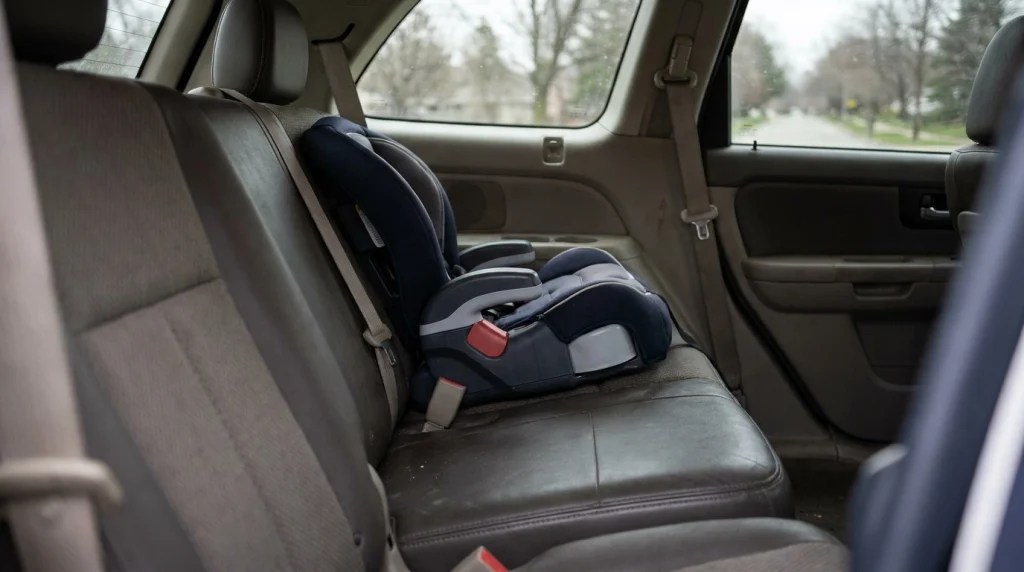
Yes, in most three-row vehicles, a car seat can go in the third row.
Your vehicle manual must allow it for that seating position, and your car seat manual must allow that install method there.
A third-row car seat is a child restraint fitted to the rearmost row of a three-row SUV, crossover, or minivan.
It works the same way as a second-row install, but space, anchors, and access are tighter back there.
I learned that the hard way in a friend’s midsize SUV. The seat looked fine from the door, but the base hung over the front edge by two inches.
We moved it to the second row, and the install went tight in five minutes.
What makes a third row different?
Third rows sit closer to the rear hatch, and the seat cushion is often shorter and flatter.
Legroom can shrink fast when the second row slides back, and the seatback angle can push a rear-facing seat upright.
Some third rows have only one or two seating positions with LATCH. Others have seat belts only, with no lower anchors at all.
Top tether anchors can also be missing, hard to find, or placed on the floor behind the seat.
Check the anchor map in your vehicle manual before you carry the seat out to the car.
Which vehicles work best?
Minivans usually work best, because the third row is wider and the sliding doors give you room to lean in.
Large three-row SUVs come next, with more legroom and a flatter seat base.
Small three-row crossovers are the hardest, and some are really made for older kids or short trips only.
- Minivan: Best access, widest third row, easiest buckle reach.
- Large SUV: Good space, but watch the high step-in height for small kids.
- Midsize SUV: Often workable for one narrow seat, tight for two.
- Small crossover: Often too tight for a rear-facing seat, and hard to load.
Section takeaway: A third-row car seat can work, but only if your manuals allow that position and the seat sits flat, tight, and level.
Is the third row safe for a car seat?
A correctly installed car seat in the third row is safe, and a loose one anywhere is not.
Safety comes from the install, not from the row number alone.
Parents often ask me if the second row is always safer. The honest answer is that the second row is easier to install and reach, so it is safer in real life for many families.
The third row adds distance from the front, but it also adds a harder install and a longer escape path in an emergency.
Pro tip: Check your vehicle manual and the NHTSA guidance for your model year before you choose a row, and ask a certified child passenger safety technician if you are unsure.
What does the research say?
Crash data is mixed, because third rows vary so much by vehicle.
Some studies point to the middle of the vehicle as the safest spot, while others show little difference once the seat is installed correctly.
Do not chase a perfect row. Chase a perfect install, a snug harness, and a child who can ride without slouching.
Rear impact and cargo risks
The third row sits close to the rear of the vehicle, so keep loose cargo out of the space behind it.
Heavy bags, strollers, and sports gear can move forward in a hard stop.
- Loose cargo: Stow it low, tie it down, and keep it out of the third-row footwell.
- Headrest fit: Adjust it so the car seat back sits flat against the vehicle seatback.
- Seatback lock: Make sure the third-row seatback clicks and locks upright before you install.
- Door access: Know how your child will get out fast if you need to help them.
Section takeaway: The third row is safe when the install is tight, the tether is used, and nothing behind the seat can strike your child.
Which car seat fits best in the third row?
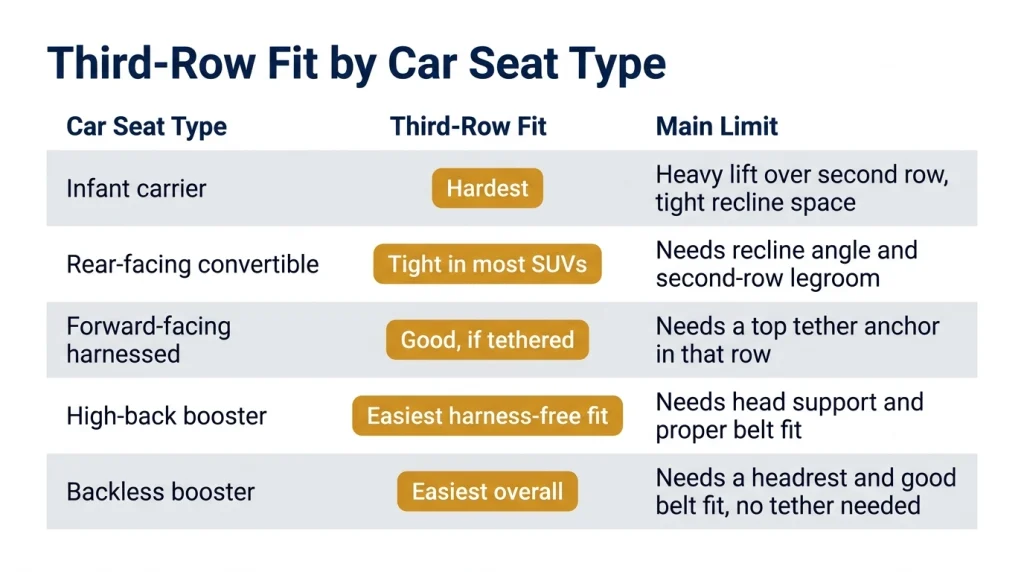
Narrow, compact seats fit best in the third row.
Wide seats, bulky bases, and long rear-facing shells often run out of room first.
Measure the seat, not just the child. A seat that fits in the second row can still fail in the third row.
Best fits by seat type
High-back boosters and backless boosters are usually the easiest third-row fit.
They need a lap-and-shoulder belt, a headrest behind the child, and enough headroom to sit tall.
Forward-facing harnessed seats come next, if you have a top tether anchor in that position.
Convertible seats can work rear-facing in a roomy third row, but they need recline space and legroom for the front seats too.
Infant carriers are the hardest to load back there, because you must lift the carrier over the second row or climb in with it.
| Car seat type | Third-row fit | Main limit |
|---|---|---|
| Infant carrier | Hardest | Heavy lift over the second row, tight recline space |
| Rear-facing convertible | Tight in most SUVs | Needs recline angle and second-row legroom |
| Forward-facing harnessed | Good, if tethered | Needs a top tether anchor in that row |
| High-back booster | Easiest harnessed-free fit | Needs head support and a proper belt fit |
| Backless booster | Easiest overall | Needs a headrest and a good belt fit, no tether needed |
If you need two seats back there, pick the narrowest seats you can, and test them side by side.
Two wide seats can push each other off the belt path, even if each one fits alone.
How to test the fit before you buy
Bring the car seat to the vehicle, or bring the vehicle measurements to the store.
Check the base width, the shell height, and the recline foot position.
Install it, tighten it, and check the one-inch test at the belt path.
Then buckle your child in, check the harness, and see if you can reach the buckle without twisting your wrist.
If you need help choosing between rear-facing vs. forward-facing car seats, read that guide before you move a seat to the back.
Section takeaway: Pick a narrow seat, test it in your actual third row, and do not trust a second-row fit to prove a third-row fit.
How do you install a car seat in the third row?
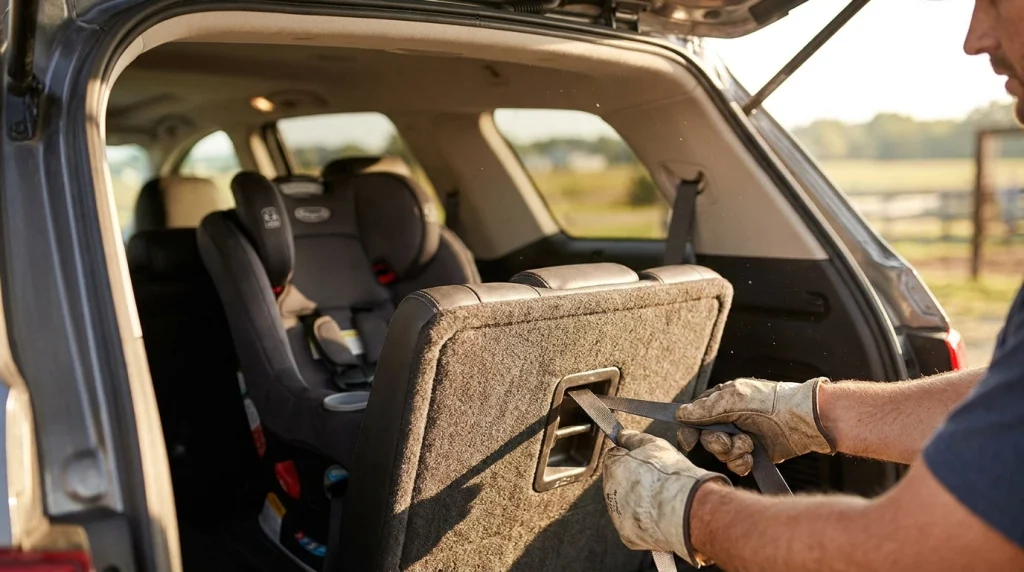
Install it the same way you would in the second row, but slower, with more checks.
Use LATCH only if that third-row position has lower anchors, and use the seat belt if it does not.
Never use both at once unless both manuals say you can.
Step 1: Find the anchors
Open your vehicle manual to the third-row anchor map.
Find the lower anchors, the top tether anchors, and the seat belt buckles for that position.
Some third rows hide the tether anchor under a flap, on the seatback, or on the floor behind the seat.
If you cannot find it, do not guess. Stop and check the manual or ask your dealer.
Step 2: Set the seat position
Slide the second row forward just enough to give the third row room.
Lock the third-row seatback upright, and remove or adjust the headrest as your manuals direct.
Place the car seat flat, with the base fully on the cushion and no overhang.
For a rear-facing seat, set the recline angle with the built-in indicator or level line.
Step 3: Tighten with LATCH or seat belt
Route the belt or LATCH strap through the correct belt path for rear-facing or forward-facing use.
Press down hard with your knee or hand, and pull the strap tight.
Check for less than one inch of movement side to side at the belt path.
If you are installing a car seat using LATCH, use the lower anchors only in positions your manual lists for LATCH.
If you are using the seat belt, lock the belt as your manuals direct, and check that it stays locked.
Step 4: Attach the top tether
A forward-facing harnessed seat must use the top tether when one is available.
Hook it to the anchor for that seating position, and pull it snug.
Do not route it over a headrest in a way your manual forbids, and do not attach it to a cargo hook.
Learn what a top tether does before you install, because a missed tether lets the seat tip forward more in a crash.
Step 5: Buckle and check the harness
Buckle your child in, and tighten the harness until you cannot pinch a fold at the shoulder.
Put the chest clip at armpit level, and remove bulky coats before you buckle.
Run through a car seat safety checklist every time you move a seat to a new row.
Section takeaway: Find the anchors first, tighten to less than one inch of movement, and always use the top tether for a forward-facing seat.
How do you get a child in and out of the third row safely?
Access is the part most parents forget, and it matters every day.
A perfect install fails if you cannot buckle the harness right on a rainy school morning.
Use the easiest door path
Minivans win here, because the sliding door opens wide and the floor is low.
In an SUV, fold or slide the second row forward, and teach your child to climb in feet first.
Hold their hand on the step, and keep the second-row seat locked once they are through.
Buckle from the best angle
Kneel on the second-row seat, or climb into the third row yourself for a small child.
Keep your back straight, and use both hands to pull the harness snug.
If you cannot reach the buckle, move the seat closer to the door side.
For a booster rider, teach them to pull the belt across, buckle it, and check that the lap belt sits low on the hips.
Plan for emergencies
Know how to fold the second row fast, and how to reach your child from the rear door.
Keep the third-row path clear of bags, toys, and loose gear.
Tell an older child how to unbuckle and climb out if you call their name.
Practice once a month, so the routine feels calm instead of rushed.
- School run: Load the third-row child first, so you are not leaning over a buckled second-row child.
- Rain or dark: Use the interior light, and keep a small torch in the door pocket.
- Two third-row kids: Buckle the far-side child first, then the door-side child.
- Car pool: Teach each rider their seat, their buckle, and their exit path.
Section takeaway: Choose the door-side position when you can, practice the buckle routine at home, and keep the exit path clear.
When should you not use the third row for a car seat?
Do not use the third row when the install fails, the tether is missing, or you cannot reach the buckle.
Those are hard stops, not small trade-offs.
I have told friends to skip the third row in a small crossover, even when they wanted three kids across the back.
It felt like a letdown in the moment, but the second row gave them a tight install they could repeat every day.
Hard no-go signs
Skip the third row if the car seat base overhangs the cushion, rocks side to side, or needs a rolled towel to sit level when your manuals forbid it.
Skip it if a forward-facing seat has no top tether anchor in that position.
Skip it if your child cannot sit with head support, or if the seat belt does not fit a booster rider correctly.
Skip it if loading the seat strains your back, or if you cannot unbuckle fast in an emergency.
When the second row is better
The second row is better for newborns, for rear-facing seats, and for any child who needs help buckling.
It is also better when you need two car seats and a third passenger in the same row.
Use the third row for an older booster rider, a child who can buckle alone, or an adult on a short trip.
That split keeps the hardest installs where you can reach them best.
If you are weighing installing a car seat in the middle seat instead, that guide covers the trade-offs of the centre position in the second row.
Also read expert reviews on Consumer Reports and Edmunds for third-row space and LATCH ratings for your exact model, because ratings vary a lot by year and trim.
Section takeaway: If the third row fails any hard check, use the second row, and save the third row for a rider who can buckle alone.
Frequently asked questions
Can a rear-facing car seat go in the third row?
Yes, if it fits with the right recline angle, the install is tight, and the second row still has legroom. Many small third rows are too short for a rear-facing convertible, so test the fit in your vehicle first.
Can a forward-facing car seat go in the third row without a tether?
No, do not install a forward-facing harnessed seat in a third-row position with no top tether anchor. Move it to a position with a tether, or use the second row instead.
Is LATCH available in the third row?
Sometimes, but not always. Some third rows have lower anchors in one or two positions, while others have seat belts only. Check your vehicle manual for the anchor map for your exact year and trim.
Can two car seats fit in the third row?
Yes, in a wide minivan or large SUV, two narrow seats can fit side by side. Test both seats together, because two wide seats can push each other off the belt path even when each one fits alone.
Can a booster seat go in the third row?
Yes, a booster often fits best in the third row, if the child has head support and the lap-and-shoulder belt fits low on the hips and flat across the chest. Check the belt fit on every ride.
What is the safest place for a car seat in a three-row vehicle?
The safest place is the position where you can get a tight install, a snug harness, and a correct belt fit every time. For most families that is the second row, with the third row used for an older child who can buckle alone.
So, can a car seat go in the third row? Yes, if it passes all 7 checks above.
Try the third row at home first, and keep the seat in the second row if any check feels rushed or unsure.

Daniel Brooks is an automotive writer and product researcher focused on car accessories, car tech, maintenance, and practical driving guides. At Plug-in Car World, he helps drivers make smarter automotive decisions through honest reviews and research-driven content.
