
Can Two Car Seats Touch Each Other? 7 Safety Checks Before You Drive
Quick Answer
Yes, two car seats can touch each other in most cases, as long as each seat is tight on its own. The real test is whether each seat still passes the 1-inch check when the other seat is out of the way, as shown in this guide to how to fit three car seats in one vehicle.
The short version
- Light touch is often fine: Fabric brushing fabric does not make an install unsafe by itself.
- Tightness comes first: Each seat must move less than 1 inch at the belt path.
- Test them apart: Check each seat alone, with the neighbour seat removed or unbuckled.
- Check both manuals: Some car seat makers ban bracing or hard contact, so read the exact wording.
- Watch the buckles: Contact must not hide a buckle, twist a belt, or block a release.
If you are unsure
- Try a different seating order, a narrower seat, or a seat belt install instead of LATCH.
- Get a free check from a certified Child Passenger Safety Technician before you drive with a tight squeeze.
Can two car seats touch each other? I asked myself that after I squeezed two seats into the back of a Honda CR-V. The shells were touching, the buckles were hard to reach, and I kept wondering if I was doing something wrong.
Touching is a clue, not a verdict, and the install test tells you the truth. This guide covers what touching means, how to test each seat alone, when contact is a problem, and how to fit two seats without forcing them.
In This Guide
What Does It Mean When Two Car Seats Touch?
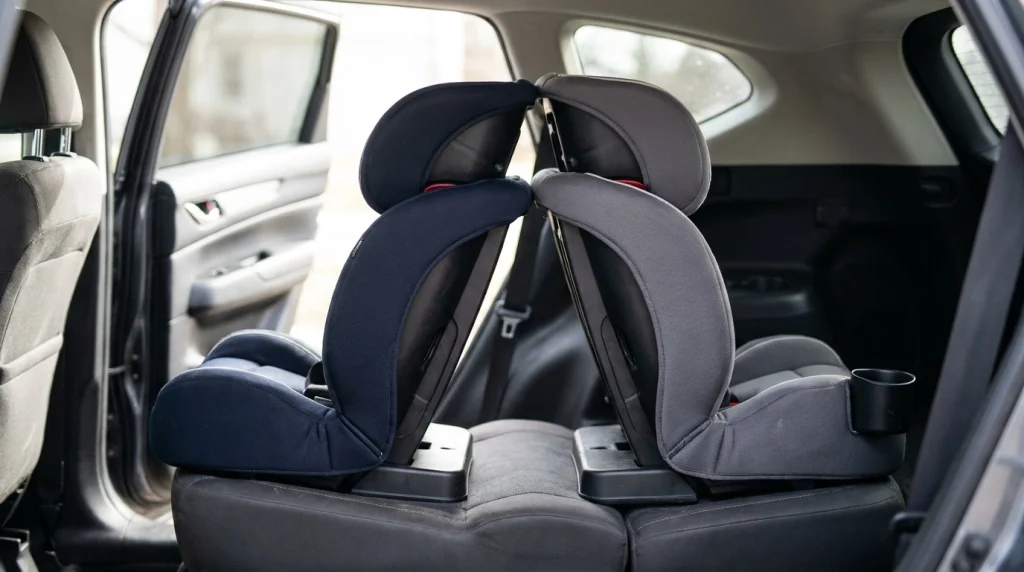
A car seat “touching” another car seat means the shells, armrests, or side wings make contact. It can be a light brush of fabric, or a firm press that holds one seat in place, and those two cases are very different.
The word parents often hear here is “independent tightness.” It means each seat must be tight by itself, without help from the seat next to it. Think of two books on a shelf: one can look steady because the other is holding it up, yet it falls when you pull the second book away.
What counts as touching?
Touching can happen in a few places. The side of one shell can press the side of the other, or a cup holder can dig into the next seat.
- Shell to shell: The hard plastic sides meet, often near the headrest or the base.
- Fabric to fabric: The covers brush, but neither seat changes shape or angle.
- Cup holder contact: A holder sticks out and presses the next seat or the door.
- Base overlap: One base sits partly over the next seating position, which is a bigger problem.
Base overlap is not the same as light shell contact. A base needs its own flat seating area, and it must not ride up on a seat hump or a buckle.
Why do seats touch in the first place?
Most back seats are not as wide as they look. The usable space shrinks once you add door panels, seat belt buckles, and the shape of the seat cushions.
Two wide convertible seats can fill a compact SUV in a hurry. Rear-facing seats make it harder still, as they take up more front-to-back room.
Section Takeaway: Touching alone does not prove a bad install, but it does mean you must test each seat on its own before you trust it.
Can Two Car Seats Touch Each Other?
Yes, in most cases two car seats can touch each other. The key rule is simple: each seat must be installed tight and correct on its own.
That rule comes from how child passenger safety checks work. A seat must pass the 1-inch test at the belt path, with no help from the seat beside it.
Some car seat makers add their own limits. One manual may allow light contact, while another may say the seat must not touch the front seat or another seat.
Always check both car seat manuals and your vehicle owner’s manual. The manual for your exact model wins over a general rule you read online.
Pro tip: Check the vehicle owner’s manual and each car seat manual for contact, bracing, and LATCH limits, or ask a certified Child Passenger Safety Technician if the wording is unclear.
What is the 1-inch test?
The 1-inch test is the standard tightness check used in the United States. Grab the seat at the belt path, where the seat belt or LATCH strap passes through, and try to move it side to side and front to back.
It should move less than 1 inch in either direction. Do not test it by shaking the top of the seat, as the top will move more even on a good install.
Does touching help or hurt in a crash?
Touching does not add crash protection. A car seat is designed to work on its own, with its own belt or LATCH connection.
Hard contact can push a seat out of its correct recline angle, lift one side of the base, or press on a buckle release. So the question is not “Are they touching?” but “Does each seat still sit right, stay tight, and work as designed?”
For a wider fit check, see how to check car seat compatibility with your vehicle before you buy a second wide seat.
Section Takeaway: Yes, light contact is often allowed, but only when each seat passes the 1-inch test alone and neither manual bans it.
How to Tell If Touching Is a Problem
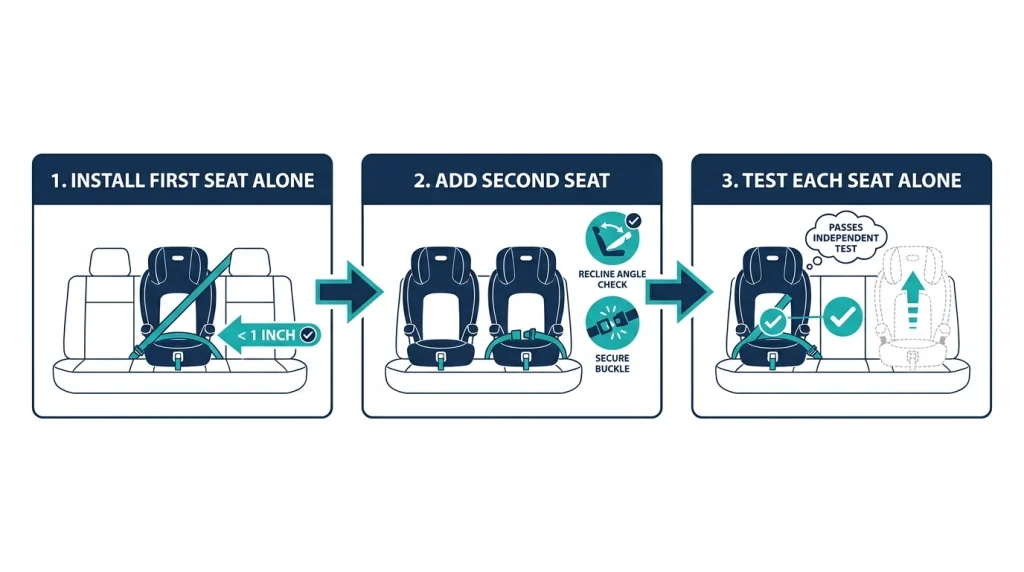
Do not judge the install by how it looks. Judge it by how each seat behaves when the other seat is not helping it.
The test below takes about 10 minutes for two seats. It is the same check a technician would start with.
Step 1: Install the first seat alone
Put the first seat in place with the second seat out of the car. Install it with LATCH or the seat belt, exactly as the manual says, then check the recline angle and do the 1-inch test at the belt path.
If it moves more than 1 inch, fix that install first. Tighten the belt, change the seating position, or switch from LATCH to seat belt.
Step 2: Add the second seat
Now install the second seat next to the first one. Do not push the first seat over to make room, and check the second seat’s recline angle and 1-inch test on its own.
If the second seat only feels tight because it is wedged against the first, that is a warning sign. A wedged seat is not a tight seat.
Step 3: Test each seat again, alone
This is the step most parents skip. Remove the second seat, then test the first seat again at the belt path. Then swap them and test the second seat alone.
Each seat must still move less than 1 inch. If either seat gets loose when its neighbour is gone, the contact was doing the holding.
I learned this in a small sedan. Both seats felt rock solid together, yet one slid more than an inch once I took the other out.
Other checks to run at the same time
- Buckle access: Can you reach and release each buckle without forcing your hand between shells?
- Belt path: Is the belt flat, untwisted, and locked as the manual requires?
- Recline angle: Has contact pushed either seat more upright or more reclined than the indicator allows?
- Harness adjuster: Can you still reach the harness tightening strap and the chest clip?
- Door and headrest: Does either seat press so hard on the door that the door will not close cleanly?
If you find why a car seat moves side to side, use that as a clue. A seat that moves after contact is removed needs a new install, not a tighter neighbour.
Section Takeaway: Test each seat alone, then together, and trust the alone test most.
When Is Touching Okay, and When Is It Not?
Light contact is often okay. Hard contact that changes the install is not.
Use the table below as a quick guide. It does not replace your manuals, but it helps you spot the line fast.
| Situation | Usually okay? | What to check |
|---|---|---|
| Fabric covers brush lightly | Yes | 1-inch test for each seat, alone |
| Shells touch but neither seat shifts | Often yes | Recline indicator, belt path, manual wording |
| One seat holds the other tight | No | Reinstall each seat alone and retest |
| Contact pushes a seat off its angle | No | Recline indicator, base contact with the vehicle seat |
| Buckle or release is hidden or pressed | No | Buckle access, belt twist, release function |
| Base overlaps the next seating position | No | Flat seating area, base placement, manual limits |
| Manual bans contact or bracing | No | Exact manual wording for both seats |
What about rear-facing and forward-facing seats touching?
A rear-facing seat and a forward-facing seat can touch too. The same rule applies, and the recline angle matters even more for the rear-facing seat, as a push upright can let a baby’s head fall forward.
Check the recline indicator after both seats are in. Do not rely on how it looked before the second seat went in.
What about two infant carriers touching?
Two infant carriers are often narrower than two convertibles. That helps, but each base must still sit flat and tight on its own, and the bases must not share a seating position.
What about a car seat touching the front seat?
That is a different rule, often called bracing. Some car seat and vehicle makers allow light contact, while others ban it, in part because it can affect airbag sensors.
Check both manuals before you allow it. Do not use the front seat to hold a rear-facing seat in place.
Section Takeaway: Light fabric contact is often fine, but contact that changes angle, tightness, or buckle access is not.
How to Fit Two Car Seats Side by Side
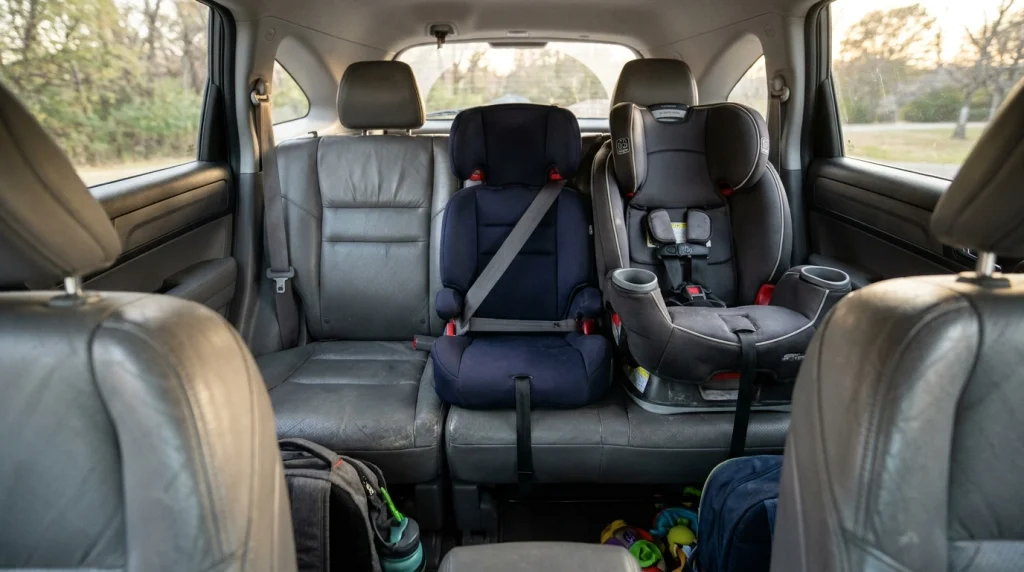
Fitting two seats is a layout puzzle. Small changes in order, position, and install method can make a big difference.
Start with the seat that is hardest to fit. That is usually the rear-facing seat, or the widest seat.
Try a different seating order
Try the rear-facing seat outboard and the forward-facing seat in the centre, then try the reverse. Seat shapes are not the same on both sides, and one order may leave the buckles clear while the other buries them.
Note the centre seat in many cars has no LATCH anchors of its own. You may need a seat belt install there, and you must not borrow anchors from the outboard seats unless the manual allows it.
Try seat belt instead of LATCH
LATCH anchors sit in fixed spots. A seat belt install lets you shift the seat a little left or right, and that small shift can clear a buckle or reduce hard contact. I have used this trick in a CR-V where LATCH put two shells right on top of each other.
Do not use LATCH and the seat belt together unless the manual says you can. Most seats allow only one method at a time.
For the general install steps, see how car seats are installed and follow your manual for the exact belt path.
Use the narrowest seat for the tight spot
Width is measured at the widest point, often at the headrest or the cup holders. A seat that looks slim at the base can be wide at the top, so remove a cup holder only if the manual allows it.
Check the vehicle seat shape
Some back seats have deep bolsters or a raised centre hump. Those shapes can tilt a base or push two seats toward each other, so try each position on its own first.
If a base will not sit flat, do not add a towel or a pool noodle unless the manual allows it. Follow the manual, not a tip from a forum.
Keep the harness and buckles usable
A fit is not good if you cannot buckle a child in safely. You need room to reach the chest clip, tighten the harness, and check the pinch test.
Try to pinch the harness strap at the child’s collarbone. You should not be able to pinch a fold, and if contact makes the harness hard to tighten, change the layout.
Section Takeaway: Change the order, the install method, or the seat in the tight spot before you force two wide seats together.
What to Do If They Still Touch or Will Not Fit
Sometimes two seats will touch no matter how you arrange them. That does not always mean you need a new car, but it does mean you need a new plan.
Work through the options below in order. Start with the cheapest and simplest change first.
Option 1: Swap one seat for a narrower model
Narrow seats are made for three-across and two-across fits. Look at the width at the widest point, not just the base width, and check fit before you buy if you can.
See what to do when a car seat does not fit in your vehicle for more layout ideas before you buy a new seat.
Option 2: Move one child to a different row
In a three-row vehicle, one child can ride in the third row. Check it for LATCH anchors, top tether anchors, and headrest support, and make sure you can still reach the child to buckle the harness.
Option 3: Use a different install method for one seat
Try LATCH for one seat and seat belt for the other. That mix can shift each seat by a small amount, and small amounts matter here.
Recheck the 1-inch test for both seats after any change. Do not mix methods on the same seat unless the manual allows it.
Option 4: Get a technician check
A certified Child Passenger Safety Technician can spot a problem in minutes. Many checks are free, and they are offered by fire departments, hospitals, and safety groups. Bring both seats, both manuals, and your vehicle manual.
You can find a technician through the NHTSA website, or through Consumer Reports and Edmunds safety guides for local check events.
If a seat will not fit safely in any layout, do not drive with it wedged in. A different seat, a different row, or a different vehicle setup is safer than a forced fit.
For infant-specific fitting, see how to install an infant car seat before you change the base position.
Section Takeaway: If two seats still touch hard after layout changes, change one seat or one row, and get a technician check before you settle for a forced fit.
Frequently Asked Questions
Can two car seats touch each other?
Yes, in most cases. Light contact is often allowed if each seat is tight on its own, passes the 1-inch test alone, and neither manual bans contact.
Can car seats touch if they are both rear-facing?
Yes, if each rear-facing seat keeps its correct recline angle and passes the 1-inch test alone. Check the recline indicator after both seats are in, because contact can push one seat more upright.
Is it okay if car seats are touching but tight?
It can be okay, but only if the tightness is real. Test each seat with the other seat removed, and if either seat loosens, the contact was holding it in place.
Can two car seats share a LATCH anchor?
No, in almost all cases. Each LATCH anchor is for one seat only, and borrowing anchors is allowed only when both manuals clearly allow it.
What if the buckle is buried between two car seats?
Change the seating order or the install method, or use a narrower seat. A buckle you cannot reach, release, or check is a safety problem, even if the seats feel tight.
Do car seats need space between them?
No set gap is required by most manuals. What matters is independent tightness, correct angle, clear buckles, and no manual ban on contact.
Bottom line: can two car seats touch each other? Yes, in most cases, if each seat is tight on its own. Test each seat alone, check both manuals, and keep the buckles and harness easy to use.

Daniel Brooks is an automotive writer and product researcher focused on car accessories, car tech, maintenance, and practical driving guides. At Plug-in Car World, he helps drivers make smarter automotive decisions through honest reviews and research-driven content.
