
Can a Car Seat Touch the Front Seat? 7 Safety Checks Parents Must Know
Quick Answer
Yes, a car seat can touch the front seat in many cars, but only if both manuals allow it. Some rear-facing seats allow light contact, while others forbid any touch at all. Always check your car seat manual and your vehicle manual first, because those two books decide the answer for your exact setup. Learn how to install a rear-facing car seat before you move anything.
The short rule
- Rear-facing, light touch: Often allowed, but only when the manual says so and the seat stays tight and level.
- Rear-facing, hard push: Not safe if the front seat pushes the car seat out of its recline angle.
- Forward-facing touch: Usually less of a problem, yet the top tether and belt path must still sit right.
- Both manuals disagree: Follow the stricter rule, every time.
- Airbag warning: A rear-facing seat must never sit in front of an active front airbag.
Do this first
- Check the recline indicator after you move the front seat.
- Push the car seat at the belt path and check for less than 1 inch of movement.
- Move the front seat forward or try the centre seat if the angle changes.
I have wrestled with this exact problem in a tight back seat more than once. You get the rear-facing seat in, you slide the front seat back, and suddenly the two seats meet.
It feels wrong, even when the install still feels tight.
Can a car seat touch the front seat? This guide goes through the full picture for 2026, with the rear-facing and forward-facing rules, the manual checks, and the fixes for a tight fit.
In This Guide
- What Does It Mean When a Car Seat Touches the Front Seat?
- Can a Rear-Facing Car Seat Touch the Front Seat?
- Can a Forward-Facing Car Seat Touch the Front Seat?
- Is It Illegal for a Car Seat to Touch the Front Seat?
- Can a Car Seat Touch the Front Seat Safely? How to Check
- How to Fix a Car Seat That Touches the Front Seat
- Frequently Asked Questions
What Does It Mean When a Car Seat Touches the Front Seat?
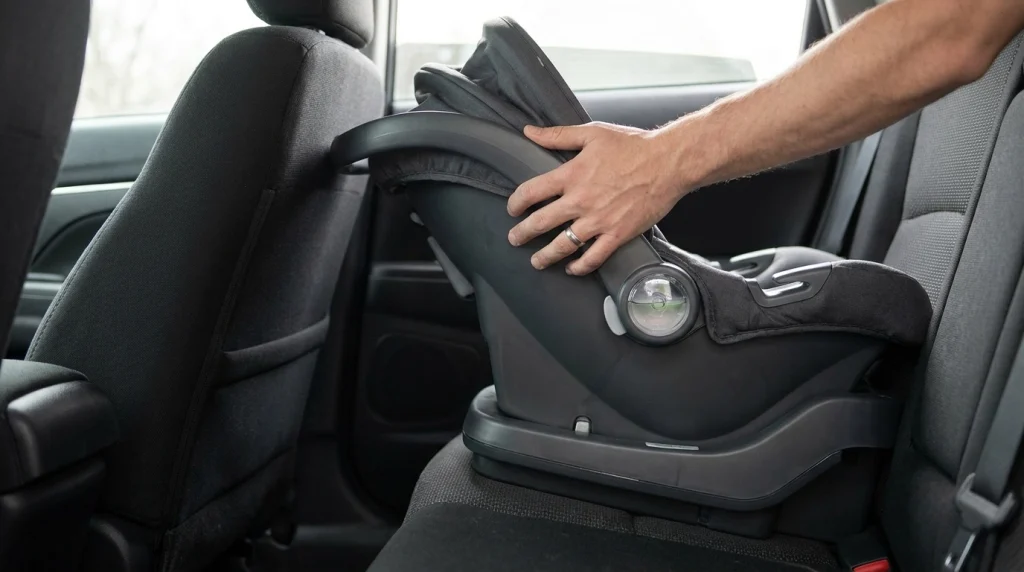
Touching means the back of the car seat, or the top of a rear-facing shell, makes contact with the back of the front seat. It can be a light brush, a firm press, or a hard wedge.
Those three are not the same thing, and the manual often treats them differently. A light brush may be fine, while a hard wedge that lifts the base is not.
Bracing is the word many manuals use for this contact. Bracing means the car seat rests against the front seat, and the front seat helps stop it from moving forward in a crash.
Some makers test their seats with bracing in mind. Others test theirs with a clear gap, so bracing changes how the seat behaves.
I learned this the hard way in my own compact SUV. The infant carrier touched the passenger seat, and I assumed a small gap would fix it.
Moving the front seat forward by one notch changed the recline bubble by a full mark. That small shift taught me to check the angle after every front-seat move, not before it.
Light contact vs. pressure vs. wedging
Light contact means the seats meet, but neither one moves the other. You can slide a hand between them with a little effort, and the recline indicator stays put.
Pressure means the front seat pushes the car seat, yet the base still sits flat. The recline may still look right, but the seat may feel loaded.
Wedging means the front seat lifts, tilts, or twists the car seat. The base may rock, the level line may shift, or the seat may feel tight in the wrong place.
- Light contact: Seats meet, angle stays correct, install stays tight.
- Pressure: Seats press together, angle needs a fresh check, install may still pass.
- Wedging: Base lifts or tilts, angle is wrong, install must change.
Section takeaway: Touching is not one single problem. Light contact, pressure, and wedging need different answers, so name what you see before you decide.
Can a Rear-Facing Car Seat Touch the Front Seat?
A rear-facing car seat can touch the front seat when both manuals allow it. Many infant carriers and convertibles allow light contact, and a few even allow firm bracing.
Other models forbid it in clear words. If your manual says “do not allow the car seat to touch the vehicle seat in front of it,” that rule wins.
Rear-facing seats sit close to the front seats by design. The shell is long, the recline is deep, and small cars leave little room behind the front row.
That tight fit is normal in a sedan or a small SUV. It becomes a problem only when the touch changes the install.
Check your recline angle first. For a newborn, most seats aim for a recline near 45 degrees, while an older baby can sit more upright, often near 30 to 35 degrees.
Your seat will show the right range on its level indicator. Use that mark, not a guess, and check it with the front seat in its normal driving spot.
What to check on a rear-facing install
- Recline indicator: Still in the correct zone after the front seat moves back.
- Base contact: Base sits flat on the vehicle seat, with no lift at the front edge.
- Belt path movement: Less than 1 inch of side-to-side or front-to-back movement.
- Handle position: Carrier handle sits where the manual allows for driving.
- Head position: Baby’s head stays back, chin stays off the chest, and the harness stays snug.
If the front seat pushes the shell forward, the recline can turn too upright. A newborn with a chin tucked to the chest can struggle to breathe well, so that angle matters more than the touch itself.
Rear-facing vs. forward-facing car seats explains how the two modes spread crash forces in different ways.
Pro tip: Check the exact wording in your car seat manual and your vehicle owner’s manual, and ask a certified child passenger safety technician if the two books seem to disagree.
Section takeaway: A rear-facing seat may touch the front seat, but only when both manuals allow it and the recline and tightness still pass after the front seat moves.
Can a Forward-Facing Car Seat Touch the Front Seat?
A forward-facing car seat can touch the front seat in most cases, and the risk is usually lower than with a rear-facing seat. The child faces forward, the shell sits more upright, and the front seat rarely changes the recline.
That does not mean any contact is fine. The seat still needs a tight install, a correct top tether, and a clear belt path.
Forward-facing seats move forward in a crash, then the top tether limits how far the top of the seat can travel. If the front seat blocks that motion in a strange way, the tether and the belt must still hold the seat in place.
Watch for the same warning signs as rear-facing installs. If the front seat pushes the car seat forward, lifts the base, or twists the shell, the install needs work.
Forward-facing checks that matter most
- Top tether: Attached, tight, and routed as the manual shows, with no slack.
- Belt path: Less than 1 inch of movement when you push at the belt path.
- Headrest: Vehicle headrest does not push the car seat shell out of position.
- Recline: Seat sits in the forward-facing recline range, not tilted by the front seat.
- Child fit: Harness sits at or above the shoulders, chest clip sits at armpit level, and straps pass the pinch test.
Why rear-facing car seats are safer for babies shows why the rear-facing position needs more space and care than the forward-facing one.
Section takeaway: Forward-facing contact is often less risky, yet the top tether, belt path, and harness fit must still pass, so check them after every front-seat move.
| Situation | Rear-facing | Forward-facing |
|---|---|---|
| Light touch | Often allowed if both manuals allow it | Usually allowed if install stays tight |
| Hard push | Risky, can change recline angle | Check tether, belt path, and shell position |
| Base lifts | Not safe, reinstall or move seats | Not safe, reinstall or move seats |
| Manual forbids touch | Follow the manual, keep a gap | Follow the manual, keep a gap |
| Front airbag | Never in front of an active airbag | Front seat is a last resort, check airbag rules |
Is It Illegal for a Car Seat to Touch the Front Seat?
There is no single United States law that says a car seat must not touch the front seat. State laws focus on the right seat, the right direction, and the right age and size, not on a gap measurement.
That does not make touching free of rules. The law in most states requires you to use the car seat as the maker directs, and the maker’s manual is part of that use.
If your manual forbids contact and you ignore it, you are not using the seat as directed. A police check, an insurance claim, or a safety inspection could treat that as misuse.
Front-seat rules are stricter. Children under 13 should ride in the back seat when possible, according to safety guidance from NHTSA.
A rear-facing seat in the front seat is a separate danger. A front airbag can strike the back of a rear-facing shell with great force, so that setup is never safe with an active airbag.
Touching the front seat from the back row is not the same as sitting in the front seat. The child stays in the back, the airbag stays in front, and the question is only about contact, not position.
Pro tip: Use NHTSA’s recall lookup and your state highway safety site for current rules, rather than relying on general advice from a shop or a social post.
Section takeaway: Touching is not illegal by itself in most states, but using the seat against its manual can count as misuse, so the manual still decides.
Can a Car Seat Touch the Front Seat Safely? How to Check
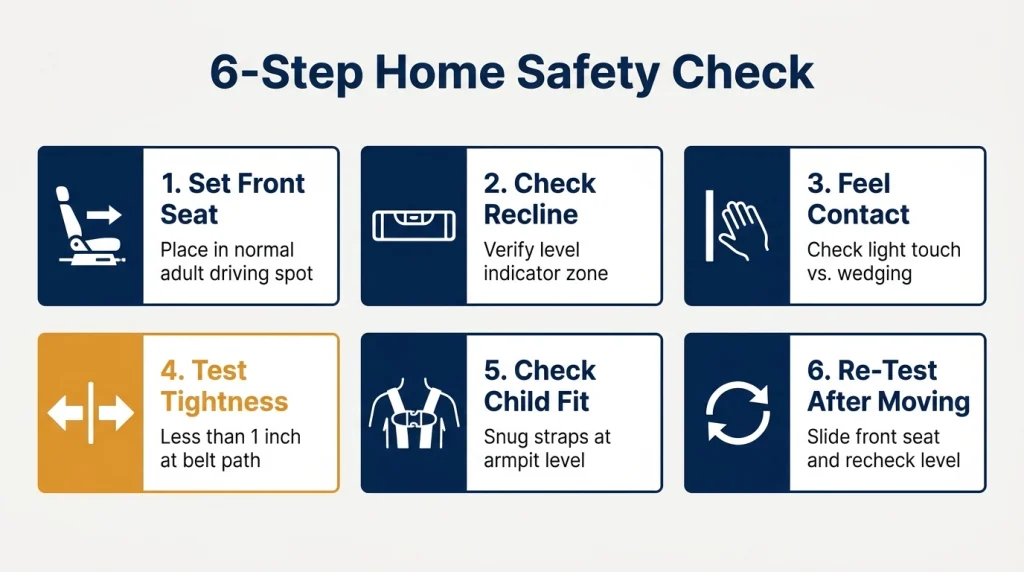
Start with the front seat in the spot where the driver or passenger will actually sit. Do not check the gap with the front seat slid all the way forward, then slide it back later.
Install the car seat first, then move the front seat to its normal spot. That order shows you the real contact, not a best-case gap.
Look at the recline indicator next. If the bubble, line, or colour zone moved out of range, the touch has changed the angle.
Push the car seat at the belt path with your non-dominant hand. It should move less than 1 inch side to side or front to back.
If it moves more than that, the install is loose, with or without touching. Tighten the belt or LATCH strap, then check again.
A five-minute check you can do at home
- Set the front seat: Put it where the adult will sit and lock it in place.
- Check the recline: Read the level indicator and note the exact zone.
- Feel the contact: Slide your hand between the seats and note light touch, pressure, or wedging.
- Test the tightness: Push at the belt path and check for less than 1 inch of movement.
- Check the child fit: Harness snug, chest clip at armpit level, head in a safe spot.
- Move the front seat again: Slide it forward and back, then repeat the recline check.
If the front seat moves the car seat when you slide it, the contact is too firm. The front seat should not drag, lift, or tilt the car seat as it moves.
How to check car seat compatibility with your vehicle can help you spot a poor fit before you buy a new seat for a small car.
Consumer guidance from Consumer Reports also stresses a tight install and a correct recline, not just a gap measurement.
Section takeaway: Check the real driving position, not a staged one, and test recline, tightness, and child fit after every front-seat move.
How to Fix a Car Seat That Touches the Front Seat
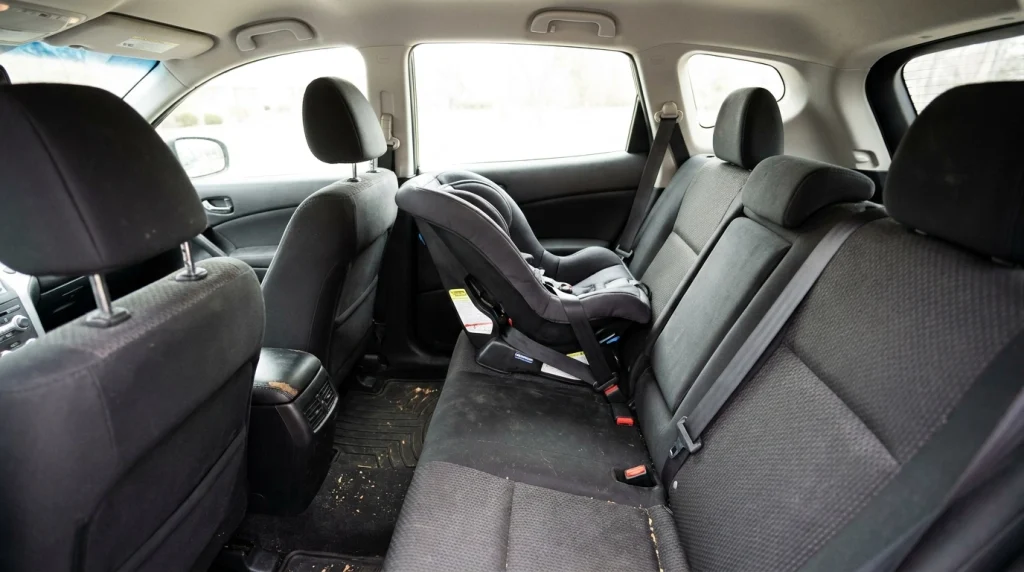
Move the front seat forward first. One or two notches can turn pressure into light contact, and it costs nothing.
Try the centre seat next. The centre often sits further back from the front seats, and it can give a long rear-facing shell more room.
Not every car allows a centre install with LATCH. Check the vehicle manual for centre LATCH rules, and use the seat belt if the centre has no dedicated lower anchors.
Change the recline if the manual allows it. An older baby can sit more upright than a newborn, and that upright angle can free up several inches.
Do not change the recline past the allowed range for your child’s age and weight. The level indicator still rules, even when space is tight.
When a new seat or a new spot is the answer
- Compact shell: Some convertibles are built for small cars and take up less front-to-back space.
- Infant carrier without the base: A baseless install can sit a little differently, but follow the manual for that mode.
- Different vehicle seat: A centre install or the other outboard spot may give you the gap you need.
- Professional check: A certified technician can spot a fit problem in minutes and suggest a safe fix.
Do not remove padding, straps, or parts to gain room. Do not use aftermarket inserts to change the fit, and do not place a towel or pool noodle under the seat unless the manual allows it.
If no spot in the car gives you a safe install, the seat may not fit that vehicle. That is a hard answer, but it is better than a loose install with a false sense of safety.
How to fit three car seats in one vehicle has more ideas for tight back seats, including narrow seats and centre installs.
Vehicle fit advice from Edmunds can also help you compare back-seat room before you shop for a new car or a new seat.
Section takeaway: Move the front seat, try the centre, use the correct recline, and get a technician check if no spot gives you a tight, level install.
Frequently Asked Questions
Can a rear-facing car seat touch the front seat?
Yes, in many cases, but only if both manuals allow it. Check the recline indicator and the belt-path movement after the front seat moves, and keep a gap if either manual forbids contact.
Can a car seat touch the front seat in a small car?
Yes, small cars often force light contact, and many seats allow it. Move the front seat forward, try the centre seat, and use the most upright recline your child’s age allows.
Is it safe if the car seat is braced against the front seat?
Bracing is safe only when the car seat manual allows it. Some seats are tested for bracing, while others are tested with a gap, so follow your exact model’s manual.
Can a forward-facing car seat touch the front seat?
Yes, forward-facing contact is usually less risky, yet the top tether must stay tight and the belt path must move less than 1 inch. Check both after you move the front seat.
What if the front seat pushes the car seat out of level?
Move the front seat forward, try another seating spot, or adjust the recline within the allowed range. If the level still fails, the install is not safe in that spot.
Does touching the front seat affect the airbag?
It can affect a front passenger sensor if the car seat presses hard on the seatback. A rear-facing seat must never sit in front of an active front airbag, and hard pressure on a front seatback should be avoided.
When should I ask a technician for help?
Ask for help if the recline will not stay correct, the seat moves more than 1 inch, or the manuals disagree. A certified technician can check the fit in your exact car and seat.
When can a child safely sit in the front seat explains the age and airbag rules for the front row, which are separate from the touching question.
So, can a car seat touch the front seat? In many cars, yes, with light contact and a correct install.
The manuals decide, the recline decides, and the tightness test decides. Check those three things after every front-seat move, and do not be afraid to try the centre seat or ask a technician.
A tight, level seat with a small touch beats a loose seat with a big gap, every time.

Daniel Brooks is an automotive writer and product researcher focused on car accessories, car tech, maintenance, and practical driving guides. At Plug-in Car World, he helps drivers make smarter automotive decisions through honest reviews and research-driven content.
