
Which Cars Can Fit Three Car Seats? Honest Guide
Quick Answer
Minivans and large three-row SUVs fit three car seats most easily. Models like the Honda Odyssey, Toyota Sienna, Chevrolet Tahoe, and Ford Expedition offer wide second rows and flexible third rows. Wide midsize SUVs and full-size sedans can work too, but only with narrow seats and a careful install. Before you buy, check will a car seat fit in your car and test all three seats together.
Cars most likely to fit three car seats
- Minivans: Offer the widest, flattest second rows and the easiest third-row access for a split install.
- Large SUVs: Provide wide benches, strong tether access, and room for three installs in one row.
- Midsize SUVs: Work for three across only with slim seats and a flat bench layout.
- Wide sedans: Can fit three slim seats, but rear-facing seats often steal front legroom fast.
- Full-size trucks: Fit three in a crew cab when the rear bench is wide and tethers are easy to reach.
What decides the fit?
- Bring all three seats to the test drive and install each one on its own.
- Check belt spacing, buckle access, and top tether anchors before you sign.
- Confirm each seat moves less than 1 inch at the belt path when the others are removed.
I’ve squeezed three seats into more back seats than I can count, and the spec sheet rarely tells the full story. A car can look huge outside and still fight you at the buckles inside.
This guide goes deeper than a list of big cars. You’ll learn what makes three-across work, which vehicle types give you the best odds, and how to test the fit before you spend a dollar.
In This Guide
- What Does It Take for a Car to Fit Three Car Seats?
- Which Cars Can Fit Three Car Seats Across One Row?
- Which Three-Row SUVs and Minivans Make Three Car Seats Easiest?
- Can Sedans, Hatchbacks, and Smaller SUVs Fit Three Car Seats?
- How Do You Choose Car Seats That Fit Three Across?
- How Do You Test a Three-Car-Seat Fit Before You Buy?
- Frequently Asked Questions About Cars That Fit Three Car Seats
- The Bottom Line on Cars That Fit Three Car Seats
What Does It Take for a Car to Fit Three Car Seats?
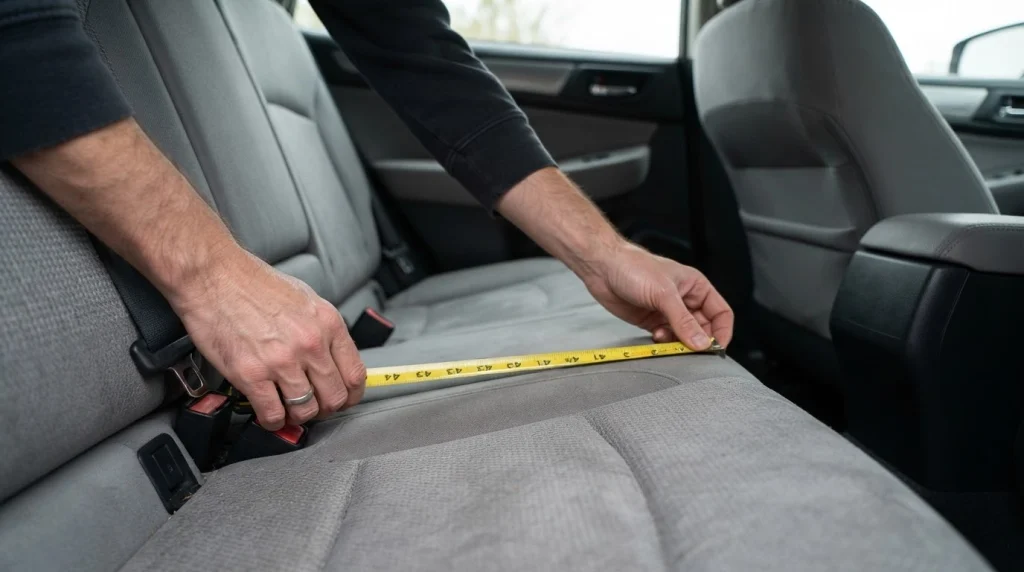
A car fits three car seats when three installs stay tight, independent, and safe at the same time. Width alone does not prove the fit.
I learned this in my garage with a midsize SUV that looked roomy on paper. The center belt sat too close to one outboard anchor, so the middle seat never tightened cleanly.
Three-across fit means three child restraints installed side by side in one row, each with its own secure belt or LATCH path and no install that depends on the seat next to it.
Each seat must pass the tightness check on its own. Remove the seats beside it, then check for movement at the belt path.
If one seat loosens when you pull the next seat out, the puzzle fails. Start over with a different seat order or a slimmer model.
What measurements matter most?
Start with usable width, not the headline spec. Door panels, armrests, and sculpted cushions steal space fast.
- Hip room: Measures side-to-side space at hip level, and wider benches puzzle better.
- Flat bench width: Shows how much level cushion you can use for bases and boosters.
- Belt and buckle spacing: Decides if you can reach each buckle without pinching a hand.
- Seat contour: Deep bolsters push seats inward and shrink the usable center spot.
- Front seat travel: Sets how much room a rear-facing seat leaves for the driver.
Measure each child seat at its widest point. Then compare that total with the flat, usable bench width.
Learn how wide a standard car seat is before you assume three will fit. Many wide convertibles measure 19 inches or more, and three of them need a big bench.
Why do LATCH anchors and seat belts change the answer?
LATCH stands for Lower Anchors and Tethers for Children. It gives you fixed lower anchor points in many rear seats.
Most cars offer LATCH only in the two outboard rear spots. The center spot often needs a seat belt install instead.
- Center LATCH: Some manuals forbid borrowing anchors from both sides, so check the manual first.
- Weight limits: Lower anchors carry a child-plus-seat weight limit, and belts take over past that limit.
- Top tethers: Forward-facing seats need a tether anchor, and some third rows offer few tethers.
- Belt geometry: A short belt stalk or angled buckle can make the center install hard to tighten.
Seat belts often win in a three-across puzzle. They let you shift each seat a half-inch to find a clean fit.
Pro tip: Check your owner’s manual and each car seat manual before every install, and use official recall and safety guidance from NHTSA when you need a verified source.
Section takeaway: A car fits three car seats only when width, belt spacing, anchors, and tethers all work together. Test independence, not just side-by-side looks.
Which Cars Can Fit Three Car Seats Across One Row?
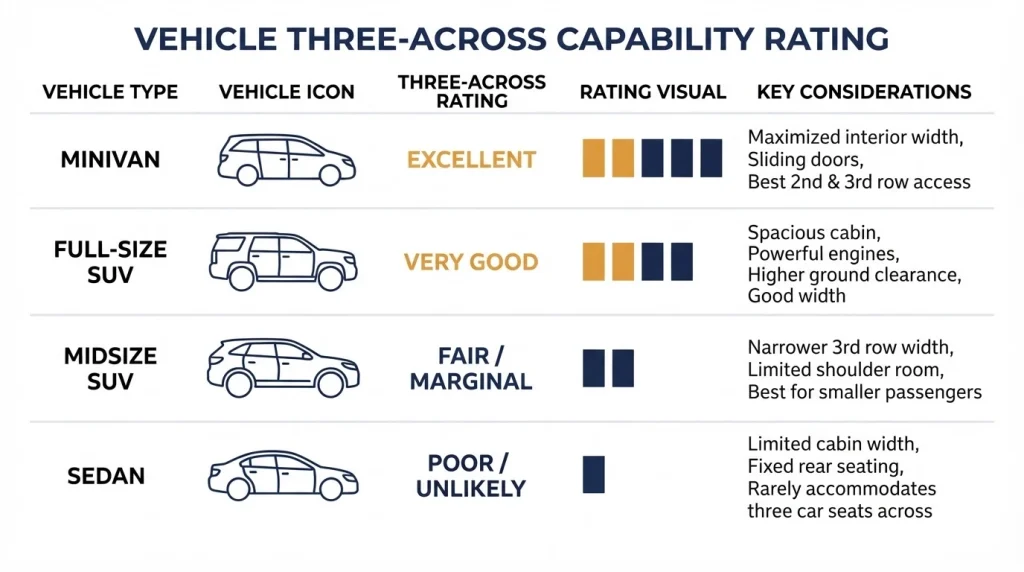
Minivans, full-size SUVs, and wide three-row SUVs fit three car seats across one row most often. Flat benches and wide belt spacing make the difference.
As of 2026, the safest shortlist starts with a second-row bench, not captain’s chairs. A bench gives you three usable spots in one row without a third-row climb.
I tested a three-across set in a Honda Odyssey and a Chevrolet Tahoe on back-to-back weekends. Both benches stayed flat, the buckles stayed reachable, and each seat tightened without help from its neighbor.
| Vehicle type | Three-across odds | Why it works | Watch out for |
|---|---|---|---|
| Minivan | Best | Widest flat bench, sliding doors, easy tether access | Some trims swap the bench for captain’s chairs |
| Full-size SUV | Best | Wide second row, strong tether layout, tall roof | High step-in height for small kids |
| Midsize three-row SUV | Good with slim seats | Bench option on many trims, split-row backup plan | Sculpted cushions and tight center buckles |
| Full-size crew-cab truck | Good | Wide rear bench and flat floor in crew cabs | Tether routing varies, and rear legroom varies by cab |
| Wide sedan | Possible with slim seats | Flat bench on many large sedans, low load height | Rear-facing seats cut front legroom fast |
| Compact SUV or hatchback | Tight, often no | Two seats fit well, and a narrow booster may squeeze in | Narrow bench, close buckles, limited recline room |
Which minivans fit three car seats best?
Minivans lead this list for a simple reason. Their second rows sit wide, flat, and low, so bases sit level with less fuss.
- Honda Odyssey: A wide second-row bench and sliding second-row seats help you reach buckles and tethers.
- Toyota Sienna: A broad bench layout and long sliding range help tall drivers keep legroom with rear-facing seats.
- Kia Carnival: A roomy bench and flexible seating layout suit mixed ages, from infant carriers to boosters.
- Chrysler Pacifica: A wide bench and easy sliding-door access make daily buckling faster for three kids.
Check the trim before you fall for a van. Higher trims often replace the bench with captain’s chairs, and that change kills a one-row puzzle.
Which large SUVs fit three car seats best?
Full-size SUVs pair a wide bench with a usable third row. That combo gives you two ways to carry three kids.
- Chevrolet Tahoe and Suburban: Wide second-row benches and clear tether access suit three-across installs.
- Ford Expedition: A broad bench and roomy third row let you split seats when one row feels tight.
- GMC Yukon: Shares the full-size bench advantage, with trim choices that change bench and captain’s chair layouts.
- Toyota Sequoia: A wide, tall cabin helps with high-back boosters and forward-facing seats.
Midsize stars include the Honda Pilot, Kia Telluride, Hyundai Palisade, and Ford Explorer with a bench. Each one needs slim seats for a true three-across fit, but each one rewards a careful test.
I cross-check hip room and second-row specs on Edmunds before a test drive. Specs narrow the list, and a hands-on install settles the choice.
Seats will touch in many tight puzzles. Learn whether two car seats can touch each other so light contact does not scare you, and wedging does not fool you.
Section takeaway: Start with a minivan or full-size SUV bench if you want three in one row. Midsize SUVs can join the list, but only with slim seats and a flat bench trim.
Which Three-Row SUVs and Minivans Make Three Car Seats Easiest?
Three-row models make life easiest when you split seats two in the second row and one in the third row. That split ends most width fights.
A split layout also keeps buckle access open. You can reach each belt without threading a hand between two tight shells.
I use this split on road trips with mixed ages. Two younger kids ride in the second row, and the oldest booster rider takes the third row where the belt fit stays clean.
Should you use the third row for a car seat?
The third row works well when it offers a full seat belt, a head restraint, and a top tether for forward-facing seats. Some third rows lack one of those parts.
- Best third-row picks: Forward-facing seats and high-back boosters, when tethers and head restraints line up.
- Trickier third-row picks: Rear-facing seats, which need recline room and easy access for buckling.
- Access matters: Sliding second rows and wide door openings cut daily hassle by a wide margin.
- Tether check: Count tether anchors in the third row before you plan a forward-facing install there.
Read the guidance on a car seat in the third row before you lock in a split plan. Anchor locations and head restraint rules vary by model year and trim.
Captain’s chairs or bench: which setup wins for three kids?
A bench wins when all three kids must share one row. Captain’s chairs win when you split rows and want a walk-through aisle.
- Bench setup: Keeps three spots in row two and leaves row three for cargo or extra passengers.
- Captain’s chairs: Give each second-row child more elbow room and open a path to row three.
- Mixed ages: A bench suits three small seats, while captain’s chairs suit two seats plus a booster in back.
- Daily use: Sliding doors and tilt-and-slide second rows matter more than raw width on school runs.
Many families pick captain’s chairs for comfort, then miss the bench on carpool days. Decide from your worst week, not your easiest day.
See how car seats in captain’s chairs install and what limits to check. Armrests, recline controls, and LATCH placement change the fit.
I shortlist three-row SUVs with help from Car and Driver reviews, then I verify seat layouts in person. Review photos show the aisle, but only a real install shows the buckle fight.
Section takeaway: A 2-plus-1 split beats a forced three-across fit in many three-row cars. Pick the layout that keeps every install tight and every buckle reachable.
Can Sedans, Hatchbacks, and Smaller SUVs Fit Three Car Seats?
Some wide sedans can fit three slim car seats, but most compact SUVs and hatchbacks cannot do it well. Narrow benches and close buckles set a hard limit.
That limit hits rear-facing seats hardest. Recline angles push front seats forward, and tall drivers feel the pinch first.
Which sedans have the best chance?
Large and midsize sedans with flat benches give you the best shot. Look for wide hip room, long rear legroom, and simple buckle stalks.
- Honda Accord: A wide rear bench and generous legroom help slim convertibles and boosters puzzle together.
- Toyota Camry: A broad bench suits two convertibles plus a narrow booster in many model years.
- Hyundai Sonata and Kia K5: Wide cabins for the class, with bench shapes that reward slim seats.
- Chevrolet Malibu: A flat bench profile helps, but rear legroom still limits rear-facing installs for tall drivers.
Test the driver seat position first. Set your normal driving spot, then install the rear-facing seat behind you.
If your knees hit the dash or the seat shell touches the front seatback, the combo fails for daily use. A puzzle that works only with the front seat jammed forward will wear you down fast.
What about compact SUVs and hatchbacks?
Compact SUVs like the Honda CR-V and Toyota RAV4 fit two car seats with ease. Three across stays a stretch, even with slim models.
- Two-seat strength: Wide door openings and flat outboard spots make daily installs quick and secure.
- Center squeeze: A narrow center cushion and close buckles often block a third tight install.
- Booster exception: A narrow backless booster may fit between two slim seats for an older child who passes the belt-fit test.
- Hatchback limit: Short rear legroom and sloped rooflines cut headroom for high-back boosters.
Subcompact SUVs and small hatchbacks rarely fit three. Their benches run narrow, and their belt spacing leaves no room to puzzle.
Don’t force a third seat into a car that fights you. A tight install that depends on pressure from the next seat is not a safe install.
Section takeaway: Wide sedans can work with slim seats and a patient test. Compact SUVs and hatchbacks usually need a bigger car when a third seat joins the family.
How Do You Choose Car Seats That Fit Three Across?
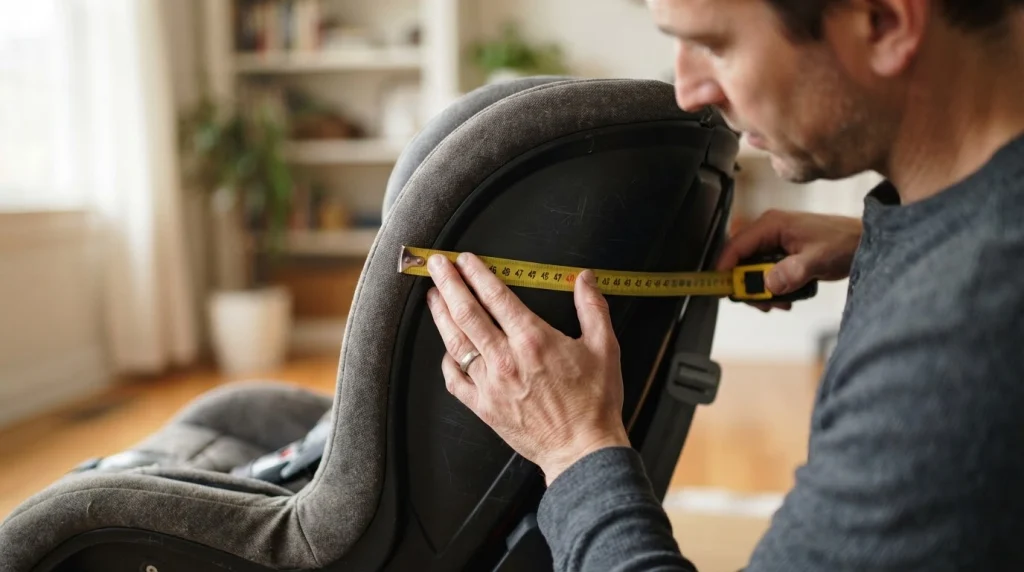
Choose narrow seats, mix seat types, and measure at the widest point of each shell. Slim width matters more than brand hype.
I keep a tape measure in my install kit for this job. Specs help, but the widest flare near the headrest or cup holder often decides the puzzle.
What width should you look for?
Many narrow convertibles and boosters measure 16.5 to 18 inches at the widest point. Three seats near 17 inches need about 51 inches of usable bench width.
- Under 17 inches: Best odds for three across in midsize SUVs and wide sedans.
- 17 to 18 inches: Workable in minivans and full-size SUVs, and tight elsewhere.
- Over 19 inches: Rarely puzzle three across, even in wide benches.
- Measure the shell: Check the base, the midsection, and the headrest, then use the largest number.
Cup holders, side wings, and recline handles add hidden width. Fold or remove them only when the manual allows it.
I compare seat widths and safety notes with help from Consumer Reports before I buy. Independent notes help me shortlist, and a hands-on test makes the final call.
Which seat types puzzle together best?
Mixed seat types puzzle better than three identical wide seats. Different shapes nest around belt paths and buckles.
- Rear-facing plus forward-facing: Opposite shell shapes often leave more buckle room than two matching shells.
- Convertible plus booster: A slim high-back booster beside a convertible frees space at the base.
- Infant carrier plus convertibles: A narrow carrier base can sit center when the belt path stays clear.
- Two boosters plus one convertible: Often the easiest mix for older kids who meet booster rules.
Try the middle seat first, then add the outboard seats. The center install sets the puzzle, and the sides fill around it.
Swap the order when one combo fails. A forward-facing seat in the center sometimes clears buckles that a rear-facing seat blocks.
What mistakes make three-across harder?
Small errors turn a workable puzzle into a daily fight. Most of them trace back to rushing the first install.
- Buying three wide seats: Wide shells crowd buckles and force installs to lean on each other.
- Skipping the independent check: A seat that feels tight only with neighbors in place is not tight.
- Ignoring tether limits: A missing third-row tether can block a forward-facing plan.
- Adding thick padding: Aftermarket pads and bulky seat protectors can change belt angles and hide slack.
- Forgetting growth room: A puzzle that fits today may fail when a headrest rises or a booster grows taller.
Plan for the next stage, not just today. A toddler who moves to forward-facing next year needs a tether spot you can reach.
Section takeaway: Slim seats, mixed shapes, and a center-first install give you the best odds. Measure the widest point, then test independence before you trust the puzzle.
How Do You Test a Three-Car-Seat Fit Before You Buy?
Test all three seats in the exact car and trim you plan to buy. Bring the seats, the manuals, and 45 to 60 minutes for a first test.
Dealers see this request often, and a good salesperson will let you install in the lot. If one refuses, try another store or book a longer test drive.
- Set the front seats: Move the driver and passenger seats to normal driving spots first.
- Install the center seat: Tighten it with a seat belt or LATCH, as the manuals allow.
- Check independence: Confirm less than 1 inch of movement at the belt path with neighbors removed.
- Add the outboard seats: Install each one, then recheck the center seat for new slack.
- Test every buckle: Buckle and unbuckle each seat without forcing a hand between shells.
- Check tethers and head restraints: Confirm each forward-facing seat reaches a tether anchor.
- Load the kids: Buckle each child, check harness fit, and confirm doors close without pinching straps.
Take photos of each belt path and tether route. Photos help you repeat the install at home without guesswork.
Use a full guide to check car seat compatibility with your vehicle when you compare two close finalists. Manual checks and measurements catch problems that a quick sit-test misses.
- Rear-facing clearance: Confirm the shell clears the front seatback at your normal driving spot.
- Buckle reach: Confirm an adult hand can reach each buckle without moving a seat.
- Door access: Confirm you can lift a carrier in and out without hitting the door frame.
- Cargo needs: Confirm stroller and bag space survives with the third row up, when you use it.
Pro tip: Book a check with a certified Child Passenger Safety Technician after you buy. Bring both manuals, and ask the technician to watch you install each seat yourself.
Section takeaway: A lot test with all three seats beats every spec sheet. Install center-first, check independence, and load the kids before you decide.
Frequently Asked Questions About Cars That Fit Three Car Seats
Can you fit three car seats in a sedan?
Yes, some wide sedans fit three slim car seats with a careful install. The Honda Accord and Toyota Camry offer the best odds in this class. Rear-facing seats still limit front legroom, so test your normal driving position first.
What is the cheapest car that fits three car seats?
Cost depends on age, trim, and local prices, so no single cheapest pick fits every buyer. Older minivans and full-size SUVs with benches often cost less than new three-row SUVs. Compare bench trims first, then test the fit before you judge value.
Do you need a minivan for three car seats?
No, a minivan helps most, but it is not the only answer. Full-size SUVs, wide midsize SUVs with benches, and crew-cab trucks can fit three seats. A split layout across two rows also works when one row feels tight.
Can three car seats fit in a Toyota RAV4 or Honda CR-V?
Three across stays tight in both models, even with slim seats. Two seats fit with ease, and a narrow booster may fit for an older child in some cases. Test all three seats together, and expect a bigger car to work better for daily use.
Is it safe to fit three car seats across one row?
Yes, three across is safe when each install stays tight and independent. Each seat must move less than 1 inch at the belt path on its own. Follow both manuals, use tethers for forward-facing seats, and get a technician check when you feel unsure.
What car seat width fits three across?
Seats near 16.5 to 18 inches at the widest point give you the best odds. Measure the base, midsection, and headrest, then use the largest number. Three seats near 17 inches need about 51 inches of usable bench width.
The Bottom Line on Cars That Fit Three Car Seats
Minivans and full-size SUVs answer this question with the least stress. Wide benches, clear tethers, and easy access turn three installs into a routine job.
Midsize SUVs and wide sedans can join the list with slim seats and a patient test. Compact SUVs and small hatchbacks rarely earn a spot, and forcing a fit helps no one.
Shortlist two or three bench models, then bring all three seats to the lot. Install center-first, check independence, and drive the car with your normal seat positions set.
Your best car is the one that keeps every install tight on a busy morning. Pick that car, keep the manuals close, and book a technician check for peace of mind.

Daniel Brooks is an automotive writer and product researcher focused on car accessories, car tech, maintenance, and practical driving guides. At Plug-in Car World, he helps drivers make smarter automotive decisions through honest reviews and research-driven content.
