
Can a Car Seat Fit in a Toyota Tacoma or Extended-Cab Truck? Honest Fit Guide
Quick Answer
Yes, a car seat fits in most Tacoma Double Cabs and many older Access Cabs. The basics of installing a car seat in a pickup truck still apply here, from anchor limits to top-tether use. Fit gets tight fast in an Access Cab, and the 2024-and-newer XtraCab has no rear seat at all.
What decides fit
- Double Cab fits most seats: A full rear bench and full doors make daily installs straightforward.
- Access Cab stays tight: A short rear bench and half doors demand a compact seat.
- XtraCab has no rear seat: The 2024-and-newer XtraCab offers storage, not a back-seat install.
- Rear-facing needs the most room: Recline and seat depth push the front seat forward first.
- Your test fit decides: The same seat can pass in one cab and fail in another.
If you own an Access Cab
- Choose a compact seat with adjustable recline and test it behind the passenger seat first.
- Set the front seat for daily driving before you judge rear room, not after the install.
I’ve wrestled car seats into more tight back seats than I care to count, and the Tacoma taught me a hard lesson early. The cab name on the window sticker matters more than the truck badge.
This guide walks through Double Cab, Access Cab, and XtraCab fit, plus other extended-cab trucks, so you can judge your exact truck. You’ll get install steps, seat-type picks, and checks I use before I tighten a single strap.
In This Guide
- Can a Car Seat Fit in a Toyota Tacoma?
- Tacoma Access Cab vs Double Cab: How Much Room Do You Get?
- Why Are Extended-Cab Trucks So Tight for Car Seats?
- How Do You Install a Car Seat in a Tacoma or Extended-Cab Truck?
- Which Car Seat Types Fit Best in a Tacoma?
- What Should You Check Before You Buy or Install?
- Frequently Asked Questions About Car Seats in a Tacoma and Extended-Cab Trucks
Can a Car Seat Fit in a Toyota Tacoma?
Yes, a car seat fits in a Tacoma Double Cab in most cases. An Access Cab can work too, but only with a compact seat and a front seat set forward.
I installed a convertible seat in a friend’s 2021 Double Cab in about 40 minutes. The outboard spot took the seat with room to spare for a 5-foot-9 front passenger.
That truck used LATCH, which means Lower Anchors and Tethers for Children, for the lower install. If you are unsure about cab space in general, check whether a car seat will fit in your car before you shop.
What about a 2024 or newer Tacoma?
A 2024 or newer Double Cab still takes a car seat in the back. The 2024 redesign kept a full rear bench in the Double Cab, so daily use stays practical.
The change to know is the XtraCab. Toyota dropped the small Access Cab rear seat for the XtraCab and left storage space behind the front seats instead.
Cab names shift by year, so confirm your cab before you order a seat. Compare cab layouts and Tacoma cab specs on Edmunds if the window sticker or listing leaves doubt.
Does cab type matter more than trim?
Yes, cab type matters more than trim for fit. A base Double Cab gives a child more rear room than a loaded Access Cab.
Trim changes seats, tech, and bed length, but it does not stretch the cab. Start with cab type, then match the seat to the space left.
Bed length does not change cab room. A Double Cab with a short bed and a Double Cab with a long bed give the same rear seat space.
- Double Cab: Choose this cab for daily car seat use with the least compromise.
- Access Cab (2016-2023): Plan for a compact seat and a front seat set forward.
- XtraCab (2024 and newer): Skip a back-seat install because this cab has no rear seat.
Section takeaway: A Double Cab fits most car seats with ease, while an Access Cab demands a compact seat and careful front-seat placement.
Tacoma Access Cab vs Double Cab: How Much Room Do You Get?
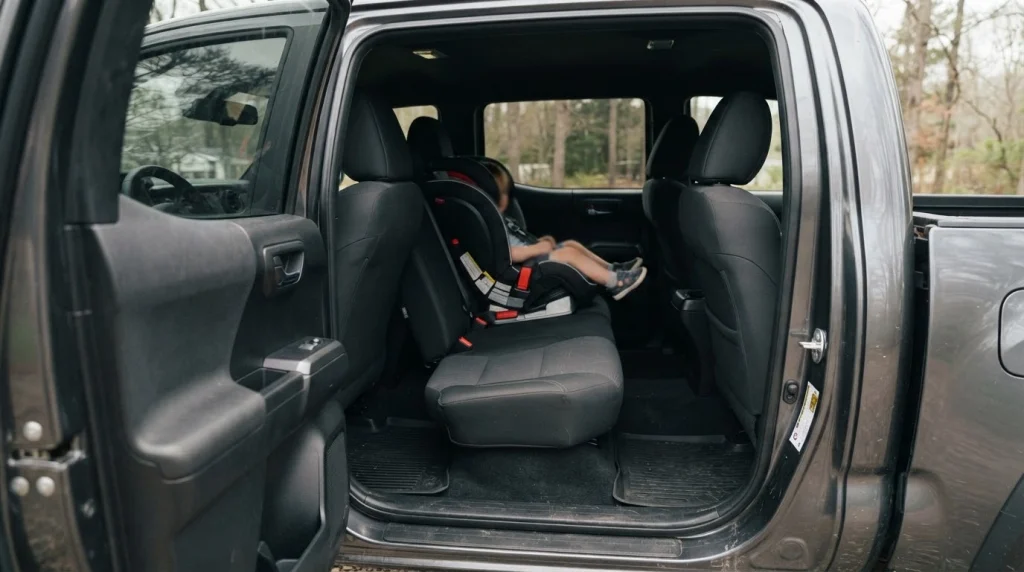
A Double Cab gives you a full rear bench and full rear doors. An Access Cab gives you a short rear bench and small rear-hinged doors.
That gap shows up the moment you load a rear-facing seat. The Double Cab lets the front passenger keep useful legroom, while the Access Cab often forces a knees-up ride.
| Cab | Rear seat setup | Rear-facing fit | Forward-facing and booster fit |
|---|---|---|---|
| Tacoma Double Cab (2016-2026) | Full rear bench with full rear doors | Fits most compact seats, front seat moves forward a bit | Fits most seats, best daily option |
| Tacoma Access Cab (2016-2023) | Small rear bench with rear-hinged half doors | Tight, needs a compact seat and front seat well forward | Possible with slim seats, check recline and headroom |
| Tacoma XtraCab (2024-2026) | No rear seat, storage behind front seats | No back-seat install | No back-seat install |
| Full-size extended cab, such as F-150 SuperCab | Larger rear bench than Tacoma Access Cab | Easier than Tacoma Access Cab, still test fit | Fits most seats with more legroom |
Published rear legroom for a recent Double Cab sits in the low-30-inch range, depending on model year. Treat that number as a starting point, not a guarantee, because recline angle and seat shape change usable space.
How much rear legroom should you expect?
Expect usable rear legroom to fall short of the published number once a car seat goes in. Recline takes inches first, and the front seatback sets the limit.
I measure from the rear seatback to the front seatback with the front seat set for the driver. That tape check beats a brochure number every time.
- Recline angle: Newborn recline pushes the seat farther toward the front seat.
- Carrier handle: An infant carrier handle can add height and block easy loading.
- Headrest shape: A fixed or bulky headrest can tilt a seat forward or block the seat.
- Front seat track: A driver who needs full rear travel leaves less room behind that seat.
How do you compare an extended cab with a crew cab?
A crew cab adds full rear doors and full rear legroom for daily family use. An extended cab keeps a shorter cab, so it suits occasional rear passengers better than daily car seat duty.
Full-size crew cabs give more room than a Tacoma Double Cab, but they cost more to park and fuel. Match the cab to your daily routine, not to the biggest spec sheet.
Section takeaway: The Double Cab wins on daily room, and the Access Cab works only when you accept less front legroom and a smaller seat.
Why Are Extended-Cab Trucks So Tight for Car Seats?
Extended cabs trade rear legroom for a shorter cab and a longer bed. That trade leaves less front-to-back space for a reclined car seat.
An extended cab is a pickup cab with a short rear seating area behind the front seats. It adds small rear doors or half doors, but it does not add full crew-cab legroom.
Rear-facing seats feel the squeeze first because they need recline plus seat depth. For tight-cab tactics, see tips for fitting a rear-facing seat in a small back seat.
What steals space first?
Seat angle steals space first, then seat depth. A deep seat set at newborn recline needs more room than the same seat set upright for a toddler.
- Upright front seats: A front seat set upright frees inches behind it.
- Short seat depth: A compact seat leaves more knee room for the front passenger.
- Flat rear cushions: A flat cushion helps a base sit level with less fuss.
- Seat crease depth: A deep crease can hide anchors and slow the install.
Rear cushion slope adds a second squeeze in some trucks. A sloped cushion can tilt a base back, so you spend more time leveling the seat.
Do door openings change the daily routine?
Yes, small rear doors change loading more than most parents expect. You lift a child through a narrow gap and twist to buckle the harness.
I learned this with a neighbor’s Access Cab on a rainy school run. The install held firm, but each buckle took longer through the half door.
I still check independent safety notes from Consumer Reports when a tight install raises a doubt. Fresh eyes catch a loose strap or a twisted belt fast.
Section takeaway: Extended cabs feel tight because recline, seat depth, and small doors all take space at once.
How Do You Install a Car Seat in a Tacoma or Extended-Cab Truck?
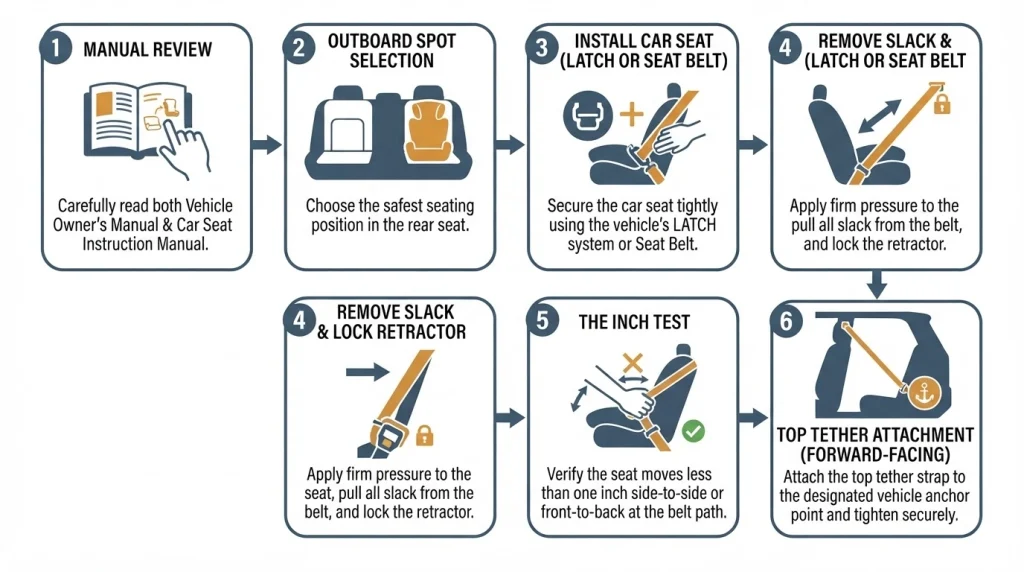
Pick an outboard rear seat, set the recline, and install with LATCH or the seat belt. Finish with the top tether for a forward-facing seat, then check for less than one inch of movement.
Outboard means a side rear seat, not the middle spot. Most Tacoma installs work best outboard because the anchors and belt path sit clear there.
- Read both manuals: Check the Tacoma manual and the car seat manual for your model year and seat mode.
- Choose the seat spot: Start outboard on the passenger side so the driver keeps full seat travel.
- Set recline first: Set the recline for your child’s age and weight before you tighten anything.
- Route one system: Use LATCH or the seat belt, not both, unless both manuals allow combined use.
- Tighten and test: Press the seat into the cushion, tighten, then tug at the belt path for the inch test.
- Add the top tether: Attach the top tether for every forward-facing install and pull it snug.
- Check the harness: Snug the harness so you cannot pinch slack at the collarbone, and set the chest clip at armpit level.
The belt path is the slot the belt or LATCH strap follows through the seat. For the middle spot, read the rules for installing a car seat in the middle seat of a truck first.
Should you use LATCH or the seat belt?
Use the system that gives the tightest install in your truck. Neither system is safer on its own when the install passes the inch test.
LATCH has a combined weight limit of 65 pounds for the child plus the car seat. Once you pass that limit, switch to a seat belt install and keep using the top tether.
Where are the top tether anchors in a Tacoma?
Top tether anchors sit behind the rear seat in most Tacomas, but the exact spot shifts by cab and year. Your owner’s manual shows the anchor for each rear seating spot.
Route the tether exactly as the manual shows, with no twists in the strap. If the routing looks unclear, follow car seat guidance from NHTSA and get a hands-on check.
How do you check the install with the inch test?
Grip the seat at the belt path and tug side to side and front to back. The seat should move less than one inch in any direction.
Test at the belt path, not at the top of the seat. The top will move more by design, above all on a rear-facing seat.
Pro tip: Check both manuals for your exact model year before you install. Use NHTSA’s recall lookup for a used seat, and ask a Child Passenger Safety Technician for a check.
Section takeaway: A tight install comes from the right spot, one install system, a snug top tether, and a pass on the inch test.
Which Car Seat Types Fit Best in a Tacoma?
Compact infant carriers and slim convertibles fit best in a Tacoma, above all in an Access Cab. Wide seats with deep recline cause the most front-seat trouble.
Do infant carriers fit in a Tacoma?
Yes, most infant carriers fit in a Double Cab with the base installed. An Access Cab needs a short carrier and a front seat set forward.
Check handle clearance and base level before you leave the driveway. A carrier that clicks in with ease saves time on every school run.
What about convertible seats?
A slim convertible works well rear-facing in a Double Cab and forward-facing in both cabs. Pick a model with an adjustable recline so you can gain room as your child grows.
I once tried a bulky convertible in an Access Cab and lost the front passenger seat to the seat back. Swapping to a compact seat gave the passenger back several inches of knee room.
Do forward-facing seats and boosters fit with ease?
Yes, forward-facing seats and boosters fit with the least fuss in both cabs. They sit upright, so they need less front-to-back room than a rear-facing seat.
Still test headrest fit and belt fit, since truck seat shapes vary. Use this guide on how to check car seat compatibility with your vehicle to compare width, belt length, and anchor access.
- Narrow width: A seat near 17 inches wide leaves room for a second passenger or seat.
- Short front-to-back depth: A short seat needs less recline room behind the front seat.
- Adjustable recline: More recline settings help you match the truck seat angle.
- Clear belt path: An open belt path speeds a seat belt install in a tight cab.
Do rotating car seats work in a Tacoma?
A rotating seat can work in a Double Cab if the door opening clears the rotation. Most Access Cabs lack the door width for a smooth turn.
Check floor space for a load leg, the support leg that reaches the truck floor. An Access Cab floor can sit high or uneven, so confirm the leg locks as the manual shows.
Section takeaway: Choose a compact, narrow seat with adjustable recline, and test it in your cab before you commit.
What Should You Check Before You Buy or Install?
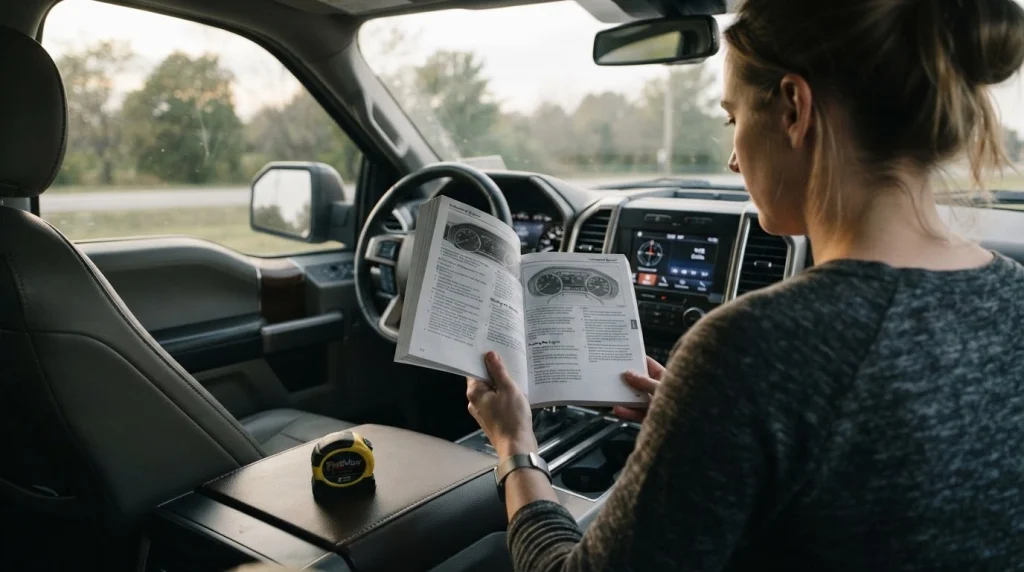
Check your cab, your manuals, your front-seat position, and your seat’s limits before you buy. A 20-minute test fit in your truck prevents a costly return.
- Cab and year: Confirm Access Cab, Double Cab, or XtraCab and the model year.
- Anchor spots: Find the lower anchors and top tether anchors in the owner’s manual.
- Front-seat position: Set the front seat for the usual driver, then test the car seat behind it.
- Recline and level: Check the level line or bubble with the truck parked on flat ground.
- Weight limits: Add child weight plus seat weight and compare it with the 65-pound LATCH limit.
- Belt length: Check that the seat belt reaches the belt path with slack to spare for tightening.
Can a tall driver still fit with a rear-facing seat behind?
A tall driver can fit if the rear-facing seat sits behind the passenger side. Put the seat behind the shorter front occupant when you can.
Front-seat contact rules vary by seat maker and truck maker, so check both manuals. Learn whether a car seat can touch the front seat before you push the front seat back against the car seat.
Can you fit two car seats in a Tacoma?
Yes, two slim seats fit in most Double Cabs, one outboard on each side. Two seats in an Access Cab stay tight and often need compact models plus patient loading.
Check your owner’s manual for seating-spot rules and tether routing for your year. Find manual help through Toyota owner resources and check your state law for rear-facing and booster rules.
Should you use a seat protector under the car seat?
Use a protector only if both manuals allow it. A thick pad can hide looseness and change how the seat grips the cushion.
A thin, approved protector can guard leather or cloth from dents and spills. Skip aftermarket inserts that sit under the child or behind the harness.
Section takeaway: Test the exact seat in the exact truck, with the front seats set for daily driving, before you buy.
Frequently Asked Questions About Car Seats in a Tacoma and Extended-Cab Trucks
Can a rear-facing car seat fit in a Toyota Tacoma Access Cab?
Yes, a compact rear-facing seat can fit in many 2016-2023 Access Cabs, but the front seat must move well forward. Test the exact seat with the front seat set for daily driving, and check recline, level, and harness fit before you buy.
Can you put a car seat in the front seat of a Tacoma?
No, do not place a rear-facing seat in front of an active airbag, and use the back seat when your truck has one. A front install only enters the picture in a truck with no rear seat, and only if the owner’s manual allows it with the airbag off.
Does a Tacoma have LATCH anchors in the back seat?
Yes, most Tacoma Double Cabs and older Access Cabs have LATCH anchors in the rear outboard spots, with top tether anchors behind the rear seat. Anchor spots shift by year and cab, so confirm each spot in your owner’s manual before you install.
Can you fit three car seats in a Tacoma Double Cab?
Three across is hard in a Tacoma Double Cab because the rear bench is narrow. You would need three slim seats, a careful install, and a test fit, and many families find two seats plus a booster a better daily plan.
Is an extended-cab truck safe for a car seat?
Yes, an extended cab can be safe when the seat fits the truck, the install passes the inch test, and the harness fits the child. Safety comes from a correct install and correct use on every ride, not from cab size alone.
What is the best car seat setup for a Tacoma Double Cab?
A compact infant carrier or slim convertible outboard on the passenger side works best for most families. Keep the seat rear-facing as long as the seat limits allow, use the top tether forward-facing, and recheck tightness each month.
Bottom line: A Tacoma Double Cab handles daily car seat duty well. An Access Cab handles it with a compact seat and less front legroom.
The XtraCab has no rear seat, so it cannot take a back-seat install. Test your exact seat in your exact truck, and get a certified check if the fit feels close.

Daniel Brooks is an automotive writer and product researcher focused on car accessories, car tech, maintenance, and practical driving guides. At Plug-in Car World, he helps drivers make smarter automotive decisions through honest reviews and research-driven content.
