
How Do You Fit a Car Seat With a Tall Driver? 7 Easy Tricks
Quick Answer
You fit a car seat with a tall driver by setting the driver seat first, then choosing the rear spot that leaves the most room. Use the center or passenger-side seat when you can, pick a compact seat, and learn how a car seat will fit in your car before you lock in the install.
Set it up in this order
- Driver seat first: Set pedals, steering reach, and backrest angle before you touch the car seat.
- Best rear spot: Try center first, then behind the passenger, then behind the driver.
- Compact seat: Choose a seat with a short front-to-back footprint for rear-facing use.
- Correct recline: Use the most upright recline your manual allows for your child’s age.
- Clearance check: Leave a finger gap or light contact only if both manuals allow it.
Quick checks before you drive
- Grab the seat at the belt path and tug. It should move less than 1 inch side to side.
- Check the recline indicator after you slide the front seat back.
- Sit in the driver seat and press each pedal fully without shifting your hips.
If you’re asking how do you fit a car seat with a tall driver, I’ve lived that puzzle in my own garage. I’m 6-foot-1, and I’ve wedged rear-facing seats behind my driving position more times than I can count.
This guide goes deeper than “buy a bigger car.” You’ll get the seat order I use, the recline tricks that free up inches, and the safety checks that keep a tight fit safe as of 2026.
In This Guide
- Why Does a Tall Driver Make a Car Seat Harder to Fit?
- Where Should You Put the Car Seat When the Driver Is Tall?
- How Do You Fit a Rear-Facing Car Seat Behind a Tall Driver?
- How Do You Set the Driver Seat Without Losing Safety?
- Which Car Seats Fit Best With a Tall Driver?
- What Mistakes Make a Tight Fit Unsafe?
- Frequently Asked Questions About Fitting a Car Seat With a Tall Driver
Why Does a Tall Driver Make a Car Seat Harder to Fit?
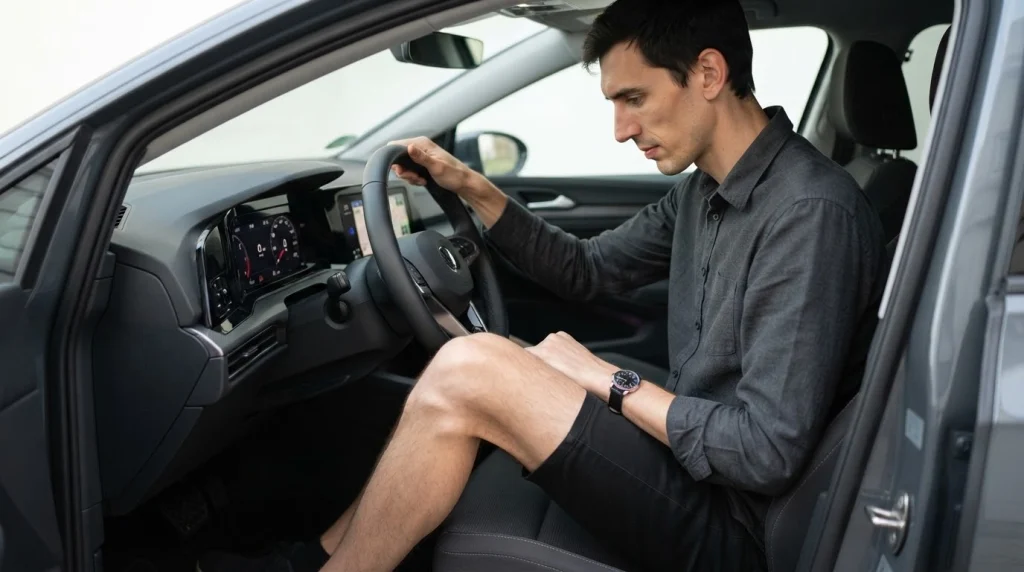
A tall driver needs more seat-track travel, and a rear-facing seat needs more front-to-back room. Those two needs fight for the same inches between the front seatback and the rear cushion.
Car seat fit means the seat installs tight, holds the correct recline, and leaves the driver full pedal and steering control. Lose one of those three, and the fit fails even if the seat looks secure.
- Seat track travel: Long legs push the front seat back and shrink rear knee room.
- Recline angle: Newborn recline tilts the shell back and eats front-to-back space.
- Seat shell depth: Tall shells and deep headrests reach farther toward the front seat.
I learned this in a 2019 Honda Civic with a standard convertible seat. My knees cleared the dash by an inch, but the car seat shell pressed hard into my seatback.
How much space does a rear-facing seat need?
Most rear-facing seats need 26 to 32 inches from the rear seatback to the front seatback, depending on recline and shell size. Compact seats sit at the short end, and standard convertibles sit at the long end.
Measure from the rear seatback cushion to the back of your driver seat in your driving position. Compare that number to the seat’s front-to-back depth in the manual or spec sheet.
You can compare published figures first through second-row legroom specs on Edmunds. Treat those figures as a starting point, then measure your car with the seat in place.
Why does front seat position matter more than car size?
A big SUV with the driver seat slammed back can fit worse than a compact car with a smart setup. Driver position decides the gap, and the car seat must live inside that gap.
Seat height, backrest angle, and steering reach all change the gap by an inch or two. Small moves add up when you’re fighting for clearance.
Light contact isn’t always a fail, but wedging is a problem. Learn the difference in our guide to whether a car seat can touch the front seat before you force the front seat back.
Section takeaway: Tall-driver fit is a space budget, so measure the gap in your driving position before you judge any car seat.
Where Should You Put the Car Seat When the Driver Is Tall?
Put the car seat in the center rear seat first if your car and seat manuals allow it. The center spot often sits between the front seats and frees the driver seat to slide back.
Behind the front passenger seat comes next, since the passenger can usually sit farther forward. Behind the driver works last, and only with a compact seat and a careful recline setup.
- Center: Often gives the most driver legroom and keeps both front seats free. Check for LATCH or seat belt rules first.
- Behind passenger: Frees the driver fully and keeps daily loading easy. The passenger gives up legroom instead.
- Behind driver: Keeps the passenger free but fights the driver for inches. Use it only when the other spots fail.
Is the center seat the best spot for a tall driver?
Yes, the center often wins for a tall driver, but only when both manuals allow a center install. Some cars lack center lower anchors, and some seats forbid borrowing anchors from the outboard spots.
A seat belt install in the center can solve that problem in many cars. LATCH (Lower Anchors and Tethers for Children) is one install method, and the seat belt is the other, so use the method your manuals approve for that spot.
- Check the vehicle manual for center LATCH or seat belt approval.
- Check the car seat manual for center install rules and anchor borrowing.
- Test the install tightness at the belt path before you call it done.
When does behind the passenger work better?
Behind the passenger works better when the center install fails or when you load the child curbside every day. It also helps when a second car seat or a third passenger needs the center spot.
Set the passenger seat for a real adult, not slammed forward. You’ll still gain driver room, and the passenger keeps a safe, comfortable ride.
Small cars add a second layer to this choice. See how to fit a rear-facing car seat in a small car for space tricks that pair well with a tall driver.
Section takeaway: Try center, then passenger side, then driver side, and let the manuals decide the winner.
How Do You Fit a Rear-Facing Car Seat Behind a Tall Driver?
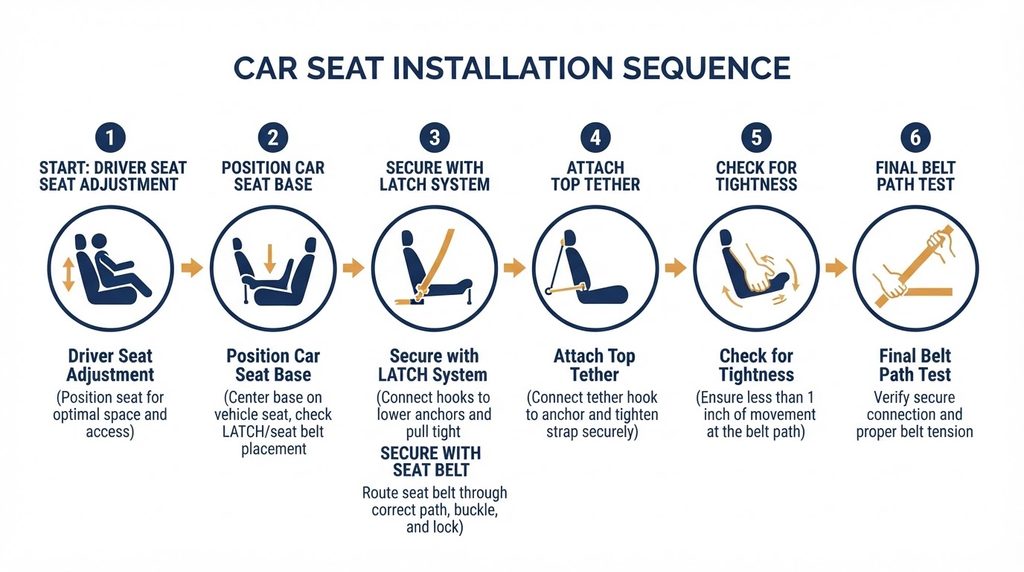
Set the driver seat first, install the car seat second, and recheck both at the end. That order stops you from building a tight install around a driving position you can’t live with.
I use the same order in every car I test, from a Civic to a RAV4. It takes 20 to 30 minutes the first time, and it saves repeat installs later.
- Set the driver seat: Adjust slide, height, backrest, and steering reach, then leave it there.
- Pick the rear spot: Test center, then passenger side, then driver side.
- Set the recline: Use the indicator and the most upright recline your manual allows.
- Route the belt or LATCH: Follow the manual, keep straps flat, and lock the belt if the manual calls for it.
- Tighten and test: Press down with a knee, tighten, then tug at the belt path for less than 1 inch of movement.
- Slide the front seat back: Return to your driving position slowly and watch clearance as you move.
- Recheck recline and harness: Confirm the indicator and harness snugness after the front seat moves.
How do you set the recline angle without losing legroom?
Recline angle is the tilt of the car seat shell, and newborns need more tilt than older babies. Use the most upright recline your manual allows for your child’s age and weight.
A rolled towel or pool noodle helps only when the manual allows it. Never guess the angle, since the built-in indicator is your proof.
Install method changes the fit too. Follow how car seats are installed to choose LATCH or seat belt for your spot and tighten the seat the right way.
Should the car seat touch the front seat?
Light contact is allowed in some cars and seats, and forbidden in others. Both manuals must allow it, and the front seat must never push the car seat out of recline.
If contact changes the recline indicator, you’ve gone too far. Move the car seat to another spot or pick a more compact seat.
Pro tip: Check your vehicle owner’s manual and car seat manual for contact, recline, and install rules, and use the NHTSA recall lookup for safety notices before you drive.
Section takeaway: Driver seat first, car seat second, recheck last, and that order protects both safety and legroom.
How Do You Set the Driver Seat Without Losing Safety?
Set the driver seat for full pedal control and clear steering reach, then fit the car seat around it. Never shrink your driving position to make a car seat fit.
I see tall drivers cheat this step most often. They slide forward an inch, lose knee bend, and hate every drive after that.
- Pedals: Press the brake fully with a slight knee bend.
- Steering: Rest your wrists on the wheel top with your shoulders on the seatback.
- Airbag gap: Keep at least 10 inches from your chest to the steering wheel cover.
- Headroom: Keep a fist of space above your head.
- Visibility: See mirrors and road without ducking or craning.
How far back is too far back?
Too far back means straight legs, stretched arms, or hips sliding forward to reach pedals. If you can’t press the brake hard without shifting, you’re too far back.
Too far forward is just as risky. Cramped knees and a chest close to the airbag cut control in a sudden stop.
Can you raise the seat to gain knee room?
Raising the seat can help in some cars, since it changes thigh angle and knee clearance. It can also cut headroom, so test it with the car seat in place.
Try small height moves of one notch at a time. Pair each move with a backrest tweak, and recheck pedal reach each time.
For the safety baseline behind these checks, read NHTSA car seat and driving safety guidance and match it to your manuals. Use how to check car seat compatibility with your vehicle to confirm anchors, belt length, and seat shape before you buy.
Section takeaway: A safe driver position is non-negotiable, so change the car seat or its spot before you change how you drive.
Which Car Seats Fit Best With a Tall Driver?
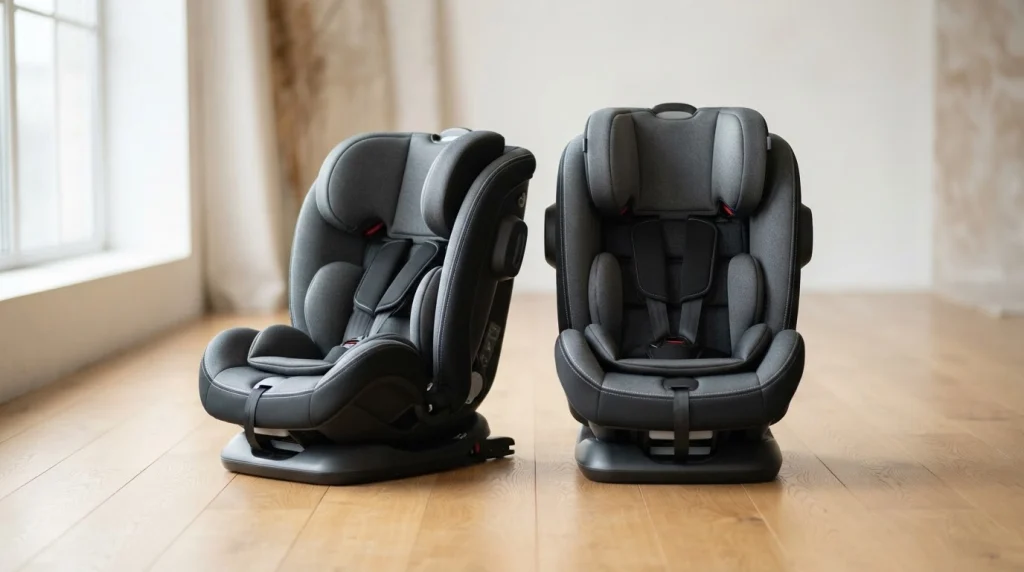
Compact convertible seats fit best for most tall drivers, since they use less front-to-back room rear-facing. Infant carriers can fit well too, but they outgrow fast and need a base check.
Shell depth matters more than brand or price. Compare front-to-back depth in rear-facing mode, not just weight limits.
| Seat type | Rear-facing footprint | Tall-driver fit | Watch out for |
|---|---|---|---|
| Infant carrier + base | 26 to 29 inches | Good | Short use life, check base overhang |
| Compact convertible | 27 to 30 inches | Best | Lower height limits on some models |
| Standard convertible | 30 to 33 inches | Tight | Needs center or passenger spot |
| All-in-one | 30 to 34 inches | Tight | Bulky shell, check recline range |
| Rotating seat | 29 to 32 inches | Good for loading | Base depth varies, test in your car |
Footprint ranges are general guides, not specs for one model. Check the manual for your seat and measure in your car.
What makes a seat compact?
A compact seat uses a shorter shell, a tighter recline range, and a base that sits closer to the rear seatback. Those traits cut inches without cutting safety when the seat fits your child.
- Short shell: Less reach toward the front seat.
- Upright recline option: Frees inches for older babies.
- Narrow base: Fits center installs more easily.
- Clear indicator: Shows recline at a glance.
Do rotating seats help tall drivers?
Rotating seats help loading, and they can help fit when the base stays compact. They don’t help when a deep base pushes the shell forward into driver space.
Test the seat locked in rear-facing mode, not just in swivel mode. The locked position decides your legroom.
How do you shortlist seats before you test them?
Independent testing notes from Consumer Reports can help you shortlist seats before a store test. Vehicle reviews on Car and Driver often note second-row room in real cars, so use those notes to narrow your list.
Rear-facing longer adds fit pressure as your child grows. Read how to keep a toddler rear-facing longer to balance legroom, recline, and extended rear-facing goals.
Section takeaway: Choose the shortest rear-facing footprint that fits your child, and test it locked in your car before you buy.
What Mistakes Make a Tight Fit Unsafe?
The riskiest mistakes force the fit by breaking recline, install tightness, or driver position. Each shortcut looks like extra room, and each one cuts protection.
- Forcing the front seat back: Pressure on the shell tilts the seat and changes recline.
- Skipping the recline check: A moved front seat can shift the indicator without any clear sign.
- Loose install: More than 1 inch of movement at the belt path means the seat needs more tightening.
- Wrong install method: Don’t use LATCH and seat belt together unless the manual allows both.
- Unapproved inserts: Extra padding can change harness fit and head position.
- Ignoring contact rules: Never assume touch is fine when a manual forbids it.
Can you force the front seat back against the car seat?
No, never force the front seat back into the car seat shell. Pressure can tilt the seat, change recline, and hide a loose install.
If the front seat won’t return to your driving position without pressure, change the spot or the seat. The fit is wrong, not your height.
What should you check after every reinstall?
Check tightness, recline, harness, and driver clearance after every reinstall. A seat that fit last month can shift after a clean, a move, or a front seat change.
- Belt path tug: Less than 1 inch of movement.
- Recline indicator: Still in the correct zone.
- Harness: Snug, flat, and at the correct height.
- Driver seat: Full pedal and steering control restored.
Section takeaway: If a tight fit needs force, a shortcut, or a guessed angle, stop and change the setup.
Frequently Asked Questions About Fitting a Car Seat With a Tall Driver
These answers cover the questions tall drivers ask me most.
Can a 6-foot-4 driver fit a rear-facing car seat behind them?
Sometimes, but it depends on the car, the seat, and the recline your child needs. Try the center or passenger side first, and use a compact seat with the most upright recline your manual allows.
Is it safe if the car seat touches the front seat?
Light contact can be safe when both the vehicle manual and the car seat manual allow it. Wedging, pressure, or a changed recline angle is not safe, so move the seat or change the spot when contact pushes the shell.
Should I put the car seat in the middle for more legroom?
The center often gives a tall driver the most legroom, since it sits between the front seats. Check both manuals first, since some cars limit center LATCH use or require a seat belt install in that spot.
Does a more upright recline give the driver more room?
Yes, a more upright recline frees front-to-back room in most rear-facing installs. Use only the recline range your manual allows for your child’s age and weight, and confirm the change on the recline indicator.
What cars have the most room for a car seat and a tall driver?
Midsize SUVs, large sedans, and crew-cab trucks often offer the most second-row legroom for this setup. Measure your driving position in each car you test, since published legroom alone does not prove a car seat will fit.
When does a forward-facing seat solve the legroom problem?
A forward-facing seat needs less front-to-back room, so it often frees driver legroom at once. Wait until your child meets the height and weight limits for forward-facing in the manual, and never rush the switch for legroom alone.
Your next step: Set your driver seat, measure the gap, and test one compact seat in the center spot first.
That 30-minute test tells you more than hours of spec-sheet guessing. You’ll know the spot, the recline, and the clearance that work in your car.
Keep both manuals in the car for the first month. Recheck tightness and recline after every move, and enjoy the drive without the knee crunch.

Daniel Brooks is an automotive writer and product researcher focused on car accessories, car tech, maintenance, and practical driving guides. At Plug-in Car World, he helps drivers make smarter automotive decisions through honest reviews and research-driven content.
