
How Wide Is a Standard Car Seat? Infant to Booster Sizes Explained
Quick Answer
Most standard car seats are 17 to 21 inches wide at their widest point, with infant carriers at the narrow end and all-in-one seats at the wide end. Check car seat compatibility with your vehicle before you buy, because shell width, base width, and back seat shape all matter.
What the numbers mean in real life
- Infant carriers: About 17.5 to 18.5 inches wide, with the handle and base adding a little bulk.
- Convertibles: About 18 to 20 inches wide, with wide side wings on some models.
- All-in-one seats: About 19 to 21 inches wide, because one shell has to cover three stages.
- Boosters: About 15 to 19 inches wide, with backless models at the narrow end.
- Narrowest seats: About 17 inches wide, and they are the ones parents usually hunt for when they need three across.
Before you order
- Measure the seat at its widest point, not just at the base.
- Measure your back seat between the door panels, then test the fit with the seat installed.
I’ve measured more car seats in driveways than I can count, and the tape measure always tells a different story than the box. A seat that looks slim can flare out at the headrest, while a bulky-looking seat can tuck in neatly at the base.
This guide gives you the width ranges by seat type, shows you how to measure, and helps you work out whether a standard seat will fit your car.
In This Guide
How Wide Is a Standard Car Seat?
A standard car seat is about 17 to 21 inches wide at its widest point. That range covers most infant carriers, convertibles, all-in-one seats, and high-back boosters sold in the United States as of 2026.
The number on the box is rarely the whole story. A seat can measure 18 inches at the base and 20 inches at the headrest, and the wider point decides whether two seats can sit side by side.
A standard car seat is a child restraint that uses a harness or a vehicle seat belt to hold a child in place during a crash. Its width is the side-to-side distance across the shell, usually at the widest part of the headrest, the side wings, or the base.
What counts as narrow, standard, and wide?
Narrow usually means about 17 to 18 inches wide. Standard usually means about 18 to 20 inches wide.
Wide usually means about 20 to 21 inches or more. A seat over 21 inches can still fit fine on its own, but it will crowd a neighbour seat fast.
- Narrow, 17 to 18 inches: Best for three across, small back seats, and tight middle seats.
- Standard, 18 to 20 inches: Fits most cars with one or two seats, and leaves a small gap for a passenger.
- Wide, 20 to 21 inches or more: Often roomy and well padded, but hard to pair with another wide seat.
I learned this with a convertible that fit on its own, then left no room beside it once I raised the headrest.
Pro tip: Check the width in your car seat manual and your vehicle owner’s manual, and confirm the fit with NHTSA’s car seat guidance at NHTSA before you rely on a single spec number.
Section takeaway: Most standard car seats are 17 to 21 inches wide, and the widest point, not the base, decides whether the seat fits beside another seat or a passenger.
How Wide Is Each Type of Car Seat?
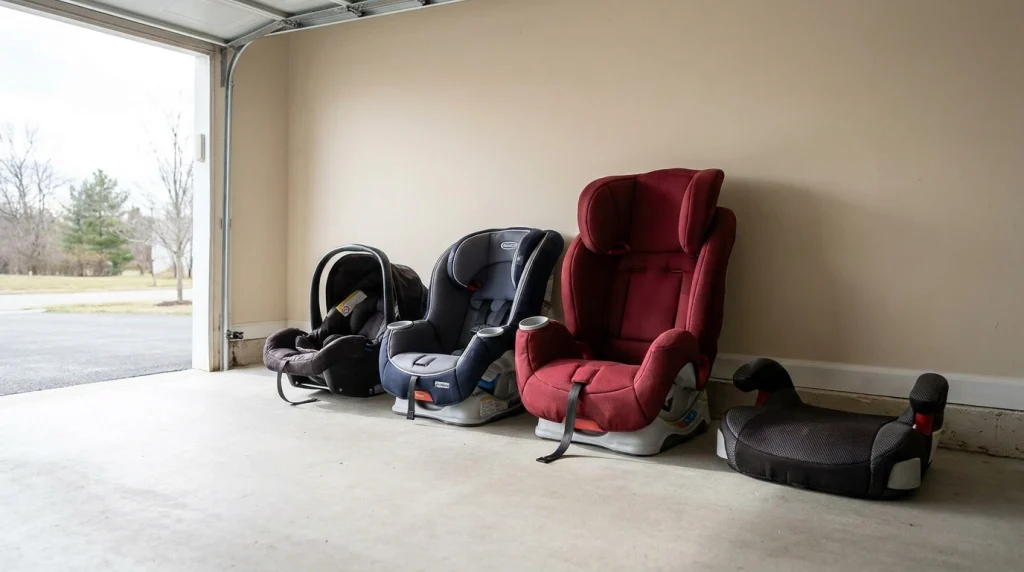
Width changes with seat type, because each type has a different job. Use the table below as a starting range, then check the exact model.
| Car seat type | Typical width | What makes it wide | Best for |
|---|---|---|---|
| Infant carrier | 17.5 to 18.5 inches | Handle, canopy, and base | Newborns, lift-out use |
| Convertible | 18 to 20 inches | Side wings and headrest | Rear-facing to forward-facing |
| All-in-one | 19 to 21 inches | Tall shell and wide headrest | Birth to booster in one seat |
| High-back booster | 16 to 19 inches | Side wings and belt guides | Older kids who need a boost |
| Backless booster | 15 to 17 inches | Seat base only | Tight rows and carpools |
| Narrow convertible | About 17 inches | Slim shell, low-profile wings | Three across |
How wide is an infant car seat?
An infant car seat is about 17.5 to 18.5 inches wide. Check the width with the handle in the travel position your manual allows.
How wide is a convertible car seat?
A convertible car seat is about 18 to 20 inches wide. Rear-facing models often feel wider because the shell leans back, and the headrest can spread wider as you raise it for a taller child.
How wide is an all-in-one car seat?
An all-in-one car seat is about 19 to 21 inches wide. It has to hold a small baby and a tall child in the same shell, so you keep one seat through three stages.
How wide is a booster seat?
A high-back booster is about 16 to 19 inches wide. A backless booster is about 15 to 17 inches wide, because it has no back or headrest to add bulk.
When you choose a car seat by child size, match the width to your child’s shoulders, not just to your car.
Section takeaway: Infant seats run about 17.5 to 18.5 inches, convertibles about 18 to 20 inches, all-in-one seats about 19 to 21 inches, and boosters about 15 to 19 inches, so check the exact model before you buy.
Why Do Car Seat Widths Vary So Much?
Car seat widths vary because makers balance safety, comfort, and fit in different ways. There is no single standard width that every maker must follow, so two seats with the same weight limit can differ by two inches.
What parts add the most width?
- Side wings: Deep wings protect the head and torso, but they add width at shoulder height.
- Headrest: A tall, adjustable headrest can flare out as it rises, especially on all-in-one seats.
- Base: A wide base can help stability, but it can also hang over a narrow vehicle seat.
- Padding and inserts: Thick infant inserts fill the shell, then come out as your child grows.
- Cup holders: Built-in cup holders can add an inch or more on each side.
- Recline foot: A recline foot can widen the footprint at the front of the base.
Check whether your cup holders fold in or come off before a tight install.
Does a wider car seat mean a safer car seat?
No, a wider car seat is not automatically safer. A narrow seat that fits tight and holds your child snug can protect better than a wide seat that wobbles.
Safety comes from the fit, the harness, and the install. A seat that moves less than one inch at the belt path, with a snug harness, does its job.
Check fit guides from Consumer Reports when you compare models, and read the maker spec sheet for the exact width.
Section takeaway: Width varies because makers trade padding, side wings, cup holders, and base shape against slim fit, and a tight, correct install matters more than an extra inch of shell.
How Do You Measure a Car Seat Correctly?
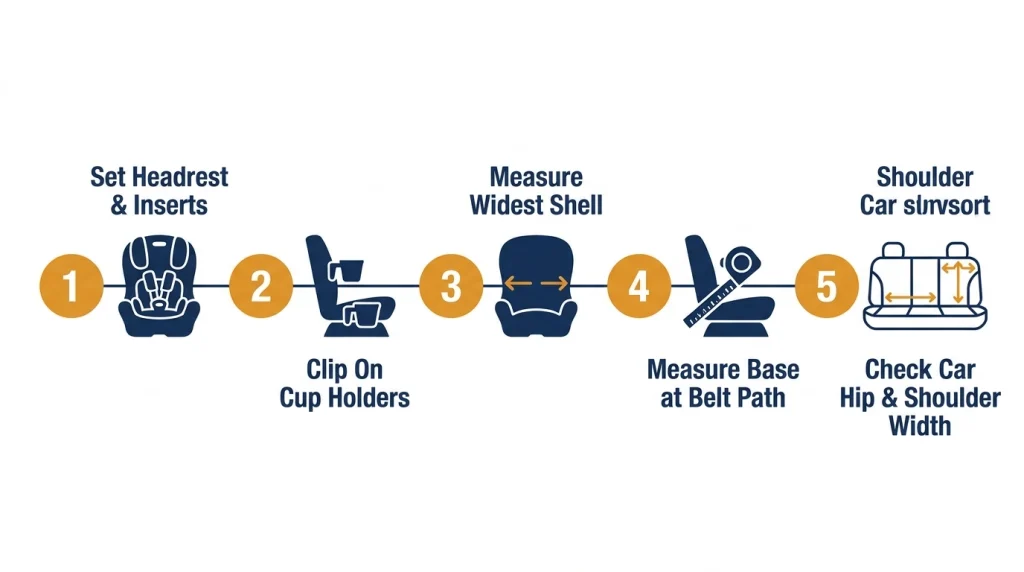
Measure a car seat at its widest point, with all the parts you will use in the car attached. That means the headrest at your child’s height, the inserts in place, and the cup holders clipped on.
What tools do you need?
- Tape measure: A cloth or steel tape that reads in inches.
- Level surface: A flat floor, so the seat sits the way it will sit in the car.
- Your child’s settings: Headrest height, harness slot, and recline angle set for your child.
Set the seat up first, then measure.
How do you measure the width step by step?
- Set the headrest: Raise it to your child’s height and lock it in place.
- Fit the inserts: Leave in the inserts your child still uses, and take out the ones they have outgrown.
- Attach the extras: Clip on the cup holders and any side padding you will use.
- Find the widest point: Look for the headrest wings, the shoulder wings, or the base edge.
- Measure side to side: Run the tape straight across, level, at that widest point.
- Measure the base too: Measure the base width at the belt path, because the base decides how the seat sits on your vehicle seat.
- Write both numbers down: Note the shell width and the base width, so you can compare models.
Measure twice if the seat has a curved shell.
How do you measure your back seat?
Measure your back seat between the door panels at hip height. Then measure again at shoulder height, where the headrest wings will sit.
Back seats taper toward the top, so the shoulder measurement is often narrower than the hip measurement.
When you learn how car seats are installed, you will see why the base footprint matters as much as the shell width.
Section takeaway: Measure the shell and the base at your child’s settings, with cup holders attached, and measure your back seat at hip and shoulder height before you decide.
Will a Standard Car Seat Fit in Your Car?
A standard car seat fits most cars with one or two seats, but it does not fit every car in every spot. Start with the numbers, then test the installed fit.
How much back seat width do you need?
Most back seats are about 48 to 56 inches wide between the door panels. A single 19-inch seat leaves plenty of room, while two 20-inch seats can fill a 48-inch bench with almost no gap.
Check the usable width, not just the door-to-door width. Door panels, armrests, and seat contours can eat two or three inches on each side.
What if your car is small?
Small cars can still fit a standard seat, often in the middle or behind the passenger seat. Try the seat behind the shorter driver or passenger first.
What if the seat is too wide for your car?
- Try another seating position: The middle seat is often flatter, while the side seats can be more contoured.
- Try a narrower model: A slim convertible can save two inches without giving up the stage you need.
- Remove the cup holders: If your maker allows it, take them off for a tight row.
- Check the base overhang: The base should sit mostly on the vehicle seat, with no more overhang than your manual allows.
If none of those steps works, do not force the fit.
Read what to do when a car seat does not fit in your vehicle before you buy a second seat to fix the first one.
For a quick size check, Edmunds lists back seat dimensions for many models, and your vehicle manual lists the seating positions that allow a car seat.
Section takeaway: Most standard seats fit most cars with one or two seats, but test the installed fit in your car, because back seat shape, front seat position, and base overhang decide the real answer.
How Do You Fit Three Car Seats Across?
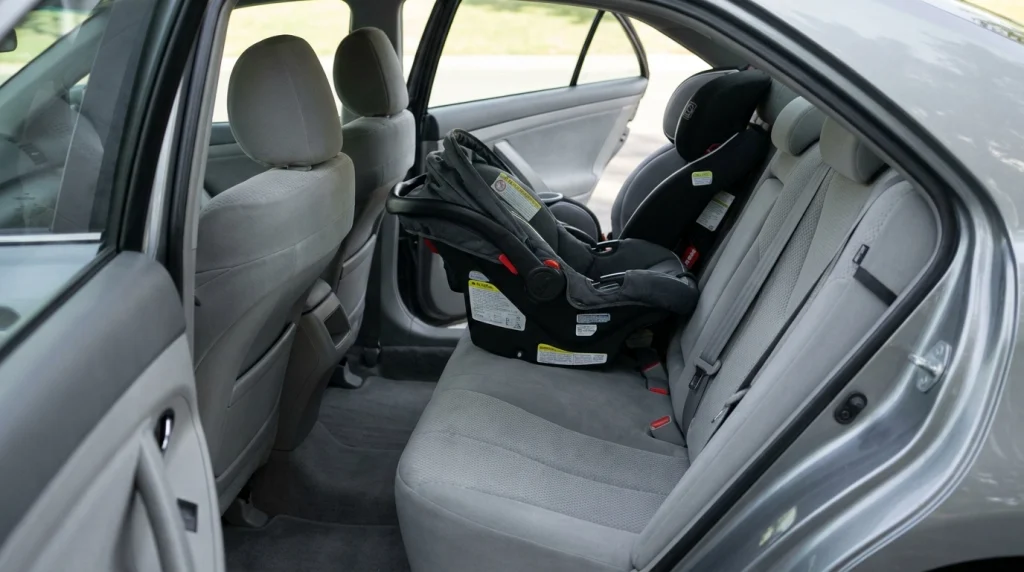
Three across works when the total width of the three seats fits your back seat, with room to install each one tight. Most families need three seats at about 17 to 18 inches each to make it work in a mid-size car.
What width do you need for three across?
Three 17-inch seats need about 51 inches of usable width. Three 18-inch seats need about 54 inches, which is close to the full width of many back seats.
Usable width is less than door-to-door width. You lose space to door panels, seat contours, and buckle stalks, so leave a small margin in your plan.
How do you install three seats without a fight?
- Install the middle seat first: Get it tight, then add the side seats one at a time.
- Use the seat belt where it fits best: LATCH anchors sit in fixed spots, while a seat belt can shift a seat a little to gain room.
- Check each seat on its own: Pull each seat at the belt path, and confirm it moves less than one inch.
- Check the buckles: Every buckle must be reachable, and no buckle should sit under a neighbouring seat.
- Test the harness: Tighten each harness with the other seats in place, because a tight row can block your hands.
For the full method, read how to fit three car seats in one vehicle.
The middle seat can help in a three-across row, and you can also read whether you can install a car seat in the middle seat before you plan around that spot. The middle seat is often flatter, but it is not always the widest spot.
Section takeaway: Three across usually needs three seats at about 17 to 18 inches each, installed middle-first, with each seat tight on its own and every buckle reachable.
Frequently Asked Questions
How wide is a standard infant car seat?
An infant car seat is about 17.5 to 18.5 inches wide. The carrier is often narrow, while the base and handle can add a little width, so measure with the handle in its travel position.
How wide is a standard convertible car seat?
A convertible car seat is about 18 to 20 inches wide. The headrest wings are often the widest point, and they can spread wider as you raise the headrest for a taller child.
What is the narrowest car seat width?
The narrowest car seats are about 17 inches wide. Slim convertibles and some infant carriers reach that width, and they are the usual pick for three across or a small back seat.
How wide is a car seat base?
A car seat base is often a little narrower than the shell, usually about 14 to 18 inches wide at the belt path. The shell can flare wider above the base, so measure both parts before you compare models.
Will two standard car seats fit side by side?
Two standard car seats fit side by side in most mid-size cars, because two 19-inch seats need about 38 inches of usable width. They may not fit in a small car, or beside a third passenger, so test the installed fit first.
Does car seat width change as my child grows?
Yes, car seat width can change as your child grows. The headrest rises, the side wings spread, and the inserts come out, so a seat can gain an inch or more between the baby stage and the toddler stage.
So, how wide is a standard car seat in your car? Measure the shell and the base, test the installed fit, and pick the narrowest seat that still fits your child well.
A tight install and a snug harness will do more for safety than an extra inch of padding ever will.

Daniel Brooks is an automotive writer and product researcher focused on car accessories, car tech, maintenance, and practical driving guides. At Plug-in Car World, he helps drivers make smarter automotive decisions through honest reviews and research-driven content.
