
How Can You Fit Three Car Seats in One Car? Safe Guide
Quick Answer
You can fit three car seats in one car by using narrow seats, installing the center seat first, and using seat belts to gain extra room. This setup, called three across, works best when you measure first and check how wide a standard car seat is before you buy.
What makes three across work
- Narrow seat width: Choose seats around 17 inches wide at the widest point.
- Seat belt installs: Seat belts let you shift each seat a little toward the door.
- Center seat first: Install the middle seat first, then fit the outboard seats around it.
- Independent check: Remove the other seats and confirm each seat stays tight on its own.
- Buckle access: Leave enough room to reach each buckle without forcing the belt.
Start here
- Measure hip room, buckle spacing, and door-to-door width with a tape measure.
- Test the exact seats in your car before you commit to all three.
I’ve wrestled three seats into a back row more times than I can count, and I’ve learned one lesson the hard way. Width on a box tells only part of the story.
This guide walks through measuring, choosing narrow seats, installing in the right order, and checking each install. You’ll also see the mistakes that turn a tight fit into an unsafe one.
In This Guide
- What Does Three Across Mean?
- How Do You Measure Your Car for Three Car Seats?
- What Are the Narrowest Car Seats for Three Across?
- How Do You Install Three Car Seats Step by Step?
- Should You Use a Seat Belt or LATCH for Three Across?
- What Mistakes Make Three Across Unsafe?
- FAQs About Fitting Three Car Seats
- Final Takeaway: Fit Three Safely, Not Just Tightly
What Does Three Across Mean?
Three across means three child seats sit side by side in one row. Each seat must install tight and work on its own.
Definition: Three across is a back-row setup with three child restraints installed in the left, center, and right seating positions. It depends on seat width, belt layout, and vehicle seat shape.
I first tried this setup in a Honda CR-V with two convertibles and a booster. The seats looked fine until I tried to buckle the booster.
That failed test taught me to check buckles early. A fit that blocks a buckle is not a fit.
- Works well: Flat bench seats with wide hip room and clear buckle stalks.
- Works with care: Contoured seats with narrow centers and short buckle stalks.
- Often fails: Rows with raised center humps, fixed armrests, or seats that slope hard at the edges.
- Needs a new plan: Rows where one seat only stays tight because its neighbor holds it in place.
Is three across safe when done right?
Yes, three across can be safe when each seat passes its own install check. Safety comes from a tight install, correct belt routing, and a snug harness.
Contact alone does not make a setup unsafe. Forced installs, twisted belts, and shared anchors do.
Which vehicles fit three across best?
Minivans, three-row SUVs with bench second rows, and wide sedans tend to offer the most room. Midsize SUVs and compact sedans can work with narrow seats.
Small cars need more care with rear-facing legroom and front-seat position. Measure before you assume a small car can’t work.
Section takeaway: Three across works when each seat fits, installs tight, and buckles cleanly on its own. Shape and belt layout matter as much as total width.
How Do You Measure Your Car for Three Car Seats?
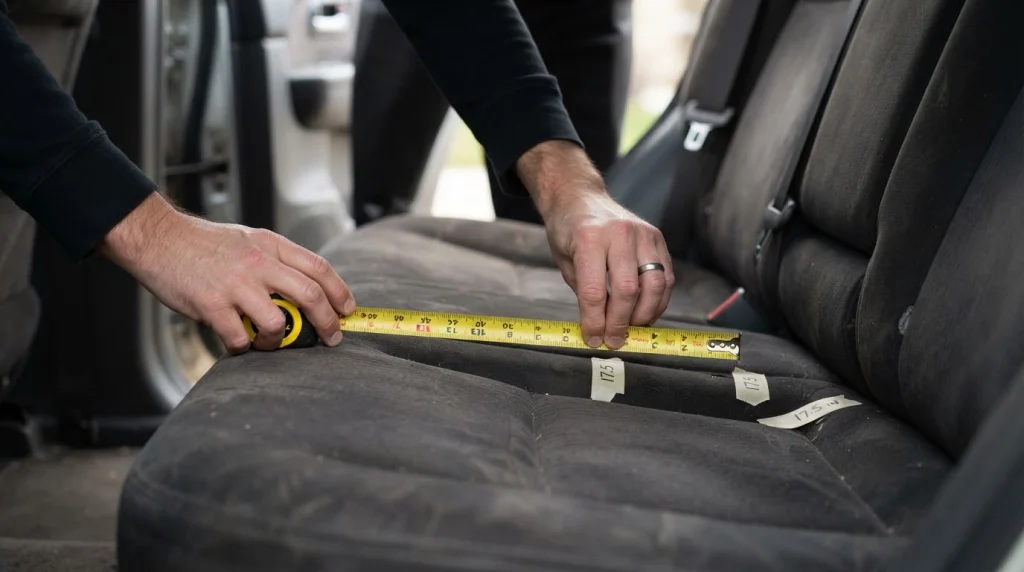
Measure door-to-door width, hip room at the seat bight, and the distance between buckles. Then compare those numbers with the widest point of each seat.
The seat bight is the crease where the seat cushion meets the seat back. Start your tape there for the most useful width.
Grab these tools before you start:
- Tape measure with inch markings
- Masking tape to mark seat edges
- Your vehicle owner’s manual for anchor and seating limits
- The seat manuals for width, install rules, and belt routing
Follow this sequence in your driveway, not in a store aisle:
- Move both front seats to their normal driving positions.
- Measure usable width across the back cushion, door panel to door panel.
- Measure hip room at the bight, where the seat bases will sit.
- Measure center-to-center distance between each pair of buckles.
- Note raised edges, humps, and buckle stalks that sit low or short.
- Write down each number and keep it with you while you shop.
What measurements matter most?
Usable width at the bight matters more than a spec-sheet number. Many rows measure 48 to 56 inches across, but contours can steal 2 to 3 inches.
Buckle spacing decides daily use. If you can’t reach a buckle with the seats in place, loading kids turns into a daily fight.
If you need a quick starting point, check whether a car seat will fit in your car before you buy a third seat. That check helps you spot seat-shape limits early.
How do seat shapes change the fit?
Deep side bolsters push outboard seats toward the center. A flat center section gives you more working room.
Sloped cushions can tilt a base and change the recline angle. Check the level line after each install, not just at the end.
Vehicle specs can guide your shortlist, and you can compare rear hip room in listings on Edmunds. Use those specs as a screen, then confirm with your tape measure.
Section takeaway: Measure the row you own, at the bight, with front seats set for driving. Specs help you shop, but your tape measure decides the fit.
What Are the Narrowest Car Seats for Three Across?
The narrowest options tend to be slim convertibles, slim all-in-one seats, and narrow boosters. Look for widths near 16.5 to 17.5 inches at the widest point.
Width alone can mislead you. Cup holders, side wings, and base flare add inches where seats meet.
| Seat type | Typical width | Best for three across | Watch out for |
|---|---|---|---|
| Infant carrier with base | 17 to 18 inches | Newborns, quick carrier removal | Handle clearance and base flare |
| Slim convertible | 16.5 to 17.5 inches | Rear-facing and forward-facing toddlers | Recline angle in small cars |
| Slim all-in-one | 17 to 18.5 inches | Long-term use from infancy to booster mode | Bulk at the headrest and wings |
| High-back booster | 17 to 19 inches | Older kids who need belt positioning | Armrest width and buckle access |
| Backless booster | 15 to 17 inches | Oldest child in the tightest row | Head support and belt fit must still pass |
As of 2026, makers keep adding slim models built for three-across rows. Check current manuals for exact width and install limits.
Compare seats by their widest point, not the narrowest point in a photo. Measure the base, the shell, and any fixed cup holders.
Which seat types puzzle together best?
Different shapes often puzzle better than three identical seats. A narrow convertible next to a booster can leave more buckle room.
- Rear-facing convertible: Place it outboard when front legroom is tight.
- Forward-facing harness seat: Place it in the center when the center has a top tether.
- Booster: Place it where the child can buckle without help from a squeezed hand.
- Infant carrier: Place it where you can lift the carrier clear without hitting a door frame.
What features help in a tight row?
Slim shells, removable cup holders, and low-profile bases help most. Built-in lockoffs, which clamp the seat belt to hold tension, also speed up a firm install.
Check independent test notes and fit guidance from Consumer Reports when you compare models. Pair those notes with a hands-on test in your car.
Light contact between shells is common in a tight row. Learn whether two car seats can touch each other so you can tell harmless contact from a forced install.
Section takeaway: Pick slim seats, measure the widest point, and test the exact trio together. The best trio puzzles well and leaves every buckle reachable.
How Do You Install Three Car Seats Step by Step?
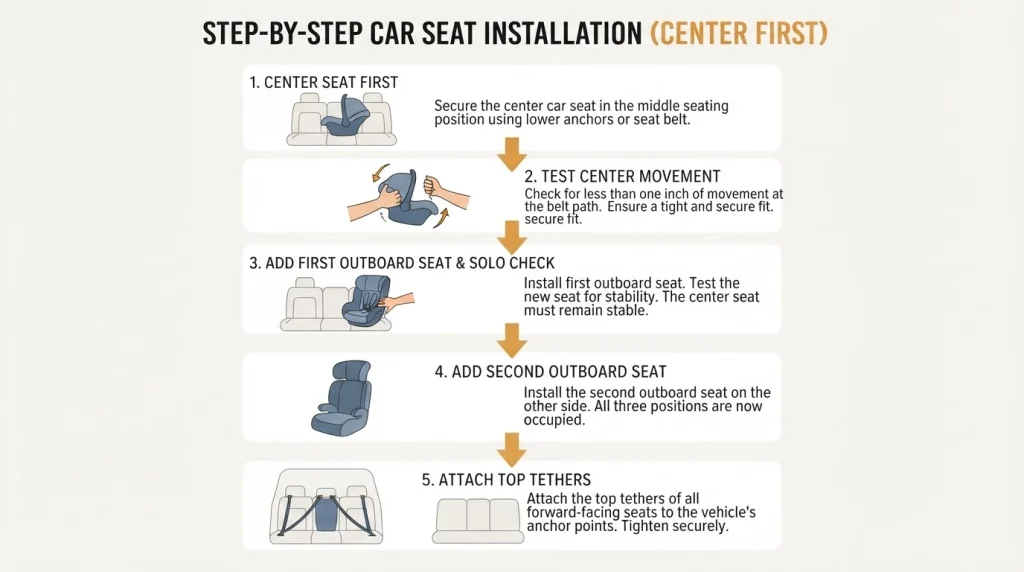
Install the center seat first with a seat belt, check it alone, then add the outboard seats one at a time. Recheck each seat after all three are in place.
Budget 45 to 60 minutes for a first three-across install. Rushing leads to loose belts and missed tethers.
- Read the vehicle manual for center seating, anchor limits, and tether locations.
- Read each seat manual for belt routing, recline, and harness height rules.
- Install the center seat first and pull the belt tight at the belt path.
- Test the center seat for less than 1 inch of movement at the belt path.
- Install one outboard seat, then test it with the center seat removed.
- Install the second outboard seat and repeat the solo test.
- Reinstall all three, attach top tethers, and check harness fit for each child.
Keep this rule front and center during the whole job. Each seat must hold tight without help from its neighbor.
Which seat should go in the center?
Put the hardest install in the center first. That seat often sets the spacing for the other two.
In my Toyota Camry test, the forward-facing seat worked best in the center. Its top tether lined up clean, and both outboard seats kept buckle access.
How do you check each install?
Use the inch test at the belt path, not at the top of the shell. Grab the seat where the belt passes through and push side to side.
- Movement: Less than 1 inch of side-to-side or front-to-back movement at the belt path.
- Recline: Level line or indicator sits in the correct range for the child’s direction.
- Harness: Straps lie flat, sit at the right height, and pass the pinch test at the collarbone.
- Tether: Forward-facing seats use the top tether when the vehicle and seat allow it.
Review how car seats are installed if belt routing or lockoffs feel unclear. A clear install method saves time when space gets tight.
Pro tip: Check your vehicle owner’s manual and the seat manual before you drive, and confirm recalls through the NHTSA recall lookup when you buy a used seat or a new model.
Section takeaway: Center first, solo test each seat, then test the full trio. A tight trio is only safe when each seat also holds tight alone.
Should You Use a Seat Belt or LATCH for Three Across?
Use seat belts for most three-across installs. Seat belts give you more side-to-side placement room than fixed lower anchors.
LATCH stands for Lower Anchors and Tethers for Children. It uses built-in lower anchors and a top tether instead of a seat belt.
Learn what LATCH is and how its spacing works in your car. Many center seats lack a dedicated set of lower anchors.
- Seat belt gains room: You can shift the seat toward the door or center by an inch or more.
- LATCH fixes position: Anchor spacing locks the seat where the anchors sit.
- Seat belt fits centers: Most center seats have a lap-and-shoulder belt or lap belt for install.
- LATCH has weight limits: Check combined seat-plus-child limits in both manuals.
Can you mix seat belt and LATCH in one row?
Yes, you can use a seat belt for one seat and LATCH for another. Never use both methods on the same seat unless both manuals allow it.
Pick one install method per seat and follow that method fully. Mixing methods on one seat can change belt tension in a crash.
What about top tethers in a tight row?
A top tether is a strap that links the top of a forward-facing seat to an anchor behind the vehicle seat. It limits forward head movement.
Route each tether without crossing another seat’s belt path. Tighten the tether after the main install feels firm.
Section takeaway: Seat belts win most three-across fights for room and flexibility. Use LATCH only where spacing, weight limits, and manuals support it.
What Mistakes Make Three Across Unsafe?
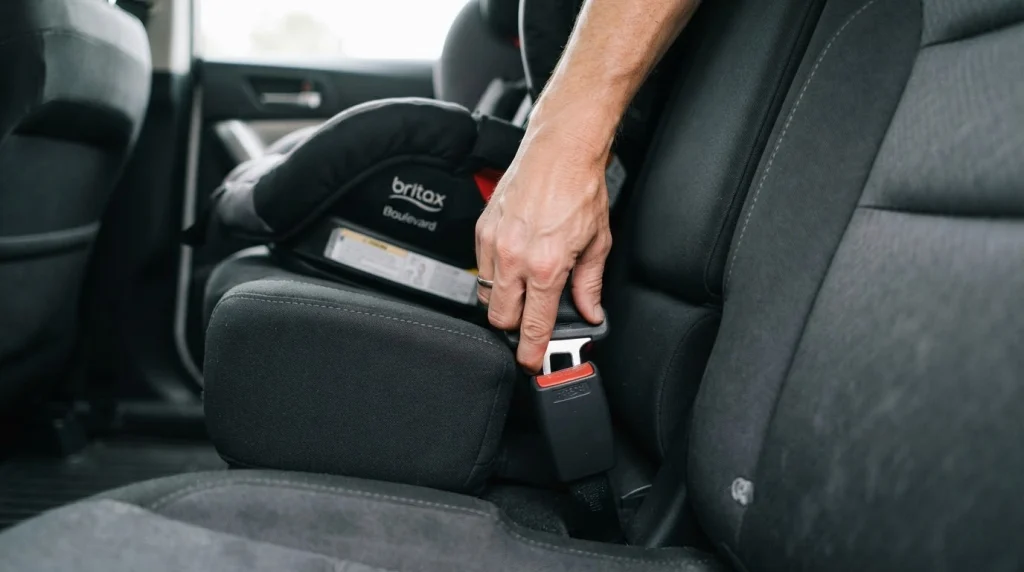
The riskiest mistakes are shared anchors, forced installs, twisted belts, and seats that only stay tight when wedged together. Each mistake can hide a loose install.
I once saw a trio that felt rock-solid as a group. One outboard seat moved 3 inches once its neighbor came out.
- Sharing anchors: Two seats must never share one lower anchor or one top tether anchor.
- Wedging seats tight: Pressure from a neighbor is not a substitute for belt tension.
- Twisting belts: Twisted belts and buckles change routing and reduce holding power.
- Skipping the tether: A loose or missing top tether leaves a forward-facing seat with more forward movement.
- Ignoring buckle access: A booster a child can’t buckle invites loose belts and daily shortcuts.
- Adding thick padding: Aftermarket pads and thick mats can change fit and hide slack.
When should you use the third row instead?
Use the third row when the second row can’t pass solo install tests. A safe split across two rows beats a forced trio in one row.
Check using the third row for anchor, tether, and access limits in your vehicle. Some third rows lack top tethers or full LATCH sets.
When you shop for a larger family vehicle, compare bench layouts and third-row access in reviews on Car and Driver. A bench second row often fits three across better than captain’s chairs.
When should you get a professional check?
Get a check when the trio feels tight but one seat fails the solo test. Get help also when belt routing, center anchors, or tether paths stay unclear.
A certified child passenger safety technician can spot routing errors in minutes. That visit costs little time and removes guesswork.
Section takeaway: Avoid shared anchors, wedged installs, and skipped tethers. If one seat fails alone, change the trio or split the row.
FAQs About Fitting Three Car Seats
Can you fit three car seats in a sedan?
Yes, many midsize sedans fit three across with narrow seats and seat belt installs. Measure hip room and buckle spacing first, then test the exact trio with front seats set for driving.
Do all three car seats need to be narrow?
Not always, but narrow seats make the job far easier in most cars. One wide seat can block a buckle or push its neighbor out of position, so test the full trio together.
Can three car seats touch each other?
Light contact is often fine when each seat installs tight on its own. Forced contact is a problem when one seat moves freely after you remove its neighbor.
Is the middle seat safe for a car seat?
Yes, the center can be a safe spot when the vehicle manual allows a child seat there. Check for a usable belt, anchor rules, and a top tether for forward-facing seats.
Can you fit three rear-facing seats across?
Yes, in wider rows with slim rear-facing seats and careful recline setup. Small cars may lose front legroom, so test front-seat comfort before you buy.
What is the cheapest way to fit three across?
Start with the seats you own, switch to seat belt installs, and change install order first. Buy one narrow seat only after a test shows which position causes the squeeze.
Final Takeaway: Fit Three Safely, Not Just Tightly
Three across rewards patience, measuring, and honest solo tests. The right trio feels firm, buckles clean, and holds tight seat by seat.
Measure your row, test narrow seats in your car, and recheck the install after a week of use. A careful fit today makes every school run and road trip calmer.

Daniel Brooks is an automotive writer and product researcher focused on car accessories, car tech, maintenance, and practical driving guides. At Plug-in Car World, he helps drivers make smarter automotive decisions through honest reviews and research-driven content.
