
Can Car Seats Be Installed in an RV? What Parents Must Know
Quick Answer
Yes, car seats can be installed in an RV, but only on a forward-facing seat with an approved seat belt and a secure install. Dinette benches, side-facing sofas, and beds do not count as safe travel seats. Learn how car seats are installed first, then confirm the RV manual allows a child restraint in that exact spot.
What decides a safe RV install
- Forward-facing seat: The vehicle seat must face the front of the RV and stay locked in travel position.
- Locking belt: The seat belt must lock, stay tight, and route through the correct belt path.
- Top tether anchor: A forward-facing harnessed seat needs an approved tether anchor for that seating position.
- Manual approval: Both the RV manual and the car seat manual must allow the install in that spot.
- No trailer riding: No child rides in a travel trailer or fifth wheel while it moves.
Do this before you book
- Ask for the seating chart and belt types for your exact RV year and floor plan.
- Test the install at home, and check it with a certified child passenger safety technician if you have doubt.
Can car seats be installed in an RV? I get this question from friends before almost each summer road trip. I have wrestled with RV belts in driveways, rental lots, and campgrounds, and the answer is never a simple yes.
This guide goes deeper than a quick yes or no. You will learn which RV seats can hold a car seat, how belts and tethers work in a motorhome, and how to test an install before you leave.
In This Guide
- Can You Install a Car Seat in an RV?
- Which RV Seats Are Safe for a Car Seat?
- How Do RV Seat Belts, LATCH, and Tethers Work?
- How Do You Install a Car Seat in an RV?
- What Should You Check Before You Drive an RV With a Child?
- Frequently Asked Questions About Car Seats in RVs
- Final Takeaway: Plan the Seat Before You Plan the Route
Can You Install a Car Seat in an RV?
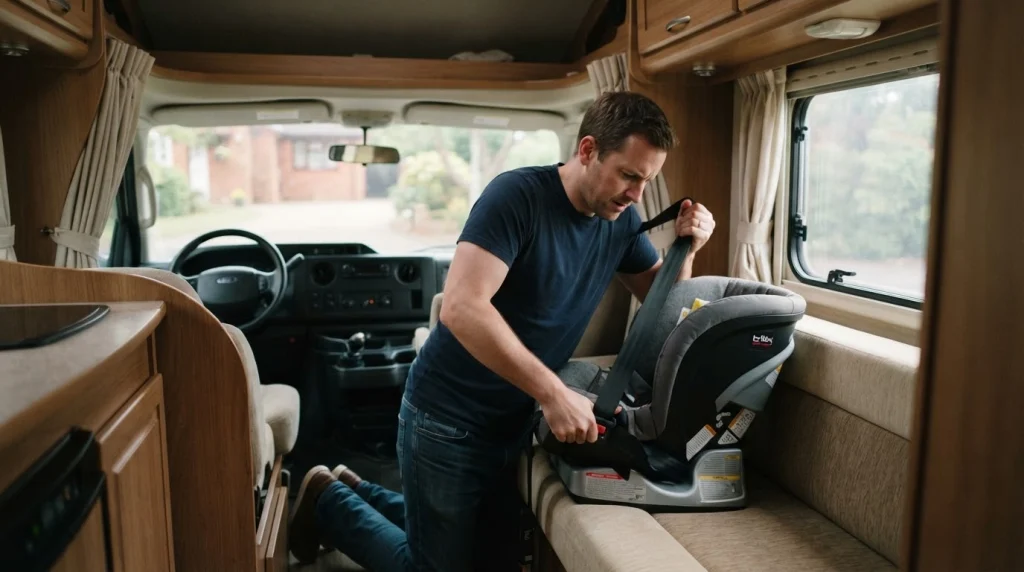
Yes, in many motorhomes. The seat must face forward, lock tight with a belt, and be approved for a child restraint in the RV owner’s manual.
I learned this the hard way on a rented Class C in 2023. I assumed the dinette would work, then spent 40 minutes proving it would not lock tight enough.
Definition: A child restraint seating position is a forward-facing vehicle seat with a belt system and anchor points rated to hold a car seat in a crash. A bench with a belt is not enough on its own.
- Approved position: The RV manual names the seat as a travel seating position.
- Forward direction: The seat faces forward and locks in place for travel.
- Usable belt: The belt locks, fits the belt path, and holds the seat with less than 1 inch of movement.
- Tether access: A forward-facing harnessed seat has an approved tether anchor within reach.
Is it legal to use a car seat in an RV?
Child passenger laws apply in RVs in most states, and they vary by state. You must follow the law for the state where you drive, not just your home state.
Legality does not prove a seat is safe. A manual that bans child restraints on a seat overrides a belt that looks usable.
Why is an RV different from a car or SUV?
Cars and SUVs have crash-tested rear seats, LATCH anchors, and top tethers in known spots. Many RV living-area seats were built for camping comfort, not crash loads.
RV floors, seat frames, and belt anchor points vary by builder and model year. Two RVs that look alike can have different approved seating positions.
- Light framing: Some dinette belts anchor to plywood or light framing.
- Soft cushions: Thick sofa cushions compress and let a tight install loosen on the road.
- Missing tethers: Many living-area seats have no tether anchor at all.
- Loose gear: Kitchens and storage add flying-object risk in a hard stop.
Pro tip: Check the RV owner’s manual and the car seat manual before you travel, and use the recall lookup on the NHTSA site for both the vehicle and the seat.
Section takeaway: A car seat can work in an RV, but only on a seat the builder approved for travel. If the manual stays silent, treat that seat as off-limits.
Which RV Seats Are Safe for a Car Seat?
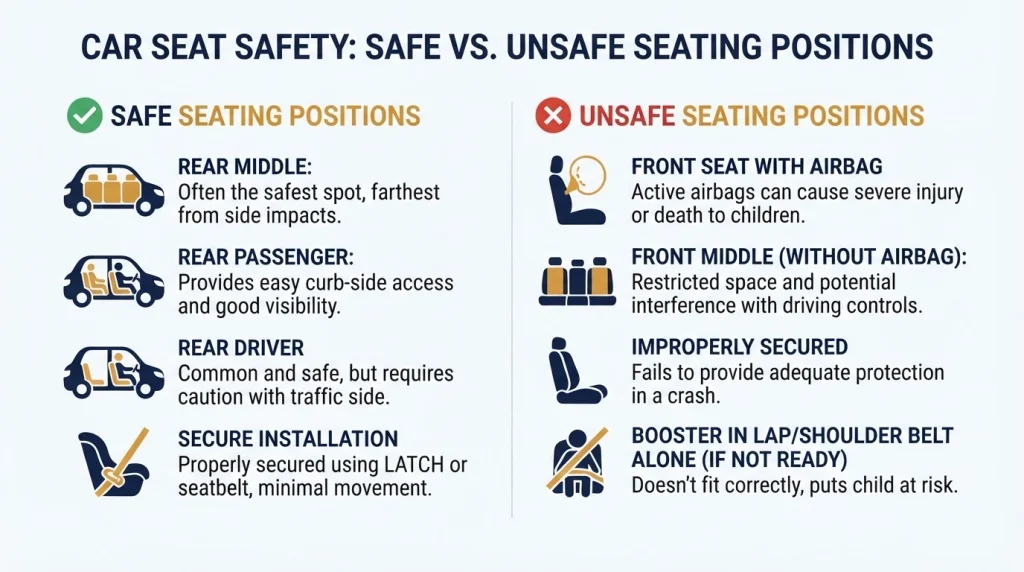
Forward-facing cab seats and some forward-facing living-area seats can work. Side-facing seats, rear-facing seats, beds, and dinette benches with weak belts seldom work.
- Check direction first: The seat must face forward for travel.
- Check the belt next: A lap-and-shoulder belt is best, and a lap-only belt works only for some harnessed seats.
- Check the base: The seat base must be firm, flat, and bolted to the floor.
- Check the tether: A forward-facing seat needs an approved anchor, not a cargo hook.
Can a car seat go in the front passenger seat of an RV?
It can in some Class B and Class C motorhomes, if the manual allows it. A rear-facing seat must never sit in front of an active front airbag.
Move the front seat back as far as it goes when you use it. Keep the airbag switch, if fitted, in the position the manual requires for a child restraint.
What about dinettes, sofas, and captain’s chairs?
A dinette bench faces forward on one side and backward on the other. The forward side still fails often, because the belt anchors, cushion depth, and tether access do not meet car seat needs.
A forward-facing sofa or captain’s chair bolted to the floor has a better chance. Look for a lap-and-shoulder belt, a firm seat base, and a clear belt path with no twist.
Check whether a car seat will fit in that exact spot before you commit to it. Measure belt length, seat depth, and headrest clearance while you test.
RV floor plans change fast, so photos can mislead you. Compare seating layouts on Edmunds and then confirm the layout in the manual for your exact year and model.
Which seats should you never use while driving?
- Side-facing sofa: Side-facing seats cannot protect a child in a frontal crash.
- Rear-facing dinette: A rear-facing bench points the child the wrong way for a car seat install.
- Bed or bunk: Beds have no crash-rated belt system for a child restraint.
- Swivel chair: A chair that swivels must lock forward, and most RV swivels are not rated for a car seat.
- Jump seat or stool: A loose or add-on seat has no approved belt path.
The table below sums up what I see most often as of 2026. Treat it as a starting check, not a substitute for your manual.
| RV type | Likely safe seats | Belts and anchors | Verdict |
|---|---|---|---|
| Class A motorhome | Front passenger, some forward-facing sofa seats | Lap-and-shoulder in cab, mixed belts in back, LATCH rare | Possible, manual check required |
| Class B camper van | Front passenger, forward-facing second row if fitted | Car-like belts, LATCH possible in second row | Often best RV option |
| Class C motorhome | Front passenger, some forward-facing dinette or sofa seats | Lap-and-shoulder in cab, lap-only common in back, tethers rare | Possible, test each seat |
| Travel trailer | None while towing | No travel seating | Do not ride inside |
| Fifth wheel | None while towing | No travel seating | Do not ride inside |
| Truck camper | Tow vehicle rear seat only | Tow vehicle belts and LATCH apply | Child rides in truck cab |
Section takeaway: Start with forward-facing, floor-bolted seats and rule out side-facing seats, beds, and dinette benches first. The manual for your exact RV decides the final list.
How Do RV Seat Belts, LATCH, and Tethers Work?
Most RVs rely on seat belts, not LATCH. You need a belt that locks, stays tight, and routes through the correct belt path on the car seat.
- Belt: The seat belt holds the car seat to the vehicle seat.
- Lower anchors: LATCH lower anchors hold the seat without a belt, where fitted.
- Top tether: The tether strap limits forward head movement for a forward-facing harnessed seat.
What is LATCH, and do RVs have it?
LATCH stands for Lower Anchors and Tethers for Children. Learn what LATCH is and how it works before you hunt for anchors that may not exist in an RV.
Most motorhomes lack LATCH in the living area, and some lack it in the cab too. A seat belt install is the normal path in an RV, and it can be just as secure when done right.
Can you use a lap-only belt?
A lap-only belt can work for some rear-facing and forward-facing seats with a harness. It cannot work for a booster, since a booster needs a lap-and-shoulder belt to position the belt on the child.
Check the car seat manual for lap-belt approval before you try it. If the manual bans lap-only use, pick a different seat.
Where does the top tether go?
A top tether is a strap on a forward-facing seat that limits head movement in a crash. It must attach to a tether anchor rated for that job, never to a cargo hook or seat frame bolt you found by eye.
Many RVs have no tether anchor in the living area. If you cannot find an approved anchor, do not improvise one.
Do you need a locking clip?
A locking clip is a small metal clip that holds a lap-and-shoulder belt tight when the belt will not lock on its own. Some older RV belts need one, and most car seats ship with one in the box.
Use a locking clip only when both manuals allow it and show the correct placement. A clip in the wrong spot can let the belt slip.
- Pull the belt out fully: Listen and feel for the locking mode to engage.
- Feed slack back slowly: Let the retractor take up slack while you press the seat down.
- Check for twists: A twisted belt can jam and leave slack in the belt path.
- Check buckle position: The buckle must not sit inside the belt path or on the seat edge.
Section takeaway: A locking belt plus an approved tether anchor makes an RV install possible. No LATCH does not end the trip, but no locking belt or no tether anchor should end that seating choice.
How Do You Install a Car Seat in an RV?
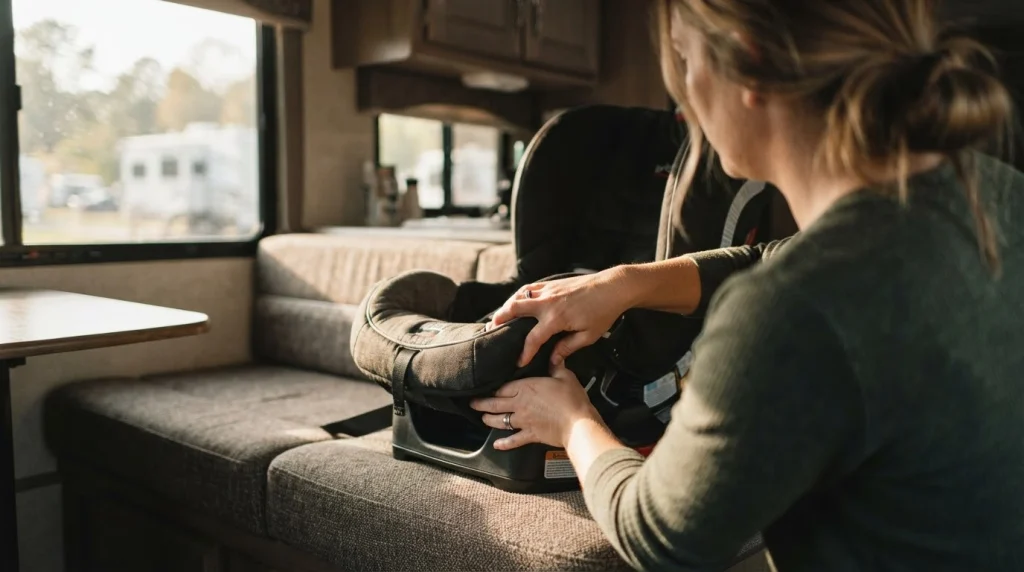
Install with the seat belt, lock the belt, and test for movement at the belt path. A good install moves less than 1 inch side to side or front to back.
What do you need before you start?
- Both manuals: RV owner’s manual and car seat manual, open to the install pages.
- Flashlight: Belt anchors and tether points hide under cushions and trim.
- Second adult: A helper can press the seat down while you tighten the belt.
- 30 minutes: A first RV install takes longer than a car install, so do not rush it.
- Park on level ground, pick the forward-facing seat, and confirm the manual allows a child restraint there.
- Set the car seat in rear-facing or forward-facing mode per the manual, and set the recline angle for your child’s age and weight.
- Route the seat belt through the correct belt path, with no twists in the webbing.
- Buckle the belt, press the car seat firmly into the vehicle seat, and remove all slack from the belt path.
- Lock the belt per the RV manual, or fit a locking clip only if both manuals allow it.
- Attach the top tether for a forward-facing harnessed seat, and tighten it per the car seat manual.
- Test the install at the belt path, check the level indicator, and re-check the harness fit on the child.
How do you know the install is tight enough?
Grab the seat at the belt path with one hand. Push and pull with firm force, and watch for more than 1 inch of movement.
Check the install again after a short drive and after each stop. RV vibration and soft cushions can loosen a belt faster than a car seat in a sedan.
On that Class C rental, my first dinette try moved 3 inches. I moved the seat to the forward-facing sofa, re-routed the belt, and got it under 1 inch in 15 minutes.
Which car seat type works best in an RV?
- Rear-facing infant seat: Works well in a cab seat or firm second row, if space and airbag rules allow it.
- Convertible seat: Works well for toddlers, since it can install rear-facing or forward-facing with a belt.
- Forward-facing harnessed seat: Needs a tether anchor, so it fails on many living-area seats.
- Booster seat: Needs a lap-and-shoulder belt, so it fails on lap-only dinette and sofa belts.
Use this guide on how to check car seat compatibility to match the seat, belt, and vehicle before your trip. A 20-minute driveway test beats a roadside surprise.
What mistakes should you avoid?
- Using a side-facing seat: Direction matters more than belt length.
- Skipping the tether: A loose tether or missing anchor leaves a forward-facing seat under-protected.
- Adding thick padding: Aftermarket inserts and thick towels can change the install and harness fit.
- Routing the belt wrong: Rear-facing and forward-facing belt paths differ, so follow the labels on the seat.
Section takeaway: A slow, manual-led belt install with a 1-inch test beats a fast install that feels tight at the top. Test at the belt path, not at the headrest.
What Should You Check Before You Drive an RV With a Child?
Check the seating chart, belt type, tether anchors, and child restraint rules before you book, rent, or load up. A five-minute manual check can save a cancelled trip.
What should you ask before you rent an RV?
- Seating chart: Which seats are rated for travel, and which face forward?
- Belt types: Which seats have lap-and-shoulder belts, and which have lap-only belts?
- Tether anchors: Where are the tether anchors, and how many seats have them?
- LATCH anchors: Does any seat have lower anchors, and what are the weight limits?
- Airbag rules: Can a child restraint go in the front passenger seat, and what switch setting applies?
What should you check on travel day?
- Install tightness: Less than 1 inch of movement at the belt path.
- Harness height: Straps at or below the shoulders rear-facing, and at or above the shoulders forward-facing.
- Chest clip: Clip sits at armpit level, with straps flat and snug.
- Recline angle: Level indicator sits in the range for your child’s mode.
- Loose gear: Coolers, bags, and kitchen items are stowed and latched shut.
- Seat locks: Swivel seats, dinette tables, and slide-outs are locked for travel.
Read child seat guidance from Consumer Reports alongside both manuals. Use it to compare seat types, not to override a manual ban on a seating position.
Run through this essential car seat safety checklist before each leg of the trip. Re-check harness height, chest clip position, and belt tightness each time you reload.
What about loose gear and sleeping while driving?
Secure coolers, luggage, and kitchen gear before you move. Loose items turn into projectiles in a hard stop.
No child should sleep in a bed, bunk, or overhead cab while the RV moves. Each rider needs a belted, forward-facing seat for travel.
Section takeaway: Confirm the seat, belt, and tether before you pay for the rental. On travel day, re-check the install, harness, and loose gear before the wheels turn.
Frequently Asked Questions About Car Seats in RVs
Can you put a car seat in the front seat of an RV?
Yes, in some Class B and Class C motorhomes when the RV manual allows a child restraint there. A rear-facing seat must never face an active front airbag, so check the airbag rules and move the seat fully back first.
Can a baby ride in an RV while it is moving?
Yes, a baby can ride in a motorhome in a correctly installed rear-facing seat on an approved forward-facing seating position. The baby must stay buckled in the car seat while the RV moves, never in a bed, bunk, or held in arms.
Do RVs have LATCH anchors?
Some Class B vans and newer motorhomes have LATCH in the cab or second row, but most living-area seats do not. Check the RV manual for anchor locations and weight limits, and plan for a seat belt install when no anchors exist.
Can you install a car seat at an RV dinette?
Seldom, and only when the forward-facing dinette seat is approved for travel, has a locking belt, and offers a tether anchor for a forward-facing seat. Most dinette installs fail on belt anchoring, cushion compression, or missing tethers, so test it before you rely on it.
Is it safe for a child to ride in a travel trailer?
No, a child must not ride in a travel trailer or fifth wheel while it is towed. Trailers lack crash-rated travel seating and restraint systems, so the child must ride in the tow vehicle in a correctly installed car seat.
Can you use a booster seat in an RV?
Yes, but only on a forward-facing seat with a lap-and-shoulder belt that fits the child correctly. A booster cannot work with a lap-only belt, and it cannot work on a side-facing seat, so check belt type first.
Final Takeaway: Plan the Seat Before You Plan the Route
An RV trip with a child can work well with the right seat in the right spot. It falls apart when you guess about belts, anchors, or manual rules.
Pick the seating position first, test the install at home, and get a certified technician check if you have any doubt. Then you can focus on the road, not the seat behind you.
Start with your RV manual tonight, test the install this week, and do not drive until the seat passes the 1-inch test. Your future self will thank you at mile 200.

Daniel Brooks is an automotive writer and product researcher focused on car accessories, car tech, maintenance, and practical driving guides. At Plug-in Car World, he helps drivers make smarter automotive decisions through honest reviews and research-driven content.
