
Which Car Can Fit 3 Car Seats? Best Minivans, SUVs & Trucks
Quick Answer
A minivan or wide three-row SUV is the easiest car to fit 3 car seats, and most families will find a Honda Odyssey, Toyota Sienna, Chrysler Pacifica, or Kia Carnival the least stressful choice. Wide bench seats, flat cushions, and three sets of top tether anchors make three-across installs far more likely to work without forcing buckles or seats together. Before you buy, test whether a car seat will fit in your car with your exact seats, because seat width and buckle spacing matter more than the badge on the grille.
What makes a car work for three seats
- Wide bench seat: A flat second-row bench gives three seats a level base and keeps buckles reachable.
- Three top tethers: Every forward-facing seat needs its own top tether anchor, so check all three spots.
- Narrow car seats: Slim seats near 17 inches wide often make the difference between a tight fit and no fit.
- Usable middle seat: A full middle seat belt and a flat cushion matter more than extra shoulder room on paper.
- Sliding second row: A sliding row helps rear-facing seats clear the front seats without crushing driver legroom.
Quick check before you buy
- Bring all three seats to the test drive and install them in the car you plan to buy.
- Check each install on its own, with the other seats removed, so no seat hides a loose fit.
I have squeezed, swapped, and re-installed enough car seats to know that “three seats fit” can mean three very different things. It can mean an easy daily setup, a daily wrestling match, or a setup that looks fine until you try to buckle the middle child.
This guide goes deeper than a model list. You will learn what width and anchors actually matter, which vehicle types work best, which specific cars to shortlist, and how to test a car before you sign anything.
In This Guide
- What Does It Mean for a Car to Fit 3 Car Seats?
- Which Types of Cars Fit 3 Car Seats Easiest?
- Which Specific Cars Can Fit 3 Car Seats?
- Can a Sedan or Small SUV Fit 3 Car Seats?
- How Do You Choose the Right Car for 3 Car Seats?
- How Do You Fit 3 Car Seats Safely?
- Frequently Asked Questions About Cars That Fit 3 Car Seats
What Does It Mean for a Car to Fit 3 Car Seats?
A car fits 3 car seats when three child seats can each install tightly and independently in one row, with working buckles and no seat relying on its neighbor for support. That test matters more than a roomy brochure photo or a wide-looking back seat.
What is a three-across fit?
A three-across fit is three child restraints installed side by side in one row, usually the second row. Each seat must pass its own tightness check at the belt path, and each harness and buckle must stay usable.
I learned this the hard way in a midsize sedan that looked huge in photos. Two seats fit fine, but the middle buckle disappeared under the third seat and I could not tighten it safely.
A car can also “fit” three kids by splitting them across rows. That is a different answer, and it works well in many three-row SUVs and minivans.
How much width do three car seats need?
Plan on roughly 51 inches of usable flat width if you use three narrow seats near 17 inches wide each. You also need room to reach buckles, route belts, and tighten each install without pinching straps.
- Narrow convertible seats: Slim models near 17 inches wide are often the starting point for three across.
- Infant carriers and bases: A carrier plus base can take more width than the carrier alone, so measure the base too.
- Boosters: A booster needs clear buckle access, and a buried buckle can turn a good fit into a daily struggle.
- Seat shape: Bolstered cushions and curved door panels steal usable width even when the spec sheet looks generous.
If you want a baseline before you shop, check how wide a standard car seat is and compare that number with the flat part of your back seat. Measure the flat cushion between the door panels, not the widest point at the armrests.
Why do LATCH and top tethers matter for three seats?
LATCH is the lower-anchor system that lets some seats install without the vehicle seat belt, and a top tether is the strap that anchors the top of a forward-facing seat to the vehicle. For three seats, you need enough anchors in the right spots, not just anchors somewhere in the car.
Many cars have lower anchors only in the two outboard spots. The middle seat often uses the seat belt instead, and that is fine when the manual allows it and the install stays tight.
- Top tethers: Count them for the row you plan to use, and confirm each forward-facing spot has one.
- Lower-anchor spacing: Shared or offset anchors can push seats together and block the middle buckle.
- Weight limits: LATCH has weight limits in the vehicle and seat manuals, so a seat belt install is often needed as kids grow.
Section takeaway: A car fits three seats only when each seat installs tight on its own, each buckle stays reachable, and each forward-facing seat has a top tether.
Which Types of Cars Fit 3 Car Seats Easiest?
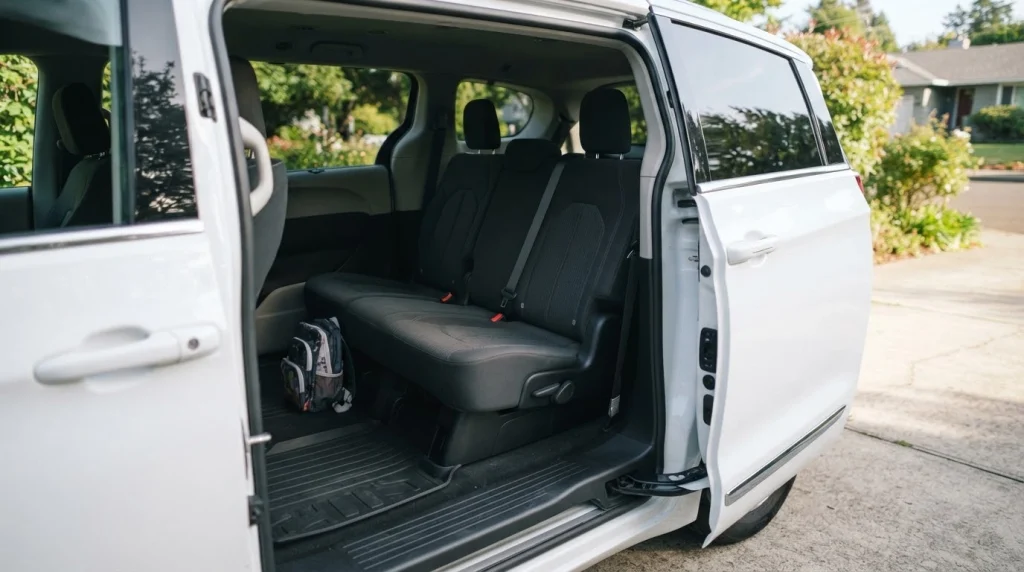
Minivans fit three car seats easiest, followed by wide three-row SUVs with a second-row bench. Full-size SUVs and crew-cab trucks can work well too, while most compact cars need narrow seats and careful testing.
The difference is rarely one magic model. It is bench width, cushion shape, anchor layout, door opening size, and how much front legroom survives a rear-facing seat.
Are minivans still the best choice for three car seats?
Yes, minivans remain the easiest choice for most families with three young kids. Sliding doors, a low step-in height, and a wide second row make daily loading far less awkward than in a tall SUV.
I fitted three seats in a neighbor’s Odyssey in about 25 minutes, including a rear-facing convertible in the middle. The same three seats took twice as long in a two-row SUV, mostly because I kept fighting the door frame and buckle stalks.
Minivans also give you a real third row for later. You can split two seats in row two and one in row three when three across gets too tight.
How do three-row SUVs compare with minivans?
A three-row SUV with a bench second row can match a minivan for three-across fit, but captain’s chairs change the math. Captain’s chairs remove the middle second-row spot, so the third seat must go in the third row.
That split setup can still work well for older kids. It gets harder with an infant carrier, because lifting a carrier into row three through a narrow gap wears thin fast.
If you want third-row use, check whether a car seat can go in the third row in that model and which third-row spots have tethers. Some third rows allow only one or two child seats, even when three belts are present.
| Vehicle type | Three-across ease | Best for | Watch out for |
|---|---|---|---|
| Minivan | Easiest | Three young kids, daily loading | Removable middle seat varies by trim |
| Three-row SUV, bench | Easy to moderate | Families who want SUV height and towing | Narrower bench than a minivan on some models |
| Three-row SUV, captain’s chairs | Split-row only | Two in row two, one older child in row three | Third-row tether and access limits |
| Full-size SUV | Easy, if bench equipped | Large families, long trips, cargo | High step-in, price, and parking size |
| Crew-cab truck | Moderate | Families who need a truck bed | Upright rear seat and tether routing |
| Large sedan or wagon | Possible with narrow seats | Older kids, boosters, tight budgets | Rear-facing legroom and buckle access |
Use reviews and spec pages as a shortlist tool, not a final answer. Car and Driver is useful for comparing second-row space and trim differences before you visit a dealer.
Section takeaway: Start with a minivan or bench-equipped three-row SUV, and treat captain’s chairs as a split-row plan rather than a three-across plan.
Which Specific Cars Can Fit 3 Car Seats?
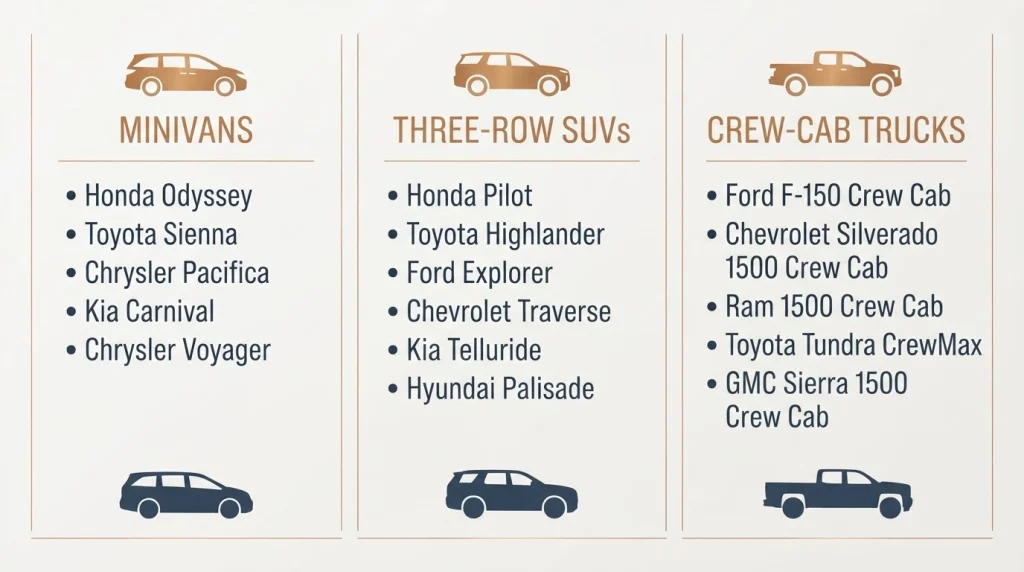
The cars below are strong starting points as of 2026 because they offer wide benches, usable third rows, or both. Trim and seat layout still decide the result, so confirm the exact car in front of you.
Which minivans fit three car seats best?
The Honda Odyssey, Toyota Sienna, Chrysler Pacifica, and Kia Carnival lead most shortlists for three-across use. Each offers a wide second row and a third row that can take child seats in many trims.
- Honda Odyssey: Wide second row with a sliding middle seat on many trims, plus a roomy third row.
- Toyota Sienna: Strong family layout with sliding second-row seats, though captain’s chairs are common, so check the bench option.
- Chrysler Pacifica: Wide cabin and flexible seating, with Stow ’n Go models that change how the second row feels under a base.
- Kia Carnival: SUV-style looks with minivan space, and a bench layout worth seeking out for three across.
I would still test the exact trim. A removable middle seat can help or hurt, depending on whether it leaves a flat surface and a full belt for the middle install.
Which three-row SUVs fit three car seats best?
The Honda Pilot, Toyota Highlander and Grand Highlander, Hyundai Palisade, Kia Telluride, Chevrolet Traverse, and Ford Explorer are common picks when buyers want an SUV. The bench version is the version that gives you a real three-across shot.
- Honda Pilot: Wide bench option and a third row that works for older kids and many forward-facing seats.
- Toyota Grand Highlander: More second- and third-row room than the standard Highlander, which helps with rear-facing seats.
- Hyundai Palisade and Kia Telluride: Roomy benches on lower trims, with captain’s chairs taking over on many higher trims.
- Chevrolet Tahoe and Ford Expedition: Full-size space and strong bench options, with a higher price and larger footprint.
If the SUV you like has captain’s chairs, learn whether car seats can go in captain’s chairs and how third-row access works with two seats installed. A good split-row plan beats a forced three-across install every time.
Compare trim-level seating charts before you shop, since the same model name can hide three seat layouts. Edmunds is a helpful place to check which trims offer a bench and which lock you into captain’s chairs.
Which trucks fit three car seats?
A full-size crew-cab truck such as a Ford F-150, Chevrolet Silverado, Ram 1500, or Toyota Tundra can fit three seats across the rear bench. Crew cabs work far better than extended cabs, which often lack the legroom and anchor layout for three seats.
Trucks add two quirks to check. The rear seatback sits more upright than a car seatback, and top tether routing can run behind the seat in a way that needs a close read of the manual.
Section takeaway: Shortlist a minivan first, a bench three-row SUV second, and a crew-cab truck when you need a bed, then verify the exact trim and seat layout.
Can a Sedan or Small SUV Fit 3 Car Seats?
Yes, some large sedans and midsize SUVs can fit three car seats, but the margin for error is small. Narrow seats, a flat bench, and patient testing decide whether the setup works day after day.
Can you fit three car seats in a Honda Accord or Toyota Camry?
A large sedan like an Accord, Camry, Hyundai Sonata, or Subaru Legacy can sometimes fit three narrow seats across. The best odds come with a mix of narrow convertibles and boosters, not three wide infant bases.
Rear-facing seats are the usual breaking point. A tall driver plus a rear-facing seat behind them can leave no safe recline angle and no knee room.
- Try the middle first: Install the middle seat first, then add the outboard seats around it.
- Check buckle stalks: Short, rigid stalks are easier to reach than long, floppy stalks buried under a base.
- Watch the door side: A seat that presses hard against the door panel may not sit flat or tighten evenly.
What about a compact SUV like a RAV4 or CR-V?
A compact SUV such as a Toyota RAV4, Honda CR-V, Mazda CX-5, or Subaru Forester can fit three seats in some combinations, but three across is tight. Two seats plus a booster often works better than three full-size convertibles.
Small cars reward compact rear-facing installs and careful front-seat placement. If rear-facing room is your main worry, read how to fit a rear-facing car seat in a small car before you rule a model out.
Do not buy a small SUV for three seats based on legroom specs alone. Hip room, cushion shape, and anchor placement tell you more about daily fit than front legroom does.
Section takeaway: A large sedan or compact SUV can work with narrow seats, but expect a tight fit and test the exact combination before you commit.
How Do You Choose the Right Car for 3 Car Seats?
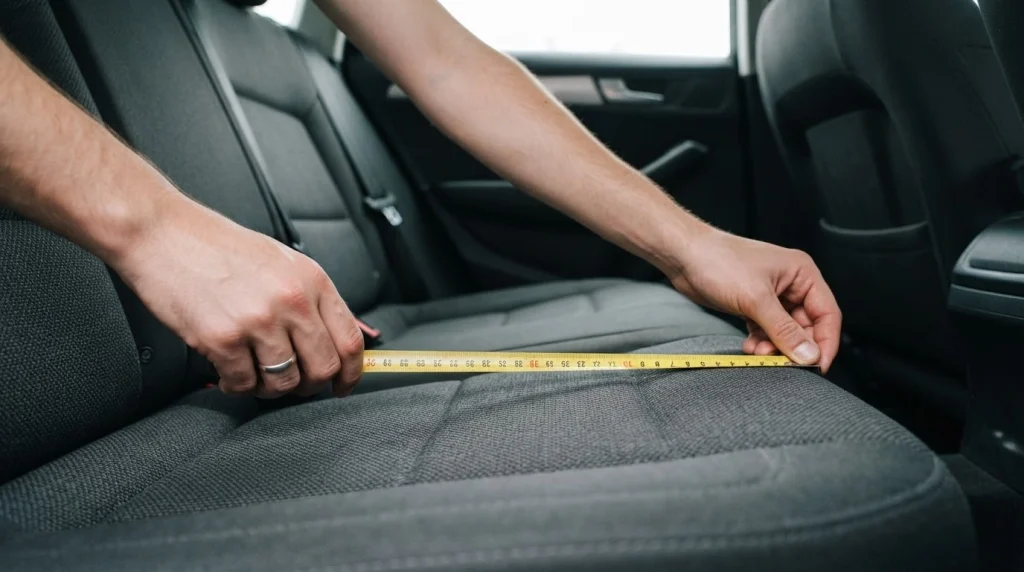
Choose the car around your seats and your kids, not around a seating-count claim. A car that fits three boosters may fail with three rear-facing seats, and a car that fits today may fail after the next growth spurt.
What should you measure before you buy?
Measure usable bench width, seat depth, and the space behind the front seats at your normal driving position. Then compare those numbers with the widest point of each child seat, including the base.
- Measure the flat bench width between the door panels at cushion level.
- Measure each child seat at its widest point, not just the shell width on the box.
- Set the front seats where you drive, then check rear-facing clearance and recline.
- Count seat belts, lower anchors, and top tethers for the exact row you plan to use.
- Open the buckles with all three seats in place and confirm each one stays reachable.
A tape measure saves a costly mistake. I once skipped this step and spent a weekend swapping seats between two cars to find a mix that worked.
How do you test three seats at the dealership?
Bring all three seats, install them in the exact car you would buy, and drive it with the front seats set for the tallest regular driver. A quick parking-lot test beats a week of regret after delivery.
- Install middle first: Start with the middle seat, check tightness, then add the sides.
- Remove and recheck: Take each neighboring seat out and confirm the remaining seat still moves less than one inch at the belt path.
- Buckle every child: Practice the harness and vehicle buckle for each spot, including the booster child if one will self-buckle.
- Load the stroller: Check cargo space with all seats installed, since a third row in use can shrink the trunk fast.
Use a structured check so you do not miss anchor or belt details in the rush of a test drive. Learn how to check car seat compatibility with your vehicle and run the same steps on every car you compare.
For used cars, add a manual check to the test. Consumer Reports can help you compare reliability and safety notes, but only the owner’s manual confirms anchor locations and install rules for that year and trim.
Section takeaway: Measure the flat bench, count the anchors, and install all three seats in the exact car before you buy.
How Do You Fit 3 Car Seats Safely?
Safe three-across fit starts with the manuals for both the car and each child seat. The car manual controls anchor use and seating rules, and the seat manual controls belt routing, recline, and weight limits.
Pro tip: Check the vehicle owner’s manual and the child seat manual for anchor limits, middle-seat rules, and top tether routing, and use NHTSA guidance or a certified child passenger safety technician when the manuals conflict or the fit stays unclear.
Should you use LATCH or the seat belt for three across?
Use whichever method gives a tight, correct install for that seating spot, within the limits in both manuals. Seat belt installs often give more side-to-side room than LATCH, which helps when buckles sit close together.
Never use LATCH and the seat belt together unless both manuals expressly allow it for that seat and spot. Pick one method, route it exactly as the manual shows, and lock the belt or tension the LATCH strap until the seat holds firm.
- Middle seat: Many middle spots require a seat belt install, so plan for that from the start.
- Outboard seats: LATCH can work well here, but a seat belt install may shift the seat slightly outward for buckle room.
- Top tethers: Always use the top tether for a forward-facing seat when the manuals require it, and route it without twists.
How do you know each seat is tight enough?
Grab the seat at the belt path and try to move it side to side and front to back. It should move less than one inch, and that check must pass with the neighboring seats removed.
Seats that only feel tight because they wedge against each other can loosen in daily use. Install each seat as if it were alone, then add the next seat and recheck the first one.
For official install and inspection guidance, start with NHTSA and look for a local car seat inspection station if you want a hands-on check. A 20-minute inspection can catch a routing error that photos and videos miss.
Section takeaway: Follow both manuals, pick one install method per seat, and prove each seat is tight on its own before you call the setup done.
Frequently Asked Questions About Cars That Fit 3 Car Seats
Can any car fit 3 car seats?
No, many small cars lack the bench width, buckle access, or anchor layout for three safe installs. A wide bench, three usable belts, and enough top tethers are the minimum starting point for a real three-across fit.
What is the cheapest car that fits 3 car seats?
A used minivan or large sedan with a flat bench is often the lowest-cost path, especially with narrow seats you already own. Prices vary by year, trim, and local market, so compare the exact seating layout rather than shopping by model name alone.
Do you need a 7-seater to carry 3 car seats?
No, a five-seat car can carry three seats if the second row is wide enough and each install stays tight and independent. A seven-seater helps when you want to split seats across rows or carry extra passengers and cargo.
Can you put 3 car seats in the third row?
Some large SUVs and minivans allow child seats in the third row, but many third rows allow only one or two. Check the owner’s manual for allowed spots, tether anchors, and head restraint rules before you plan a third-row install.
What is the narrowest car seat for three across?
Narrow convertible and booster models near 17 inches wide are commonly used for three-across setups, but the best choice depends on your child’s age, size, and seat type. Measure the widest point of the seat and base, then test it in your car before you buy three of anything.
Is it safe for car seats to touch each other?
Light contact alone does not prove a seat is unsafe, but a seat must still install tight on its own without help from its neighbor. Check both manuals, test each seat with the others removed, and change the mix if any seat loosens or any buckle becomes unusable.
My takeaway is simple: buy width, anchors, and door access, not just seats and cupholders. A minivan or bench-equipped three-row SUV will save you time on school mornings and stress on long trips.
Shortlist two or three cars from this guide, bring all three seats to each test drive, and install them before you talk price. The car that passes that test is the car that truly fits your family.

Daniel Brooks is an automotive writer and product researcher focused on car accessories, car tech, maintenance, and practical driving guides. At Plug-in Car World, he helps drivers make smarter automotive decisions through honest reviews and research-driven content.
