
How Do You Fit a Rear-Facing Car Seat in a Small Car? 7 Tricks That Work
Quick Answer
How do you fit a rear-facing car seat in a small car? Measure your back seat first, try the centre or passenger side, and set the recline to the upright end of the allowed range for an older baby. A compact carrier or narrow convertible usually fits where a wide seat will not. That is why rear-facing keeps babies safer, so keep it rear-facing and fix the fit instead of turning it early.
What saves the most space
- Measure first: Check back-seat legroom and seat depth before you buy or borrow a seat.
- Pick the right spot: The centre often frees both front seats, while the passenger side suits a taller driver.
- Set recline right: Newborns need more recline, while older babies can sit more upright within the marked range.
- Choose compact: A narrow shell and a short front-to-back footprint matter more than brand name.
- Test the front seat: Sit in front after the install and check knees, pedals, and airbag distance.
Do not do this
- Do not turn a baby forward-facing just to gain legroom, and do not force the car seat against the front seatback to make it fit.
I have fitted rear-facing seats into a Honda Civic, a Toyota Corolla, and a Mazda3. Each one felt tight at first, and each one worked once I stopped fighting the car.
The trick was never brute force. It was measuring, moving the seat to a better spot, and setting the recline with care.
How do you fit a rear-facing car seat in a small car? Start with the tape measure, not the shopping cart.
In This Guide
- Why Does a Rear-Facing Car Seat Need So Much Room?
- How Do You Measure Your Small Car First?
- Where Is the Best Spot for a Rear-Facing Seat in a Small Car?
- How Do You Fit a Rear-Facing Car Seat in a Small Car Without Losing Legroom?
- Which Compact Rear-Facing Seats Fit Small Cars Best?
- What If the Car Seat Touches the Front Seat?
- What Mistakes Should You Avoid in a Small Car?
- Frequently Asked Questions
Why Does a Rear-Facing Car Seat Need So Much Room?
A rear-facing car seat needs so much room because the baby faces the back of the car. The shell points toward the front seats, and its length eats into the legroom in front of it.
That length is not wasted space. It is the cradle that supports the head, neck, and spine in a crash.
A rear-facing car seat is a seat that faces the rear of the vehicle, so crash forces spread across the whole back of the seat. The shell holds the baby in place instead of letting the head snap forward.
Newborns add a second problem. They need a reclined angle so their head does not flop forward and block the airway.
That recline pushes the top of the seat farther forward. A seat that looks short on the shelf can feel long once you tilt it back for a newborn.
Older babies change the math. Once a baby has strong head control, most seats allow a more upright angle within the marked range.
That small change can free a few inches of front legroom. Check your manual for the allowed range before you adjust anything.
How much room does a small car really have?
Small cars vary more than their size suggests. A Civic and a Corolla can have different rear legroom even when their outside length looks close.
Section takeaway: Rear-facing seats are long by design, newborn recline makes them longer, and older babies can sit more upright within the marked range.
How Do You Measure Your Small Car First?
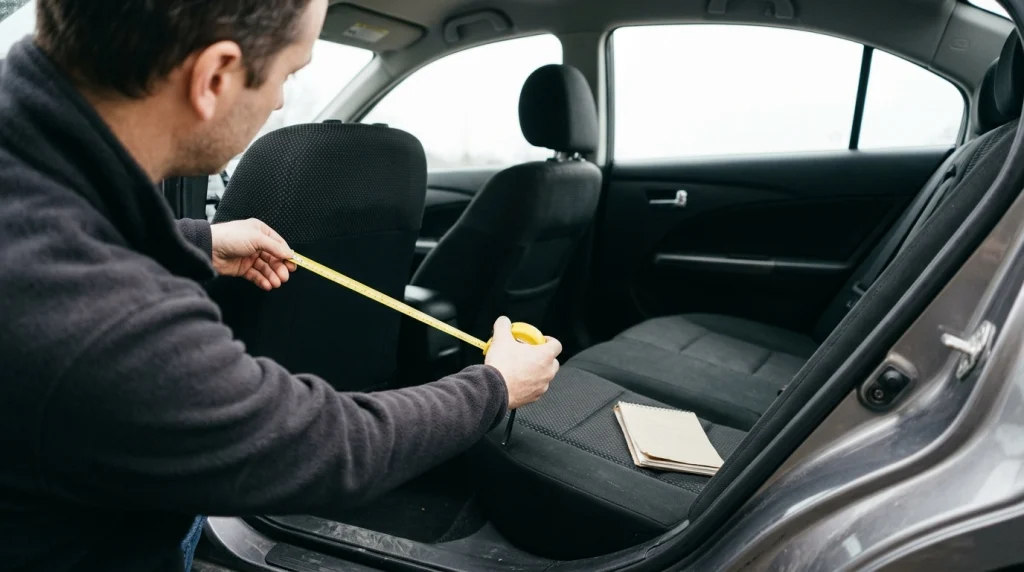
Measure your small car first because guessing leads to returns. Ten minutes with a tape measure beats a week of wrestling with the wrong seat.
Start with the front seats in their normal driving positions. Do not push them all the way forward just to make the numbers look good.
Measure from the back of the front seatback to the front edge of the rear seat cushion. That gap is the space your car seat must live in.
Then measure the rear seat depth from front edge to seatback. A short cushion can leave a base hanging over the edge, which most manuals forbid.
Write the numbers down and take them to the shop. A photo of the tape in place helps even more.
Check car seat compatibility with your vehicle before you buy, as fit depends on the seat and the car together, not on either one alone.
What should you check on the car seat box?
Look for the front-to-back length in rear-facing mode. Some makers list it, and some only list width, so ask for the full dimensions when the box stays quiet.
Check the weight and height limits for rear-facing use. A seat with a high rear-facing limit lets you keep a toddler rear-facing longer in the same small car.
Check the recline range on the side label. The indicator shows the allowed angle, and the manual explains which part of the range fits a newborn.
Edmunds lists rear legroom and interior dimensions for many models, which helps when you compare two small cars side by side.
Section takeaway: Measure with the front seats where you really drive, check depth and width at the belt line, and carry those numbers when you shop.
Where Is the Best Spot for a Rear-Facing Seat in a Small Car?
The best spot in a small car is usually the rear centre, if your car and seat allow it. It sits between the front seats, so neither driver nor passenger loses as much legroom.
The centre also keeps the baby away from the doors. That matters in a side impact, and it helps when the rear bench is narrow.
But the centre is not always usable. Some cars have no LATCH anchors there, a raised centre hump, or a narrow centre belt that will not hold a base tight.
Check your vehicle manual for approved centre installs. If the manual forbids it, move to an outboard spot and do not improvise.
Behind the front passenger is the next best choice for many families. The passenger is often shorter than the driver, so that front seat can move forward more.
Behind the driver works when the driver is short. It fails fast when a tall driver needs the seat all the way back.
| Rear position | Legroom saved | Install ease | Best when |
|---|---|---|---|
| Rear centre | Most, as it sits between both front seats | Harder, often seat belt only, with a hump to work around | Both front adults are tall, or you want the baby away from the doors |
| Behind passenger | Good, if the passenger can move forward | Easiest, with LATCH anchors and a flat cushion | The driver is taller than the passenger |
| Behind driver | Least, if the driver needs full legroom | Easy, with LATCH anchors and a flat cushion | The driver is short, or the passenger seat must stay back |
Installing a car seat in the middle seat covers centre installs in more depth, including when the centre belt is the only option.
Section takeaway: Try the centre first, fall back to the passenger side for a tall driver, and test both front seats after every move.
How Do You Fit a Rear-Facing Car Seat in a Small Car Without Losing Legroom?
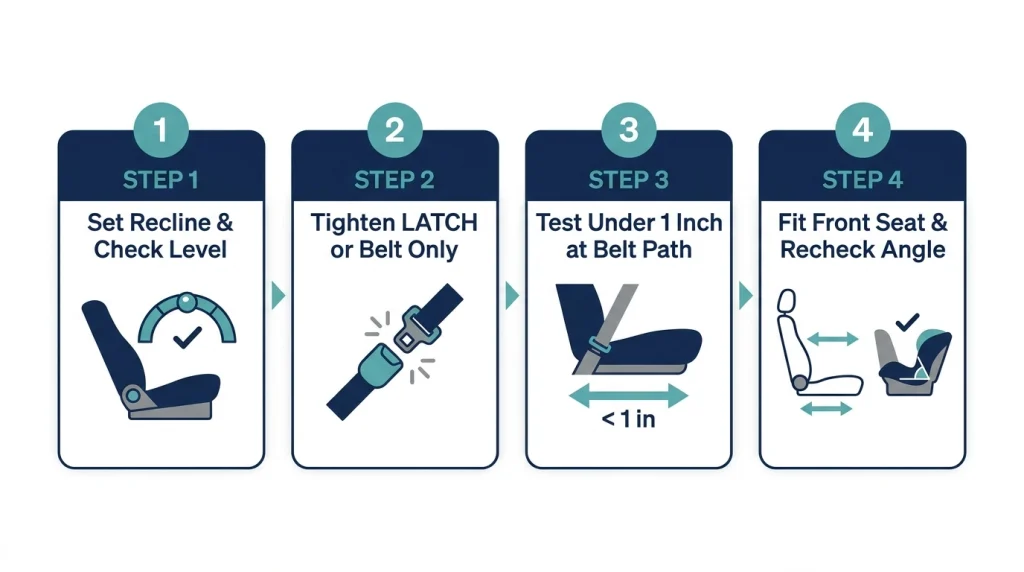
Install a rear-facing car seat to save space by working in order, not by shoving it in. Set the recline, place the seat, tighten, then move the front seat to fit.
Set the recline foot or adjuster before you put the seat in the car. For a newborn, use the reclined end of the range, and for an older baby with head control, use the upright end your manual allows.
Step 1: Place the seat and check the angle
Set the seat on the rear cushion with the baby facing the back of the car. Check the level indicator on the side of the seat.
The bubble or line should sit inside the marked range for your baby’s age. If it sits outside the range, adjust the foot or use a rolled towel only if your manual allows it.
Step 2: Route LATCH or the seat belt, not both
Use LATCH or the seat belt, not both at once, unless your manual says otherwise. Thread the strap or belt through the rear-facing belt path, which is the path marked for rear-facing use.
Push down on the seat with your knee or hand while you pull the strap tight. Your body weight compresses the cushion and takes slack out of the install.
Step 3: Test for movement at the belt path
Grab the seat at the belt path and push it side to side and front to back. It should move less than one inch in any direction.
Test at the belt path only. The top of a rear-facing seat will move more, and that is normal.
Step 4: Move the front seat to fit, then recheck
Slide the front seat forward until it clears the car seat, then sit in it. Check pedal reach, steering distance, and knee room.
Recheck the recline indicator after you move the front seat. A front seatback pressing on the car seat can change the angle.
How to install a rear-facing car seat walks through the full install, including the belt path and the one-inch test.
Pro tip: If the angle will not stay in range, check your vehicle manual and your car seat manual together. One of them usually names the fix for your exact car and seat pair.
Section takeaway: Set recline first, tighten with body weight, test for less than one inch of movement at the belt path, then fit the front seat around it.
Which Compact Rear-Facing Seats Fit Small Cars Best?
Compact rear-facing seats fit small cars best when they are narrow and short front-to-back. Those two numbers matter more than any feature list.
An infant carrier is often the easiest fit for a newborn in a small car. It is short, it clicks onto a base, and you can carry the baby in and out without reinstalling the base.
A compact convertible is the long-term answer for many small cars. It stays rear-facing longer, and some models have a short shell that leaves front legroom intact.
Look for a narrow width, a low profile, and a recline adjuster you can reach with the seat in place. A seat you cannot adjust in the car will stay at the wrong angle.
- Infant carrier: Shortest footprint, easiest to carry, outgrown earliest.
- Compact convertible: Best long-term rear-facing fit, narrow shell, needs a careful recline set.
- Rotating convertible: Easiest loading in a narrow door, often wider, check the turn clearance.
Fitting three car seats in one vehicle uses the same narrow-seat logic, and its width tips work for a single seat in a small car too.
Consumer Reports tests car seats for ease of use and fit, which helps when two seats look the same on the box.
Section takeaway: Start with a carrier for a newborn, move to a compact convertible for the long rear-facing years, and measure any rotating seat before you buy it.
What If the Car Seat Touches the Front Seat?
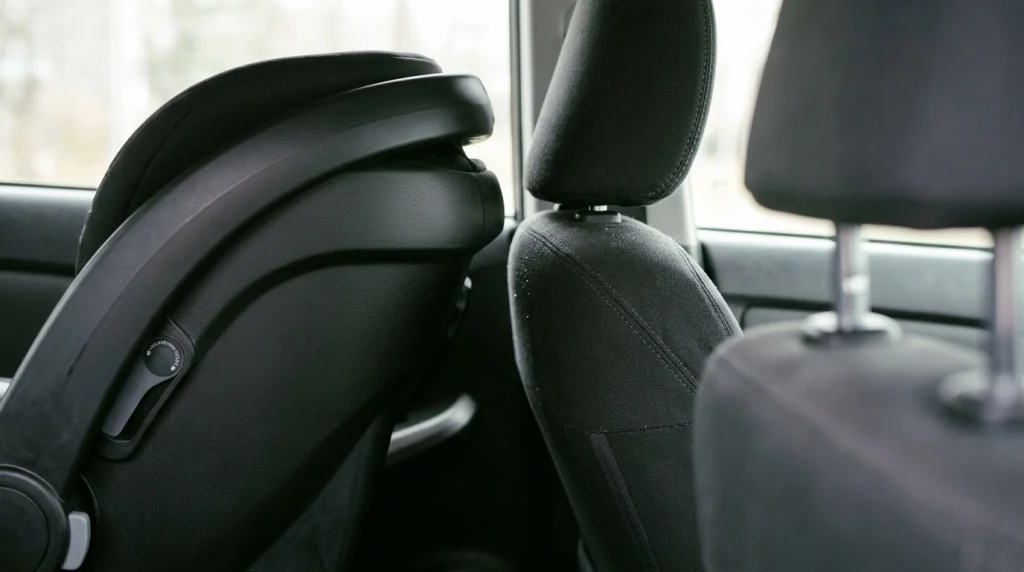
A car seat touching the front seat is a common worry in a small car. The answer depends on what your manuals allow, so do not guess.
Some car seat makers allow light contact with the front seatback. Others forbid any contact at all, and some vehicle makers forbid it too.
Read both manuals before you decide. If either one says no contact, move the front seat forward until there is a gap.
Light contact is not the same as pressure. A seat wedged tight against the front seatback can change the recline angle over time.
It can also push the car seat forward in a crash in ways the maker did not test. That is why the manuals are so specific here.
If you cannot get a gap, try the centre position. The centre often clears both front seats at once, even when an outboard spot touches.
What to do when a car seat does not fit in your vehicle covers the next steps when measuring, moving, and swapping seats still leave you short on room.
Section takeaway: Light contact is allowed only when both manuals allow it, pressure is never a fit, and a shorter shell or the centre spot often solves it.
What Mistakes Should You Avoid in a Small Car?
The biggest mistake in a small car is turning the seat forward-facing early to gain room. Rear-facing protects the head and neck far better, and legroom is never a good trade for that protection.
Children can sit rear-facing with bent legs. Bent legs look cramped to adults, but they are not a safety problem on their own.
A second mistake is using both LATCH and the seat belt at once. Most seats allow one method only, and using both can change how the seat moves in a crash.
A third mistake is skipping the recline check after the front seat moves. The front seatback can nudge the car seat, and the angle can drift out of range without you noticing.
A fourth mistake is adding aftermarket inserts, strap covers, or padding to make a tight seat feel softer. Extra padding can change the harness fit, and most makers forbid it.
A fifth mistake is leaving the harness loose because the baby looks squeezed. Do the pinch test at the shoulder, and tighten until you cannot pinch a fold in the strap.
NHTSA lists free car seat inspection stations, and a certified technician can check a tight small-car install in person.
Pro tip: Book a check with a certified child passenger safety technician before you buy a second seat. A ten-minute check can save a return and a reinstall.
Section takeaway: Do not turn the seat early, do not use LATCH and belt together, recheck recline after every front-seat move, and keep the harness snug.
Frequently Asked Questions
Can a rear-facing car seat fit in a small car?
Yes, in most small cars, with the right seat and the right spot. Measure the back seat, try the centre or passenger side, set the recline to the upright end of the range for an older baby, and choose a compact carrier or convertible.
How much legroom will I lose in the front?
It depends on the car, the seat, and who sits in front. A compact seat in the centre often costs each front adult only a little legroom.
Is it safe if the car seat touches the front seat?
Only if both your car seat manual and your vehicle manual allow contact. If either forbids it, move the front seat forward until there is a clear gap, and recheck the recline after the move.
Can I put a rear-facing car seat in the middle seat of a small car?
Yes, if your vehicle manual allows a centre install and the centre belt or LATCH setup holds the seat tight. The centre often saves the most front legroom, but a raised hump or narrow belt can rule it out.
When can my baby sit more upright rear-facing?
Once your baby has strong head control, most seats allow a more upright angle within the marked range. Check the manual for the exact range, and never go past the upright mark to gain room.
What is the best rear-facing car seat for a small car?
The best one is the compact seat that fits your car and your baby and installs tight every time. Look for a narrow shell and a short front-to-back length.
Should I turn my baby forward-facing if the car is too small?
No, do not turn a baby forward-facing just for legroom. Keep the baby rear-facing to the seat’s height or weight limit, and fix the fit with a better spot, a more upright recline, or a more compact seat.
How do you fit a rear-facing car seat in a small car? Treat it as a measurement job first and a shopping job second. Measure the car, try the centre, set the recline with care, and test the front seats after the install.
Keep the baby rear-facing, keep the harness snug, and get a free technician check if the fit still feels tight. A small car can work, and the right fit makes it feel roomy enough.

Daniel Brooks is an automotive writer and product researcher focused on car accessories, car tech, maintenance, and practical driving guides. At Plug-in Car World, he helps drivers make smarter automotive decisions through honest reviews and research-driven content.
