
How to Choose a Car Seat Based on a Child’s Size
Quick Answer
To choose a car seat based on your child’s size, check their current height and weight against the seat manufacturer’s limits. Start with a rear-facing seat, move to a forward-facing harness seat only after the rear-facing limits are reached, and introduce a booster after the forward-facing limits are outgrown. Finally, check that the seat fits your vehicle and that your child fits it correctly. Follow the NHTSA car seat recommendations and your specific seat’s instructions.
What to check before choosing
- Child’s weight: Confirm that the child falls within the seat’s permitted weight range.
- Child’s height: Check the maximum height and any head-position requirements.
- Seat stage: Choose rear-facing, forward-facing, or booster according to the child’s current stage.
- Harness fit: Make sure the straps sit at the correct shoulder position and tighten properly.
- Vehicle fit: Confirm that the seat installs correctly in your vehicle.
- Expiration and recalls: Check the manufacture date, useful-life limit, and recall status.
Choosing a car seat gets easier when you understand how your child’s size affects the decision. Age provides a starting point, but height and weight determine whether a particular seat remains suitable.
I’ve organized this guide around the measurements parents should check, the different seat stages, and the details that are easy to overlook. You’ll also learn how to avoid buying a seat that your child outgrows too quickly.
Why Does a Child’s Size Matter When Choosing a Car Seat?
A car seat is a child restraint designed to protect a child within specific height, weight, and usage limits. Its harness, shell, and positioning features must accommodate the child’s body correctly.
Two children of the same age can have very different body sizes. One might still fit comfortably within a rear-facing seat’s limits while another has already reached its maximum permitted height.
That’s why I recommend checking measurements before comparing brands or features.
Height and weight serve different purposes
Weight tells you whether the child is within the seat’s permitted load range. Height helps determine whether their head, shoulders, and body still fit within the restraint’s design.
Both measurements matter. A child who reaches either the maximum height or maximum weight limit has outgrown that particular mode, even if the other measurement remains acceptable.
- Weight measurement: Use a reliable scale and record the child’s current weight.
- Height measurement: Measure the child without shoes, standing straight against a wall when appropriate.
- Seat requirements: Compare both measurements with the seat’s labels and instruction manual.
Some seats also have specific head-clearance or shoulder-position requirements. These can matter even when the child remains below the advertised maximum height.
Which Car Seat Type Should You Choose for Your Child’s Size?
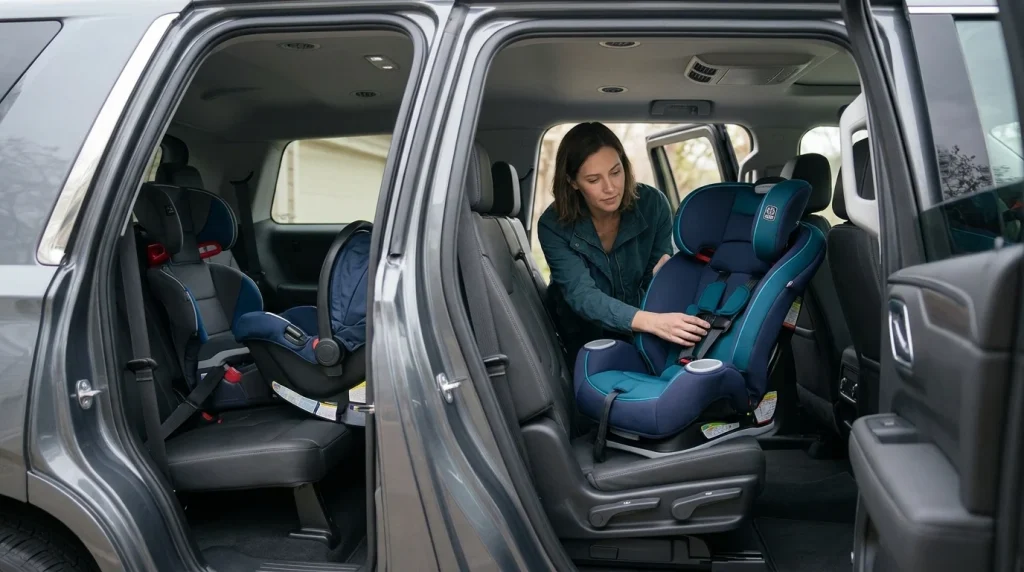
The correct seat depends on the stage your child has reached. In general, children progress from rear-facing restraints to forward-facing harness seats, then to booster seats and eventually adult seat belts.
Here is how the four stages work under current US safety guidance.
1. Rear-facing car seats for infants and toddlers
A rear-facing car seat supports a young child’s head, neck, and back during a crash. It is the recommended starting position for infants and toddlers.
Keep your child rear-facing for as long as possible, until they reach the seat manufacturer’s maximum rear-facing height or weight limit.
You can choose between two common designs:
- Infant-only seat: Designed exclusively for rear-facing use, often with a removable carrier.
- Convertible seat: Can begin in rear-facing mode and later convert to forward-facing mode when the child outgrows its rear-facing limits.
A convertible seat with higher rear-facing limits can provide more room for growth. However, always check its individual measurements and installation requirements.
Never place a rear-facing seat in front of an active passenger airbag.
2. Forward-facing car seats for growing children
Once a child outgrows the rear-facing limits of their seat, the next stage is a forward-facing car seat with a harness and top tether.
This type of restraint holds the child using an integrated harness rather than relying on the vehicle’s adult seat belt to position the body.
Before making the switch, check:
- The child’s weight is within the forward-facing limits.
- The child’s height does not exceed the manufacturer’s maximum.
- The shoulders remain within the permitted harness-slot positions.
- The child’s head remains within the seat’s stated head-position limits.
Keep using the forward-facing harness until the child reaches the applicable height or weight limit. A child who seems tall enough for a booster may still benefit from remaining in a suitable harnessed seat.
3. Booster seats for children who outgrow harnessed seats
A booster seat raises a child so the vehicle’s lap-and-shoulder belt fits across the stronger parts of their body.
It becomes appropriate after the child outgrows the forward-facing seat’s permitted limits and meets the booster manufacturer’s requirements.
There are two common options:
- High-back booster: Provides a backrest and belt guides to help position the shoulder belt.
- Backless booster: Raises the child without an attached backrest and requires suitable vehicle head support.
A booster must be used with a compatible lap-and-shoulder belt. Never use a booster with a lap-only belt.
Don’t choose a booster simply because your child wants to sit like an older sibling. They must meet the seat’s minimum requirements and be mature enough to sit correctly throughout the journey.
4. Vehicle seat belts for children who have outgrown boosters
A child is ready to stop using a booster when the vehicle seat belt fits correctly without one.
Check these five points:
- The child sits with their back against the vehicle seat.
- Their knees bend comfortably at the seat edge.
- The lap belt rests across the upper thighs, not the stomach.
- The shoulder belt crosses the center of the chest and shoulder.
- The child can maintain this position throughout the trip.
If the shoulder belt touches the neck or the lap belt crosses the stomach, continue using an appropriate booster.
US guidance recommends keeping children in the rear seat until at least age 13.
How Do You Compare Car Seat Height and Weight Limits?
The easiest way to compare car seats is to look at the permitted measurements for each stage rather than assuming every seat has identical limits.
The following table shows illustrative requirements from specific products and general selection principles. These are not universal limits for every car seat.
| Seat example | Weight range | Height limit | Usage |
|---|---|---|---|
| Chicco KeyFit 35 | 4–35 lb | 32 in | Rear-facing only |
| Graco Extend2Fit 3-in-1 | 4–50 lb rear-facing | Check model-specific manual | Convertible |
| Graco TurboBooster 2.0 | 40–100 lb | 43–57 in | High-back or backless booster |
Product specifications can vary by model version, manufacturing date, and configuration. Always confirm the exact requirements on the seat itself and in its current manual before using it.
What if your child reaches the weight limit before the height limit?
Stop using that seat in the applicable mode when either maximum is reached. A remaining allowance in the other measurement does not make continued use acceptable.
For example, imagine a rear-facing seat allows up to 40 pounds and 40 inches. If your child reaches 40 pounds at 37 inches, the child has reached the weight limit.
You’ll need another suitable seat or configuration that accommodates the child’s current measurements.
What if your child is tall but lightweight?
A tall, lightweight child can outgrow a seat by height before reaching its weight limit. This is one reason weight alone is not enough when comparing car seats.
Check the manufacturer’s head-clearance rules, shoulder position, and maximum height. If any requirement is exceeded, select an appropriate alternative.
How Do You Measure Your Child Before Buying a Car Seat?
Take accurate measurements before shopping. This helps narrow your options and prevents you from choosing a seat that your child has already outgrown.
Measure your child’s weight
Use a reliable household or medical scale. If your child is too young to stand safely on a regular scale, use an appropriate infant scale.
Record the measurement in pounds or kilograms. Make sure you compare it with the same unit used in the manufacturer’s specifications.
Measure your child’s height
For a standing child, remove their shoes and have them stand straight against a flat wall. Measure from the floor to the top of the head.
For babies who cannot stand, use a suitable flat measuring surface and measure their body length carefully.
Remember that the manufacturer’s instructions may define fit using additional measurements. Overall standing height does not replace seat-specific head-clearance or harness-position requirements.
Check the actual seat fit
Measurements are only the first step. Place your child in the seat and check the harness and body positioning according to the manual.
- The child’s back and bottom should rest against the seat as instructed.
- The harness should lie flat without twists.
- The straps should occupy the correct shoulder slots for the selected direction.
- The harness should be snug enough that you cannot pinch excess webbing at the shoulder.
- The chest clip should sit at armpit level when the seat has one.
A correct measurement on paper does not guarantee a correct harness fit. Check both before every journey.
How Do You Choose a Car Seat That Fits Your Vehicle?
A car seat must fit both your child and your vehicle. A seat with generous height and weight limits is not a good choice if you cannot install it correctly in your car.
Before purchasing, I would compare these practical details:
- Seat dimensions: Check the width, depth, and height of the restraint.
- Rear-seat space: Confirm there is enough room for the seat in its permitted recline position.
- Installation method: Check whether the seat supports an approved vehicle belt installation or compatible lower-anchor system.
- Top tether: Confirm that your vehicle provides the required tether anchor for a forward-facing installation.
- Other passengers: Make sure the installation does not interfere with neighboring seats or their belts.
Read both manuals before installation. The car seat manual explains how the restraint works, while the vehicle manual identifies the permitted seating positions and installation methods.
Do not assume that a seat fits because it physically sits on the vehicle cushion. It must also meet the manufacturer’s installation requirements.
Should you use LATCH or the vehicle seat belt?
Both methods can provide a correct installation when used according to the manuals. LATCH refers to the lower anchors and tether system used in compatible vehicles and child restraints.
Some seats permit either lower anchors or a vehicle seat belt, but they may have specific restrictions on using both together.
Follow the seat’s instructions and check the vehicle’s lower-anchor weight limits. For forward-facing installations, use the top tether as directed.
After installation, check movement at the belt path. NHTSA’s general installation guidance calls for no more than one inch of movement from side to side or front to back at that point.
What Features Matter When Comparing Different Car Seats?
Once you’ve identified the correct stage, compare features that affect fit, installation, and everyday use. A more expensive seat does not automatically offer better protection.
Adjustable harness and headrest
An adjustable harness helps accommodate a growing child without requiring an entirely new seat immediately. A no-rethread harness can make some adjustments easier.
However, adjustment ranges differ between models. Check the harness limits rather than relying on the feature name.
Extended rear-facing capacity
Some convertible seats offer higher rear-facing limits than basic infant carriers. This can help children remain rear-facing for longer.
Compare both weight and height capacity, along with the required head clearance and available installation space.
Easy installation features
Clear belt paths, built-in lock-offs, leveling indicators, and accessible adjustment mechanisms can make a seat easier to install and use.
These features are useful only when they work with your particular vehicle and seating position.
Expiration and recall information
Check the manufacture date, model number, and expiration or useful-life information. Manufacturers determine the permitted useful life for their individual seats.
Also check whether the exact model has an outstanding safety recall. A seat should not be used with an unresolved recall that affects its safe operation.
What Car Seat Mistakes Should Parents Avoid?
Several common mistakes can lead to an unsuitable seat or an incorrect installation. I recommend checking these points whenever you buy or adjust a restraint.
- Choosing by age alone: Children grow at different rates, so check height and weight.
- Moving forward too early: Keep children rear-facing until they reach the applicable rear-facing limit.
- Ignoring one measurement: Reaching either maximum can mean the seat has been outgrown.
- Using a loose harness: Follow the manual’s instructions for a snug fit.
- Buying without checking vehicle compatibility: A seat must install correctly in the intended vehicle.
- Using an unknown second-hand seat: You may not know its crash history, missing parts, or recall status.
- Ignoring expiration information: Do not use a seat beyond its manufacturer-stated useful life.
For a second-hand seat, NHTSA recommends checking its crash history, model identification, recall status, condition, and availability of all necessary parts and instructions.
If you cannot verify the seat’s history or condition, choosing a different seat is the safer decision.
Which Car Seats Are Worth Comparing?
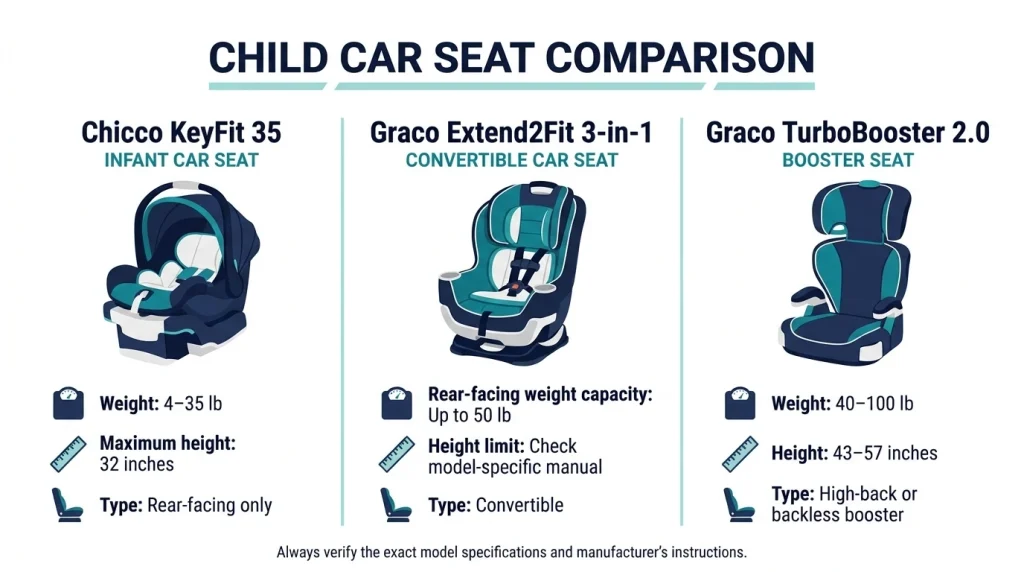
After identifying your child’s current stage, you can compare actual models that offer the required size range. These examples illustrate different seat types rather than claiming that one model is universally best.
Always verify the exact version, current specifications, and compatibility before purchasing.
Infant-only option
Chicco KeyFit 35
Rear-facing infant carrier designed for children weighing 4–35 pounds and up to 32 inches tall. Its adjustable headrest and installation features are useful comparison points for infant-seat shoppers.
Convertible option
Graco Extend2Fit 3-in-1
A convertible restraint with a rear-facing capacity of up to 50 pounds on the listed model. Compare its rear-facing limits, forward-facing requirements, and vehicle installation dimensions.
Booster option
Graco TurboBooster 2.0 Highback
A belt-positioning booster with a removable back. The documented model range is 40–100 pounds and 43–57 inches. Confirm that your child meets its minimum age and size requirements.
These models are starting points for comparison, not substitutes for checking your child’s measurements. Product availability, specifications, and prices can change.
Frequently Asked Questions
Should I choose a car seat based on age or weight?
Use age as a general guide, but choose the seat using your child’s actual height and weight. Both measurements must fall within the manufacturer’s requirements. Also check the child’s head position, shoulder placement, and harness fit before deciding that a particular seat is suitable.
Can a child use a car seat if they exceed its height limit but not its weight limit?
No. If a child exceeds either the maximum height or maximum weight limit for the selected mode, stop using that mode. Check the manufacturer’s instructions for the next suitable configuration or choose another restraint that accommodates the child’s current measurements.
When should I move my child from rear-facing to forward-facing?
Move your child only after they reach the maximum rear-facing height or weight limit of their current seat. Until then, keep them rear-facing. A convertible seat with higher rear-facing limits may provide additional time in this position.
How do I know when my child is ready for a booster seat?
Your child should first outgrow the forward-facing harness limits and meet the booster manufacturer’s minimum requirements. They must also be mature enough to sit properly throughout the journey. The vehicle’s lap-and-shoulder belt must fit correctly when used with the booster.
Does a more expensive car seat offer better protection?
Not necessarily. A higher price does not automatically mean better protection. The most appropriate seat is one that meets the applicable safety standards, fits your child’s measurements, installs correctly in your vehicle, and is used properly on every trip.
Final Takeaway: Choose the Seat That Fits Your Child Today
The best way to choose a car seat is to start with your child’s current height and weight. Then identify the correct seating stage and compare the manufacturer’s limits before considering additional features.
Keep your child rear-facing as long as their seat permits, use a forward-facing harness after they outgrow that stage, and introduce a booster only when they meet its requirements.
Before your next trip, check the seat installation, harness tightness, and vehicle compatibility. A properly selected and correctly used restraint is more important than choosing a popular brand or paying for extra features.
For additional guidance, consult the NHTSA and CDC child passenger safety resources and follow the instructions supplied with your specific car seat.

Daniel Brooks is an automotive writer and product researcher focused on car accessories, car tech, maintenance, and practical driving guides. At Plug-in Car World, he helps drivers make smarter automotive decisions through honest reviews and research-driven content.
