
How to Install a Booster Seat? Step-by-Step Guide for Parents
Quick Answer
To install a booster seat, place it flat on a back seat with a lap-and-shoulder belt, thread the belt through the red guides, buckle it, and remove all slack. The lap belt must sit low on your child’s hips, and the shoulder belt must cross the middle of the chest. First check whether a high-back or backless booster fits your child and your car.
The fast version
- Check readiness first: Your child must meet the booster’s weight, height, and age limits in its manual.
- Use the back seat: A booster belongs in the back seat, never in front of an active airbag.
- Route the belt: Thread the lap and shoulder belt through every red guide on the booster.
- Buckle and tighten: Buckle the belt, then pull the shoulder belt to remove slack from the lap belt.
- Test the fit: The lap belt sits on the hips, the shoulder belt crosses the chest, and the booster does not slide.
Before you drive
- Do the five-step seat belt fit test with your child sitting in the booster.
- If the belt rides up on the stomach or touches the neck, adjust the guides or headrest and recheck.
I’ve installed booster seats in sedans, SUVs, and a tight three-row minivan, and the job looks simple until the belt won’t sit right. A booster does one job, and it does it well.
It lifts your child so the adult seat belt fits a smaller body. This guide walks through readiness, high-back and backless choices, the exact install steps, and the fit checks I use every time.
In This Guide
Is Your Child Ready for a Booster Seat?
A booster seat is a child restraint that raises a child so the vehicle’s lap-and-shoulder belt fits the hips and chest correctly. It does not use a harness, and it does not restrain your child on its own.
The adult belt does the restraining work, so the fit matters more than the brand. A booster that lifts the belt into the wrong place can make a crash worse, not better.
What age, weight, and height should you check first?
Most children move to a booster after they outgrow the forward-facing harness seat, often around age five or older. Age alone never decides the move, though.
Check the booster’s manual for its minimum weight and height, then check your child’s current numbers. Many boosters start at 40 pounds, while others start lower or higher.
- Weight limit: Weigh your child first, then compare the number with the manual’s minimum and maximum.
- Height limit: Measure standing height and seated shoulder height if the manual lists both.
- Maturity: Your child must sit upright for the whole ride without leaning, slouching, or unbuckling.
- Harness fit: Stay in the harness seat until the shoulders pass the top harness slots or the weight limit is reached.
Check your state rules too, because minimum ages and booster requirements vary by state. The NHTSA site explains the four stages of child passenger safety and links to state law summaries.
How do you know if your child still needs a harness?
If your child still fits the harness seat, keep them in it. A harness spreads crash forces across the shoulders and hips, and it holds a wiggly child in place.
Watch for these signs that the harness seat still fits. The harness straps sit at or above the shoulders for forward-facing use, the ears stay below the top of the shell, and the chest clip stays at armpit level.
Pro tip: Check the booster manual and your vehicle owner’s manual together, and confirm the seat’s expiration date and recall status before the first install.
Section Takeaway: A booster is a belt-positioning tool, not a shortcut. Move up only when your child meets the weight, height, and maturity limits.
High-Back vs Backless: Which Booster Fits Your Car?
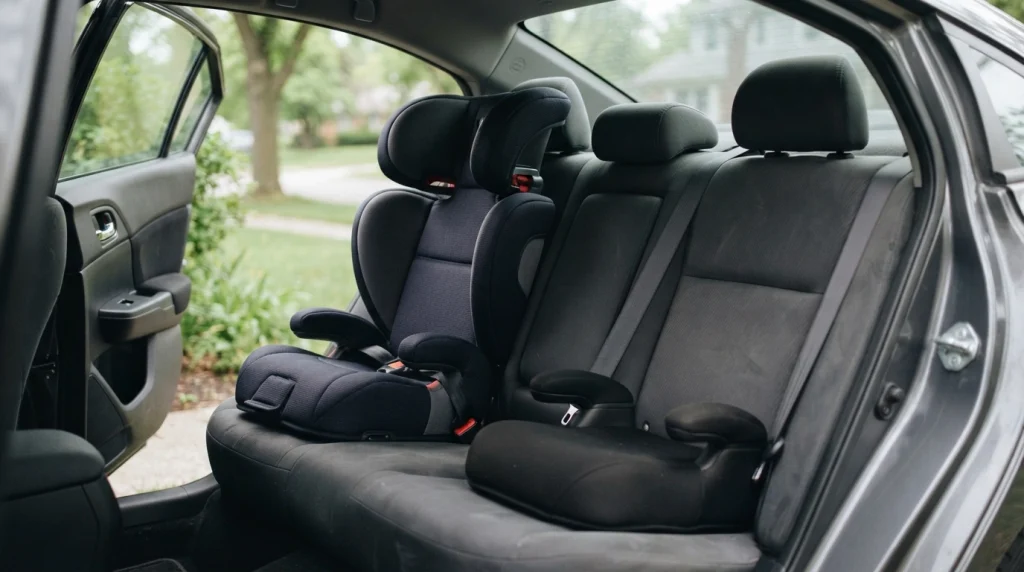
A high-back booster has a backrest, a headrest, and belt guides at the shoulders. A backless booster is just a seat cushion with armrests and lap-belt guides.
Both lift your child the same way, but they suit different cars and children. Your car’s seats and headrests often decide the choice for you.
When does a high-back booster work best?
Choose a high-back booster when your back seat has low headrests or no headrest at all. The booster’s own headrest then supports your child’s head and neck.
High-back models also help children who fall asleep in the car, because the side wings keep the head from flopping forward. They suit younger booster riders and cars with flat bench seats.
When does a backless booster work best?
Choose a backless booster when your car already has tall, adjustable headrests behind your child. The vehicle headrest then protects the head, and the booster only needs to lift the hips.
Backless models also fit better in tight three-across setups and in cars where a wide high-back seat blocks the buckle. They suit older children who sit upright without reminders.
| Feature | High-Back Booster | Backless Booster |
|---|---|---|
| Best for | Younger riders, low car headrests, sleepers | Older riders, tall car headrests, tight rows |
| Head support | Built-in headrest and side wings | Relies on the vehicle headrest |
| Belt guides | Lap and shoulder guides on the backrest | Lap guides under the armrests |
| Install | Heavier, takes more width, LATCH optional | Light, narrow, easy to move between cars |
| When to switch | Move to backless when the headrest still fits and the child sits tall | Use until the adult belt fits without a booster |
Fit the booster to the car first, then check the child. A booster you cannot buckle easily will not get used right.
Section Takeaway: Pick a high-back booster for head support and sleep, and a backless booster when your car already gives that support.
What You Need Before You Install a Booster Seat
You need less gear than a harness install, but the checks still matter. Gather the booster, its manual, and your vehicle owner’s manual before you start.
Read both manuals in the driveway, not on the road. The booster manual shows the belt path, and the vehicle manual shows which seats have lap-and-shoulder belts.
- Booster and manual: Keep the manual in the glovebox so a grandparent or sitter can follow the same steps.
- Vehicle manual: Check the child-restraint section for booster seating positions and headrest rules.
- Clean seat: Vacuum crumbs and remove thick seat covers, because they let the booster slide.
- Working belt: Pull each candidate belt fully out, let it retract, and check for twists, frays, or a stuck buckle.
Which seat in the car should you use?
Use a back seat with a lap-and-shoulder belt, and prefer the centre seat only if it has that belt type. Many centre seats have a lap-only belt, and a booster must never use a lap-only belt.
Check the headrest behind the booster too. For a high-back booster, the vehicle headrest must not push the booster forward, so remove it or adjust it if the manual allows.
For a backless booster, the vehicle headrest must reach at least to the top of your child’s ears. Raise it until it does, and lock it in place.
Should you use LATCH with a booster seat?
Some boosters offer lower anchor connectors, known as LATCH, to hold the empty seat in place. LATCH does not restrain your child in a booster, and the adult belt does that job.
Use LATCH only if the booster manual allows it for your model. Clip the connectors to the lower anchors, tighten them, and leave the belt routing unchanged.
An unsecured booster becomes a projectile in a crash when empty, so LATCH helps most when the seat rides empty often. If your booster has no LATCH, buckle the empty booster with the seat belt when no child rides in it.
Section Takeaway: Pick a back seat with a lap-and-shoulder belt, set the headrest right, and use LATCH only to stop an empty booster from flying.
How to Install a Booster Seat Step by Step
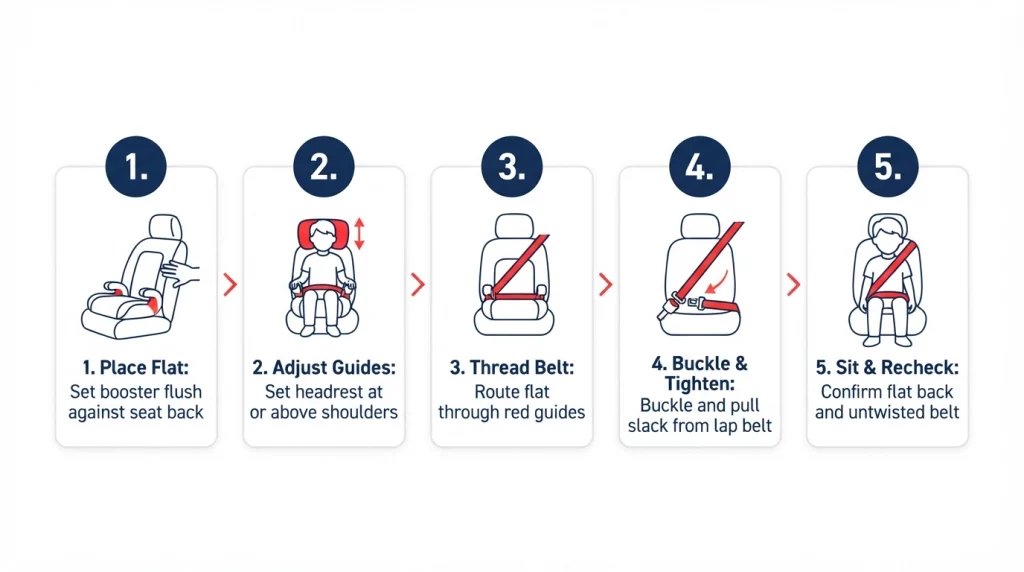
Most booster installs take about 10 minutes once you know the belt path. Slow down on the first install, because the belt guides are easy to miss.
Follow the manual for your exact model, and use these steps as the general pattern. Every booster routes the belt a little differently.
Step 1: Place the booster flat on the seat
Set the booster flat against the vehicle seat back, with no gap behind it. Push it back until the base sits fully on the cushion.
Check that the booster does not hang over the front edge of the vehicle seat. If it overhangs, move it to a flatter seat or choose a smaller model.
Step 2: Adjust the headrest and belt guides
Raise the high-back headrest so the shoulder belt guide sits at or just above your child’s shoulder. The guide should hold the belt flat, not twist it.
For a backless booster, check the armrest guides instead. The lap belt must pass under both armrests, low across the hips.
Step 3: Thread the seat belt through the guides
Pull the lap-and-shoulder belt across your child, then thread it through the red guides. Red marks the belt path on most boosters, so follow the colour.
Keep the belt flat and untwisted through each guide. A twisted belt can cut into the shoulder and will not retract smoothly.
Step 4: Buckle the belt and remove the slack
Buckle the belt, then pull the shoulder belt gently to take slack out of the lap belt. The lap belt should feel snug on the hips, not loose over the stomach.
Press the booster down with one hand while you pull the belt with the other. This seats the booster firmly and stops it rocking side to side.
Step 5: Sit your child in and recheck the belt
Ask your child to sit upright with their back flat against the booster. Their knees should bend at the edge of the seat, and their feet should rest near the floor.
Recheck the belt path now, because a child shifting in the seat can pull the belt out of a guide. Fix any twist before you drive.
I learned this the hard way on a school run, when my nephew slid the shoulder belt behind his arm to stop it rubbing his neck. The belt looked buckled, but it could not protect his chest at all.
Section Takeaway: Place, guide, buckle, tighten, then recheck after your child sits down. The last check is the one that saves the install.
How to Check the Seat Belt Fit After Install
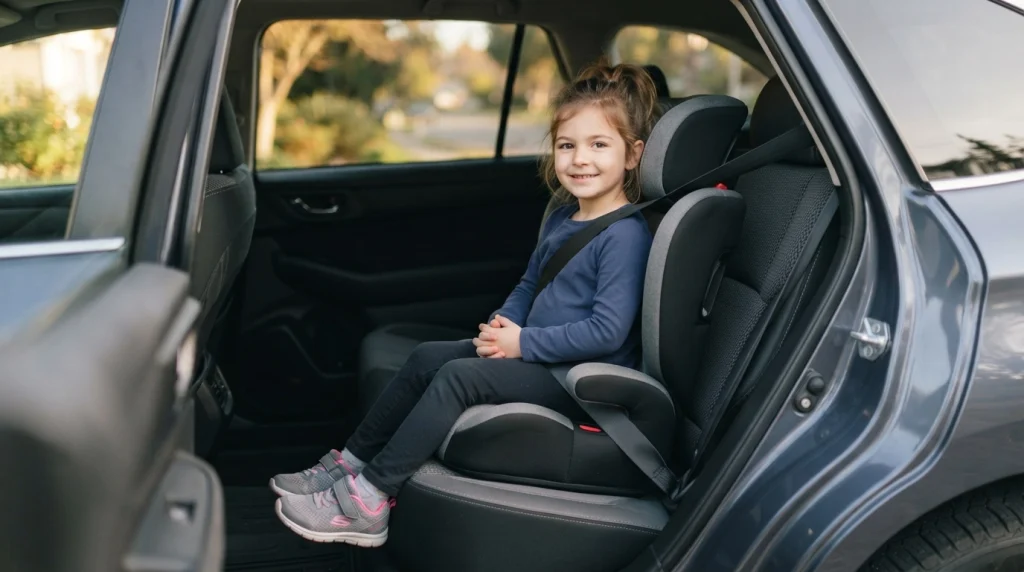
A booster install is not finished until the belt fits your child’s body. Use the five-step test, and repeat it as your child grows.
The five-step seat belt fit test gives you a pass-or-fail answer in under a minute. If any step fails, keep using the booster.
- Back flat: Your child sits with their back flat against the vehicle or booster seat back.
- Knees bend: Knees bend naturally at the edge of the seat, without slouching forward.
- Lap belt low: The lap belt sits low on the hip bones, touching the tops of the thighs.
- Shoulder belt centred: The shoulder belt crosses the middle of the chest and shoulder, not the neck or face.
- Feet flat: Feet rest on the floor, and your child can stay in that position for the whole ride.
What if the shoulder belt touches the neck?
First, move the high-back headrest up or down until the guide centres the belt on the chest. A guide set too low pulls the belt toward the neck.
Next, try a different seating position, because belt anchor points vary by seat. The outboard seats often give a better belt angle than the centre seat.
Never use a belt adjuster clip or put the shoulder belt behind your child’s back. Both tricks hide the problem and remove chest protection in a crash.
What if the lap belt rides up on the stomach?
A lap belt on the stomach can injure soft organs in a crash, so fix it before you drive. Pull the belt through the lap guides again, and tighten the slack.
Check for bulky coats too, because thick padding lifts the belt off the hips. Remove the coat, buckle the belt snugly, then place the coat over the belt like a blanket.
Read the Consumer Reports booster seat buying guide for model-specific belt-fit notes, and compare its findings with your manual before you switch models.
Section Takeaway: The belt must sit low on the hips and flat across the chest. If it touches the neck or stomach, adjust the booster, not the belt.
Common Booster Seat Mistakes to Avoid
Most booster mistakes look small, yet they change how the belt works. I see the same five errors at school pickup lines, and each one takes seconds to fix.
Run through this list after every install, especially when another driver moves the seat. A quick scan beats a long correction later.
- Lap-only belt: Never install a booster with a lap-only belt, because it gives no upper-body protection.
- Belt behind the back: Never route the shoulder belt behind your child’s arm or back, because it leaves the chest unprotected.
- Thick seat cover: Remove thick towels or covers under the booster, because they let the seat slide in a crash.
- Wrong headrest: Do not use a backless booster when the vehicle headrest sits below your child’s ears.
- Loose install: Do not accept a booster that slides more than a hand’s width side to side when buckled.
- Expired seat: Check the expiration date moulded into the shell, because plastic weakens with age and heat.
Read the common car seat installation mistakes guide for the wider list, and check the guide to checking whether your car seat is installed correctly after any change of car or seat position.
The Edmunds car seat guides and the Car and Driver child-seat coverage both stress the same point. Read your manual first, because each booster routes its belt differently.
Section Takeaway: Skip the shortcuts, keep the belt flat and low, and recheck the install whenever the seat moves.
Frequently Asked Questions
How do I install a booster seat with LATCH?
Clip the lower connectors to the vehicle anchors if your booster manual allows it, then tighten them so the empty seat stays put. Buckle the adult belt through the guides as normal, because LATCH holds the seat, not your child.
Can I install a booster seat in the front seat?
No, keep a booster in the back seat whenever your car has one. A front airbag can injure a child in a booster, even in a low-speed crash.
Do booster seats need a top tether?
No, booster seats do not use a top tether. The adult lap-and-shoulder belt restrains your child, while the booster only positions that belt correctly.
How tight should a booster seat be?
The booster should sit flat and stay put when you push it side to side with the belt buckled. The belt itself should feel snug on the hips, with no loose loop over the stomach.
When can my child stop using a booster seat?
Your child can stop when the adult belt fits without help, usually between ages 10 and 12. Check the five-step fit test, and read when a child can stop using a booster seat and when a child should switch to a booster seat for the timing signs.
Can I use a booster seat on an airplane?
No, airlines do not allow booster seats during flight, because planes use lap-only belts. Use an approved harness seat for flying, and pack the booster for the car at your destination.
How often should I recheck the booster install?
Recheck the belt fit every few weeks and after any growth spurt, car change, or wash. A child who grew two inches can outgrow a headrest setting without you noticing.
Installing a booster seat takes ten careful minutes, and the payoff lasts the whole ride. Place it flat, route the belt through every guide, buckle it snug, and test the fit before you pull away.
If the belt still touches the neck or rides up on the stomach, adjust the headrest or move seats. When in doubt, ask a certified child passenger safety technician to check the install in person.

Daniel Brooks is an automotive writer and product researcher focused on car accessories, car tech, maintenance, and practical driving guides. At Plug-in Car World, he helps drivers make smarter automotive decisions through honest reviews and research-driven content.
