
When Can a Child Stop Using a Booster Seat? Safety Guidelines
Quick Answer
Most children can stop using a booster seat when they reach approximately 4 feet 9 inches tall and can wear an adult seat belt correctly without help. This often happens between ages 8 and 12, but height, body proportions, seat-belt fit, and local laws matter more than age alone. Check the guidance from the National Highway Traffic Safety Administration before making the switch.
How to Know Your Child Is Ready
- Proper height: Your child is around 4 feet 9 inches tall, although height alone doesn’t guarantee a good fit.
- Lap belt: The belt rests low across the upper thighs, not across the stomach.
- Shoulder belt: It crosses the middle of the chest and shoulder, away from the neck.
- Back position: Your child can sit with their back against the vehicle seat.
- Knee position: Their knees bend naturally at the seat edge without slouching.
- Safe behavior: Your child can maintain the correct sitting position throughout every trip.
One Important Safety Tip
- Test the seat belt in the actual vehicle and seating position. If any part of the fit test fails, continue using an appropriate booster seat.
Knowing when to stop using a booster seat can be confusing, especially when children grow at different rates. I’ll explain the practical seat-belt fit test, age and height guidelines, and the mistakes parents should avoid.
What Is the Right Age to Stop Using a Booster Seat?
There isn’t one exact birthday when every child becomes ready for an adult seat belt. In the United States, many children need a booster until somewhere between ages 8 and 12.
The important milestone is proper seat-belt fit. A child who is 10 years old might still need a booster, while another child of the same age may fit the vehicle seat belt correctly.
Age is a useful starting point, but it isn’t the final safety test.
Why Do Most Children Need a Booster Until Around Age 8–12?
Vehicle seat belts are designed primarily for adult body proportions. Younger children often have shorter legs and smaller bodies, making the lap and shoulder belts sit incorrectly.
A booster raises the child so the vehicle’s existing seat belt can fit the body more appropriately. It helps position the lap belt across the thighs and the shoulder belt across the chest.
- Before age 8: Many children still need a booster because their bodies haven’t grown enough.
- Ages 8–10: Some children may pass the fit test, but many still need additional support.
- Ages 10–12: More children become ready, provided the seat belt fits properly.
- After age 12: A child who passes the fit test can generally use the vehicle seat belt without a booster.
These are general developmental guidelines, not permission to stop using a booster at a particular age. Always follow applicable child-restraint laws and the vehicle and booster manufacturers’ instructions.
How Tall Should a Child Be to Stop Using a Booster Seat?
A height of approximately 4 feet 9 inches (57 inches or 145 cm) is a common guideline for transitioning out of a booster seat. However, children with different body proportions may need a booster even after reaching that height.
The reason is simple: height doesn’t always determine where a vehicle seat belt rests. A longer torso or shorter legs can affect belt positioning.
For that reason, I recommend checking actual seat-belt fit rather than relying on a height measurement alone.
Height and Booster Seat Readiness Compared
| Child’s height | General guidance | What to check |
|---|---|---|
| Under 4 feet | Usually needs a booster | Proper lap and shoulder belt positioning |
| 4 feet to 4 feet 8 inches | Often still needs a booster | The five-step seat-belt fit test |
| Around 4 feet 9 inches | May be ready | Check fit in the actual vehicle |
| Over 4 feet 9 inches | May no longer need a booster | Confirm all five fit-test requirements |
This table provides general guidance, not a substitute for checking your child’s individual fit. The vehicle’s seat design can also affect the result.
How Do You Know If Your Child Is Ready to Stop Using a Booster Seat?
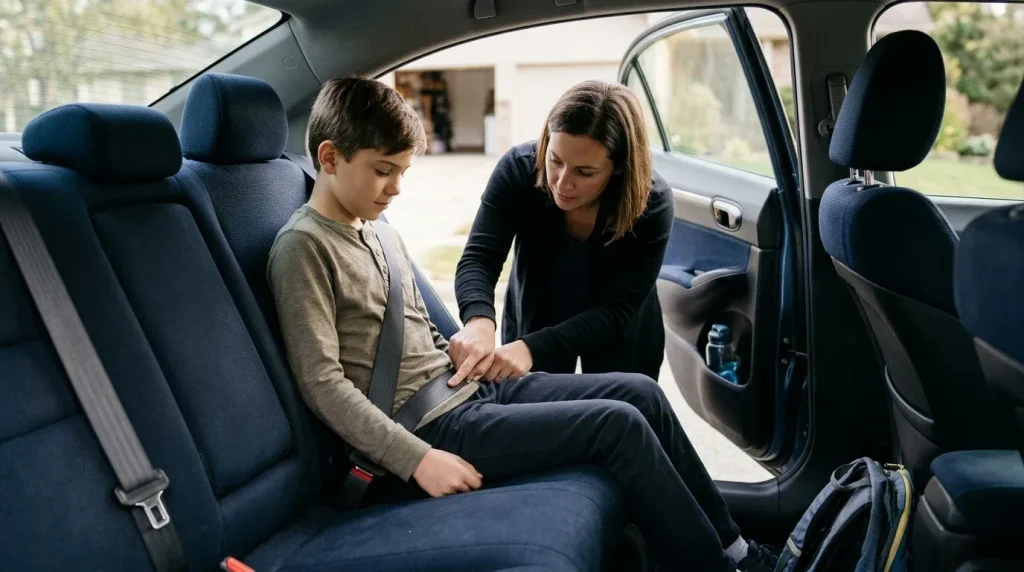
The five-step seat-belt fit test is one of the most practical ways to check booster-seat readiness. It examines how the vehicle’s seat belt fits your child’s body while they’re sitting normally.
Try this test with your child in the back seat, without the booster.
The Five-Step Seat-Belt Fit Test
- Back against the seat: Can your child sit with their back completely against the vehicle seat?
- Knees bend naturally: Do their knees bend comfortably over the front edge of the seat?
- Shoulder belt position: Does the shoulder belt cross the middle of the shoulder and chest rather than the neck or face?
- Lap belt position: Does the lap belt rest low across the upper thighs rather than the stomach?
- Stays seated correctly: Can your child maintain this position throughout the entire journey without slouching?
If your child fails even one part, continue using a properly fitted booster seat in that vehicle.
Don’t rush this test. Repeat it occasionally as your child grows.
What Does a Proper Seat-Belt Fit Look Like?
A correctly fitted seat belt rests against stronger parts of your child’s body. The lap portion should sit low across the hips and upper thighs, while the shoulder portion crosses the chest.
- Good fit: The lap belt stays below the stomach.
- Good fit: The shoulder belt rests between the neck and upper arm.
- Poor fit: The lap belt crosses the soft stomach area.
- Poor fit: The shoulder belt touches the neck or slides off the shoulder.
- Poor fit: Your child has to slouch to bend their knees.
A seat belt that looks comfortable isn’t necessarily positioned safely. Check both belt sections carefully.
Why Should You Avoid Switching Out of a Booster Seat Too Early?
A booster seat helps protect children by positioning the vehicle’s seat belt correctly. Without it, a poorly positioned belt may place crash forces on vulnerable parts of a child’s body.
Children also tend to move around during longer journeys. Slouching, leaning forward, or moving the shoulder belt can change how the restraint fits.
Common Problems When Children Stop Using Boosters Too Soon
- Lap belt rides upward: The belt may cross the abdomen instead of the upper thighs.
- Shoulder belt touches the neck: Children may move the belt behind their backs or under an arm to feel comfortable.
- Child slides forward: Slouching can move both belt sections away from their intended positions.
- Uncomfortable knee position: Short legs may not bend naturally at the edge of the vehicle seat.
- Incorrect sleeping position: A sleeping child may lean forward or sideways, changing belt placement.
These problems explain why reaching a certain birthday shouldn’t automatically end booster-seat use. Proper positioning matters on every trip.
Does a Child Need a Booster Seat Until Age 12?
Not every child needs a booster until their twelfth birthday, but many do. The right time depends on body size, vehicle seat design, seat-belt geometry, and the child’s ability to sit correctly.
The Centers for Disease Control and Prevention (CDC) places the usual booster-to-seat-belt transition around ages 9–12. The American Academy of Pediatrics (AAP) also recommends continuing booster use until the adult seat belt fits properly.
Some children pass the fit test earlier. Others need more time.
Booster Seat vs. Seat Belt: What’s the Difference?
| Feature | Booster seat | Seat belt alone |
|---|---|---|
| Purpose | Raises the child for proper belt positioning | Restrains a child whose body fits correctly |
| Lap belt | Rests low across the upper thighs | Rests low across the upper thighs |
| Shoulder belt | Positioned across the chest and shoulder | Naturally fits across the chest and shoulder |
| Best suited for | Children who have outgrown harnessed seats but not adult belt fit | Children who pass all five fit-test steps |
| Extra equipment | Appropriate belt-positioning booster | Vehicle lap-and-shoulder belt |
The booster doesn’t replace the seat belt. It works with the vehicle’s lap-and-shoulder belt to improve its positioning.
Does the Type of Vehicle Affect When a Child Can Stop Using a Booster?
Yes. The same child may fit an adult seat belt in one vehicle but still need a booster in another.
Vehicle seats differ in cushion depth, seat height, and shoulder-belt anchor position. These differences affect how the belt crosses a child’s body.
Checking Different Vehicles
- Family sedan: Check whether your child’s knees bend naturally over the front edge of the rear seat.
- SUV: Check the seat cushion depth and shoulder-belt position.
- Pickup truck: Check the specific seating position and available head restraint.
- Another parent’s vehicle: Repeat the fit test rather than assuming the same result.
- Rental car: Check belt positioning before allowing your child to ride without a booster.
I would treat every different vehicle as a fresh fit check. A child shouldn’t automatically graduate from a booster simply because they passed the test in the family car.
Should Children Still Sit in the Back Seat After Outgrowing a Booster?
Yes. In the United States, children younger than 13 should generally ride properly restrained in the back seat because it offers better protection from front-seat air bags and crash forces.
Stopping booster use doesn’t mean a child is ready for the front passenger seat.
Keep these safety habits in place:
- Use a properly fitted lap-and-shoulder belt on every trip.
- Keep the shoulder belt across the chest, never behind the back.
- Never place the lap belt across the stomach.
- Use the back seat until at least age 13.
- Make sure every passenger has their own seat belt.
The CDC recommends keeping children properly buckled in the back seat until age 13. You can review its child passenger safety guidance for more details.
What Do Booster Seat Laws Say About When Children Can Stop?
Booster seat laws depend on where you live. In the United States, individual states establish their own child-restraint requirements, including age, height, and sometimes weight limits.
A child might pass the physical seat-belt fit test but still fall under a legal booster-seat requirement. Always check the rules in your state before changing your child’s restraint.
What Should Parents Check in Their State?
- Age requirement: Find out how long the law requires a child to use an approved restraint.
- Height requirement: Check whether the law specifies a minimum height for using an adult seat belt.
- Weight requirement: Some jurisdictions include weight-related rules.
- Seating position: Check whether children must ride in the back seat until a certain age.
- Approved equipment: Confirm that the booster seat meets applicable safety standards.
For reliable information, start with the NHTSA car-seat and booster-seat safety resources. Then check your state’s official transportation or public safety website.
Important: The age and height recommendations in this article are U.S.-focused. Other countries may have different child-restraint laws and safety standards.
What Should You Do If Your Child Is Uncomfortable Using a Booster Seat?
Some older children feel embarrassed about using a booster seat, especially when their friends have already stopped. However, comfort and peer pressure shouldn’t decide when the booster comes out.
Explain that children grow at different speeds. The booster isn’t a punishment; it’s a way to help the seat belt fit their body.
Practical Ways to Handle Booster-Seat Resistance
- Explain the reason: Show your child where the lap and shoulder belts should rest.
- Involve them: Let them participate in the five-step fit test.
- Check comfort: Make sure the booster is correctly installed and compatible with the vehicle.
- Set clear rules: Explain that everyone wears the restraint appropriate for their body size.
- Be consistent: Apply the same safety rules on short drives and long journeys.
As your child grows, repeat the fit test. This gives them a clear way to understand when they can safely transition.
What If Your Child Passes the Fit Test in One Car but Not Another?
Continue using a booster in the vehicle where the seat belt doesn’t fit correctly. A child’s booster-seat needs can change depending on the vehicle and seating position.
For example, a child might sit comfortably in a sedan’s rear seat but have the shoulder belt cross their neck in an SUV. The booster should stay in use for the SUV until the fit improves.
There’s no need to force the same decision across every vehicle.
What Should You Check Before Removing a Booster Seat?
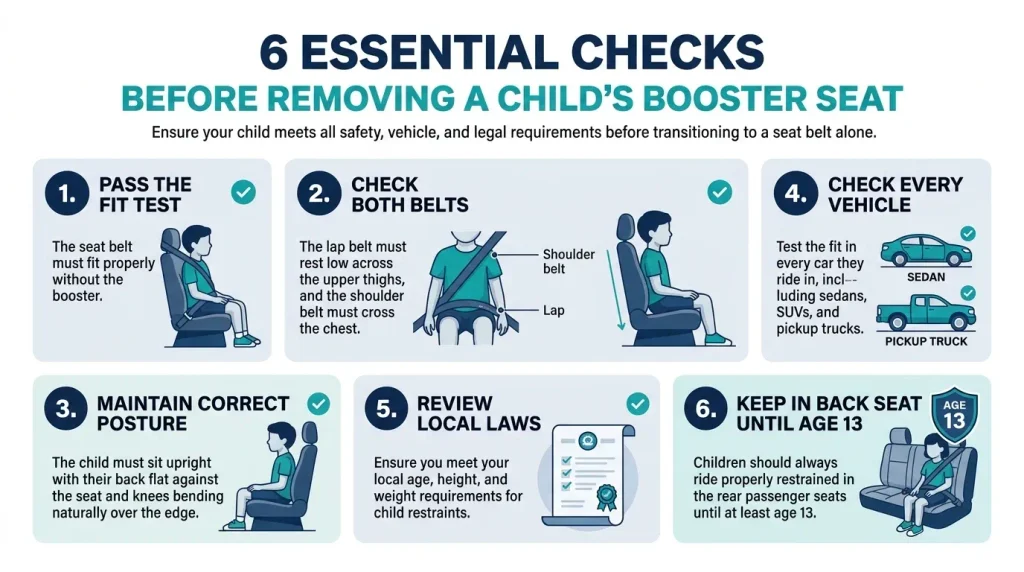
Before making the transition, take a few minutes to check the child’s readiness, the vehicle, and the applicable instructions.
- Confirm that your child has outgrown the booster stage only after passing the seat-belt fit test.
- Check the lap and shoulder belt in the actual seating position.
- Make sure your child can maintain the correct position without reminders.
- Repeat the check in every vehicle they regularly use.
- Review local child-restraint laws.
- Keep your child in the back seat until at least age 13 under U.S. safety guidance.
One successful test isn’t a permanent guarantee. Growth and changes in vehicles can affect belt fit over time.
Do You Need to Buy a Different Booster Seat?
Not necessarily. If your child hasn’t passed the fit test, a properly fitting booster that meets the manufacturer’s instructions may remain the right choice.
There’s no safety benefit in buying a new booster simply because your child is getting older. First check the limits, condition, compatibility, and correct use of the seat you already own.
If your child needs a replacement, compare the manufacturer’s height and weight limits, belt guides, vehicle compatibility, and instructions. Don’t choose a model based only on its appearance or a star rating.
When Should You Replace an Existing Booster?
- Outgrown limits: Your child exceeds the manufacturer’s height or weight limits.
- Expiration: The booster has reached its stated expiration date, if one applies.
- Damage: The seat has cracks, broken parts, or other damage.
- Missing instructions: You cannot establish how to use it safely.
- Vehicle incompatibility: The seat cannot be positioned correctly in the vehicle.
Follow the manufacturer’s instructions after a crash, since replacement guidance can vary by seat and crash circumstances.
Frequently Asked Questions
1. Can a 7-year-old stop using a booster seat?
Most 7-year-olds still need a booster seat because their bodies may not fit an adult seat belt correctly. Continue using a booster until the lap and shoulder belts fit properly and your child can pass all five steps of the seat-belt fit test.
2. Can a 9-year-old ride without a booster seat?
Yes, if the child passes all five seat-belt fit requirements and local laws allow it. However, many 9-year-olds still need boosters. Check belt positioning in the actual vehicle rather than making the decision based on age alone.
3. Does a child need to be 4 feet 9 inches to stop using a booster?
Four feet 9 inches is a common guideline, not an absolute requirement for every child. Some children may fit correctly at a different height. The five-step seat-belt fit test provides a more useful way to evaluate readiness.
4. Should a 12-year-old still use a booster seat?
A 12-year-old may still need a booster if the vehicle seat belt crosses the stomach or neck, or if they cannot sit comfortably without slouching. If the seat belt fits properly, a booster may no longer be necessary, subject to local laws.
5. When can a child sit in the front seat without a booster?
Outgrowing a booster doesn’t mean a child is ready for the front passenger seat. U.S. safety guidance recommends keeping children properly restrained in the back seat until age 13. Follow your vehicle manufacturer’s air-bag instructions and local laws.
Final Thoughts: Let Seat-Belt Fit Decide
Knowing when a child can stop using a booster seat comes down to more than age or height. The most important question is whether the vehicle’s seat belt fits your child’s body correctly.
Use the five-step test, check every vehicle, and follow local child-restraint laws. If your child fails even one step, keep using an appropriate booster seat.
There’s no need to rush this milestone. A little extra time in a booster is better than moving to an adult seat belt before your child is ready.
“`

Daniel Brooks is an automotive writer and product researcher focused on car accessories, car tech, maintenance, and practical driving guides. At Plug-in Car World, he helps drivers make smarter automotive decisions through honest reviews and research-driven content.
