
When Should a Child Switch to a Booster Seat? A Parent’s Safety Guide
Quick Answer
A child should switch to a booster seat after outgrowing their forward-facing car seat’s harness height or weight limits, provided they are mature enough to sit correctly. Many children make this transition around age 5 or older, but readiness depends on the individual child and the seat manufacturer’s instructions. See the CDC child passenger safety recommendations for guidance.
Signs Your Child May Be Ready for a Booster
- Outgrown harness: Your child has reached the forward-facing seat’s height or weight limit.
- Minimum requirements: Your child meets the booster manufacturer’s minimum age, weight, and height requirements.
- Good posture: Your child can sit upright without slouching.
- Proper behavior: Your child can keep the seat belt correctly positioned throughout every trip.
- Correct belt system: Your vehicle has a compatible lap-and-shoulder seat belt.
Important Safety Reminder
- Don’t move a child into a booster simply because they have reached their fifth birthday.
- Keep children in the back seat until at least age 13.
- Continue using a booster until the adult seat belt fits correctly without it.
Moving from a harnessed car seat to a booster feels like a big milestone. However, I wouldn’t rush this transition just because a child wants to sit like an older sibling.
The right timing depends on more than birthdays or clothing sizes. In this guide, I’ll explain how to recognize booster readiness, check seat belt fit, choose the right booster, and avoid common safety mistakes.
What Is a Booster Seat?
A booster seat is a child passenger safety device that raises a child so the vehicle’s adult seat belt fits correctly across their body. It helps position the lap and shoulder belts over stronger areas of the body rather than the stomach or neck.
Unlike a traditional forward-facing car seat, a standard belt-positioning booster doesn’t use an internal five-point harness. It works with the vehicle’s lap-and-shoulder seat belt to restrain the child.
The main purpose is simple: a child who is too small for an adult seat belt needs help achieving a safer belt position.
Why Do Children Need Booster Seats?
Vehicle seat belts are designed primarily around adult body proportions. A younger child’s body may not fit those belts correctly without additional height and positioning support.
Without a suitable booster, the lap belt may ride over the abdomen. The shoulder belt may also cross the neck or slip off the shoulder.
A properly selected booster helps address these problems by:
- Positioning the lap belt low across the upper thighs and hips.
- Keeping the shoulder belt across the middle of the chest and shoulder.
- Helping the child sit at an appropriate height for the vehicle seat.
- Reducing the risk of improper belt positioning during everyday travel.
The CDC reports that booster seat use reduces the risk of serious injury by 45% compared with seat belt use alone. This makes the booster stage an important part of child passenger safety.
At What Age Should a Child Switch to a Booster Seat?
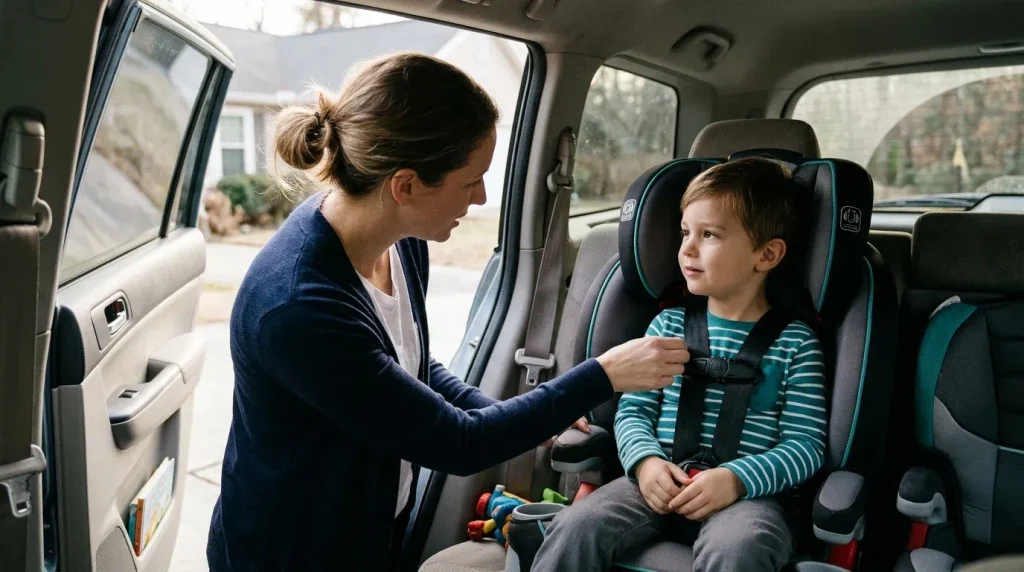
Many children become candidates for a booster around age 5 or older, but there isn’t one universal birthday that determines readiness. The transition should happen after the child outgrows the forward-facing harnessed seat and meets the booster manufacturer’s requirements.
The American Academy of Pediatrics recommends keeping children in forward-facing seats with harnesses until they reach the manufacturer’s height or weight limits. After that, most children should use belt-positioning boosters.
Here is a general guide to the different stages:
| Seat Type | Typical Stage | When to Move On |
|---|---|---|
| Rear-facing seat | Birth through approximately ages 2–4 | When the seat’s rear-facing limits are reached |
| Forward-facing harnessed seat | After outgrowing rear-facing mode, through at least age 5 when possible | When the harnessed seat’s limits are reached |
| Belt-positioning booster | Often approximately ages 5–12 | When the adult seat belt fits correctly without a booster |
| Vehicle seat belt | Often ages 9–12 or older | When proper fit continues in the vehicle |
These are general developmental ranges, not mandatory transition dates. Always follow the limits and instructions for the specific seat your child uses.
The CDC recommends using a booster after a child outgrows the forward-facing seat and continuing until the vehicle seat belt fits properly. Its guidance also recommends keeping children in the back seat until age 13.
What Signs Show That a Child Has Outgrown a Forward-Facing Car Seat?
A child has outgrown a forward-facing car seat when they reach one of its stated height or weight limits or another manufacturer-defined fit limit. Check the seat label and instruction manual rather than relying on appearance alone.
Several signs deserve attention:
- Weight limit reached: Your child’s weight has reached the maximum permitted for harness use.
- Height limit reached: Your child has reached the maximum standing height allowed by the manufacturer.
- Shoulders above harness slots: Your child’s shoulders exceed the permitted harness position for that particular seat.
- Head position limit: Your child’s head has reached the maximum permitted position relative to the seat shell or headrest.
Different car seats have different limits. Never assume that two seats from the same brand have identical requirements.
What If Your Child Outgrows the Harness but Isn’t Ready for a Booster?
This is an important situation that parents sometimes overlook. A child may become too large for a particular harnessed seat but still struggle to remain correctly positioned with an adult seat belt.
In that situation, look for another harnessed car seat with higher height and weight limits if one is appropriate. Don’t move a child into a booster before they meet its requirements and can use it correctly.
The NHTSA car seat guidance explains how to choose the next appropriate restraint based on a child’s size and the manufacturer’s limits.
How Do You Know If Your Child Is Mature Enough for a Booster?
Physical size isn’t the only factor. A child must also have the maturity to sit properly and follow seat belt rules throughout the journey.
A booster uses the vehicle’s seat belt instead of an internal harness. That means your child needs to maintain the correct position without constant physical restraint from the car seat.
Look for these behaviors:
- Your child sits upright against the booster and vehicle seat.
- They don’t lean forward to reach toys or objects.
- They don’t twist sideways during the drive.
- They keep the shoulder belt across the chest.
- They never move the shoulder belt behind their back or under an arm.
- They can maintain proper posture even when tired.
That last point matters. A child who sits correctly for a short trip might struggle during a longer journey.
If your child frequently slouches, wiggles, or moves the belt, they may need more time in a suitable harnessed seat.
What Is the 4-Foot-9-Inch Rule for Booster Seats?
The 4-foot-9-inch guideline refers to the height at which many children begin fitting adult vehicle seat belts correctly without a booster. It equals 57 inches, or approximately 145 centimeters.
However, reaching 4 feet 9 inches doesn’t automatically mean every child can stop using a booster. Actual seat belt fit matters more than height alone.
Many children reach this height between ages 8 and 12. Some need a booster for longer, depending on their body proportions and the vehicle’s seat design.
How to Perform the Five-Step Seat Belt Fit Test
Before removing a booster, check whether your child can pass all five parts of this test while sitting directly on the vehicle seat.
- Back against the seat: Your child can sit with their back resting comfortably against the vehicle seat.
- Knees bend naturally: Their knees bend at the edge of the seat without slouching.
- Lap belt position: The lap belt sits low and snug across the upper thighs, not the stomach.
- Shoulder belt position: The shoulder belt crosses the middle of the shoulder and chest, not the neck or face.
- Comfortable posture: Your child can maintain this position for the entire trip without leaning or sliding down.
If your child fails even one part, continue using a suitable booster.
Repeat the test periodically as your child grows. Also perform it in every vehicle they regularly ride in because seat designs and belt positions differ.
High-Back vs. Backless Booster: Which Should You Choose?
Both high-back and backless boosters help position a child’s body for the vehicle’s lap-and-shoulder belt. The right option depends on your vehicle, your child’s size, and the manufacturer’s instructions.
Here’s how the two types compare:
| Feature | High-Back Booster | Backless Booster |
|---|---|---|
| Back support | Includes a supportive back | No built-in back support |
| Head support | May include an adjustable headrest | Depends on the vehicle seat and head restraint |
| Belt positioning | Often includes shoulder belt guides | Uses the booster and vehicle belt arrangement |
| Portability | Generally bulkier | Usually lighter and easier to move |
| Vehicle requirements | Must fit the vehicle seat and manufacturer’s requirements | Requires adequate vehicle head support or a high seat back |
| Best suited for | Children who benefit from back and head support | Children who meet the model’s requirements and have suitable vehicle support |
When Is a High-Back Booster Better?
A high-back booster can be a useful choice for a child transitioning from a harnessed seat. Its backrest and headrest provide additional positioning support.
It can also help guide the shoulder belt into the correct position. This is particularly useful in vehicles with low seat backs or without suitable head restraints, provided the booster and vehicle instructions allow its use.
When Is a Backless Booster Appropriate?
A backless booster is designed for children who meet its specific height, weight, and age requirements. It raises the child without providing a separate backrest or headrest.
Use one only when the vehicle has adequate head and neck support through its seat and head restraint. The shoulder belt must also fit properly.
Neither type is automatically the best choice for every child. Proper fit and correct use matter most.
How Should You Install and Use a Booster Seat?
A booster seat works by positioning your child rather than restraining them with an internal harness. Correct placement and seat belt routing are therefore essential.
Follow these steps:
- Read both manuals: Check the booster manufacturer’s instructions and your vehicle owner’s manual.
- Choose the back seat: Place the booster in an approved rear seating position.
- Check the seating surface: Make sure the booster sits flat and fits the vehicle seat correctly.
- Position your child: Have your child sit upright with their back against the booster.
- Buckle the seat belt: Route the lap and shoulder portions according to the manufacturer’s instructions.
- Check belt placement: Confirm that the lap belt rests low across the upper thighs and the shoulder belt crosses the chest.
- Secure an empty booster: Follow the manual’s instructions for keeping an unoccupied booster from moving around the vehicle.
Some boosters have lower-anchor attachments that help secure the empty seat. Others rely on the vehicle seat and belt arrangement.
Never assume that a booster installs like a traditional harnessed car seat. The correct procedure depends on its design.
For additional installation instructions, consult the NHTSA booster seat installation guide.
What Booster Seat Mistakes Should Parents Avoid?
Even a good booster cannot provide its intended protection when someone uses it incorrectly. A few common mistakes deserve special attention.
- Switching too early: Don’t move a child into a booster before they outgrow the harnessed seat and meet the booster requirements.
- Using a lap belt alone: Standard belt-positioning boosters require a compatible lap-and-shoulder belt.
- Allowing belt misuse: Never let a child place the shoulder belt behind their back or under their arm.
- Ignoring head support: Don’t use a backless booster without the vehicle support required by its manufacturer.
- Choosing by appearance: A comfortable-looking booster isn’t necessarily suitable for your child or vehicle.
- Skipping manual instructions: Different booster designs have different installation and adjustment requirements.
- Removing the booster too soon: Don’t stop using it until the adult belt passes the fit test.
Another mistake is assuming a booster cushion or ordinary pillow can replace a certified booster. Household cushions and improvised supports aren’t safe substitutes.
How Long Should a Child Use a Booster Seat?
Most children need a booster until they can use the vehicle’s adult seat belt correctly without additional support. This commonly happens between ages 9 and 12, although some children need one longer.
The American Academy of Pediatrics identifies approximately 4 feet 9 inches as a common height for proper adult seat belt fit. However, it also emphasizes checking the actual fit in the vehicle.
Don’t remove a booster simply because your child reaches a particular birthday or starts middle school.
Why Should Children Stay in the Back Seat Until Age 13?
The rear seat offers important protection for younger passengers. Front airbags and other vehicle safety features are primarily designed around adult occupants.
The CDC and NHTSA recommend keeping children properly restrained in the back seat until at least age 13.
Even when a child no longer needs a booster, they should continue using the rear seat whenever possible until reaching that age.
What If Your Child Uses Different Vehicles?
A booster that fits correctly in one vehicle may not provide the same belt positioning in another. Vehicle seat cushions, belt anchors, and head restraints can all affect the result.
For example, a child might pass the seat belt fit test in a family SUV but still need a booster in a relative’s sedan.
Check these details whenever your child travels in another vehicle:
- Does the booster fit securely and sit flat?
- Does the vehicle have the required lap-and-shoulder belt?
- Does the shoulder belt cross the middle of the chest?
- Does the lap belt remain low across the thighs?
- Does the seating position provide appropriate head support?
Don’t assume the same setup works everywhere. Check each vehicle separately.
Which Booster Seat Features Should You Look For?
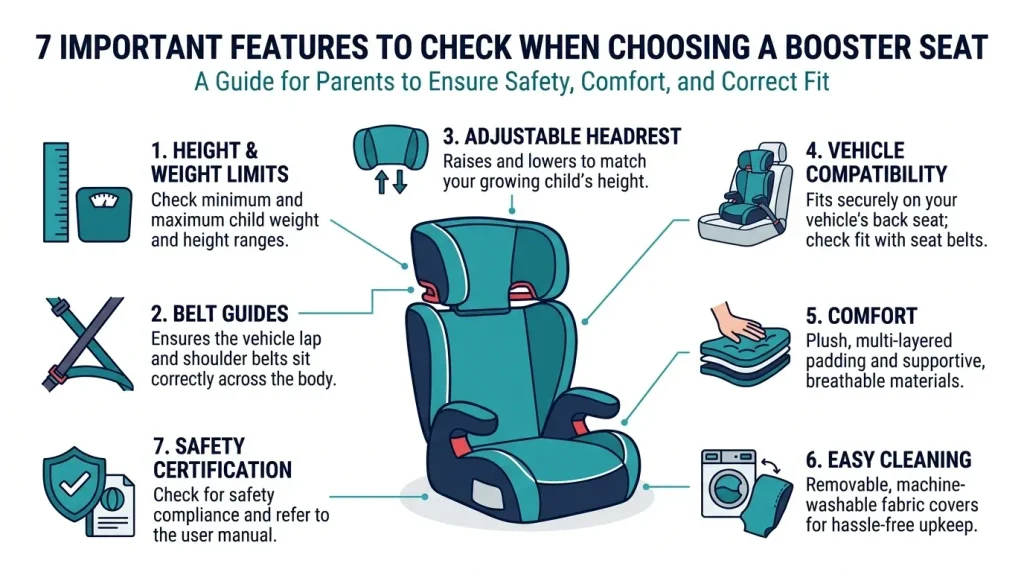
Choosing a booster involves more than picking a popular brand. The most important consideration is whether the product fits your child, your vehicle, and your daily needs.
Before purchasing, review these features:
- Appropriate limits: Check the minimum and maximum weight and height requirements.
- Belt guides: Look for clear instructions and suitable guides for positioning the shoulder belt.
- Headrest adjustment: An adjustable headrest can help accommodate a growing child.
- Vehicle compatibility: Check the seat’s dimensions and approved seating arrangements.
- Comfort: Consider padding and seating space without compromising belt fit.
- Cleaning: Removable, washable covers can make regular maintenance easier.
- Safety certification: Check applicable standards and local regulatory requirements.
For families shopping in the United States, check that the product meets applicable federal motor vehicle safety standards. Also verify that the specific model hasn’t been recalled.
As of October 2026, manufacturer instructions and current regulatory requirements should take priority over general shopping advice.
Recommended Booster Seats to Consider
If your child is ready for the booster stage, these established models offer different configurations worth comparing. I would first check each model’s current specifications and vehicle compatibility rather than choose based on brand popularity alone.
🏆 HIGH-BACK OPTION
Graco TurboBooster 2.0 LX Highback
A high-back belt-positioning booster with adjustable support and a design intended to help position the vehicle seat belt. I’d shortlist it for families who want a conventional high-back option, subject to the child’s fit and model limits.
Independent current star rating not verified.
⭐ ADJUSTABLE OPTION
Chicco KidFit 2-in-1
This convertible booster design offers high-back and backless configurations, depending on the model. I’d compare its adjustment features and fit before choosing it for a growing child.
Independent current star rating not verified.
💰 SIMPLE BACKLESS OPTION
Chicco GoFit Backless Booster
A backless belt-positioning booster designed for children who meet its requirements and vehicles with adequate head support. I’d consider it when portability and a simpler design are priorities.
Independent current star rating not verified.
These are product examples, not a universal ranking or a substitute for a fit check. Always confirm the exact model’s current weight, height, age, and vehicle requirements before purchasing.
Frequently Asked Questions
1. Can a 4-year-old use a booster seat?
Some booster models list minimum ages that include certain 4-year-olds, but that doesn’t mean every 4-year-old is ready. Children should remain in an appropriate forward-facing harnessed seat until they reach its limits. Follow the booster manufacturer’s requirements and assess whether your child can sit correctly.
2. Should my child be 40 pounds before using a booster?
Not necessarily. Booster seats have different minimum weight and height requirements. Some models specify a 40-pound minimum, while others have different requirements. Always follow the exact product label and manual rather than applying one weight rule to every booster.
3. Can a child use a booster seat without a back?
Yes, if the child meets the model’s requirements and the vehicle provides adequate head and neck support. A backless booster must also position the lap and shoulder belts correctly. If the vehicle lacks an appropriate head restraint or high seat back, choose a compatible high-back option.
4. When can my child stop using a booster seat?
Your child can stop using a booster when the vehicle’s seat belt fits properly without it. Check that the lap belt stays across the upper thighs, the shoulder belt crosses the chest and shoulder, and the child can sit comfortably without slouching. This often happens between ages 9 and 12.
5. Is a high-back booster safer than a backless booster?
Neither type is automatically safer in every vehicle. Both can provide appropriate belt positioning when correctly selected and used. A high-back model offers additional head and back support, while a backless model depends on suitable vehicle head support. Choose according to your child’s needs and the vehicle manufacturer’s instructions.
Final Takeaway: Don’t Rush the Booster Seat Transition
Knowing when a child should switch to a booster seat means looking beyond age and weight. The most important step is confirming that the child has outgrown the forward-facing harnessed seat and meets the booster manufacturer’s requirements.
Just as importantly, make sure your child can sit properly and keep the vehicle seat belt in the correct position throughout every journey.
My recommendation is to prioritize proper fit over convenience or appearances. Keep using the appropriate restraint until your child is genuinely ready for the next stage.
When you’re unsure, consult a certified Child Passenger Safety Technician for an individual assessment. A careful check today can help you make a safer decision for every trip.

Daniel Brooks is an automotive writer and product researcher focused on car accessories, car tech, maintenance, and practical driving guides. At Plug-in Car World, he helps drivers make smarter automotive decisions through honest reviews and research-driven content.
