
High-Back vs. Backless Booster Seats: What Parents Should Know
Quick Answer
High-back and backless booster seats both raise children so adult seat belts fit correctly. A high-back booster adds head, neck, and side support, along with shoulder-belt positioning guides. A backless booster is smaller, lighter, and easier to move between vehicles, but it requires adequate support from the vehicle seat or head restraint. The right choice depends on your child’s size, belt fit, vehicle design, and the booster manufacturer’s instructions.
Key differences parents should consider
- Head support: High-back models provide an additional headrest and backrest.
- Belt positioning: High-back models generally include shoulder-belt guides.
- Vehicle compatibility: Backless models need adequate head support from the vehicle.
- Portability: Backless boosters are lighter and easier to transfer.
- Cost: Backless models generally cost less than comparable high-back models.
- Child readiness: Both require a child who can sit upright and follow seat-belt rules.
A safety check before choosing
- Check that the lap belt sits low across the upper thighs.
- Make sure the shoulder belt crosses the middle of the chest and shoulder.
- Confirm that the vehicle provides adequate head support for a backless booster.
- Follow the child seat and vehicle manuals, plus applicable local laws.
Choosing a booster seat can feel confusing when both styles appear to do the same job. They raise your child, position the seat belt, and help provide better protection during a crash.
However, the differences matter once you consider your vehicle’s seats, your child’s height, and everyday travel habits. This guide explains how each style works, where it fits best, and what to check before buying one.
What Is the Difference Between High-Back and Backless Booster Seats?
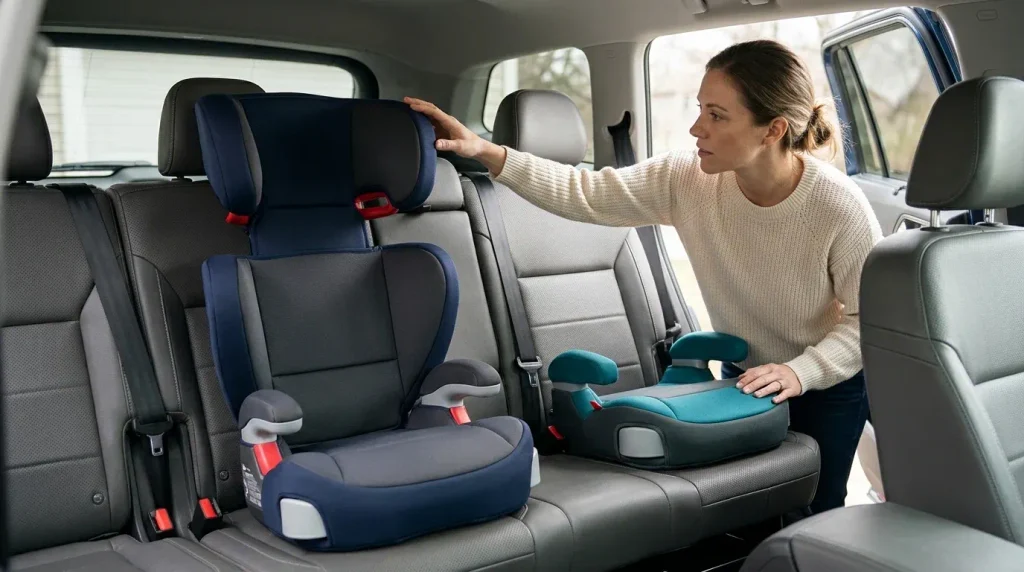
A high-back booster seat is a belt-positioning booster with a raised seat, backrest, headrest, and usually shoulder-belt guides. A backless booster seat is a raised cushion that positions a child higher without providing its own backrest or head support.
Both styles work with the vehicle’s lap-and-shoulder seat belt. Neither should replace a forward-facing car seat with a harness before a child outgrows that seat’s permitted limits.
| Feature | High-Back Booster | Backless Booster |
|---|---|---|
| Backrest | Built-in | None |
| Head support | Built-in headrest | Provided by vehicle seat or head restraint |
| Shoulder-belt guide | Usually included | Depends on the model |
| Portability | Bulkier | Lightweight |
| Storage | Requires more space | Requires less space |
| Typical cost | Often higher | Often lower |
| Vehicle requirement | Must fit vehicle seat | Needs adequate vehicle head support |
One important distinction: a high-back booster does not automatically provide better belt fit in every vehicle. The specific model, child, and seating position all affect the result.
How Does a High-Back Booster Seat Work?
A high-back booster raises your child while providing a backrest and headrest. Its belt guides help position the shoulder belt across the chest rather than the neck.
This design can be useful when the vehicle has a low seatback or lacks a suitable head restraint. It can also help children who need reminders to maintain a proper sitting position.
Benefits of a High-Back Booster
- Head and neck support: The backrest and headrest provide additional support when the vehicle seat alone is insufficient.
- Shoulder-belt guidance: Many models include adjustable guides to help position the belt correctly.
- Side structure: Some models include padded side wings around the head and torso.
- Adjustable fit: Many high-back boosters have adjustable headrests that accommodate growing children.
- Resting comfort: Some children find the backrest more comfortable during longer journeys.
These features can make a high-back booster practical for younger booster-ready children. However, the presence of side wings or extra padding doesn’t guarantee a particular crash outcome.
What Are the Limitations of High-Back Boosters?
High-back boosters take up more room than backless models. Their larger frames may also create fitting problems in vehicles with narrow rear seats.
Some designs can interfere with vehicle headrests or shoulder-belt movement. Always check the manufacturer’s instructions for approved seating positions and headrest adjustments.
How Does a Backless Booster Seat Work?
A backless booster raises a child without adding a backrest or headrest. It uses the vehicle’s existing seat structure for upper-body support while helping the lap belt sit lower across the child’s thighs.
Its simple design makes it easy to carry and transfer. However, the vehicle must provide adequate head support, and the seat belt must fit properly.
Benefits of a Backless Booster
- Easy portability: Its compact shape makes transfers between compatible vehicles simpler.
- Less storage space: It takes up less room when stored outside the vehicle.
- Lower purchase cost: Many backless models are less expensive than high-back alternatives.
- Simple design: Fewer components can make everyday handling easier.
- Older-child acceptance: Some older children prefer its less restrictive appearance.
What Are the Limitations of Backless Boosters?
A backless booster cannot provide its own headrest or back support. The vehicle seat must support the child’s head adequately, including around the top of the ears.
It also offers fewer positioning features for the upper body. If the shoulder belt doesn’t sit correctly, another booster model may fit better.
Which Booster Seat Is Safer for Your Child?
Neither design is automatically safer in every situation. A properly fitting, approved booster that matches the child and vehicle is more important than choosing a style based on appearance alone.
A high-back booster may suit a vehicle with low seatbacks or limited head support. A backless booster may work well when the vehicle already provides suitable head support and the belt fits correctly.
The Insurance Institute for Highway Safety emphasizes proper lap- and shoulder-belt positioning when evaluating booster performance. Its former booster ratings ended in 2024, so older rating labels should not be treated as current evaluations.
When Should Parents Consider a High-Back Model?
- The vehicle seat has no head restraint.
- The vehicle head restraint is too low to support the child’s head adequately.
- The shoulder belt needs the booster’s guide to achieve a suitable position.
- Your child tends to lean or move out of position during journeys.
- The child fits the high-back model within its stated limits.
When Might a Backless Model Be Suitable?
- The vehicle seat provides adequate head support.
- The lap-and-shoulder belt fits properly with the booster.
- Your child meets the manufacturer’s minimum requirements.
- You frequently move the booster between compatible vehicles.
- The smaller design works better with your vehicle’s seating arrangement.
Remember that convenience should never override proper fit. A compact booster is not a suitable choice if the vehicle cannot provide the support it requires.
What Should Parents Check Before Buying a Booster Seat?
The best way to compare boosters is to test their fit in the vehicle where your child will use them. A seat that works well in one car may position the belt differently in another.
Before purchasing, check these important details.
1. Your Child’s Height and Weight
Every booster has manufacturer-set minimum and maximum height and weight limits. Check the product label and instruction manual before using it.
Don’t switch to a booster simply because your child reaches a particular birthday. First, make sure the child has outgrown the forward-facing harness seat according to its limits.
2. Vehicle Head Restraints
Check the vehicle’s head restraint before considering a backless booster. The child’s head needs adequate support from the vehicle seat or head restraint.
A useful check involves the top of the child’s ears. They shouldn’t extend above the top of the vehicle seatback or head restraint when using a backless booster.
3. Lap-Belt Position
The lap belt should rest low and snug across the upper thighs. It shouldn’t cross the soft stomach area.
If the belt rides upward, the booster may not provide the positioning your child needs. Try another approved model or seating position.
4. Shoulder-Belt Position
The shoulder belt should cross the middle of the chest and shoulder. It shouldn’t touch the neck, cross the face, or slip off the shoulder.
Never let your child place the shoulder belt behind their back or under an arm. That changes how the belt restrains the upper body.
5. Vehicle Seat Compatibility
Check the vehicle owner’s manual for restrictions on booster seats and head restraints. Also confirm that the booster sits flat and follows the manufacturer’s installation instructions.
Some vehicles have sculpted seats, unusual belt anchors, or fixed headrests. These details can affect compatibility.
How Do You Know When Your Child Is Ready for a Booster?
A child is generally ready for a booster after outgrowing a forward-facing car seat with a harness. The child must also be mature enough to sit upright and keep the seat belt correctly positioned throughout every journey.
Age alone doesn’t establish readiness. Height, weight, seat limits, and behavior all matter.
Signs Your Child May Be Ready
- Your child has reached the harness seat’s permitted height or weight limit.
- Your child can sit upright without leaning forward or sideways.
- Your child can keep the shoulder belt in its correct position.
- Your child understands that the seat belt must remain buckled.
- Your child can follow instructions throughout the journey.
If your child regularly slouches, leans toward the window, or moves the shoulder belt, a booster may not be appropriate yet. Consider a forward-facing harness seat with higher limits if one is available and suitable.
When Can a Child Stop Using a Booster?
Children should stop using a booster only when the vehicle’s adult seat belt fits correctly without it. This often happens between ages 9 and 12, although individual children develop at different rates.
The five-step seat-belt fit test helps parents check readiness:
- Back position: Your child’s back rests against the vehicle seat.
- Knee position: Your child’s knees bend naturally at the edge of the seat.
- Lap belt: The belt sits low across the upper thighs.
- Shoulder belt: The belt crosses the middle of the shoulder and chest.
- Sitting position: Your child can maintain this position for the entire journey.
If any part of this test fails, continue using an appropriate booster. Check the fit in every vehicle your child regularly rides in.
Can You Use a Backless Booster in Every Vehicle?
No. A backless booster requires a vehicle seat with adequate head support and a compatible lap-and-shoulder belt.
Some vehicles have low seatbacks or unusual head restraint designs. These arrangements may make a backless booster unsuitable for a particular seating position.
Before using one, check the following:
- The vehicle seatback or head restraint supports the child’s head adequately.
- The booster sits flat on the vehicle cushion.
- The lap-and-shoulder belt works with the booster as instructed.
- The seat belt doesn’t become trapped or twisted.
- The child’s head remains properly supported when sitting normally.
Never assume a backless booster is suitable just because an older child uses one in another car. Vehicle compatibility can change the answer.
Do High-Back Booster Seats Offer Better Side Protection?
Some high-back boosters include side wings and energy-absorbing materials around the head and torso. These features add structure that a backless booster doesn’t provide.
However, side wings alone don’t establish that one booster is safer than another. Proper belt positioning, correct installation, and compatibility remain essential.
When comparing side-support features, look for:
- Headrest adjustment: The headrest should accommodate your growing child within the seat’s instructions.
- Shoulder guides: The belt should move freely and remain correctly positioned.
- Side structure: Check the manufacturer’s description of the protective design.
- Seat stability: The booster should sit correctly against the vehicle seat.
Don’t add aftermarket headrests, cushions, or positioning accessories unless the booster manufacturer explicitly approves them. Unapproved additions can interfere with proper belt positioning.
Are High-Back or Backless Boosters Better for Long Road Trips?
A high-back booster may offer a more comfortable resting position for some children during longer journeys. Its headrest and backrest can provide support when the child sits upright.
A backless booster may be easier to move between vehicles during family trips. Its compact shape also leaves more room for other passengers and luggage.
Comfort should never encourage unsafe sleeping positions. If your child regularly slumps or falls out of position, address the fit and seating arrangement before taking a long trip.
Practical Example: Two Different Vehicles
Imagine your family uses a newer SUV and an older sedan. The SUV has adjustable rear head restraints, while the sedan has a low rear seatback.
A backless booster might work correctly in the SUV after a fit check. The same child may need a compatible high-back booster in the sedan because the vehicle provides less head support.
This is why I wouldn’t buy a booster based on the child’s age alone. I would compare the actual seating positions in both vehicles first.
What Safety Mistakes Should Parents Avoid?
Even a suitable booster can become less effective when families use it incorrectly. Small everyday habits can change the position of the seat belt.
Watch for these common mistakes:
- Switching too early: Don’t move a child out of a harness seat before reaching its permitted limits.
- Ignoring the manual: Don’t assume every booster works with every vehicle.
- Using a lap-only belt: Standard belt-positioning boosters require a compatible lap-and-shoulder belt.
- Allowing belt misuse: Never let children put the shoulder belt behind their back or under an arm.
- Ignoring head support: Don’t use a backless booster where the vehicle cannot support the child’s head adequately.
- Adding unapproved accessories: Avoid aftermarket inserts and cushions unless specifically permitted.
- Leaving the booster unsecured: Follow the manufacturer’s instructions for securing an empty booster when the child isn’t riding.
What Do Safety Organizations Recommend in 2026?
Current child passenger safety guidance continues to emphasize using the correct restraint for a child’s size and developmental stage. Parents should keep children in a forward-facing harness seat until they reach its manufacturer-set limits.
Afterward, use a suitable booster until an adult seat belt fits correctly without assistance. The CDC’s child passenger safety guidance explains these stages and the correct belt fit.
The National Highway Traffic Safety Administration (NHTSA) also provides booster selection and installation information.
The American Academy of Pediatrics’ family car seat guidance offers additional advice on choosing and using child restraints.
For independent information about booster belt fit, the IIHS booster seat research explains how booster designs affect lap- and shoulder-belt positioning. Its historical ratings are not a current product ranking.
Which Booster Seat Models Should Parents Compare?
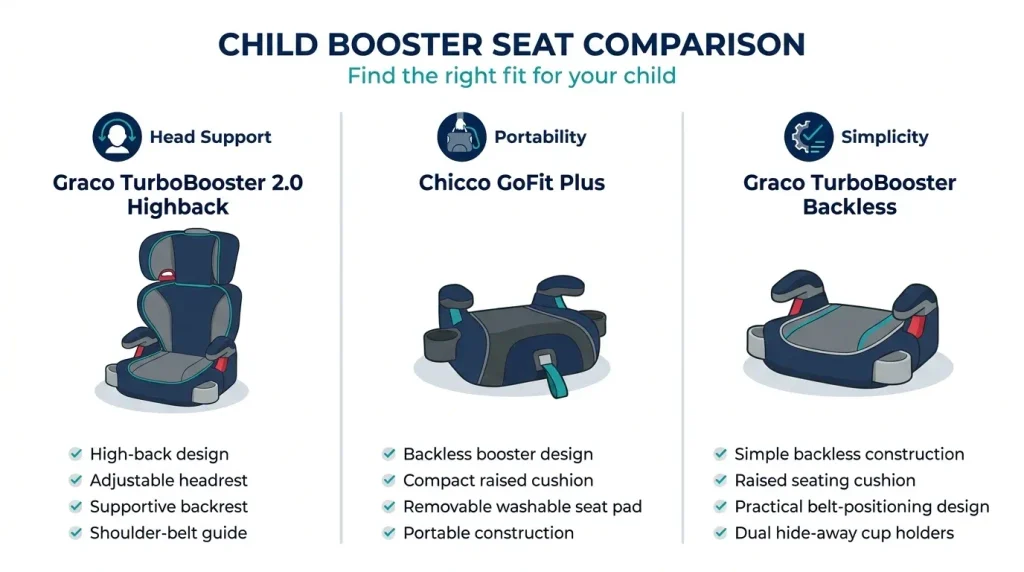
Once you’ve identified the right style, compare individual models rather than assuming every seat in the same category performs equally. The following are established models worth investigating, subject to current availability and manufacturer specifications.
These are examples for comparison, not independently tested rankings. Check current labels, manuals, recalls, and vehicle compatibility before purchasing.
HIGH-BACK OPTION
Graco TurboBooster 2.0 Highback
A high-back belt-positioning booster with an adjustable headrest and shoulder-belt guide. Compare its height and weight limits with your child’s measurements and vehicle seating position.
PORTABLE OPTION
Chicco GoFit Plus
A backless booster with a compact design and removable, washable seat pad. Consider it only when your vehicle provides adequate head support and the belt fits your child correctly.
SIMPLE BACKLESS OPTION
Graco TurboBooster Backless
A straightforward backless booster designed to raise a child for better seat-belt positioning. Check the specific model’s belt guides, size limits, and compatibility before choosing it.
One final buying tip: test the booster in your actual vehicle whenever possible. A model that looks comfortable in a product photo may not position your child’s seat belt correctly.
Frequently Asked Questions
1. Is a high-back booster safer than a backless booster?
Not automatically. High-back boosters provide their own backrest, headrest, and usually shoulder-belt guides. Backless boosters can also provide appropriate protection when the vehicle supplies adequate head support and the belt fits correctly.
2. At what age can a child use a backless booster?
There isn’t one universal age. Check the booster manufacturer’s minimum height and weight requirements, your child’s readiness, and vehicle compatibility. A child must also have adequate head support from the vehicle when using a backless model.
3. Can a child sleep in a high-back booster seat?
A high-back booster doesn’t replace a properly positioned harness or guarantee safe sleeping support. If your child falls asleep, check that the child remains upright and the belt stays correctly positioned. Never add an unapproved head or neck support accessory.
4. Do backless booster seats need headrests?
Yes, they require adequate head support from the vehicle seat or head restraint. The child’s head should remain supported within the vehicle’s seatback limits. Follow the booster and vehicle manuals before using a backless model.
5. Can parents switch from a high-back booster to a backless booster?
Yes, if the child meets the backless model’s requirements and the vehicle provides adequate head support. Check belt positioning again after switching. A child may need a high-back booster in one vehicle and a backless booster in another.
Final Takeaway: Choose the Booster That Fits Your Child and Vehicle
High-back and backless booster seats serve the same main purpose: positioning a child so the adult seat belt fits properly. Their different designs make them suitable for different children and vehicle seating arrangements.
Choose a high-back booster when its headrest and shoulder-belt guides help achieve the required fit. Consider a backless booster when your vehicle provides adequate head support and its simpler design still positions the belt correctly.
Most importantly, keep your child in an appropriate booster until the adult seat belt fits properly without one. Check the fit regularly, follow the manufacturer’s instructions, and keep children under 13 in the back seat whenever possible.

Daniel Brooks is an automotive writer and product researcher focused on car accessories, car tech, maintenance, and practical driving guides. At Plug-in Car World, he helps drivers make smarter automotive decisions through honest reviews and research-driven content.
