
What Is LATCH in a Car Seat? A Parent’s Guide for 2026
Quick Answer
LATCH is a built-in system that anchors a car seat to your vehicle without using the seat belt. It uses two lower anchors in the seat crease and, for forward-facing seats, a top tether behind the seat. The system holds the seat tight, and the seat belt stays free for other uses. Learn how LATCH vs seat belt installs compare before you choose one.
What LATCH does for you
- Lower anchors: Two metal bars in the seat bight clip to connectors on the car seat base.
- Top tether: A strap from the top of a forward-facing seat clips to an anchor behind the vehicle seat.
- Tight fit: Tightened LATCH straps should move the seat less than one inch side to side at the belt path.
- Weight limit: Lower anchors have a combined child-plus-seat weight limit, so check both manuals.
- Not both methods: Use LATCH or the seat belt to install, not both at the same time.
Before you drive
- Check your vehicle manual for anchor locations, weight limits, and centre-seat rules.
- Do the one-inch test at the belt path after every install, and recheck after a long drive.
I’ve hunted for LATCH anchors with a flashlight in a dark parking lot, and I know how fiddly that first install can feel. The anchors hide deep in the seat crease, and the straps seem to fight you.
Once you find them, though, the system makes sense fast. This guide explains what LATCH means, how each part works, where to find the anchors, when to switch to the seat belt, and the mistakes I see most often.
In This Guide
What Does LATCH Stand For?
LATCH stands for Lower Anchors and Tethers for Children. It is the standard system in the United States for attaching a car seat to a vehicle without the seat belt.
The name describes the two parts of the system. Lower anchors hold the bottom of the seat, and a tether holds the top of a forward-facing seat.
What is the difference between LATCH and ISOFIX?
ISOFIX is the international version of the same idea, and it works in much the same way. It uses rigid connectors and lower anchor points in the vehicle seat.
A seat sold as ISOFIX in Europe may not match United States LATCH rules, so check the labels before you use it here. The NHTSA site explains the United States system and links to current child passenger safety guidance.
Is LATCH safer than a seat belt install?
No, LATCH is not safer than a correct seat belt install. Both methods hold a car seat tight when you follow the manuals and pass the one-inch test.
LATCH feels easier for many parents, because the connectors click and the straps tighten without locking the seat belt. That ease helps, yet it does not add extra protection on its own.
Pro tip: Check your vehicle owner’s manual and the car seat manual together before the first install, and confirm the anchor locations and weight limits for your exact model year.
Section Takeaway: LATCH means Lower Anchors and Tethers for Children, and it anchors a car seat without the seat belt. It is a different method, not a safer one.
How Does LATCH Work?
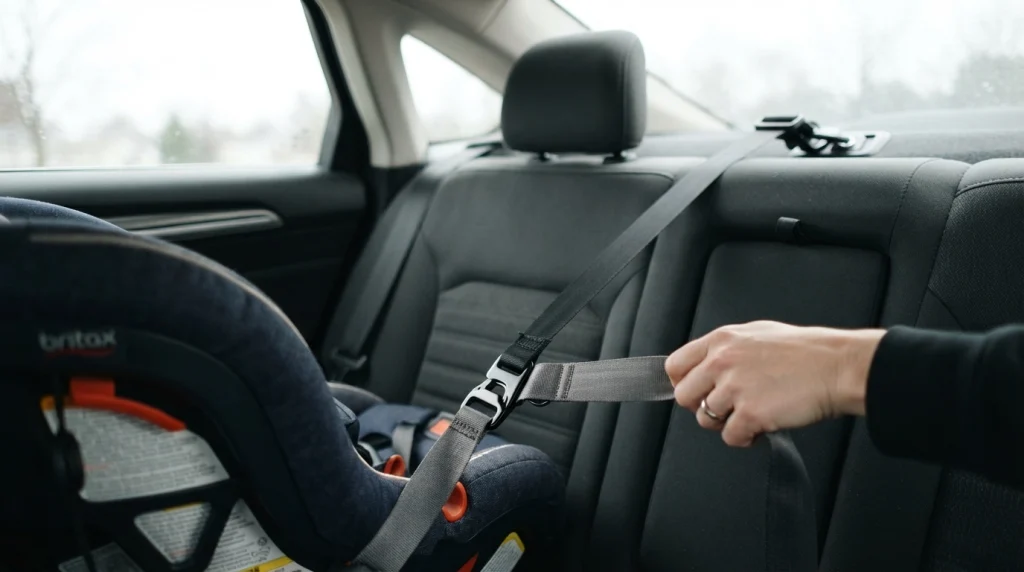
LATCH works by clipping the car seat directly to metal bars built into your vehicle. The lower anchors take the main load, and the top tether steadies the top of a forward-facing seat.
What are lower anchors?
Lower anchors are two small metal bars set into the crease where the vehicle seat back meets the seat cushion. That crease is called the seat bight, and the bars sit about 11 inches apart.
Most cars mark the anchors with a small child-seat symbol on the seat back or on a plastic cover. Some cars hide the bars under a flap, and some leave them open in the crease.
Your car seat has two lower connectors that clip onto those bars. Push-button connectors click on and release with a button, while hook-style connectors latch on and need a squeeze to release.
What is a top tether?
A top tether is a strap attached to the top of a forward-facing car seat. It clips to a tether anchor in your vehicle, and it limits how far the seat tips forward in a crash.
The anchor may sit on the back of the vehicle seat, on the rear shelf, on the floor behind the seat, or on the ceiling in some SUVs. Your vehicle manual shows the exact spot for each seating position.
Always use the top tether for a forward-facing seat when your car and seat both provide one. The top tether guide explains where the anchor hides in common body styles and what to do when it feels hard to reach.
Rear-facing seats do not use a top tether in most United States installs, unless the seat manual gives a specific rear-facing tether route. Follow your seat manual, and do not invent a tether point.
How do the connectors tighten?
Flexible LATCH straps tighten with a pull strap, much like a backpack strap. Pull the free end until the seat moves less than one inch side to side at the belt path.
Rigid LATCH arms slide straight onto the anchors and lock with a click, and you push the seat back to tighten the fit. Both styles need the same final check, so do not skip the push test.
Section Takeaway: Lower anchors hold the base, and the top tether steadies a forward-facing seat. Clip both, tighten the strap, then test for movement at the belt path.
How to Find LATCH Anchors in Your Car
Finding the anchors is the hardest part of a first LATCH install. They sit deep in the seat crease, and thick cushions can hide them completely.
Start with the vehicle manual, because it lists which seats have lower anchors and where each tether anchor sits. Do not guess a centre-seat install from the outboard anchors.
Where are the lower anchors usually located?
Most cars have lower anchors in the two outboard rear seats, and many have them in the second row of an SUV or minivan. The centre rear seat often has no dedicated anchors of its own.
Some cars allow you to borrow the inner anchors from the two outboard seats for a centre install, but only if both manuals allow it. The spacing must match, and the seat must still sit tight.
- Look for the symbol: A small child-seat icon on the seat back marks an anchor location.
- Feel the crease: Slide your fingers into the seat bight and feel for two firm metal bars.
- Move the cushion: Push the seat cushion down with one hand to open the crease and see the bars.
- Use a flashlight: Shine a light into the crease in a dark garage, because the bars sit low and blend in.
How do you clip the connectors on the first try?
Loosen the LATCH straps fully before you start, so the connectors reach the anchors without pulling the seat. Place the car seat in position, then clip one connector at a time.
Listen for the click, then tug each connector to confirm it locked. A connector that looks clipped but pulls free will not hold in a crash.
Where is the top tether anchor?
The tether anchor location changes by body style, so check the manual for your car. In a sedan, it often sits on the rear shelf behind the back seat.
In an SUV or hatchback, it may sit on the back of the seat, on the floor, or on the ceiling near the tailgate. In a pickup truck, it may sit behind the rear seat or on the back wall of the cab.
Read the guide on how to install a car seat using LATCH safely and tightly for the step-by-step tightening sequence, and compare it with your seat manual before you drive.
Section Takeaway: Use the manual to find the anchors, feel for the bars in the seat crease, and clip one connector at a time. A borrowed centre install needs permission in both manuals.
LATCH vs Seat Belt: Which Should You Use?
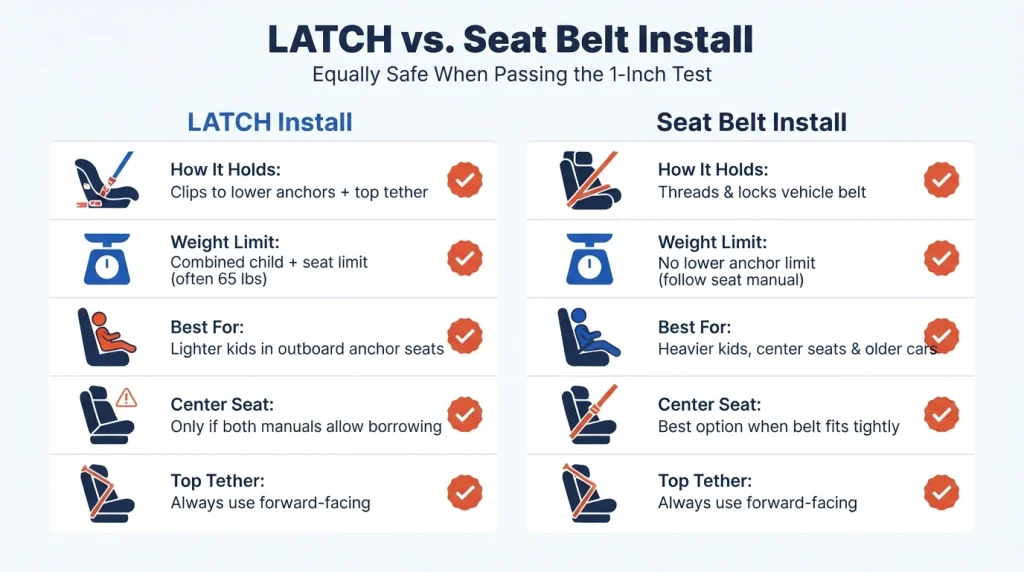
Use LATCH when it gives a tight fit and your child-plus-seat weight stays under the lower anchor limit. Use the seat belt when LATCH does not fit well, when the weight limit passes, or when the seat position has no anchors.
Both methods work when done right, so the best choice depends on your car, your seat, and your child. Do not pick LATCH just because it feels modern.
| Feature | LATCH Install | Seat Belt Install |
|---|---|---|
| How it holds | Clips to lower anchors, plus top tether forward-facing | Threads through the belt path and locks the belt |
| Weight limit | Lower anchors have a combined child-plus-seat limit | No lower anchor limit, but follow the seat manual |
| Best for | Younger, lighter children in anchor seats | Heavier children, centre seats, and cars without anchors |
| Centre seat | Often not allowed unless both manuals permit borrowing | Often the best centre option when the belt fits |
| Common snag | Hidden anchors and twisted straps | Forgetting to lock the belt or leaving slack |
| Top tether | Use it forward-facing whenever it is available | Use it forward-facing too, even with a belt install |
When does LATCH work best?
LATCH works best for infant carriers and lighter convertible seats in outboard rear seats. The connectors click fast, and the straps tighten without locking the vehicle belt.
Try LATCH first in a new car, then test the fit. If the seat moves less than one inch at the belt path, you have a good install.
When does the seat belt work best?
The seat belt works best when your child outgrows the lower anchor weight limit, or when you need the centre seat. It also works best in older cars without LATCH anchors.
A belt install needs a locked belt, so pull the belt fully out to engage the lock, then feed the slack back in. Read the guide on how to install a car seat using the seat belt for the locking steps for your belt type.
Read the Consumer Reports child car seat guidance for model-specific install notes, and compare its findings with your manuals before you switch methods.
Section Takeaway: Pick the method that passes the one-inch test in your car and seat. LATCH suits lighter children in anchor seats, and the belt suits heavier children and centre seats.
What Are the LATCH Weight Limits?
Lower anchors have a weight limit, and it covers your child plus the car seat together. Once that combined weight passes the limit, you must switch to a seat belt install for the lower part of the seat.
The top tether has its own rules, and you should keep using it forward-facing even after you switch the lower install to the belt. Check both manuals, because the limit can vary by car and seat.
What is the 65-pound combined limit?
Many vehicles and seats use a combined limit of 65 pounds for child plus seat. That number comes from current federal guidance, and many manufacturers print it in the manual.
Weigh your child, then add the car seat weight from its label or manual. If the total reaches the limit, switch the lower install to the seat belt.
Read the guide on understanding car seat lower anchor weight limits for the full breakdown, and check the Edmunds car seat guides for the weight limits listed by common seat types.
What happens when your child outgrows LATCH?
Switch the lower install to the seat belt, and keep the top tether attached for a forward-facing seat. The belt then holds the base, and the tether still steadies the top.
Recheck the install after the switch, because the belt path and tightening steps differ from LATCH. Do the one-inch test again at the belt path.
Do booster seats use LATCH?
Some booster seats offer LATCH connectors, but they only hold the empty booster in place. LATCH does not restrain your child in a booster, and the adult seat belt does that job.
Section Takeaway: Add your child’s weight to the seat weight, and switch to the seat belt when the total reaches the lower anchor limit. Keep using the top tether forward-facing.
Common LATCH Mistakes to Avoid
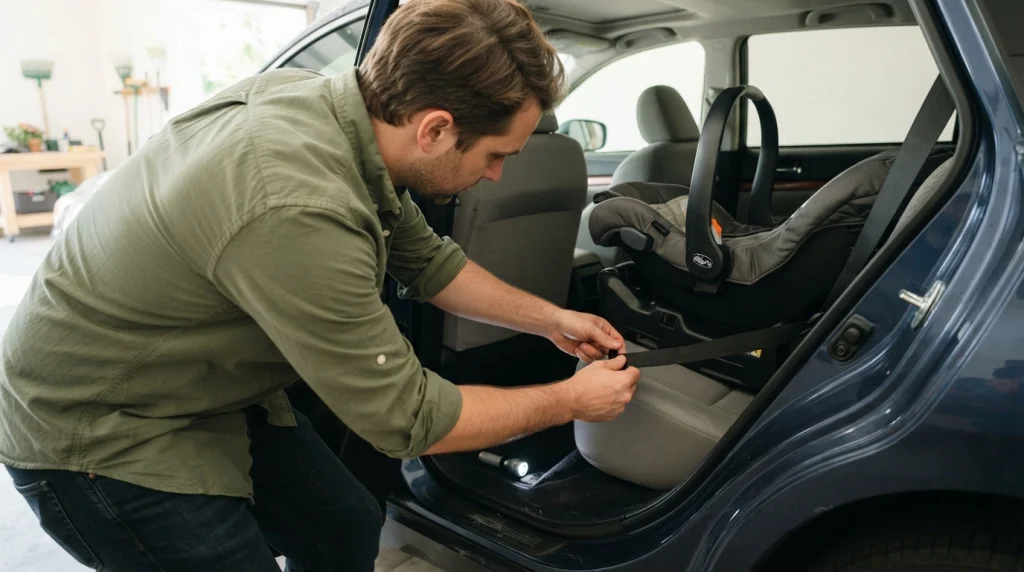
Most LATCH mistakes look small, yet they change how the seat holds in a crash. I see the same errors again and again, and each one takes seconds to fix.
Run through this list after every install, especially when another driver moves the seat. A quick scan beats a long correction later.
- Using both methods: Never install with LATCH and the seat belt together, because the extra belt can change the crash load.
- Skipping the tether: Never skip the top tether on a forward-facing seat, because it limits forward tip.
- Twisted straps: Straighten every LATCH strap before you tighten it, because a twist can slip under load.
- Wrong belt path: Thread the LATCH strap through the correct rear-facing or forward-facing belt path for your seat.
- Borrowed anchors: Do not borrow outboard anchors for the centre seat unless both manuals allow it.
- Loose fit: Do not accept a seat that moves more than one inch side to side at the belt path.
- Past the limit: Do not keep using lower anchors after the combined child-plus-seat weight passes the limit.
Read about using LATCH and the seat belt together to see why the two methods must stay separate, and read the Car and Driver child-seat coverage for the same warning in its install guides.
Section Takeaway: Use one install method, use the tether forward-facing, keep straps flat, and test for movement at the belt path. One loose check can undo a good install.
Frequently Asked Questions
What does LATCH stand for in a car seat?
LATCH stands for Lower Anchors and Tethers for Children. It is the United States system that clips a car seat to metal anchors in the vehicle, without using the seat belt for the lower install.
Is LATCH safer than using a seat belt?
No, neither method is safer when both are installed correctly. Choose the method that gives the tightest fit in your car and seat, and always pass the one-inch test at the belt path.
Can I use LATCH in the centre seat?
Sometimes, but only if both your vehicle manual and your car seat manual allow borrowing the inner anchors. Many centre seats have no dedicated anchors, so the seat belt often works better there.
Do I still need the top tether with LATCH?
Yes, use the top tether for a forward-facing seat whenever your car and seat provide one. It limits forward movement in a crash, and it works with both LATCH and seat belt lower installs.
When should I stop using LATCH?
Stop using the lower anchors when your child plus the car seat reaches the combined weight limit in the manuals, often 65 pounds. Switch the lower install to the seat belt, and keep using the top tether forward-facing.
Can I use LATCH and the seat belt together?
No, do not use both methods at the same time unless both manuals specifically allow it for your seat. Using both can change how crash forces travel through the seat.
Does my car have LATCH if it is older than 2003?
Maybe, but not always. LATCH became standard in most new United States vehicles from model year 2003 onward, so check your manual for anchor locations. If your car has no anchors, install with the seat belt and top tether.
LATCH is simple once you know the parts. Lower anchors hold the base, the top tether steadies a forward-facing seat, and the one-inch test tells you if the install is tight enough.
Find your anchors, clip one connector at a time, tighten the strap, attach the tether, and test the fit before you drive. When in doubt, ask a certified child passenger safety technician to check the install in person.

Daniel Brooks is an automotive writer and product researcher focused on car accessories, car tech, maintenance, and practical driving guides. At Plug-in Car World, he helps drivers make smarter automotive decisions through honest reviews and research-driven content.
