
Can You Use an ISOFIX Car Seat in a Vehicle Without ISOFIX? 2026
Quick Answer
Yes, in most cases you can. Most ISOFIX car seats also allow a seat belt install, so you thread the vehicle belt through the seat’s belt path instead of clicking it onto lower anchors. Check your seat manual first, because a few ISOFIX-only seats do not allow it, and always finish with a tightness check. Learn the seat belt installation steps before your first ride.
What to check first
- Manual allows it: Look for a seat belt install section in your car seat manual.
- Belt path is clear: Use the blue path for rear-facing and the red path for forward-facing, if your seat marks them that way.
- Belt locks tight: The belt must lock and hold the seat with less than one inch of movement at the belt path.
- Top tether or leg: Use the top tether for a forward-facing seat when one is fitted, and set the support leg correctly if your seat has one.
- No mixed install: Do not use ISOFIX lower anchors and the seat belt together unless your manual says you can.
If you are unsure
- Stop and check the manual, or get the fit checked by a certified child passenger safety technician before you drive with your child in the seat.
I have fitted car seats in cars with ISOFIX, and in cars with no anchors at all. The older car always made me pause for a second longer.
My first test was my own 2008 hatchback, which had no ISOFIX points in the back seat. The seat I owned at the time still fitted fine, once I learned the belt route properly.
This guide goes deeper than a yes or no. You will learn what ISOFIX is, how a seat belt install works, when it is safe, and which shortcuts you should never try.
In This Guide
- What is ISOFIX, exactly?
- Can you use an ISOFIX car seat in a vehicle without ISOFIX?
- How do you install an ISOFIX seat with a seat belt?
- ISOFIX vs seat belt: which is safer?
- What if your car has ISOFIX in some seats but not others?
- What should you never do with an ISOFIX seat?
- Frequently Asked Questions
What is ISOFIX, exactly?
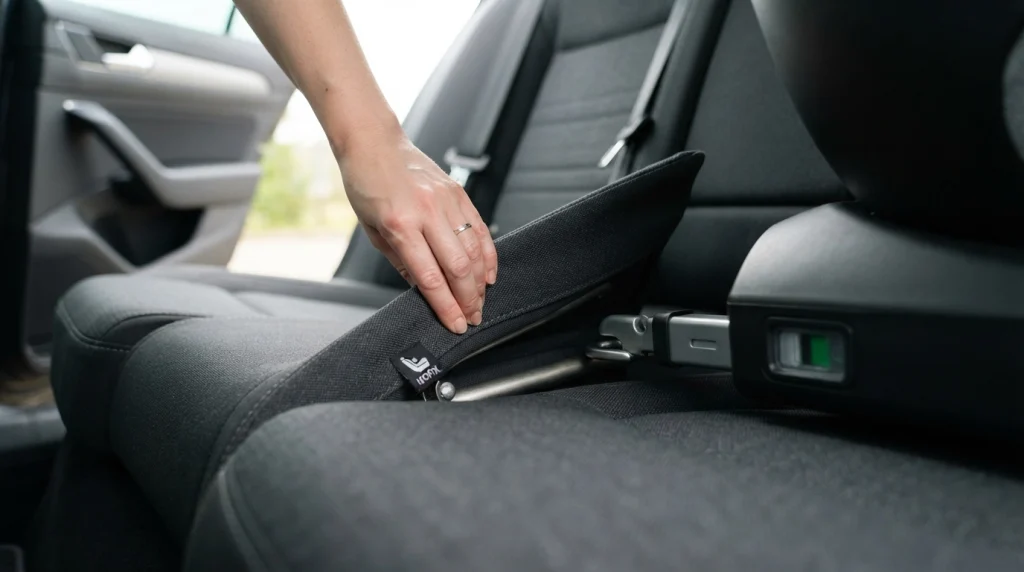
ISOFIX is a standard way to attach a car seat directly to metal anchor points built into a vehicle seat. Two lower anchors sit in the gap between the seat base and the seat back.
The seat clicks onto those anchors with rigid arms or flexible straps. A top tether or a support leg then stops the seat from tipping forward in a crash.
ISOFIX is the name used in Europe and in many other markets. In the United States, the same idea is called LATCH, which stands for Lower Anchors and Tethers for Children.
The two systems work on the same principle, even though the names and some weight limits differ. If you want the US wording, read our guide to what the car seat LATCH system is and how its lower anchors work.
How do you know if your car has ISOFIX?
Look for a small ISOFIX label on the seat, near the join between the base and the backrest. Many cars also have a small plastic guide or a tag with the ISOFIX symbol.
Check your vehicle handbook too. It lists which seating positions have ISOFIX, and whether a top tether point is fitted behind that seat.
What parts make up an ISOFIX install?
- Lower anchors: Two metal bars fixed to the vehicle body, hidden in the seat crease.
- ISOFIX connectors: The arms or clips on the car seat that lock onto those bars.
- Top tether: A strap from the top of a forward-facing seat to an anchor point behind the vehicle seat.
- Support leg: A leg from the seat base down to the vehicle floor, used on many rear-facing and infant seats instead of a top tether.
- Indicators: Green and red markers on many seats that show when a connector is locked.
Section Takeaway: ISOFIX is a direct click-on fixing to built-in lower anchors, plus a tether or support leg to control rotation, and LATCH is the US name for the same idea.
Can you use an ISOFIX car seat in a vehicle without ISOFIX?
Yes, most ISOFIX seats can be used in a car without ISOFIX, as long as the seat manual allows a seat belt install. The seat belt becomes the main fixing instead of the lower anchors.
This is a common setup for grandparents, taxis, hire cars, and older family cars. I have done it in a car from 2008, in a rental on holiday, and in a friend’s pickup with no rear anchors.
The key point is simple. A seat belt install is not a weaker fallback. It is a tested install method for that seat, when you follow the belt path and lock the belt correctly.
Which seats allow a seat belt install?
Most convertible seats, infant carriers on a base, and many all-in-one seats allow it. The manual will have a full seat belt section, with diagrams for rear-facing and forward-facing use.
A few seats are ISOFIX-only, or they allow a belt install only in one direction. Check both directions if you plan to turn the seat around later.
When should you not use the seat without ISOFIX?
- Manual says no: If the manual lists no belt install, do not invent one.
- No locking belt: If the belt will not lock and hold the seat tight, stop and try another seating position.
- Wrong belt type: A lap-only belt is not right for most seats, unless your manual says it is.
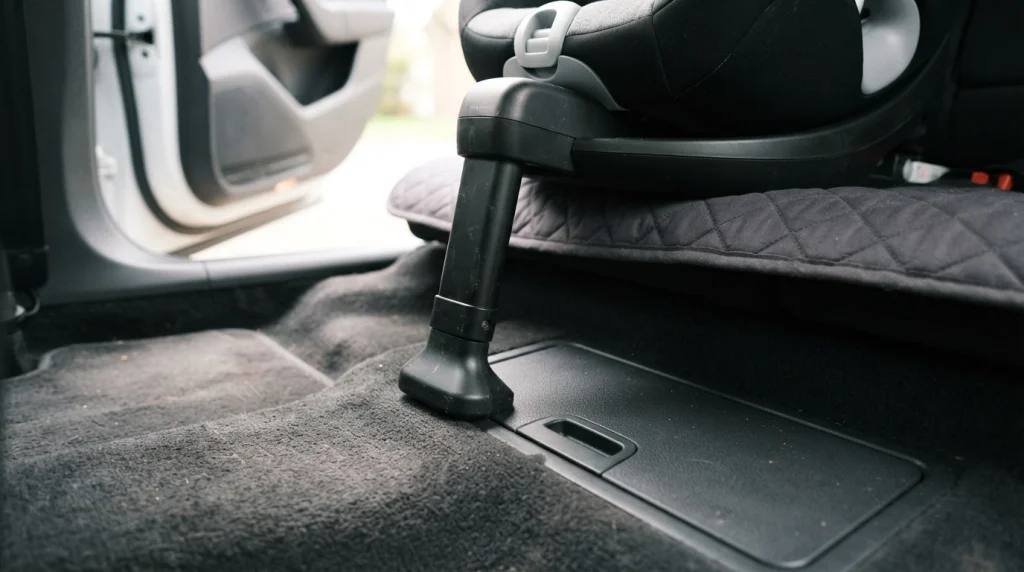
- Support leg has nowhere to sit: If the leg lands on an underfloor storage lid or a raised floor, check the manual before you use it.
- Seat moves too much: If you cannot get less than one inch of movement at the belt path, get help before you drive.
Pro tip: check the seat manual and the vehicle handbook together, and use the NHTSA car seat guidance at nhtsa.gov if you need a trusted starting point for fit checks.
Section Takeaway: Most ISOFIX seats work without ISOFIX anchors through a seat belt install, but only when the manual allows it and the belt locks the seat tight.
How do you install an ISOFIX seat with a seat belt?
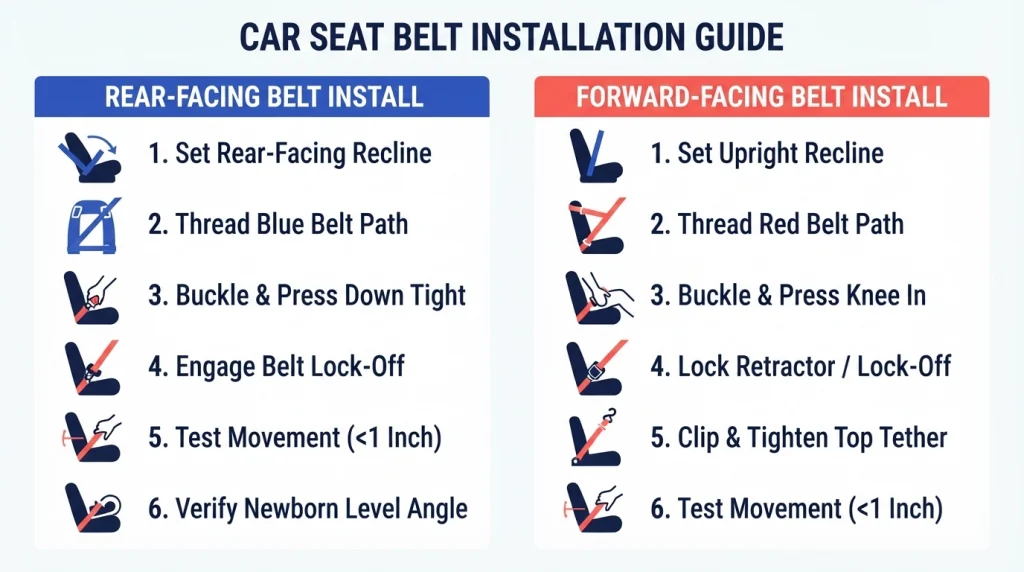
Rear-facing belt install in six steps
- Set the recline: Put the seat at the rear-facing recline angle shown in the manual for your child’s weight.
- Find the blue path: Thread the lap and shoulder belt through the rear-facing belt path, usually marked in blue.
- Buckle and tighten: Buckle the belt, then press down firmly into the seat base while you pull the belt tight.
- Lock the belt: Use the seat’s lock-off, or pull the shoulder belt fully out to switch the retractor to locking mode if your car works that way.
- Check the movement: Grip the seat at the belt path and push side to side and front to back. It should move less than one inch.
- Check the angle: Look at the level indicator and adjust the recline if your child is a newborn who needs a flatter angle.
Forward-facing belt install in six steps
- Set the seat upright: Move the seat to the forward-facing recline position in the manual.
- Find the red path: Thread the belt through the forward-facing belt path, usually marked in red.
- Buckle and tighten: Buckle the belt, then press your knee into the seat while you pull the shoulder belt tight.
- Lock the belt: Use the lock-off or the locking retractor, then check that the belt stays tight when you let go.
- Attach the top tether: Clip the tether to the anchor point behind the seat and tighten it, if your car has one. Our guide explains what a top tether on a car seat is and where to find its anchor.
- Check the movement: Test again at the belt path. Less than one inch of movement is the pass mark.
Common mistakes I see with belt installs
- Wrong belt path: Using the forward-facing path for a rear-facing seat is the most common error I have spotted.
- Twisted belt: A twisted lap belt will not sit flat, and it will not tighten evenly.
- Loose shoulder belt: If the shoulder section is slack, the seat can shift in a sudden stop.
- Lock-off left open: Some seats need the lock-off closed to hold the belt, so check it clicks shut.
- Harness too loose: A tight seat with a loose harness is still unsafe, so do the pinch test on the straps every ride.
Section Takeaway: Use the correct colour-coded belt path, lock the belt, press the seat down while you tighten, and pass the one-inch movement test before you drive.
ISOFIX vs seat belt: which is safer?
Neither method is safer on its own. A correct install is safer than a loose one, whichever fixing you use.
ISOFIX is often easier to get right, because the connectors click and the indicators turn green. A belt install takes more care, but it is just as safe when it is tight and the belt path is correct.
That is why safety advice focuses on the fit, not the fixing. Read the comparison in our guide to LATCH vs seat belt for a car seat if you want the same question in US terms.
| Feature | ISOFIX / LATCH install | Seat belt install |
|---|---|---|
| Main fixing | Lower anchors built into the vehicle seat | Vehicle lap and shoulder belt |
| Ease of fitting | Usually quicker, with click and colour indicators | Takes more care with the belt path and locking |
| Works without anchors | No, it needs ISOFIX points in the car | Yes, in most cars with a three-point belt |
| Weight limits | Lower anchor limits apply, so check the manual | No lower anchor limit, but the seat limits still apply |
| Top tether | Use it for forward-facing seats when fitted | Use it for forward-facing seats when fitted |
| Best for | Everyday use in a car with ISOFIX | Older cars, taxis, hire cars, and centre seats |
Weight limits matter here. Lower anchors have a combined child-plus-seat limit in many manuals, so you may need to switch to a belt install as your child grows. Consumer Reports notes how much install method affects real-world fit.
Section Takeaway: ISOFIX is easier to fit, a belt install is just as safe when done correctly, and the right choice is the one you can install tight every time.
What if your car has ISOFIX in some seats but not others?
Many cars have ISOFIX only on the two outer rear seats. The centre rear seat often has no lower anchors, even in a newer car.
That does not leave you stuck. You can use a belt install in the centre seat, or use an outer seat with ISOFIX, whichever gives the tighter fit for your seat and your child.
Check your vehicle handbook before you choose. Some cars forbid a centre install, and some forbid borrowing anchors from the outer seats to make a centre ISOFIX fit.
How to choose the best seating position
- Start with the manual: It lists the approved positions for ISOFIX and for belt installs.
- Test both spots: Fit the seat in each approved position and compare the movement test.
- Check the tether: A forward-facing seat needs a tether anchor, so pick a position that has one.
- Check the support leg: The leg needs a flat, solid floor, so avoid a position with a storage well under it.
- Check access: A tight fit matters most, but you also need to lift your child in and out safely.
Before you buy a seat for an older car, check Edmunds family car reviews for rear-seat space, and use our guide to how to check car seat compatibility with your vehicle. It walks through the same checks I do in a car park.
What about older cars, classic cars, and taxis?
Older cars built before ISOFIX became common often have no anchors at all. A belt install is the normal route there, if the seat manual allows it.
Section Takeaway: Use ISOFIX where it is fitted, use a belt install where it is not, and never borrow outer anchors to create a centre ISOFIX fit unless the handbook allows it.
What should you never do with an ISOFIX seat?
Shortcuts around ISOFIX are tempting, especially when you are in a hurry. Most of them make the seat less safe, not more convenient.
Aftermarket ISOFIX kits and retrofit anchors
Do not fit an aftermarket ISOFIX kit unless your vehicle maker approves it for your exact model. A bolt-on anchor is not the same as a factory-fitted anchor welded into the body.
Some makers do offer a dealer-fitted retrofit for certain models. That is a different thing, because it is tested and approved for that car.
If no approved retrofit exists, use the belt install instead. It is the safe, tested route for a car without ISOFIX.
Using ISOFIX and the seat belt together
Do not use both fixings at once unless your manual says you can. Most seats are tested with one method, not both, and using both can change how the seat moves in a crash.
Our live guide to understanding car seat lower anchor weight limits explains why limits and install methods are linked, and when a switch to the belt is needed.
Other mistakes to avoid
- Loose ISOFIX arms: If the arms are not fully extended or locked, the seat will rock.
- Support leg on a lid: A leg resting on a hollow storage lid can punch through in a crash, so check the floor first.
- Top tether slack: A loose tether does not control forward movement, so tighten it after the main install.
- Thick padding under the seat: A folded towel or thick mat can hide a loose fit, so fit the seat on the vehicle seat itself.
- Ignoring the manual: A tip from a forum is not a substitute for the manual for your exact seat model.
Pro tip: if anything feels wrong, get the fit checked by a certified technician, and check Car and Driver for plain-language car seat and family car explainers before you buy your next seat.
Section Takeaway: Never retrofit unapproved ISOFIX anchors, never mix ISOFIX and belt unless the manual allows it, and never hide a loose fit under padding.
Frequently Asked Questions
Can I use an ISOFIX base in a car without ISOFIX?
Only if the base manual allows a seat belt install. Many bases do, and the belt threads through a marked path on the base. If your base is ISOFIX-only, you will need a different base or a seat that allows a belt install.
Is a seat belt install safe for a newborn?
Yes, when the seat is rear-facing, the recline is correct, and the belt holds it tight. Newborns need a flatter recline angle, so check the level indicator and the manual before every early ride.
Can I use ISOFIX in the middle seat?
Only if your vehicle handbook lists the centre seat as an ISOFIX position. Do not borrow the inner anchors from the two outer seats to make a centre fit, unless the handbook says that is approved.
Do I still need the top tether with a seat belt install?
Yes, for a forward-facing seat, use the top tether when your car has an anchor point. The tether limits forward head movement, and it works with a belt install just as it does with ISOFIX.
What if my car has ISOFIX but my seat is too heavy for the anchors?
Switch to a seat belt install when your child plus the seat passes the lower anchor limit in the manual. This is a planned change, and the belt install is tested for that seat.
Can I fit an ISOFIX seat in a taxi or hire car without ISOFIX?
Yes, in most cases, with a belt install if the manual allows it. Allow extra time, bring the manual, and test the one-inch movement check before you travel.
Is ISOFIX the same as LATCH?
They are the same idea with different names. ISOFIX is the international name, and LATCH is the US name for lower anchors and tethers. Check your manual for the weight limits that apply to your system.
Yes, you can use an ISOFIX seat in a car without ISOFIX. Check the manual, use the seat belt path, lock the belt, and test the fit.
If the fit is tight and the harness is snug, you are ready to drive. If it is not, refit it or get it checked before your child rides in it.

Daniel Brooks is an automotive writer and product researcher focused on car accessories, car tech, maintenance, and practical driving guides. At Plug-in Car World, he helps drivers make smarter automotive decisions through honest reviews and research-driven content.
