
How Do You Fit Two Car Seats and a Booster Together?
Quick Answer
You fit two car seats and a booster together by choosing narrow seats, installing the harnessed seats with seat belts, and placing the booster where its buckle stays clear. Start with the center seat, then work outward and test each install on its own before you test all three together. Before you buy anything, check whether a car seat will fit in your car by measuring hip room and buckle spacing, not just total bench width.
What makes it work
- Narrow seats: Choose seats about 17 inches wide or less at the widest point.
- Seat belt installs: Seat belts let you shift each seat a little, while LATCH anchors fix its position.
- Booster position: Put the booster outboard when you can, so the child can reach the buckle.
- Independent installs: Each seat must stay tight when its neighbors are removed.
- Buckle access: Leave enough room for small hands to buckle without pulling the next seat loose.
- Harness check: Keep harness straps snug and chest clips at armpit level on every ride.
Quick test before you drive
- Install all three, then remove one seat at a time and tug each remaining seat at the belt path.
- Buckle and unbuckle the booster three times with the other seats in place.
- Check that no seat lifts, tilts, or presses hard enough to open a neighboring buckle.
I’ve spent too many Saturday mornings kneeling on a driveway, trying to squeeze a third seat into a back row that looked roomy until I opened the doors. This guide is the method I wish I’d had then, built from real installs in family SUVs and sedans.
You’ll learn how to measure your car, pick the right seat order, and install two car seats and a booster together without forcing anything. We’ll also cover narrow seats, common mistakes, and the checks that tell you the fit is safe.
In This Guide
- What Is a Three-Across Fit With Two Car Seats and a Booster?
- Will Two Car Seats and a Booster Fit in Your Car?
- Which Seat Should Go Where?
- How Do You Install Two Car Seats and a Booster Step by Step?
- What Are the Best Narrow Seats for a Three-Across Fit?
- What Mistakes Make a Tight Fit Unsafe?
- Frequently Asked Questions
- Final Takeaway: A Tight Fit Can Still Be a Safe Fit
What Is a Three-Across Fit With Two Car Seats and a Booster?
A three-across fit means three child restraints share one bench seat, with each one installed on its own. In this setup, two harnessed seats sit beside one booster that uses the vehicle seat belt.
Definition: A three-across fit is three child seats installed side by side in one row, each with its own belt path, buckle, and tight install. The seats may touch lightly, but none should depend on its neighbor to stay in place.
Parents ask for this setup when a third child arrives, when grandparents ride along, or when a minivan is not in the budget. I have set it up for friends in a Honda CR-V, a Toyota RAV4, and a Mazda CX-5, and the same rules held in each car.
The booster changes the job. A harnessed seat locks to the car with LATCH or a seat belt, while a booster only lifts the child so the adult belt fits right.
- Two harnessed seats: Rear-facing or forward-facing seats with a five-point harness.
- One booster seat: A high-back or backless booster that positions the vehicle belt.
- Three belt paths: Three separate buckles and three separate belt routes, with no sharing.
- Three tight installs: Each restraint passes the one-inch movement test on its own.
Does three-across mean the seats must touch?
No. Light contact is common in a tight row, and it is not a problem on its own.
Trouble starts when one seat pushes another out of position or blocks a buckle. I once installed a wide convertible next to a booster in a sedan, and the booster leaned a full inch to one side.
Swapping the convertible for a slimmer model fixed the lean in ten minutes. Width solved what force could not.
Who is this setup for?
This setup fits families with two younger children in harnessed seats and one older child ready for a booster. It also helps caregivers who need three seats in a car with only two rows.
Check your state rules and each seat manual before you move a child to a booster. Age alone does not make a child booster-ready, and maturity matters as much as size.
Section takeaway: Three-across works when each seat holds its own install and the booster buckle stays reachable. Width, order, and belt access decide success more than brute force.
Will Two Car Seats and a Booster Fit in Your Car?
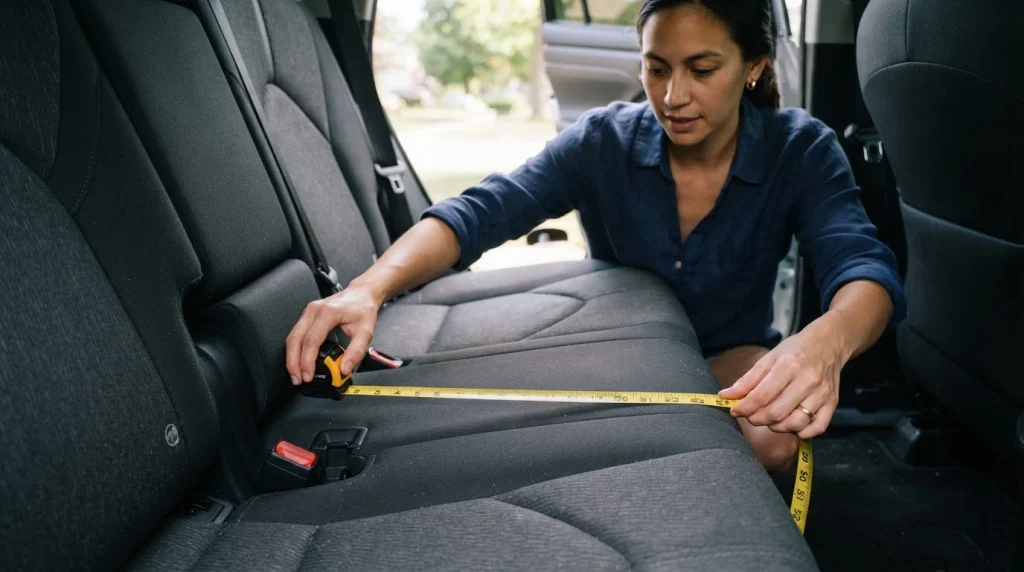
You can fit this setup in many midsize SUVs, crossovers, and larger sedans, but not in every back seat. Usable hip room, buckle spacing, and seat shape matter more than the badge on the trunk.
Start by learning how wide a standard car seat is at its widest point, not just at the base. A seat that measures 19 inches at the headrest can fail in a row where a 17-inch seat fits with room to spare.
How do you measure your back seat?
Measure before you shop. Guessing from photos leads to returns and driveway frustration.
- Measure hip room across the bench at cushion level, from door to door.
- Measure the distance between buckle stalks for all three seating positions.
- Note raised seat bolsters, armrests, and contour dips that narrow the flat space.
- Add the widest width of each seat you plan to use, then compare the total to your hip room.
- Leave at least two fingers of space around each buckle for hands to work.
As of 2026, many compact SUVs offer about 52 to 55 inches of rear hip room. Three 17-inch seats total 51 inches, so the margin stays thin even in a roomy row.
Buckle stalks cause more failures than total width. Short, stiff stalks buried between cushions turn a simple buckle into a daily struggle.
Which cars make this easiest?
Wide, flat benches with long buckle stalks and three full sets of belt anchors make the job easier. Boxy SUVs and minivans with bench second rows tend to offer the most forgiving space.
Check rear seat dimensions on Edmunds before a test fit, then confirm the numbers with a tape measure in the car. Published hip room does not show how much space a sculpted cushion steals.
- Minivans with bench seats: Widest flat space and easy buckle access.
- Midsize three-row SUVs: Workable in the second row, tighter in the third row.
- Midsize sedans: Possible with slim seats, but buckle access needs care.
- Compact hatchbacks: Rarely workable, and a test fit is essential.
Section takeaway: Measure hip room, buckle spacing, and seat contours before you buy. A flat, wide bench with reachable buckles beats a larger car with a sculpted rear seat.
Which Seat Should Go Where?
Put the hardest install in first, and give the booster the spot with the clearest buckle. In most cars, that means a harnessed seat in the center, a harnessed seat outboard, and the booster on the other outboard side.
Order matters because the center seat sets the spacing for the other two. Install it first, lock it tight, then fit the neighbors around it.
- Center harnessed, outboard booster: Best when the center belt install is solid and the booster child can buckle alone.
- Center booster, outboard harnessed: Works in some wide rows, but only when the center buckle stays easy to reach.
- Two harnessed outboard, booster center: Rarely ideal, since the center buckle often hides between two wide seats.
I prefer the booster outboard in most family cars I have worked on. The child climbs in, buckles at the door side, and never has to crawl past a harnessed seat.
Should the booster go in the middle?
The booster can go in the middle when the center belt fits the child correctly and the buckle stays reachable. That happens less often than parents expect, because center buckles sit low and close to the next seat.
Test the center spot with the other seats installed, not empty. If you must lift a harnessed seat to find the buckle, the spot fails the daily-use test.
What if you have two rear-facing seats?
Two rear-facing seats need more front-to-back room, so seat order and recline angle matter even more. Place the more upright rear-facing seat behind the taller front passenger when the manual allows it.
Learn whether two car seats can touch each other before you judge light contact as a failure. Light touch is fine, while wedging that tilts a seat is not.
Keep both rear-facing seats within their recline limits, even when space feels tight. Never force a seat upright to gain legroom.
Section takeaway: Install the center harnessed seat first, then place the booster where buckling stays simple. The best layout is the one your oldest child can buckle without help.
How Do You Install Two Car Seats and a Booster Step by Step?
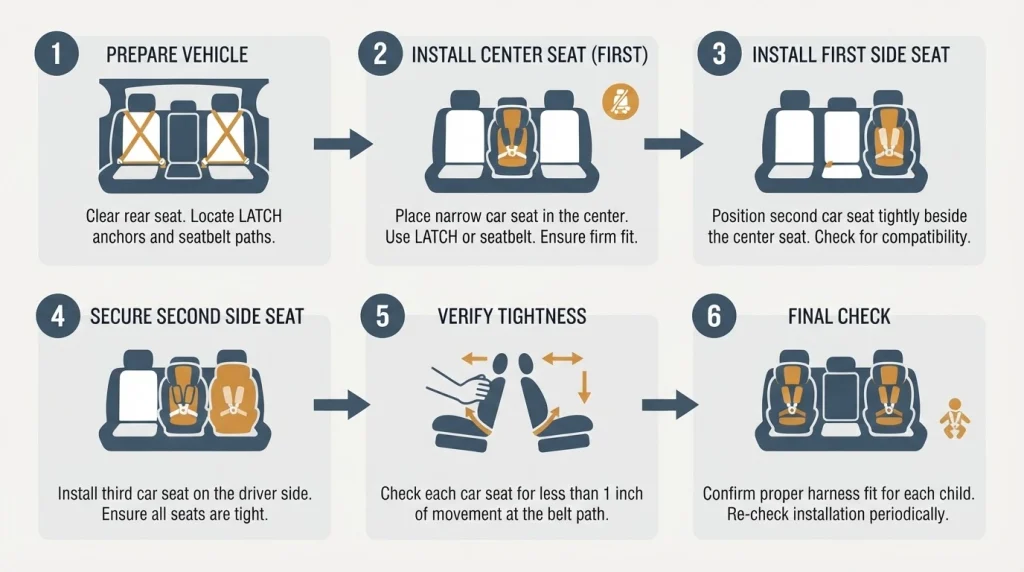
Install the center seat first with a seat belt, then install the second harnessed seat, then place the booster last. Test each seat alone, then test all three together before anyone rides in the car.
This order saves time. I learned that the hard way after installing two outboard seats first and finding no room left for the center belt path.
Review how car seats are installed in your vehicle manual and each seat manual before you start. Manuals differ on center installs, belt locking, and tether use, and those details decide the method you choose.
- Clear the bench, remove headrests that interfere, and lay out all three seats outside the car.
- Install the center harnessed seat with the seat belt, tighten it, and check for less than one inch of movement at the belt path.
- Install the second harnessed seat the same way, keeping its belt path clear of the first seat.
- Attach top tethers for forward-facing seats, following the manual for anchor locations and routing.
- Place the booster, route the vehicle belt through its guides, and buckle it with the child sitting in it.
- Remove each harnessed seat in turn and recheck the neighbor, so you know each install stands alone.
- Buckle the booster, tighten harnesses, and check chest clips, belt fit, and headrest height on every child.
Should you use LATCH or the seat belt?
Use the seat belt for most three-across installs. Seat belts let you center each seat in its space, while LATCH anchors often sit off-center and steal usable inches.
Understand what LATCH is and its weight limits before you choose a method. LATCH stands for Lower Anchors and Tethers for Children, and both systems are safe when used correctly.
- Seat belt: More lateral adjustment, works in the center in many cars, and avoids anchor spacing limits.
- LATCH: Faster in a single-seat install, but fixed anchor positions can push seats together.
- Never both: Use one method at a time, unless both manuals explicitly allow it.
Lock the seat belt correctly for a harnessed install. Pull the belt all the way out to engage the locking retractor, or use a locking clip when the manual calls for one.
How do you check the booster belt fit?
The lap belt must lie low on the hips, not on the belly, and the shoulder belt must cross the middle of the shoulder and chest. The belt should stay flat, with no twists and no slack at the buckle.
Follow how to install a booster seat for your model, including belt guide use and headrest adjustment. A booster that slides around when empty still needs a secure belt route when a child sits in it.
- Lap belt: Snug on hip bones, below the stomach.
- Shoulder belt: Centered on the shoulder, off the neck and off the arm.
- Buckle access: Child can buckle and unbuckle without adult help on most rides.
- Seat stability: Booster stays upright and centered when the child leans to one side.
Pro tip: Check your vehicle owner’s manual and each seat manual for center seating, tether anchors, and airbag notes, and use the NHTSA recall lookup to confirm no open recall affects your seats.
Section takeaway: Install center first with a seat belt, test each seat alone, and finish with a booster belt-fit check. A slow, ordered install beats three rushed installs every time.
What Are the Best Narrow Seats for a Three-Across Fit?
The best narrow seats share three traits: a slim shell, a straight side profile, and a belt path you can reach in a crowded row. Width alone does not guarantee a good fit, because armrests and cup holders add inches where you need them least.
I measure every seat at its widest point, including cup holders and side wings. A spec sheet number taken at the base can hide three extra inches at shoulder height.
| Seat type | Typical width | Best install | Three-across note |
|---|---|---|---|
| Slim convertible | 16 to 18 inches | Seat belt | Best first pick for rear-facing and forward-facing use. |
| Narrow combination seat | 17 to 19 inches | Seat belt | Harness now, booster later, with a slimmer base than many convertibles. |
| High-back booster | 16 to 18 inches | Vehicle belt | Adds head support and belt guides, but side wings need clearance. |
| Backless booster | 14 to 16 inches | Vehicle belt | Slimmest choice, best when the vehicle headrest supports the child. |
Compare seats by shape, not just by a single width number. A seat with a tapered base and straight sides often puzzles better than a wider seat with curved sides.
Vehicle reviews from Car and Driver can flag tight rear seats before you shop, but only a hands-on test fit proves a three-across setup. Bring your tape measure to the dealer lot, not just your hope.
What width should you look for?
Aim for 17 inches or less at the widest point for each harnessed seat in a tight row. Boosters can run a little wider outboard, where the door side offers more room.
Test fit beats spec sheets every time. Bring all three seats to the car, install them in order, and check buckle access before you keep the boxes.
High-back or backless booster for three-across?
A high-back booster suits younger booster riders and cars with low seat backs, because it guides the belt and supports the head. A backless booster suits older children in cars with tall headrests and good belt geometry.
Read independent notes from Consumer Reports alongside manufacturer manuals when you compare models. Independent testing context helps you weigh ease of install, belt fit, and build quality together.
- Choose high-back when: Child still naps in the car, belt guides help, or head support is limited.
- Choose backless when: Space is tight, child sits tall, and the vehicle headrest reaches at least ear level.
- Skip oversized extras: Removable cup holders and wide armrests often cost the inch you need most.
Section takeaway: Pick slim, straight-sided seats and judge them by a real test fit in your car. The right booster style depends on belt fit and head support, not on width alone.
What Mistakes Make a Tight Fit Unsafe?
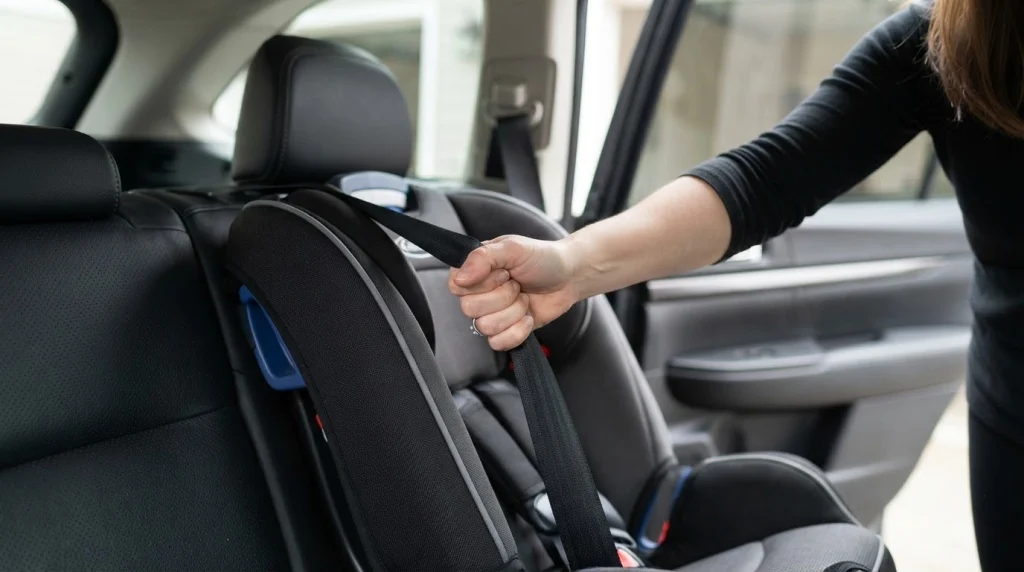
A tight fit turns unsafe when seats depend on each other, buckles hide, or belts route around a neighbor instead of through the right path. The danger hides in daily habits, not in one dramatic install error.
- Forcing seats together: Wedging seats so tight that one tilts or lifts off the cushion.
- Sharing a buckle: Routing two belts to one buckle, or using the wrong buckle for a position.
- Skipping the solo test: Accepting a tight feel that disappears when a neighbor seat comes out.
- Ignoring tether anchors: Leaving a forward-facing tether loose or routed around a headrest the wrong way.
- Loose harness straps: Leaving slack that lets a child shift in a crash, even when the seat itself feels solid.
- Twisted booster belts: Allowing twists that change belt geometry and slow buckling.
Why does forcing seats together backfire?
Pressure from a neighbor can hold a loose seat still during a quick tug test. That false tightness disappears on the road, when vibration and child movement shift the seats apart.
Install each seat, remove its neighbors, and tug again at the belt path. If movement grows past one inch, the install was never tight on its own.
When should you stop and get help?
Stop and get help when buckles stay buried, tethers will not reach, or the center install will not hold without neighbor pressure. A certified child passenger safety technician can spot routing and spacing fixes in minutes.
Pro tip: Check the NHTSA site and your owner’s manual for inspection stations, recall checks, and model-specific install notes before a long trip.
Help is not a failure. I have asked for a second set of eyes on a stubborn center install, and the fix took five minutes once someone else saw the belt routing.
Section takeaway: Never let neighbor pressure hide a loose install. If a seat moves more than one inch alone, reinstall it before you drive.
Frequently Asked Questions
These answers cover the questions I hear most often in the driveway. Each one stands alone, so jump to the one you need.
Can two car seats and a booster fit in a sedan?
Yes, in many midsize sedans, when you use slim seats and seat belt installs. Measure hip room and buckle spacing first, then test all three seats together with buckle access checked.
Can the booster go in the middle seat?
It can, when the center belt fits correctly and the buckle stays easy to reach with neighbors installed. In most cars, an outboard spot works better for daily buckling and keeps the center free for a harnessed seat.
Is it safe if the seats touch each other?
Light contact is safe when each seat passes the one-inch test alone and no seat tilts or lifts its neighbor. Unsafe contact pushes a seat out of position, blocks a buckle, or changes a belt path.
Do I need special narrow car seats for three-across?
You often need slimmer models, because standard seats total more width than most benches offer. Aim for seats about 17 inches wide or less, and test the exact combination in your car before you buy.
Should I use LATCH or seat belts for three-across?
Seat belts usually work better, because they let you shift each seat to use the full bench width. LATCH anchors sit in fixed spots that can waste inches, and many center positions have no dedicated LATCH set.
How do I know if the booster belt fit is correct?
The lap belt should sit low on the hips, and the shoulder belt should cross the middle of the shoulder and chest. If the belt rides up on the belly or cuts into the neck, adjust the booster, belt guide, or seating position.
Final Takeaway: A Tight Fit Can Still Be a Safe Fit
Two car seats and a booster can share one row safely when you respect width, order, and buckle access. The winning setup feels calm at buckling time, not like a daily wrestling match.
Start with measurements, install the center seat first, and test each seat on its own. Swap one wide seat for a slim model before you force a fit that fights you every morning.
- Measure hip room and buckle spacing today, before you order another seat.
- Test your current seats in the order center, outboard, booster.
- Book a seat check if any install, tether, or belt fit still feels wrong.
Your car does not need to be huge to carry three children safely. It needs the right combination, installed with patience and checked with honest tug tests.

Daniel Brooks is an automotive writer and product researcher focused on car accessories, car tech, maintenance, and practical driving guides. At Plug-in Car World, he helps drivers make smarter automotive decisions through honest reviews and research-driven content.
