
Why Are Rear-Facing Car Seats Safer for Babies? 2026
Quick Answer
Why are rear-facing car seats safer for babies? A rear-facing seat cradles your baby’s whole back, head, and neck in a crash, so the force spreads across the shell instead of pulling on a small neck. That support matters most in a frontal crash, which is the most common serious crash type. Keep your baby rear-facing until the seat’s own height or weight limit is reached, as rear-facing vs. forward-facing car seats explains in more detail.
The short version
- Force spreads out: The shell takes the load across your baby’s back, not just at the harness straps.
- Neck stays supported: The head moves with the seat, so the neck does not snap forward on its own.
- Head stays contained: The deep shell and side wings help keep the head inside the seat.
- Frontal crashes covered: The seat faces away from the impact, so your baby moves into the seat, not away from it.
- Longer is safer: Age alone does not end rear-facing, the seat’s limits do.
Check before every ride
- The seat moves less than one inch at the belt path, the harness passes the pinch test, and the chest clip sits at armpit level.
I still remember the first time I fitted a rear-facing seat in my own car. I tugged the base, checked the recline bubble three times, and still asked myself if I had it right.
That doubt is normal, and it is also useful. It makes you slow down and check the fit instead of guessing. This guide goes deeper than a quick “rear-facing is safer” answer, so you can see the physics, the baby’s body, and the common mistakes that undo the benefit.
In This Guide
What Does Rear-Facing Actually Mean?
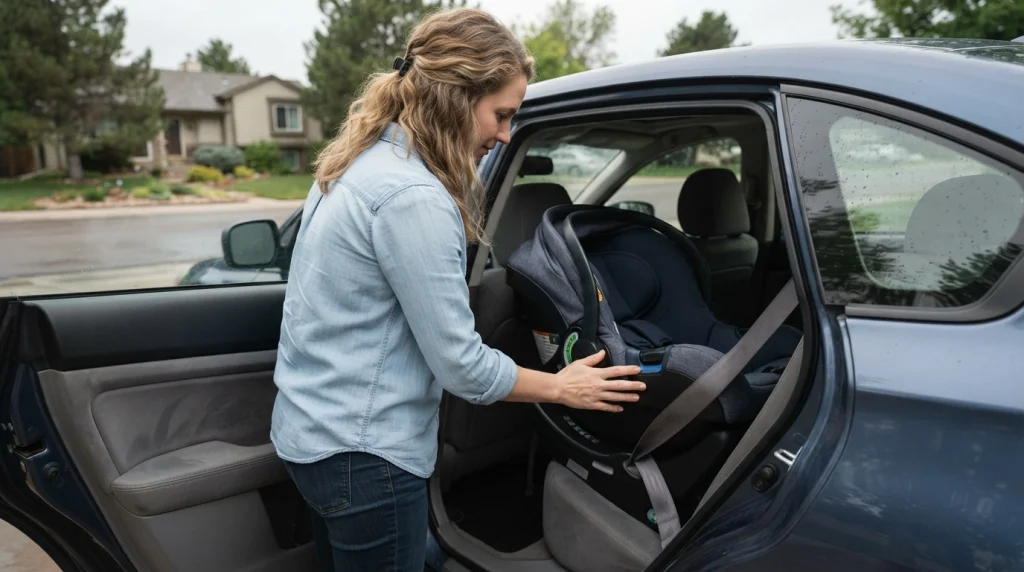
A rear-facing car seat is a seat that holds your baby facing the back window of the car. Your baby’s back rests against the seat shell, and the baby’s feet point toward the back of the car.
The seat still uses a harness, just like a forward-facing seat. The difference is direction, and direction changes how crash forces travel through your baby’s body.
There are two main types of rear-facing seats, and most families use one or both of them.
- Infant carrier: A small seat with a handle and a base that stays in the car. You click the carrier in and out, which helps with a sleeping newborn.
- Convertible seat: A larger seat that starts rear-facing and later turns forward-facing. It stays in the car, and it usually allows a higher rear-facing weight limit.
Both types belong in the back seat only. Never put a rear-facing seat in front of an active airbag.
An airbag opens with great force, and it opens toward the back of a rear-facing seat. That is why the back seat is the rule, not a preference.
Pro tip: Check your vehicle owner’s manual and the car seat manual together before the first ride, and check the NHTSA recall lookup if your seat is secondhand.
What does the recline angle do?
The recline angle keeps a newborn’s airway open. A newborn cannot hold the head up, so a seat that sits too upright lets the chin drop to the chest.
Most seats have a recline indicator, often a bubble or a line. Set it to the range your manual gives for your baby’s age and weight.
Section Takeaway: Rear-facing means the baby faces the back of the car, in the back seat, at the recline angle the manual gives. The shell, not just the harness, does the protecting.
How Does a Rear-Facing Seat Protect a Baby in a Crash?
A rear-facing seat protects a baby by letting the whole seat move with the baby. In a frontal crash, the car stops fast, but the baby keeps moving forward for a split second.
Rear-facing, that forward motion pushes your baby into the seat shell. The shell supports the back, the head, and the neck at the same time.
Forward-facing, the harness holds the body, but the head keeps moving forward on its own. That is the key difference, and it is why direction matters so much for a baby.
How does the shell spread crash force?
Crash force has to go somewhere, and a wide surface handles it better than a narrow strap. The rear-facing shell gives that wide surface across the back and head.
The harness still matters rear-facing, and it must stay snug. It holds your baby in the shell, so the shell can do its job.
- Shell: Supports the back, head, and neck as one unit.
- Harness: Keeps your baby in place inside the shell.
- Side wings: Help contain the head and limit side-to-side movement.
- Base and belt path: Hold the seat tight, so it moves with the car, not inside it.
What happens to the head and neck?
The head is the heaviest part of a baby for its size, and the neck is still weak. Rear-facing, the head rests against the shell, so it moves with the body.
That shared movement is the whole point. The neck does not have to stop the head on its own.
Forward-facing, the body stops at the harness, and the head keeps going. The neck takes that strain, and a baby’s neck is not built for it.
Guidance from NHTSA is clear on the direction of travel: keep children rear-facing as long as possible, until they reach the top height or weight limit allowed by the seat maker.
Section Takeaway: A rear-facing seat turns a frontal crash into a push into a padded shell. The head, neck, and back move together, instead of the neck taking the load alone.
Why Is a Baby’s Body More at Risk Forward-Facing?
A baby is not a small adult. The body proportions, the bones, and the muscles are all still developing, and that changes how a crash affects them.
The head is large for the body, and the neck muscles are weak. The bones in the spine are still growing, and the ligaments stretch more easily than an adult’s.
That mix is risky forward-facing. The head has more weight to throw forward, and the neck has less strength to stop it.
How does the head-to-body size change the risk?
A baby’s head makes up a much larger share of body weight than an adult’s head does. In a sudden stop, that weight keeps moving, and the neck feels it first.
Rear-facing, the shell holds the head, so its weight works with the seat. Forward-facing, the harness holds the torso, but the head is free to move.
That is why a baby can look fine in a forward-facing seat on a normal drive, yet face a very different load in a crash.
What about the spine and neck?
A baby’s spine is still forming, and the bones are not yet fully hardened. The spinal cord inside is delicate, and it does not tolerate a sharp stretch.
Rear-facing spreads the load along the spine. The whole back presses into the shell, so no single point takes the full force.
Forward-facing concentrates the load at the neck and upper spine. The body stops, the head moves, and the neck bridges the gap.
Section Takeaway: A baby’s large head, weak neck, and developing spine make forward-facing riskier. Rear-facing supports the whole body, so the neck never works alone.
Rear-Facing vs. Forward-Facing in Each Crash Type
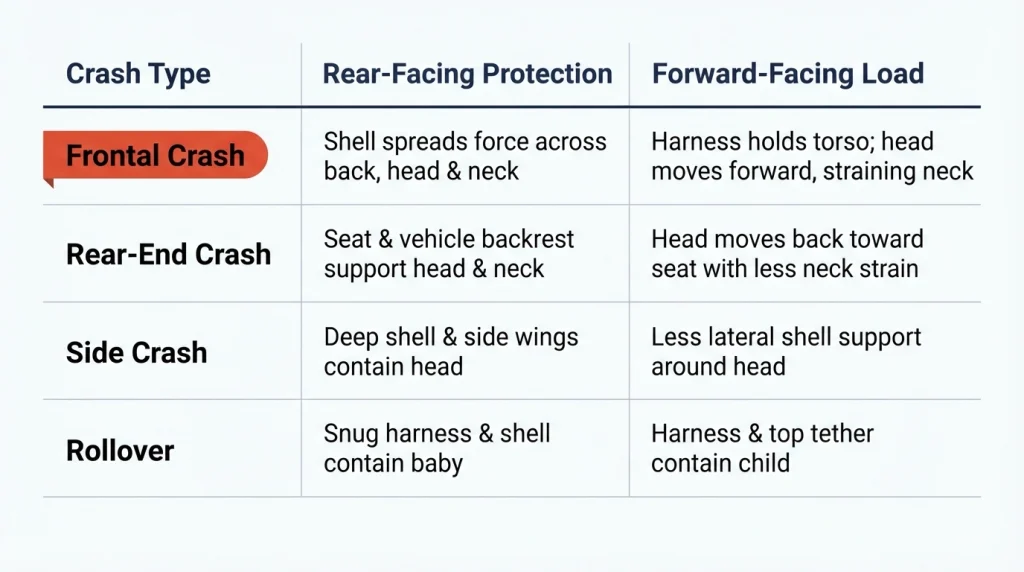
Not every crash works the same way, and rear-facing does not help in the same way each time. Frontal crashes show the biggest gap, because they are both common and severe.
Rear-end crashes work differently. The car is pushed forward, and your baby moves into the back of the vehicle seat, which can help.
Rear-facing still holds the head and neck, but the advantage is smaller here.
Side crashes are harder for any seat, because the force comes from the side. A rear-facing shell with deep side wings still helps contain the head, and a tight install keeps the seat from shifting.
| Crash type | Rear-facing | Forward-facing |
|---|---|---|
| Frontal crash | Baby moves into the shell, and force spreads across the back, head, and neck. | Harness holds the body, but the head moves forward and the neck takes the strain. |
| Rear-end crash | Seat and vehicle seat support the head and neck as the car is pushed forward. | Head moves back toward the seat, with less forward neck strain than a frontal crash. |
| Side crash | Deep shell and side wings help contain the head, if the install is tight. | Harness and tether hold the seat, but the head has less side support from the shell. |
| Rollover | Snug harness and shell help keep the baby contained inside the seat. | Snug harness and top tether help keep the child contained inside the seat. |
The table shows why the frontal crash matters most. It is the crash where direction changes the load on the neck the most.
For a clear check on fit and install, see how to install a rear-facing car seat before your next long drive.
Section Takeaway: Rear-facing wins biggest in a frontal crash, helps in a side crash, and still holds the head steady in a rear-end crash. Direction matters most where the force is greatest.
How Long Should a Baby Stay Rear-Facing?
Keep your baby rear-facing until the seat’s rear-facing limit is reached. That limit is a height or a weight number on the label, and it beats any birthday.
Age one was once treated as the turning point, and that idea is now out of date. Many babies can stay rear-facing well past age two, and many toddlers can stay rear-facing to age three or four.
Your seat’s label decides the end point, not a family tradition or a comment at daycare. Check the label, then check it again after a growth spurt.
What limits actually end rear-facing?
Three limits can end rear-facing, and any one of them is enough. Hitting one means the seat is outgrown in that direction, even if the other two still have room.
- Weight limit: Many convertible seats allow rear-facing to 40 pounds, and some allow 50 pounds. Check your exact label.
- Height limit: Some seats give a standing height limit, and some give a seated height rule. Follow the rule your manual prints.
- Headroom rule: The top of your baby’s head must stay at least one inch below the top of the shell. This is the limit most parents miss.
Headroom often ends rear-facing before weight does, especially for a tall baby. Measure it with your baby sitting in the seat, not standing beside it.
When you need a seat with more room, compare the rear-facing limits first. Reviews from Consumer Reports and guides from Edmunds can help you shortlist seats, but the label on your own seat is the final word.
Are bent legs a reason to turn?
No, bent legs are not a reason to turn. Toddlers sit cross-legged, dangle their legs over the sides, or rest their feet on the vehicle seat back.
That looks cramped to an adult, but it is normal for a toddler. Leg injuries are rare rear-facing, and a bent leg is far safer than an unprotected neck.
Use the parents checklist for car seat transitions when you think a change is near. It walks through fit, the local rules, and the expiry date before you move to the next stage.
Section Takeaway: Stay rear-facing until a weight, height, or headroom limit is hit. Bent legs do not end rear-facing, but a head within one inch of the shell top does.
What Mistakes Undo the Safety Benefit?
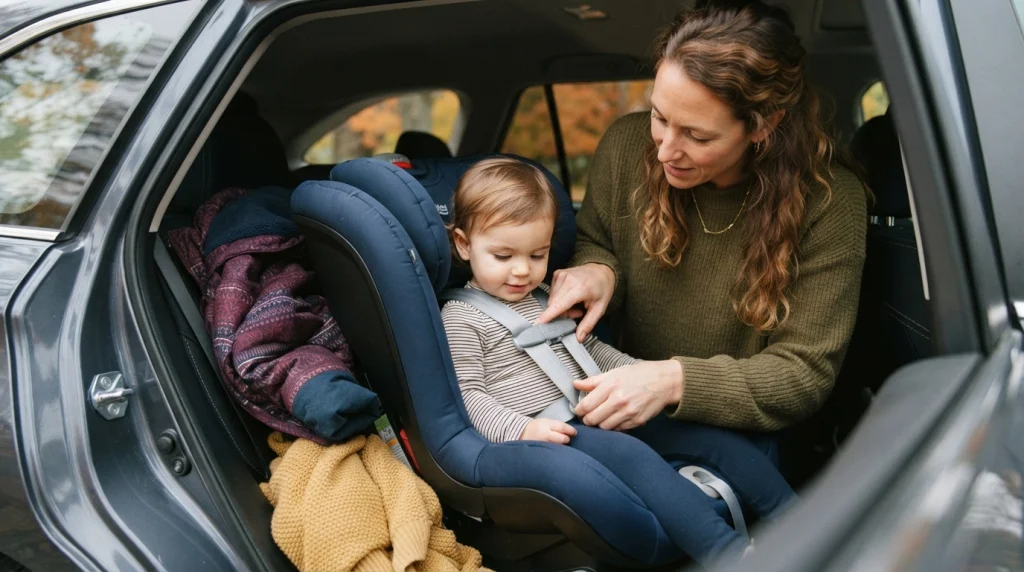
A rear-facing seat only protects if it is installed and used right. A small mistake can undo a big part of the benefit, and most of these mistakes are easy to fix.
Start with the install, then the harness, then the extras. That order catches the most common errors first.
- Turning at age one: Age alone is not a limit, so an early turn gives up protection for no safety gain.
- Loose install: If the seat moves more than one inch at the belt path, it can shift in a crash. Push down with your weight and tighten again.
- Loose harness: If you can pinch a fold in the strap at the shoulder, it is too loose. Tighten until the pinch test passes.
- Bulky coats: A thick coat leaves slack under the harness, and that slack lets the baby move in a crash. Remove the coat, then cover with a blanket over the harness.
- Wrong harness height: Rear-facing straps should sit at or below the shoulders, not above them. Move the straps as your baby grows.
- Aftermarket inserts: Extra padding, head supports, and strap covers can change the harness fit. Use only what your seat maker allows.
- Wrong recline: A seat that is too upright can let a newborn’s chin drop, and a seat that is too reclined can move too much. Check the indicator each time you reinstall.
Run the full check in the essential car seat safety checklist for parents once a month, and again after any reinstall. It takes five minutes, and it catches the errors that creep in over time.
Many myths make these mistakes worse, from “a tight harness hurts the baby” to “a bulky coat is fine if the straps feel snug.” Read common car seat safety myths parents should know if a well-meaning relative is pushing you to turn early or loosen the straps.
If you are choosing between an infant carrier and a convertible, infant vs. convertible car seat explains the fit, limits, and trade-offs.
The right choice is the seat that fits your baby, your car, and your budget, and that you can install correctly every time.
Section Takeaway: Turning early, a loose install, a loose harness, and bulky coats are the mistakes that matter most. Fix those first, and the seat can protect the way it was designed to.
Frequently Asked Questions
Is rear-facing safer than forward-facing for babies?
Yes, rear-facing is safer for babies. The shell supports the head, neck, and back together in a frontal crash, and it spreads the force across the back. Forward-facing leaves the head free to move while the harness holds the body.
At what age can my baby turn forward-facing?
There is no single safe age to turn forward-facing. Turn only when your baby reaches the seat’s rear-facing weight limit, height limit, or one-inch headroom rule. Many children can stay rear-facing to age three or four.
Are bent legs safe when a baby is rear-facing?
Yes, bent legs are safe rear-facing. Babies and toddlers sit cross-legged with ease, and leg injuries are rare in this position. Turn only when a weight, height, or headroom limit is hit, not because the legs look folded.
Is rear-facing safe in a side crash?
Yes, rear-facing helps in a side crash too. The deep shell and side wings help contain the head, and a tight install keeps the seat from shifting. No seat can remove all side-crash risk, but containment and a snug harness help.
Can a newborn use a rear-facing seat in a small car?
Yes, a rear-facing seat can fit in a small car with the right seat and angle. Try the centre seat, use the recline range your manual allows, and test a compact convertible in your own car. A test fit tells you more than any spec sheet.
Does rear-facing protect my baby in a rear-end crash?
Yes, rear-facing still protects in a rear-end crash. The seat and the vehicle seat support the head and neck as the car is pushed forward. The advantage is smaller than in a frontal crash, but the seat still holds your baby in place.
Rear-facing is not about keeping your baby facing backwards for as long as possible for its own sake. It is about giving a small, developing body the support it needs in the crash that matters most.
Check the label today, fix the harness, and keep your baby rear-facing until a limit is hit. For more on choosing and fitting seats, see the guides from Car and Driver alongside your seat manual.

Daniel Brooks is an automotive writer and product researcher focused on car accessories, car tech, maintenance, and practical driving guides. At Plug-in Car World, he helps drivers make smarter automotive decisions through honest reviews and research-driven content.
