
Can I Fit 3 Car Seats in One Row? 3-Across Guide
Quick Answer
Yes, you can fit 3 car seats in one row in many sedans, SUVs, and minivans, but only when the bench is wide enough and the seats are narrow enough to install independently. Most successful setups use slim seats around 17 to 18 inches wide, seat belt installs in tight spots, and a careful check that each seat stays tight on its own. Before you buy anything, learn how wide a standard car seat is and measure your own back seat at the belt line.
What makes 3 across work
- Narrow seats: Slim shells near 17 to 18 inches wide leave room for buckles, hands, and harness adjusters.
- Usable width: Flat benches with 52 inches or more of usable width give you a fair shot at a clean fit.
- Seat belt installs: A locked seat belt often fits the center spot better than borrowed LATCH anchors.
- Puzzle-friendly shapes: Seats with straight sides and low-profile bases nest together without wedging each other out of place.
- Independent tightness: Each seat must stay tight when its neighbor comes out, with less than one inch of movement at the belt path.
Check before you drive
- Measure first: Tape your bench at the belt line before you order a third seat.
- Test each seat alone: Remove one neighbor at a time and recheck the install.
- Check buckle access: If you cannot reach and release each buckle, the fit fails daily life.
I’ve spent too many Saturday afternoons kneeling on driveways, trying to wedge a third seat into a back row that looked roomy until the buckles vanished. This guide pulls together what worked, what failed, and the checks that keep a tight-looking fit safe.
You’ll learn how to measure your bench, pick seats that puzzle together, and install all three so each one holds tight on its own. Read it once before you shop, and you’ll save a return trip or two.
In This Guide
- What Does 3 Across Actually Mean?
- How Much Space Do You Need for 3 Car Seats in One Row?
- Which Car Seats Work Best for a 3-Across Fit?
- How Do You Install 3 Car Seats in One Row Safely?
- What If 3 Car Seats Won’t Fit in One Row?
- What Mistakes Can Undo a Good 3-Across Fit?
- Frequently Asked Questions About Fitting 3 Car Seats in One Row
- The Bottom Line: Measure First, Then Buy
What Does 3 Across Actually Mean?
3 across means three child restraints installed side by side on one row of seats. Most parents mean the second row, with one seat in the center and one on each side.
The term covers any mix of infant carriers, convertibles, and boosters. It does not mean three identical seats, and it does not require a minivan.
Is 3 across the same as using a third row?
No. A third row spreads three children over two rows, which is far easier. 3 across keeps all three on the same bench, so width and buckle access decide the outcome.
I learned that split in a friend’s three-row SUV. The third row took a booster in minutes, while the second row fought us for an hour.
Why doesn’t width alone tell the whole story?
Two seats can share the same listed width and fit very differently. Shell shape, base shape, and where the widest point sits all change the result.
- Seat contours: Deep side bolsters and a raised center hump push seats toward each other.
- Buckle stalks: Short, stiff stalks can hide under a neighboring base and turn buckling into a daily fight.
- Belt path height: A high or angled belt path can clash with the seat next door during tightening.
- Door and armrest shape: Curved door panels and fixed armrests steal an inch you thought you had.
That is why a tape measure beats a spec sheet every time. Measure your bench, then test the seats you own before you buy more.
Section takeaway: 3 across means three independent installs on one bench, not three seats squeezed until they hold each other up. Judge the fit by tightness and buckle access, not by looks alone.
How Much Space Do You Need for 3 Car Seats in One Row?
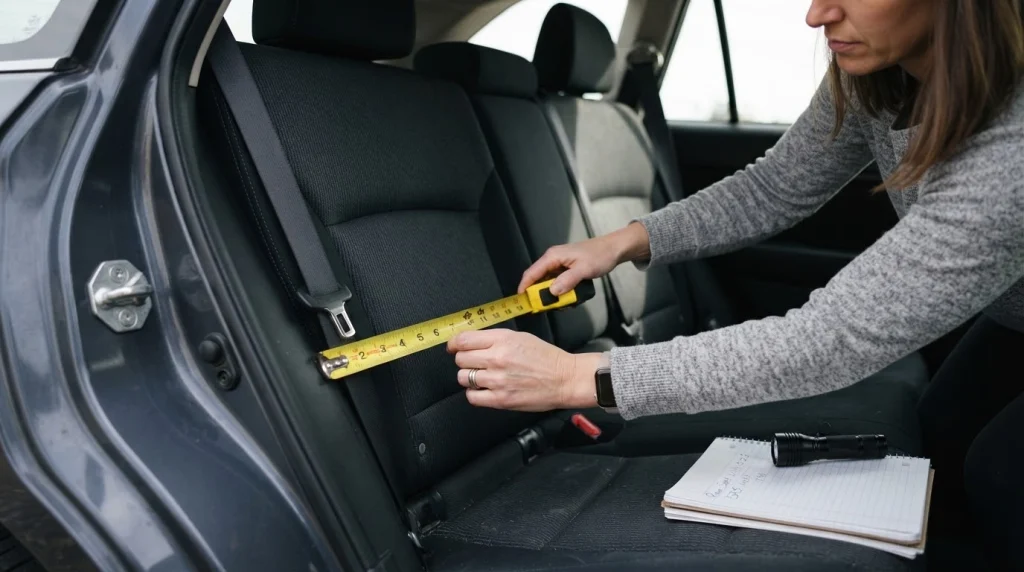
You need enough flat, usable bench width for three seats to sit side by side without leaning on each other. As a rough guide, many workable setups land near 52 to 54 inches of usable width with slim seats.
Published hip room numbers help you shortlist cars, but they do not replace a tape measure. Hip room is measured at a set point, and your seats live at the belt line, the cushion, and the buckles.
How do you measure your back seat in 5 minutes?
Grab a tape measure, a notepad, and a flashlight. Measure with the front seats set where you drive, since rear-facing seats need that legroom too.
- Measure belt-line width: Run the tape door to door across the seat back, at the height where the belts exit.
- Measure cushion width: Repeat the tape across the seat cushion, between the door panels or armrests.
- Mark the buckles: Note where each buckle sits and how far its stalk flexes toward the center.
- Note the humps: Press the cushion and spot raised centers, seams, and bolsters that tilt a base.
- Find the anchors: Locate the lower anchors and top tether anchors, and note which spots lack them.
Write down the smallest width you found, not the largest. That smallest number is the one your three seats must share.
What counts as enough room?
Add the widest points of your three seats, then add room for your hands. If the math leaves no gap for buckles, the daily routine will punish you.
- Three slim seats: Three seats near 17 inches each need about 51 inches before you count buckle space.
- Two seats plus a booster: A backless booster can ease the math, but its belt fit still needs clear buckle access.
- Three wide seats: Three seats near 19 to 20 inches each rarely puzzle well on a sedan bench.
- One rear-facing seat: Rear-facing seats need front-to-back room too, so check legroom with the front seat in place.
My own test in a Honda CR-V gave me 54 inches at the belt line and a clean puzzle with two slim convertibles and a booster. The same three seats in an older compact sedan left one buckle buried, and I stopped forcing it.
If you are still unsure about your car, start by checking whether a car seat will fit in your car with a hands-on test. You can also compare rear hip room figures on Car and Driver when you shortlist a new vehicle, then confirm with your tape.
Section takeaway: Measure the smallest usable width, add your seats’ widest points, and keep room for buckles. If the math is tight on paper, it will feel tighter in the driveway.
Which Car Seats Work Best for a 3-Across Fit?
Slim convertibles and slim all-in-one seats work best for 3 across, since they pair a narrow shell with a long usable life. Narrow boosters round out the mix for older kids who pass the belt-fit check.
As of 2026, many makers publish a maximum width, but that number can sit at the headrest, the base, or the cup holders. Check the width at each level, and fold or remove cup holders when the manual allows it.
| Seat type | Typical width | 3-across fit | Best for |
|---|---|---|---|
| Narrow convertible | 17 to 18 inches | Strong | Babies and toddlers, rear- and forward-facing |
| Standard convertible | 18.5 to 20 inches | Mixed | Wide benches, or one wide seat plus two slim ones |
| Infant carrier with base | 17.5 to 19 inches | Mixed | Newborns, when the base stays narrow and flat |
| High-back booster | 17 to 19 inches | Good, if buckles stay clear | Older kids who need belt positioning and head support |
| Backless booster | 15 to 17 inches | Strong, if belt fit is correct | Older kids with good belt fit and vehicle head support |
Treat these widths as typical ranges, not promises for a single model. Always check the manual for the seat you own, and measure the seat at its widest point.
What makes a seat narrow-friendly?
A good 3-across seat stays slim from base to headrest. It also keeps its belt path and harness adjuster easy to reach when neighbors crowd in.
- Straight sides: Flat shell sides slide past neighbors instead of wedging against them.
- Low-profile base: A base that sits flat on the cushion resists tilting on a raised center hump.
- Open belt path: A clear belt path lets you route and tighten the belt without lifting the next seat.
- Front harness adjuster: A front adjuster you can reach saves you from digging between shells at school drop-off.
- Removable cup holders: Cup holders add width fast, so seats that shed them gain precious space.
Which seat mixes puzzle best together?
Mixed ages often puzzle better than three matching seats. Different shell heights let headrests and bases nest without stacking wide points at the same height.
- Rear-facing plus forward-facing: A rear-facing seat in the center can free door-side room for a forward-facing shell.
- Two harnessed seats plus a booster: Place the booster where its buckle stays reachable, often on a door side.
- Infant carrier in the center: A narrow carrier base can sit flat in the center while wider convertibles take the outboard spots.
Try each layout before you settle. I once swapped the center and door-side seats and gained a full inch of buckle room with no new purchase.
Should you buy three matching seats?
Matching seats can help when the model is truly slim and puzzle-tested by other families. They can hurt when three identical wide points line up at the same height and fight for space.
Buy for your kids’ sizes, heights, and weights first, then for width. A seat that fits the child poorly is a bad deal at any width.
Section takeaway: Slim, straight-sided seats with open belt paths puzzle best, and mixed layouts often beat three matching seats. Measure each seat at its widest point before you trust the box.
How Do You Install 3 Car Seats in One Row Safely?
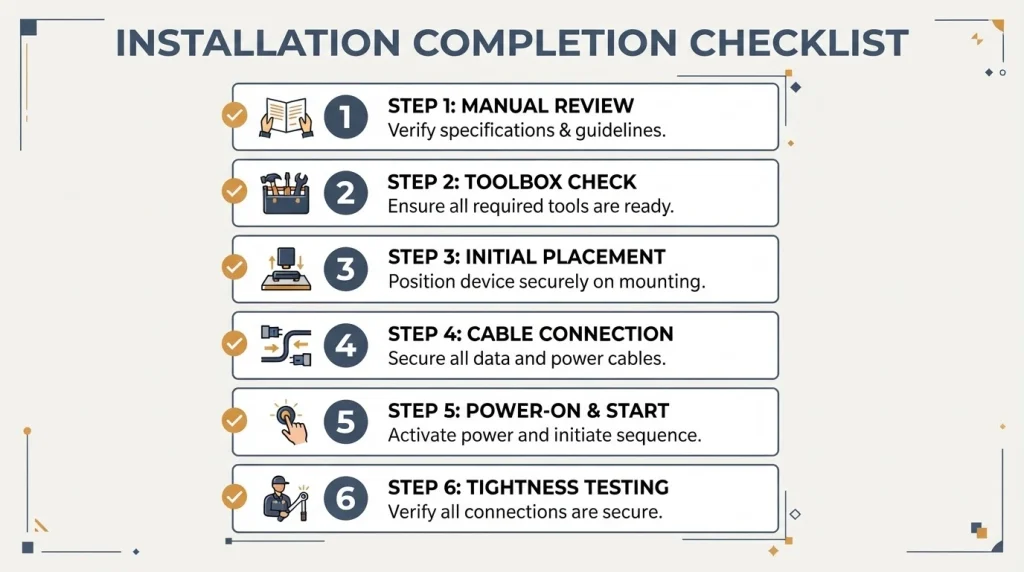
Install each seat so it holds tight on its own, using its own belt or approved anchors, and never let one seat brace another. Work slowly, check each seat alone, and follow both the car seat manual and the vehicle owner’s manual.
Set aside 45 to 60 minutes for your first 3-across attempt. Rushing this job leads to loose installs and buckles you cannot reach.
- Read both manuals first: Confirm which seating spots allow a car seat, where the anchors sit, and what the weight limits are.
- Plan the order: Start with the seat that needs the most room, often the rear-facing seat or the center seat.
- Install the center seat: Use the seat belt for the center spot unless the manual clearly allows a center LATCH setup.
- Add the door-side seats: Install each one without shifting the center seat, and keep belt paths clear.
- Attach top tethers: Connect every forward-facing top tether to its own anchor, and tighten it after the base install.
- Test each seat alone: Remove each neighbor in turn and confirm the seat left behind still moves less than one inch at the belt path.
Should you use LATCH or the seat belt for 3 across?
Use whichever method gives a tight, correct install in that spot, and follow the manuals for limits. Seat belts often win in the center, since many cars offer only two sets of lower anchors per row.
LATCH stands for Lower Anchors and Tethers for Children, and you can learn what LATCH is and how it works before you pick a method. Never borrow an inner anchor from a door-side set unless both manuals allow that exact setup.
A locked seat belt is just as safe as LATCH when the install is tight and correct. I use belts for most 3-across centers, since the belt lets me center the seat where it sits flattest.
What is the independent-tightness test?
The test proves each seat holds tight without help from its neighbors. Take one seat out, grab the seat left behind at the belt path, and push it side to side and front to back.
Less than one inch of movement passes. More than that means you need to reinstall that seat alone, even if the full row looked solid.
Light touching can be fine, but pressure that lifts, tilts, or loosens a neighbor is not. Learn whether two car seats can touch each other so you can tell harmless contact from a failed install.
Pro tip: Check your vehicle owner’s manual and the car seat manual for anchor locations, belt-locking steps, and tether rules, and confirm the fit with a certified Child Passenger Safety Technician or NHTSA guidance when you are unsure.
Section takeaway: Install each seat on its own merits, test it alone, and tether every forward-facing seat. A row that only feels tight as a group has not passed the test.
What If 3 Car Seats Won’t Fit in One Row?
Try a new layout, a slimmer seat, or a different install method before you assume the car has failed you. Many rows that fail on the first try pass after one swap.
If the row still fails the independent-tightness test, do not drive with a forced fit. Use another row, another seat, or another vehicle plan instead.
Which fixes should you try before you give up?
Small changes add up fast in a tight row. Change one thing at a time, then retest the full row.
- Swap positions: Move the rear-facing seat to the center or to the side with more legroom.
- Switch the install method: Try a seat belt install where LATCH anchors crowd the center.
- Remove the base: Install an infant carrier without its base when the manual allows a baseless install.
- Shed cup holders: Take off bulky cup holders that push shells apart at the widest point.
- Adjust recline: Use the allowed recline range to level a seat on a contoured cushion.
- Try a slimmer model: Borrow or test-fit a narrow seat before you buy a full set.
When does a third row or a different vehicle make more sense?
A third row makes sense when your bench fails the tightness test with slim seats, or when daily buckling stays a struggle. It also helps when an older child needs easy access without climbing past two harnessed seats.
Third rows carry their own limits, from tether counts to legroom and cargo space. Check whether a car seat can go in the third row of your vehicle before you plan around it.
If you shop for a new car, bring your seats to the test drive and install all three. Specs on Edmunds can narrow the list, but only a test install proves the fit.
Section takeaway: Exhaust the cheap fixes first, then use a third row or a wider bench without guilt. A safe, easy fit beats a heroic squeeze every day.
What Mistakes Can Undo a Good 3-Across Fit?
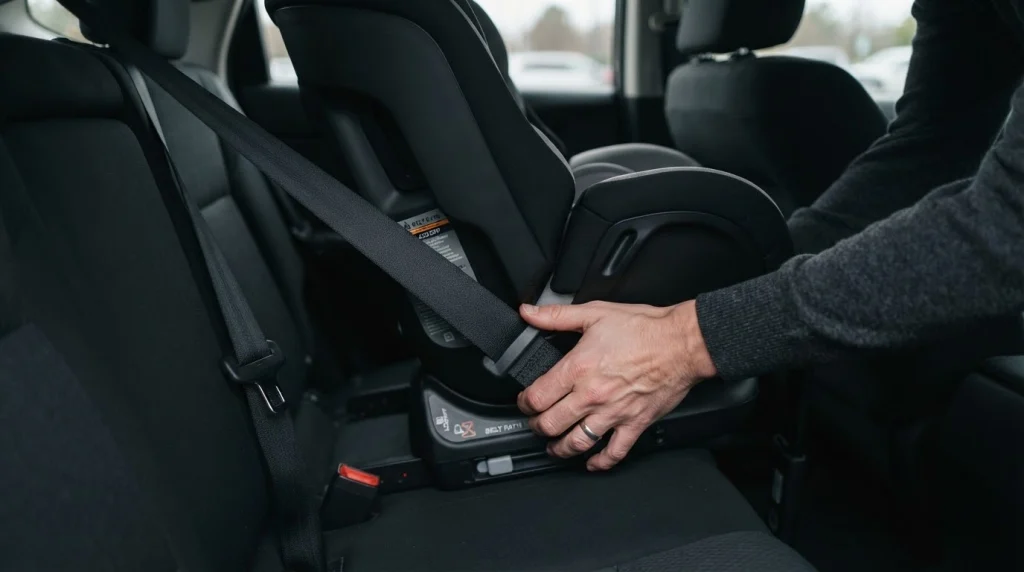
Most 3-across failures come from install habits, not from the car alone. The row looks full, so a loose seat hides behind its neighbors.
Run through this list after every install, and recheck the row after a seat moves. Kids grow, seats shift, and a fit that passed last season can drift.
- Letting seats brace each other: A seat that leans on its neighbor can loosen the moment that neighbor comes out.
- Borrowing LATCH anchors: Using an inner anchor from another set without manual approval creates an untested install.
- Skipping the top tether: A forward-facing seat without its tether loses a key limit on head movement, so attach it every time.
- Ignoring buckle crunch: A buckle pressed hard against a shell can sit at a bad angle and resist a clean latch.
- Trusting a group wiggle test: Shaking all three seats together hides a loose center seat, so test each one alone.
- Adding unapproved padding: Thick mats, towels, and aftermarket inserts can change the install, so use only what the manuals allow.
I once passed a group wiggle test, then found the center seat sliding two inches once I pulled a door-side seat out. That 10-minute recheck taught me to trust the solo test over the full-row feel.
If any step feels unclear, review how car seats are installed and rebuild the row one seat at a time. Independent testing notes from Consumer Reports can also help you compare seat designs before your next purchase.
Section takeaway: Test each seat alone, use only approved anchors and tethers, and keep buckles clear. The safest row is the one you checked seat by seat.
Frequently Asked Questions About Fitting 3 Car Seats in One Row
Can I fit 3 car seats in a sedan?
Often, yes, if the sedan has a flat bench near 54 inches wide and you use narrow seats. Compact sedans with sculpted seats and short buckle stalks make the job much harder, so measure and test-fit before you commit.
Can 3 car seats touch each other?
Light contact is often fine, but one seat must never hold another seat in place. Check each install on its own by removing its neighbor and confirming it still moves less than one inch at the belt path.
Do I need special narrow car seats for 3 across?
In most cars, yes, at least one or two slim seats make the difference between a safe fit and a forced one. Standard-width seats can work in wide minivan and large SUV benches, but narrow shells leave room for buckles and hands.
Is it safe to put a car seat in the middle seat?
Yes, when both manuals allow it and the install is tight with its own belt or approved LATCH setup. The center spot only helps if the seat sits flat, the belt locks correctly, and the seat stays tight without leaning on its neighbors.
Can I use LATCH for all three seats?
Rarely, because most cars provide only two sets of lower anchors in a row. You will often install at least one seat with the seat belt, which is just as safe when done correctly, so check your owner’s manual for anchor locations and limits.
How do I know my 3-across install is tight enough?
Test each seat alone at the belt path with your non-dominant hand, and look for less than one inch of side-to-side or front-to-back movement. Recheck the harness fit, the top tether on forward-facing seats, and buckle access after every seat goes back in.
The Bottom Line: Measure First, Then Buy
You can fit 3 car seats in one row when the bench, the seats, and the install all work together. Measure your car, pick slim seats that puzzle well, and test each install on its own before you call the job done.
If the row fights you, change the layout or the seat before you force the fit. A calm, tight, easy-to-buckle row is worth far more than three seats that only look installed.

Daniel Brooks is an automotive writer and product researcher focused on car accessories, car tech, maintenance, and practical driving guides. At Plug-in Car World, he helps drivers make smarter automotive decisions through honest reviews and research-driven content.
