
Can a Honda Civic Hold Three Car Seats? Yes, Use Slim Seats
Quick Answer
Yes, a Honda Civic can hold three car seats, but only with slim seats and careful installs. Three wide convertibles will not fit, and bulky infant carriers will fight for buckle space. Success comes from narrow shells, seat-belt installs, and the right mix of rear-facing, forward-facing, and booster seats. This guide covers the width limits and install order that make it possible to fit three car seats in one vehicle like a compact Civic sedan.
What makes it work
- Narrow shells win: Choose seats that measure 17 inches or less at their widest point.
- Center uses seat belt: The Civic has lower anchors only in the two outboard seats, so the middle seat must use the seat belt.
- Install center first: Lock the middle seat in place, then puzzle the two side seats around it.
- Test each seat alone: Remove the neighbors and check that each seat still moves less than one inch at the belt path.
- Buckle access matters: A seat can fit and still fail if you cannot reach the buckle to tighten the harness or belt.
Skip three across if
- The driver or front passenger needs the front seat pushed fully back for legroom.
- You need to buckle and unbuckle three kids daily in tight parking spaces.
- Any seat needs a neighbor seat to hold it tight, because that install is not safe.
I’ve spent more than one afternoon kneeling on a Civic’s back seat, knees on the cushion and hands buried between buckles. The Civic rewards patience and slim seats, and it punishes wide shells fast.
This guide goes deeper than a yes or no answer. You’ll get real width math, working seat combinations, a step-by-step install order, and honest signs that a bigger car would serve your family better as of 2026.
In This Guide
- What Makes Three Across So Tight in a Civic?
- Which Seat Combinations Actually Work in a Civic?
- How Wide Can Each Car Seat Be?
- How Do You Install Three Car Seats in a Civic?
- Does Sedan, Hatchback, or Model Year Change the Answer?
- When Should You Choose a Bigger Car Instead?
- Frequently Asked Questions
- Final Takeaway
What Makes Three Across So Tight in a Civic?
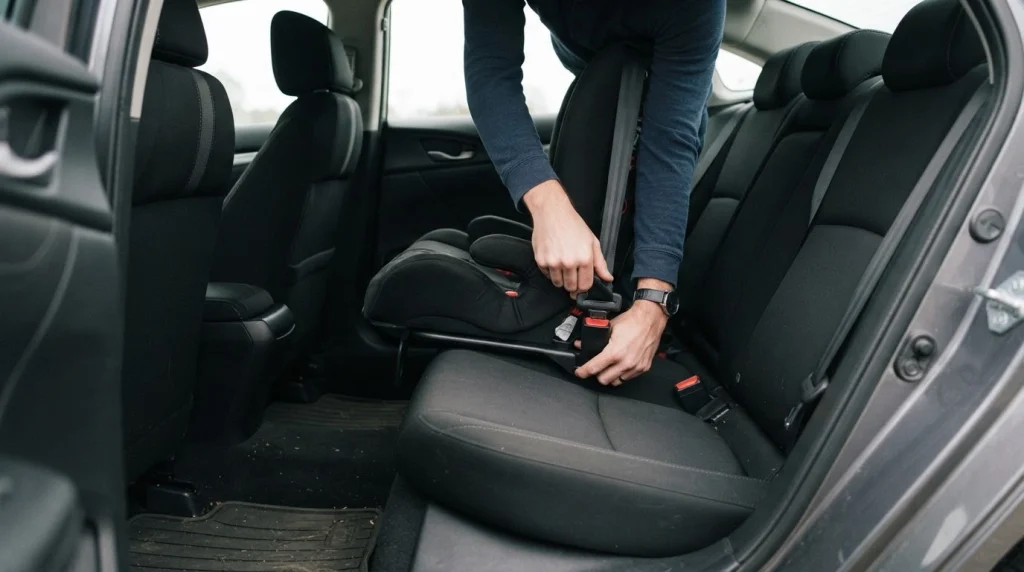
Three across means three child restraints installed side by side on one rear bench. In a Civic, that bench gives you about 48 inches of rear hip room in recent sedans, and every inch counts.
The Civic was built as a compact sedan, not a three-row family hauler. Its rear bench curves at the doors, dips in the middle, and places buckle stalks close together.
I learned this the hard way with a 2023 Civic sedan in my driveway. Two slim convertibles slid in with room to spare, and the third seat turned a simple job into a puzzle.
Why width alone does not tell the full story
Published hip room measures the bench at one height. Car seats bulge at different heights, so shells can nest together or clash at the shoulders.
Door panels slope inward near the top of the bench. A wide headrest or side-impact wing can hit that slope long before the base runs out of room.
- Bench shape: Raised outboard cushions tilt side seats inward and steal center space.
- Center hump: The middle seat sits higher and narrower, which makes leveling a base harder.
- Buckle stalks: Short, stiff stalks can hide under a wide base and block your hand.
- Seat contours: Deep side bolsters push shells toward the middle and change the belt angle.
Front legroom adds a second squeeze. A rear-facing seat behind a tall driver may force the front seat forward, even when three seats fit side by side.
Check your own Civic before you buy seats. Door stickers, the owner’s manual, and current spec listings from Edmunds can confirm rear legroom and hip room for your model year.
If you are still deciding between cars, start with the basics of whether a car seat will fit in your car. A quick tape-measure check beats a return trip to the store.
Section Takeaway: The Civic can work for three across, but its curved bench, center hump, and tight buckles leave no room for wide seats or sloppy installs.
Which Seat Combinations Actually Work in a Civic?
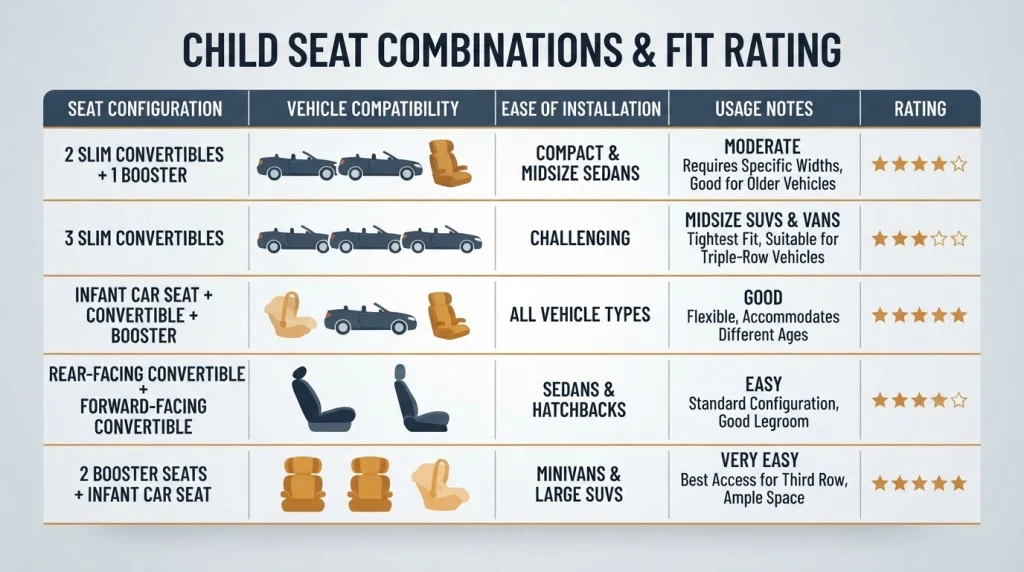
The easiest Civic setup pairs two slim harnessed seats with one narrow booster. The hardest setup tries three wide convertibles at once, and it fails most of the time.
Mix ages and seat types in your favor. A backless booster takes far less width than a convertible, and a forward-facing seat often puzzles better next to a rear-facing seat.
| Seat combination | Fit in a Civic? | Why it works or fails |
|---|---|---|
| 2 slim convertibles + 1 backless booster | Easiest | Booster is low and narrow, and it leaves buckle access open. |
| 1 infant carrier + 2 slim convertibles | Tight but possible | Carrier base is narrow, but the handle and canopy need clearance. |
| 2 rear-facing slim convertibles + 1 high-back booster | Possible | High-back booster wings can clash, so pick a slim booster shell. |
| 3 slim convertibles | Hardest harnessed mix | Only seats at 17 inches or less stand a chance, and puzzling takes time. |
| 3 infant carriers with bases | Very tight | Bases fit better than carriers, but lifting three carriers past door frames gets old fast. |
| 3 standard convertibles, 19 inches or wider | Unlikely | Total width tops 57 inches, well past the usable bench space. |
What is the easiest three-across mix for daily use?
Put the oldest child in a narrow booster on one side. Place two slim convertibles in the center and the other side, with the rear-facing seat behind the shorter front occupant when you can.
That mix keeps one buckle easy to reach. It also leaves the booster rider free to buckle with less help from you.
Can three rear-facing seats fit in a Civic?
Three rear-facing seats can fit only with slim shells and upright install angles allowed by each seat manual. Three reclined infant seats will crowd the front seats and block door access.
Rear-facing seats also take more front-to-back space than forward-facing seats. Learn how to fit a rear-facing car seat in a small car before you commit to three rear-facing installs.
What about twins plus a toddler?
Twins in slim infant carriers plus a toddler in a slim forward-facing seat is a common Civic test. It works best when the toddler sits in the center and the carriers sit outboard, where you can lift them in and out.
Try the reverse layout too, with one carrier in the center. Small changes in shell shape can free up a full inch of buckle space.
Section Takeaway: Choose the mix, not just the seats, because one booster or one slim shell can turn an impossible row into a workable daily setup.
How Wide Can Each Car Seat Be?
Each seat should measure 17 inches or less at its widest point for a realistic Civic three-across fit. Seats at 17.5 inches can work when shells puzzle at different heights, but seats at 19 inches rarely work at all.
Do the simple math first. Divide 48 inches of hip room by three seats, and you get 16 inches per seat before buckles, door trim, and cushion curves take their cut.
Puzzling buys back a little space. A forward-facing seat sits higher than a rear-facing seat, so their widest points may not meet at the same height.
Why does listed width mislead shoppers?
Many brands list width at the base, not at the shoulders or headrest. A seat can list 17 inches at the base and measure 19 inches at the side-impact wings.
Cup holders, armrests, and storage pockets add hidden width too. Remove cup holders when the manual allows it, and measure with them off.
- Measure the base: Use a tape at the widest part of the base, front and back.
- Measure the shoulders: Check the widest point of the shell at mid-height, where seats touch.
- Measure the headrest: Raise it to your child’s height, then measure again, since width can grow as it rises.
- Measure in the car: Place all three seats on the bench uninstalled and check buckle gaps before you tighten anything.
Weight and height limits matter just as much as width. A slim seat that your child outgrows in six months is a poor buy, even when it fits today.
Use independent fit notes and safety guidance from Consumer Reports as a second check. Cross-check the seat manual for width, install method, and allowed recline angles.
Standard seats run wider than most parents expect. See how wide a standard car seat is to judge why a slim model earns its place in a Civic.
Section Takeaway: Shop by measured width at the base, shoulders, and headrest, not by a single marketing number, and aim for 17 inches or less per seat.
How Do You Install Three Car Seats in a Civic?
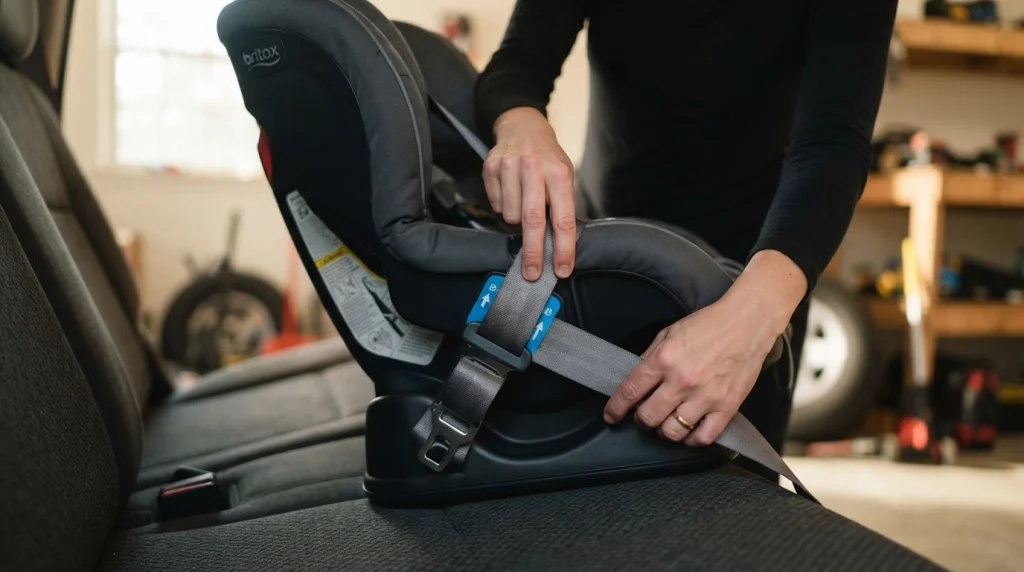
Install the center seat first with the vehicle seat belt, then install the outboard seats with seat belts too. Seat-belt installs let you shift each seat a half inch left or right, while lower anchors lock you into fixed spacing.
Plan for 45 to 90 minutes on your first three-across attempt. Rushing leads to loose installs, twisted belts, and buckles buried under bases.
- Read both manuals: Check the Civic owner’s manual for anchor locations, and check each seat manual for install methods and recline limits.
- Clear the bench: Remove seat protectors, thick covers, and loose items that change how a base sits.
- Set front seats: Move front seats to normal driving positions first, so you test real legroom, not best-case legroom.
- Install the center seat: Route the center seat belt through the correct belt path, lock the belt, and tighten until movement stays under one inch.
- Install the outboard seats: Use seat belts for the side seats in most three-across setups, and keep belt paths flat with no twists.
- Attach top tethers: Connect forward-facing top tethers to the correct anchors behind the bench, and remove slack without over-tightening.
- Test each seat alone: Remove the neighbors one at a time and recheck movement at the belt path for the seat left behind.
- Check buckles and harness: Buckle each child in, tighten harnesses to pass the pinch test, and confirm booster belts sit flat on hips and shoulders.
Can the center seat use LATCH in a Civic?
No, the center seat should not borrow lower anchors from the side seats unless Honda and the seat maker both allow it. Most Civics provide lower anchors only for the outboard seats, so the center install uses the seat belt.
LATCH stands for Lower Anchors and Tethers for Children, a system of built-in anchors for child seats. A seat-belt install is just as safe as a LATCH install when done correctly, and it gives you more side-to-side freedom.
Review the rules for how to install a car seat in the middle seat before you start. Your Civic manual shows the exact anchor map for your model year.
Is it safe for car seats to touch each other?
Seats may touch lightly when each seat stays tight on its own. Touching becomes a problem when one seat props up another, changes its recline, or blocks a buckle.
Check the details on whether two car seats can touch each other if your shells press together. The independent movement test settles the question every time.
What mistakes ruin a Civic three-across install?
Borrowed LATCH anchors top the list, followed by loose center installs hidden by tight side seats. Twisted seat belts, skipped top tethers, and recline angles outside the allowed range cause trouble too.
Don’t use both LATCH and seat belt for one seat unless the seat manual allows that method. Don’t add aftermarket padding, mats, or inserts that the seat maker did not approve.
Pro tip: Confirm anchor locations, tether routes, and headrest rules in your Civic owner’s manual, and use the safety guidance at NHTSA or a certified child passenger safety technician for a final check.
Section Takeaway: Center first, seat belts for flexibility, top tethers attached, and an independent tightness test for each seat make a Civic three-across install safe and repeatable.
Does Sedan, Hatchback, or Model Year Change the Answer?
Sedan and hatchback Civics share nearly the same rear bench width, so body style alone rarely decides the fit. Model year, trim, and front-seat position matter more than the shape of the cargo area.
The hatchback helps with loading gear, not with bench width. Its wider cargo opening makes stroller loading easier, while the rear seat itself stays compact.
How do 10th-gen and 11th-gen Civics compare?
The 11th-generation Civic, sold from the 2022 model year onward, offers a bit more rear legroom than the 10th-generation car. That extra legroom helps rear-facing seats, even when bench width stays close.
The 10th-generation Civic, sold from 2016 to 2021, still works for three slim seats. Expect tighter front legroom and less slack for reclined rear-facing installs.
Older Civics, including 9th-generation models, feel tighter still. Their benches narrow faster at the doors, and buckle access gets harder with three bases in place.
Do Si, Type R, or leather trims change the fit?
Sport trims add firmer bolsters that can push side seats inward. Leather cushions can feel slick under a base, so check movement again after a short drive.
Cloth seats grip bases a bit better in my experience. That grip helps, but it never replaces a correct belt lock and tightness check.
Compare specs and rear-seat reviews for your exact trim at Car and Driver. Small trim differences in headrests and seat shape can change how shells puzzle.
Section Takeaway: Buy for bench width and legroom in your exact model year and trim, not for sedan versus hatchback labels, because the bench tells the true story.
When Should You Choose a Bigger Car Instead?
Choose a bigger car when three across works on paper but fails in daily life. A fit you dread using will lead to shortcuts, and shortcuts lead to loose installs.
Daily buckling time is a fair test. If school drop-off turns into a five-minute wrestling match, the Civic setup costs you more than it saves.
- Tall front occupants: Drivers over six feet tall may lose safe legroom with a rear-facing seat behind them.
- Three rear-facing riders: Three reclined seats leave little room for front seats, bags, and door access.
- Frequent carpooling: Swapping seats in and out daily wears down installs and patience.
- Large strollers and gear: A double stroller plus three kids can outgrow Civic trunk space fast.
- Special needs: Medical seats, bulky carriers, or frequent transfers need door space a compact bench cannot give.
A midsize sedan, compact SUV, or minivan buys bench width and door opening space. Wider benches also keep buckles reachable, which matters more than parents expect.
Test-fit your exact seats before you trade cars. Bring all three seats to the dealer, install them in driving positions, and buckle each child in before you sign anything.
Cost matters too, and a new car costs far more than three slim seats. Run the numbers on seats first, then weigh a trade only when daily use stays hard after a correct install.
Section Takeaway: Keep the Civic when three slim seats install tight and buckle easily every day, and move up in size when legroom, access, or daily stress stays high.
Frequently Asked Questions
Can you fit three car seats in a Honda Civic sedan?
Yes, you can fit three car seats in a Civic sedan with slim seats that measure 17 inches or less at their widest point. Use seat-belt installs, install the center seat first, and test each seat alone for movement under one inch.
Can the center seat in a Civic use LATCH?
Most Civics do not offer dedicated lower anchors for the center seat, so use the center seat belt instead. Do not borrow outboard lower anchors unless Honda and the car seat maker both approve that method in writing.
Can three rear-facing car seats fit in a Honda Civic?
Three rear-facing seats can fit only with slim shells, allowed upright angles, and front seats set for shorter occupants. Expect tight legroom, and test the setup with front seats in normal driving positions before you buy.
Do all three car seats need to be the same brand?
No, seats do not need to match by brand, and mixed brands often puzzle better than three identical shells. Mix shapes and heights to use space well, and follow each seat manual for install and weight limits.
Is it safe for car seats to touch in a Civic?
Light contact is fine when each seat stays tight without help from its neighbors. Remove the side seats one at a time to confirm the remaining seat still moves less than one inch at the belt path.
Will the front seats still have enough legroom?
Front legroom depends on rear-facing recline, seat depth, and driver height, so results vary by family. Place the most reclined seat behind the shorter front occupant, and use the most upright angle your seat manual allows.
Final Takeaway
A Honda Civic can hold three car seats when you pick slim shells, use seat belts, and install with patience. The bench rewards careful puzzling, and it exposes wide seats at once.
Start with measurements, test-fit before you buy, and get a certified technician check when the row feels tight. Your kids deserve a row that stays tight on a rushed Monday morning, not just on install day.

Daniel Brooks is an automotive writer and product researcher focused on car accessories, car tech, maintenance, and practical driving guides. At Plug-in Car World, he helps drivers make smarter automotive decisions through honest reviews and research-driven content.
