
Rear-Facing vs. Forward-Facing Car Seats: Key Differences
Quick Answer
Rear-facing car seats position children toward the back of the vehicle and cradle their heads, necks, and spines during a crash. Forward-facing seats position children toward the front and use a harness and top tether to control movement. Keep your child rear-facing until reaching the seat’s maximum rear-facing height or weight limit, then transition to a forward-facing harness seat. See the NHTSA car seat safety recommendations for guidance.
The main differences
- Seat direction: Rear-facing seats point toward the back; forward-facing seats point toward the windshield.
- Crash protection: Rear-facing seats support the head, neck, and spine; forward-facing seats use a harness and tether.
- Child development: Rear-facing is appropriate for infants and toddlers; forward-facing follows once rear-facing limits are reached.
- Harness position: Rear-facing straps generally sit at or below the shoulders; forward-facing straps generally sit at or above them.
- Installation: Both require a secure installation, but their belt paths and positioning requirements differ.
- Transition timing: Your child’s actual height and weight relative to the seat limits matter more than age alone.
One important safety reminder
- Don’t rush: Keep children rear-facing as long as their particular seat allows, and use the forward-facing harness and tether until those limits are reached.
Choosing a car seat can feel confusing, especially when your toddler starts looking uncomfortable or seems too big for an infant seat. I want to make this decision easier by explaining what each position does and when a change makes sense.
We’ll compare crash protection, age and size guidelines, installation, harness placement, and common mistakes. I’ll also explain what to look for when choosing a convertible seat in 2026.
What Is the Difference Between Rear-Facing and Forward-Facing Car Seats?
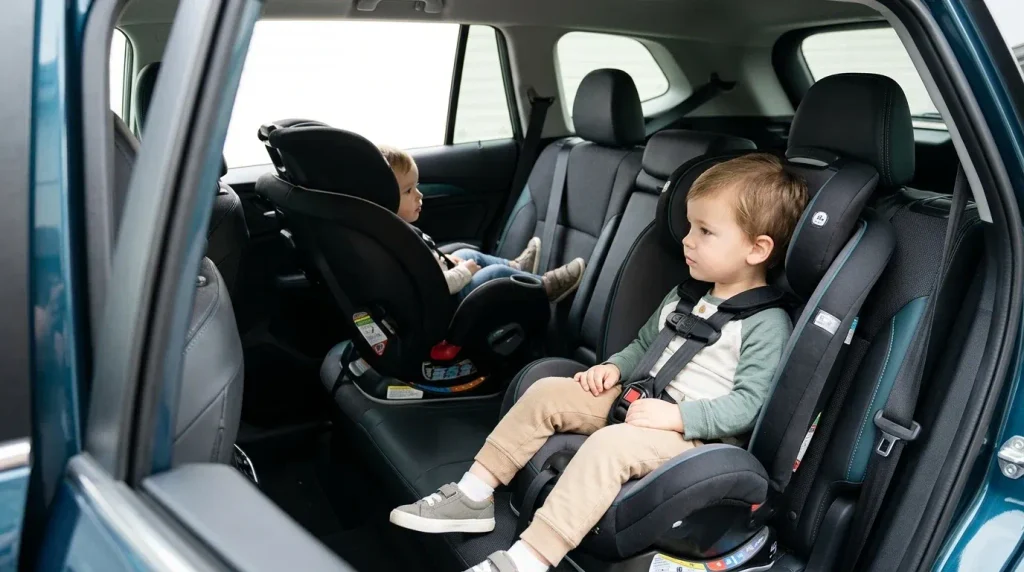
A rear-facing car seat holds a child facing the back of the vehicle, while a forward-facing car seat holds the child facing the windshield. Both use a harness, but their positions and installation requirements differ.
The biggest difference is how each seat supports a child’s body during a collision.
- Rear-facing: The seat shell supports the head, neck, and back as the child moves into the seat during a frontal crash.
- Forward-facing: The harness restrains the child’s body while the top tether helps limit forward movement of the seat.
Neither position should be chosen simply because a child prefers looking out the front window. The correct position depends on the manufacturer’s height and weight limits.
Why Are Rear-Facing Car Seats Safer for Young Children?
Rear-facing seats provide important support for young children’s heads, necks, and spines during a frontal collision. Their design spreads crash forces across the back of the seat rather than relying mainly on the harness to restrain the upper body.
Young children have developing bones and relatively large heads compared with their bodies. Their necks also need more protection during sudden changes in movement.
How Does a Rear-Facing Seat Protect a Child?
During a frontal crash, a rear-facing seat cradles the child’s head and torso as the vehicle slows down. The seat helps distribute the forces across a larger area of the body.
Several design features contribute to this protection:
- Supportive shell: Surrounds the child’s head and torso.
- Rear-facing harness: Keeps the child properly positioned within the seat.
- Recline angle: Helps maintain an appropriate position, particularly for infants.
- Side protection: Some models include additional side-impact design features.
The exact features differ by manufacturer and model. A seat’s manual explains which adjustments and accessories are approved.
Does Rear-Facing Really Make a Difference?
Yes. Major child passenger safety organizations recommend keeping children rear-facing as long as possible within their car seat’s limits.
The American Academy of Pediatrics reaffirmed its child passenger safety policy in February 2025. Its recommendations support rear-facing for as long as possible, followed by forward-facing seats with harnesses for children who have outgrown rear-facing seats.
This isn’t just about a child’s age. It’s about matching the restraint to the child’s physical development and the seat’s design.
How Does a Forward-Facing Car Seat Protect a Child?
A forward-facing car seat protects a child with an integrated harness and, when required, a top tether connected to the vehicle’s tether anchor. These features help restrain the child’s body and limit movement during a crash.
Forward-facing seats become appropriate after a child outgrows the rear-facing limits of the current seat.
What Does the Top Tether Do?
The top tether is an adjustable strap attached to the upper part of a forward-facing car seat. It connects to a designated anchor in the vehicle and helps reduce forward movement during a collision.
It is an important part of forward-facing installation. Always use it according to both the car seat and vehicle manufacturers’ instructions.
- Find the designated tether anchor in your vehicle.
- Connect the tether hook to the correct anchor.
- Remove excess slack according to the manufacturer’s instructions.
- Check that the strap isn’t twisted.
Don’t confuse a tether anchor with a luggage hook or another attachment point. Use only the vehicle’s designated anchor.
How Is the Harness Different?
Both seat positions use a harness, but the shoulder strap position changes when you switch directions. Rear-facing straps generally come from at or below the child’s shoulders, while forward-facing straps generally come from at or above them.
Some seats have special reinforced harness slots or additional positioning rules. Follow the exact instructions for your model rather than assuming every seat works identically.
Rear-Facing vs. Forward-Facing Car Seats: Side-by-Side Comparison
The following comparison highlights the practical differences parents should understand before changing their child’s seating position.
| Feature | Rear-Facing | Forward-Facing |
|---|---|---|
| Direction | Toward the rear window | Toward the windshield |
| Typical stage | Infants and toddlers | Children who outgrow rear-facing |
| Crash support | Supports head, neck, and torso | Harness restrains the body |
| Harness slots | Generally at or below shoulders | Generally at or above shoulders |
| Top tether | Depends on seat design and instructions | Recommended when permitted by both manufacturers |
| Installation | Rear-facing belt path and approved recline | Forward-facing belt path and tether |
| Transition requirement | Remain until a rear-facing limit is reached | Remain until a forward-facing limit is reached |
| Next stage | Forward-facing harness seat | Appropriate booster seat |
One detail matters more than the table’s general age descriptions: manufacturers set different limits for individual seats. Always check the labels and manual before making a transition.
When Should You Switch From Rear-Facing to Forward-Facing?
Switch your child to forward-facing only after they reach the maximum rear-facing height or weight limit of their current seat. If they still fit within both limits, keeping them rear-facing is the recommended approach.
The CDC describes rear-facing as the first stage, from birth until approximately age two to four, depending on the child’s growth and seat limits.
What If My Toddler Is Already Two Years Old?
Turning two doesn’t automatically mean your child should face forward. A two-year-old who still fits the rear-facing requirements can continue using that position.
For example, imagine a toddler who weighs 28 pounds and measures 34 inches tall. If the convertible seat allows rear-facing use up to 40 pounds and 40 inches, the child remains within both limits.
That example is illustrative, not a universal seat specification. Check your actual seat’s labels and instructions.
What If My Child’s Legs Touch the Vehicle Seat?
Legs touching the vehicle seatback do not automatically mean a child has outgrown a rear-facing seat. Toddlers often bend or cross their legs as they grow.
Check the seat’s stated height, weight, and head-clearance requirements instead. Never switch positions just because your child looks cramped.
What If My Child Reaches the Weight Limit First?
Stop using the rear-facing position once your child reaches either its maximum weight or height limit. You don’t need to wait until both limits have been reached.
Read the manufacturer’s instructions to determine whether a convertible seat can continue in forward-facing mode. Some seats accommodate both positions.
How Do You Install Rear-Facing and Forward-Facing Car Seats Correctly?
Correct installation matters in either position. A suitable car seat cannot provide its intended protection if it moves excessively, uses the wrong belt path, or doesn’t fit the child correctly.
Before installing anything, read both the car seat manual and your vehicle owner’s manual.
Rear-Facing Installation Checklist
- Place the seat in an approved rear seating position.
- Use the designated rear-facing belt path.
- Install with either the vehicle seat belt or lower anchors, following the instructions.
- Set the recline angle within the manufacturer’s permitted range.
- Check movement at the belt path.
- Position the harness straps at or below the shoulders, as directed.
- Ensure the harness fits snugly against the child’s body.
Forward-Facing Installation Checklist
- Place the seat in an approved rear seating position.
- Use the designated forward-facing belt path.
- Secure the seat with the seat belt or lower anchors, as permitted.
- Connect and tighten the top tether when allowed by both manuals.
- Check movement at the belt path.
- Position the harness straps at or above the shoulders, as directed.
- Secure the chest clip at armpit level if the seat uses one.
For either position, NHTSA generally advises that the installed seat should not move more than one inch side-to-side or front-to-back when tested at the belt path.
Don’t pull on the top of the seat to judge this movement. Check near the belt path instead.
What Are the Most Common Car Seat Safety Mistakes?
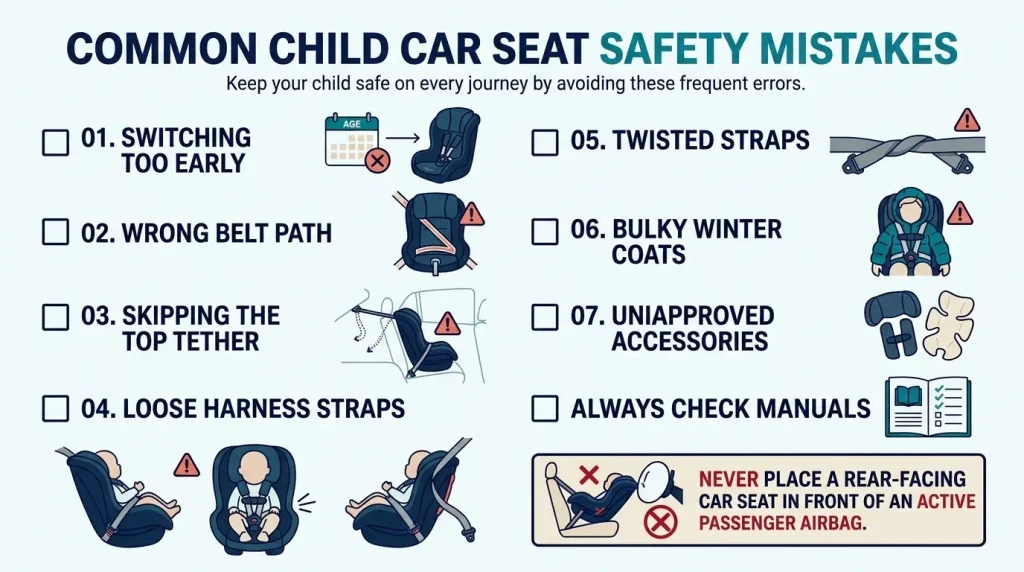
Many car seat mistakes happen because parents rely on general advice instead of checking their specific seat instructions. A small adjustment can make a meaningful difference to the fit and installation.
- Switching too early: A child’s birthday doesn’t override the rear-facing limits.
- Using the wrong belt path: Each seating direction has its designated installation path.
- Skipping the tether: Forward-facing seats should use the top tether when permitted.
- Loose harness straps: A harness should fit snugly without excess slack.
- Twisted straps: Twists can interfere with proper harness positioning.
- Bulky winter coats: Thick clothing can prevent a secure harness fit.
- Unapproved accessories: Extra inserts or padding can interfere with proper restraint.
One mistake deserves special attention: placing a rear-facing car seat in front of an active passenger airbag. Never do this, because an inflating airbag can seriously injure or kill a child.
Can You Use One Convertible Car Seat for Both Positions?
Yes. A convertible car seat is designed to work in rear-facing and forward-facing positions, provided the child meets the requirements for each mode.
This makes convertible seats useful for families who want to avoid purchasing a separate infant-only seat and forward-facing seat.
What Should You Check Before Buying One?
- Rear-facing limits: Look for a seat that accommodates your child’s growth for as long as possible.
- Forward-facing limits: Check the maximum harness weight and height.
- Vehicle compatibility: Confirm that the seat fits your vehicle and preferred seating position.
- Installation system: Look for clear instructions and accessible installation features.
- Harness adjustments: Check whether the harness adjusts easily as your child grows.
- Expiration and recalls: Check the seat’s expiration date and current recall information.
A higher maximum rear-facing limit can provide more room for growth, but it doesn’t automatically make a seat suitable for every vehicle. Installation and child fit remain essential.
Does a Rear-Facing Car Seat Need a Special Cover?
Not every accessory marketed as a car seat cover is suitable for every child restraint. A cover that changes the harness fit, adds padding, or interferes with the seat’s structure can create a safety problem.
This is especially important when shopping for winter covers, replacement fabrics, and infant inserts.
- Use only covers and inserts approved by the car seat manufacturer.
- Avoid thick padding beneath the child’s body unless the manufacturer specifically permits it.
- Don’t place bulky clothing between the child and harness.
- Keep aftermarket accessories away from buckles and adjustment mechanisms.
- Check that a weather cover doesn’t interfere with the harness or the child’s breathing.
For cold weather, buckle your child securely first and place a blanket over the harness when appropriate. This helps keep the harness snug against the child’s body.
What Happens After a Child Outgrows a Forward-Facing Car Seat?
Once a child reaches the maximum height or weight limit of their forward-facing harness seat, the next stage is generally a belt-positioning booster seat. The booster helps position the vehicle’s seat belt correctly across the child’s body.
Children should remain in a forward-facing harness seat as long as possible within its limits before moving to a booster.
A properly fitting vehicle seat belt should meet these conditions:
- The lap belt rests across the upper thighs, not the stomach.
- The shoulder belt crosses the center of the chest and shoulder.
- The child can sit with their back against the vehicle seat.
- The child’s knees bend naturally at the seat edge.
- The child can maintain this position throughout the trip.
Children younger than 13 should ride in the back seat whenever possible, following the guidance from child passenger safety authorities.
Where Can Parents Find Reliable Car Seat Safety Guidance?
Car seat rules and product specifications can vary between countries, manufacturers, and vehicle models. I recommend checking official safety resources rather than relying on social media advice or general age charts.
- National Highway Traffic Safety Administration (NHTSA) — installation instructions, seat recommendations, and safety guidance.
- Centers for Disease Control and Prevention (CDC) — child passenger safety stages and prevention information.
- American Academy of Pediatrics (AAP) HealthyChildren — guidance for parents about choosing and using child restraints.
- SaferCar.gov — vehicle and equipment safety information.
If you’re outside the United States, also check your country’s child restraint regulations and approved product standards. U.S. recommendations are useful guidance, but local legal requirements may differ.
Which Car Seat Models Are Worth Comparing?
If you’re shopping for a convertible seat, I would start by comparing rear-facing capacity, installation requirements, forward-facing harness limits, and compatibility with your vehicle. These three established models offer different approaches to those needs.
🏆 Extended Rear-Facing
Graco Extend2Fit Convertible Car Seat
Designed with an adjustable extension panel and extended rear-facing capacity. I’d compare its size, rear-facing limits, and installation instructions against your vehicle before choosing it.
🚗 Convertible Versatility
Britax One4Life ClickTight
An all-in-one restraint designed for multiple growth stages, with ClickTight installation technology. Check the exact model’s rear-facing and forward-facing limits and whether its dimensions suit your back seat.
🛠️ Installation Features
Chicco NextFit Max Zip Convertible Car Seat
Offers adjustable recline positions and installation features intended to help achieve a secure fit. Compare its available rear-facing limits, harness adjustments, and vehicle compatibility before purchasing.
These are comparison candidates, not a universal ranking or a claim of hands-on testing. Product versions, availability, specifications, and prices can change, so verify the exact model and current manufacturer’s instructions before ordering.
Frequently Asked Questions
Is rear-facing safer than forward-facing?
Rear-facing is the recommended position for infants and toddlers because it supports the head, neck, and spine during a crash. Children should remain rear-facing until they reach the maximum height or weight limit of their particular seat before moving to a forward-facing harness seat.
At what age should a child face forward in a car seat?
There isn’t one universal age for switching. A child should move forward-facing after outgrowing the rear-facing limits of their specific car seat. Many children remain rear-facing until approximately two to four years old, depending on their growth and seat specifications.
Can a two-year-old still use a rear-facing car seat?
Yes. A two-year-old can continue riding rear-facing if their height and weight remain within the manufacturer’s limits. Age alone isn’t a reason to change positions, and keeping a properly fitted child rear-facing longer is the recommended safety practice.
Should a forward-facing car seat use a top tether?
Yes, NHTSA recommends using the top tether with a forward-facing car seat whenever both the car seat and vehicle manufacturers permit it. The tether helps limit forward movement during a crash and is an important part of correct installation.
Do a child’s legs need to be straight in a rear-facing seat?
No. Children’s legs can bend, cross, or rest against the vehicle seatback while riding rear-facing. This alone doesn’t mean the seat has been outgrown. Check the manufacturer’s height, weight, and head-clearance requirements instead.
Final Takeaway: Choose the Right Position for Your Child’s Size
The main difference between rear-facing and forward-facing car seats comes down to positioning and crash protection. Rear-facing seats cradle a young child’s head, neck, and torso, while forward-facing seats use a harness and top tether to restrain a child who has outgrown rear-facing use.
My most important advice is simple: don’t rush the transition. Check your child’s measurements against the exact seat limits, follow both manuals during installation, and keep the seat properly adjusted as your child grows.
Whether you’re using an infant seat or a convertible model, the safest choice is the correctly installed restraint that matches your child’s current size. A little extra time checking the details can help make every car journey safer.

Daniel Brooks is an automotive writer and product researcher focused on car accessories, car tech, maintenance, and practical driving guides. At Plug-in Car World, he helps drivers make smarter automotive decisions through honest reviews and research-driven content.
