
Can a Car Seat Be Installed in the Middle Seat of a Truck? 7 Checks First
Quick Answer
Yes, a car seat can go in the middle seat of a truck when the truck manual allows it, the car seat fits the narrow center bench, and you can install it tight. The center rear seat is often a good spot because it sits farther from both doors.
A secure side-seat install always beats a loose center install. Learn how to install a car seat in the middle seat in a regular car first, then check the truck differences below.
Before you choose the middle
- Check both manuals: Your truck manual and your car seat manual must both allow a center install.
- Use the seat belt: Most truck center seats have no dedicated lower anchors, so the seat belt does the job.
- Test the fit: The base must sit flat, with the support your car seat maker requires.
- Check the tether: A forward-facing harnessed seat needs its top tether on the truck anchor.
- Do the inch test: The seat must not move more than one inch side to side at the belt path.
If it will not fit tight
- Move the seat to an approved rear outboard position and install it there instead.
- Never borrow lower anchors from the two side seats to make a center install.
I have wrestled car seats into more truck back seats than I can count. The middle seat always looks like the obvious choice, and in a crew cab it often is.
But trucks are not sedans with a bigger badge. Their center benches are narrow, their belts sit in odd spots, and their tether anchors hide behind the seat.
This guide shows how a car seat can be installed in the middle seat of a truck, step by step. You can tell in ten minutes whether the middle works for your truck and your seat.
In This Guide
- Is the Middle Seat of a Truck Safe for a Car Seat?
- Which Trucks Allow a Car Seat in the Middle Seat?
- How Can a Car Seat Be Installed in the Middle Seat of a Truck?
- Can You Use LATCH in the Middle Seat of a Truck?
- Where Are the Top Tether Anchors in a Pickup Truck?
- When Is a Side Seat Better Than the Middle Seat in a Truck?
- Frequently Asked Questions
Is the Middle Seat of a Truck Safe for a Car Seat?
Yes, the middle rear seat of a truck can be a safe spot for a car seat when the install is correct. It puts your child farther from both doors than either side seat does.
That distance matters most in a side impact. It is the main reason parents ask about the center first, and it is a fair reason.
But position alone does not make a seat safe. A center seat that wobbles, tips, or hangs off the cushion edge is worse than a rock-solid side seat.
A middle seat installation is a car seat fitted in the center rear seating position, using the center seat belt and, for a forward-facing harnessed seat, the center top tether anchor. The seat must sit flat, stay tight, and leave the harness and recline angle correct for your child.
I learned this the hard way on a friend’s extended-cab pickup years ago. The center looked fine until I pushed the base and felt it rock over the raised hump.
We moved the seat outboard, and it locked down tight on the first try.
Check the NHTSA car seat guidance if you want the official take on seating positions and installation checks. Your truck manual and car seat manual still have the final word for your exact models.
Section Takeaway: The middle seat of a truck is safe when it installs tight and fits flat. A secure side seat is always safer than a loose center seat.
Which Trucks Allow a Car Seat in the Middle Seat?
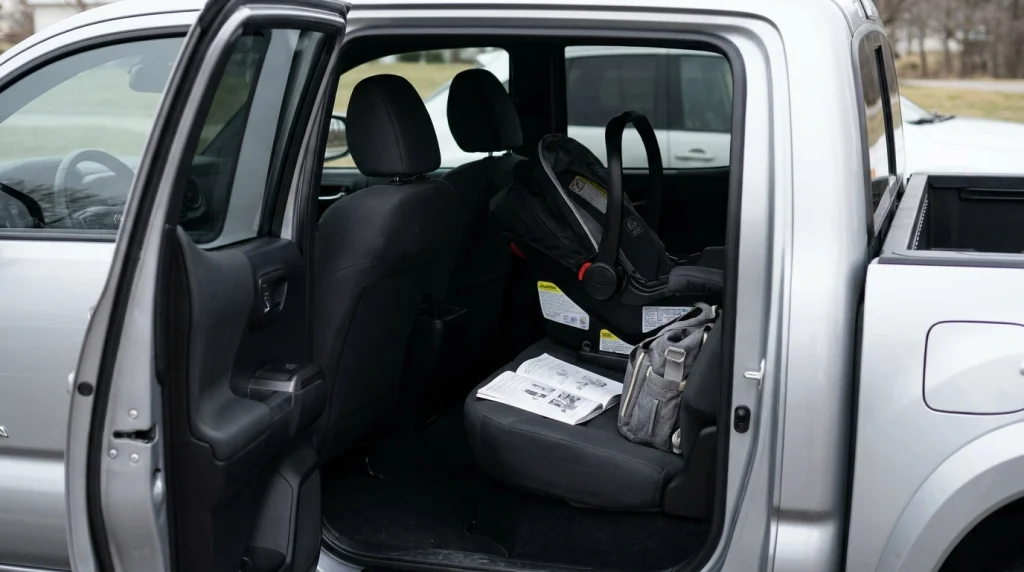
It depends on the cab, not the brand on the tailgate. A crew cab, an extended cab, and a regular cab are three different jobs.
Start with your truck manual, in the child restraint section. It lists which rear positions allow a car seat, and it often shows a small diagram of the bench.
Some trucks allow the center rear seat. Some allow it only with a seat belt, not with lower anchors.
A few older trucks do not list the center as an approved child restraint position at all.
| Truck cab type | Middle seat usually like | Main thing to check |
|---|---|---|
| Crew cab | Full rear bench, most room | Center cushion width and belt fit |
| Extended cab | Shorter bench, less legroom | Base support and front seat clearance |
| Regular cab | No rear row at all | Front seat rules, airbag, and local law |
| Older pickup | May lack center anchors or a locking belt | Approved positions and tether availability |
A crew cab gives you the best shot at a center install. The bench is wide, the cushion is flatter, and you can usually get your knees in there to press the base down while you tighten the belt.
An extended cab is trickier. The rear bench is short, and a rear-facing seat may push the front seat too far forward.
Set the seat in place before you fasten anything, and check the front seat still locks in a safe driving position.
A regular cab has no rear middle seat to use. Its front middle spot, where one exists, is not a substitute.
Read the guide to installing a car seat in a pickup truck before you even consider a front-seat install, and check the airbag rules first.
Look at the center cushion itself while you are there. Truck centers often have a raised hump, a fold-down armrest, or a narrow dip between two firmer side cushions.
Those shapes can tip a wide base. If the base rocks side to side on the cushion before you tighten it, the center is already telling you no.
Pro tip: Your truck manual shows the approved child restraint positions for your exact cab and year. Trust that diagram over any general advice, including mine.
Section Takeaway: Crew cabs usually suit a center install best, extended cabs need a careful fit check, and regular cabs have no rear middle seat at all.
How Can a Car Seat Be Installed in the Middle Seat of a Truck?
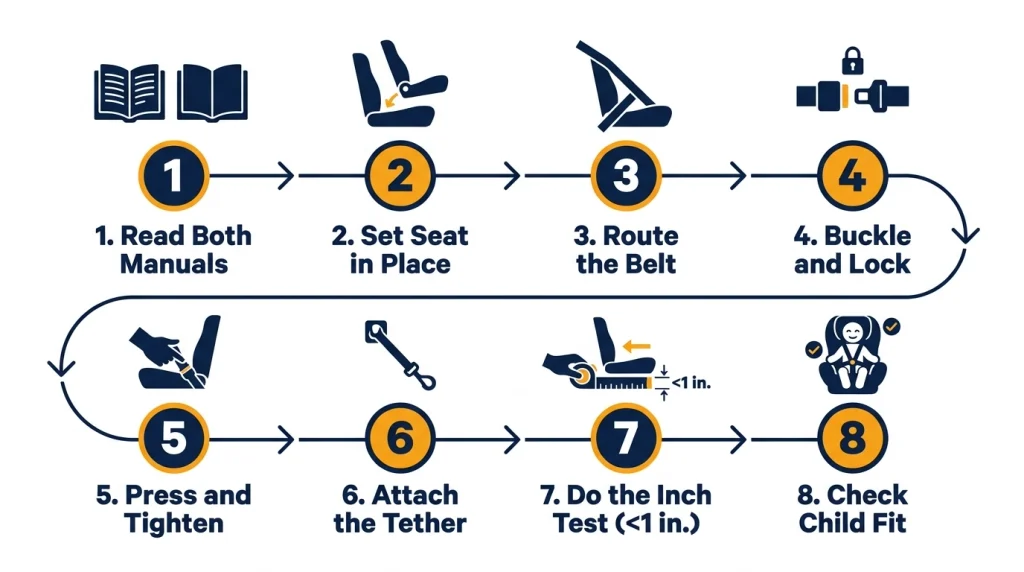
Use the center seat belt for almost every truck middle install. That is the normal method, and it works fine when the belt locks and the base sits flat.
Work slowly and check each step before you move on. Rushing this job is how a seat ends up looking tight and moving an inch too much.
- Read both manuals: Confirm the center rear position is approved and note the belt and tether routing for your truck.
- Set the seat in place: Put the base flat on the center cushion, with no armrest or cup holder in the way.
- Route the belt: Thread the center seat belt through the correct belt path on the car seat, rear-facing or forward-facing as marked.
- Buckle and lock: Buckle the belt, then lock it the way your truck manual says, usually by pulling the shoulder belt all the way out.
- Press and tighten: Press your knee into the base, pull the belt tight, and remove the slack while the base stays level.
- Attach the tether: For a forward-facing harnessed seat, hook the top tether to the truck anchor and remove the slack.
- Do the inch test: Grab the seat at the belt path and push side to side. It must not move more than one inch.
- Check the child fit: Set the recline angle, harness height, and chest clip for your child before you drive.
The center belt in a truck is often a lap-and-shoulder belt, but some older trucks have a lap-only center belt. A lap-only belt can still install many seats, yet your car seat manual must allow it.
Watch the buckle stalk while you tighten. Truck center buckles sometimes sit on a long, stiff stalk that lands right under the base and stops it sitting flat.
If the buckle twists the base or lifts one edge, try turning the buckle stalk once, only if both manuals allow it. If that does not fix it, the center is not the right spot for that seat.
As of 2026, the one-inch test is still the check every installer I know uses first. It takes five seconds, and it catches most bad installs before a child ever rides in the seat.
Section Takeaway: Install a truck middle seat with the center seat belt, press the base down as you tighten, then pass the one-inch test at the belt path.
Can You Use LATCH in the Middle Seat of a Truck?
Usually, no. Most trucks have dedicated lower anchors only at the two rear outboard seats, not in the center.
LATCH is the system of lower anchors and a top tether that many cars use to install a child seat without the seat belt. Your truck manual shows exactly where those lower anchors live.
Never borrow one inner anchor from the left seat and one from the right seat to make a center LATCH install. That trick is common, and it is not allowed unless both your truck maker and your car seat maker say so in writing.
The anchor spacing matters here. Center borrowing puts the connectors wider apart than the system was built for, and the anchors may not hold the way they should.
A few trucks do offer dedicated center lower anchors. If yours is one of them, your manual will say so clearly, with a diagram and a spacing figure.
Read what LATCH is and how its lower anchors work if the terms are new to you. The short version is simple: lower anchors are a convenience, not a safer method than a correct seat belt install.
Check the lower anchor weight limits too. Once your child plus the car seat pass the limit in your manuals, you must switch to a seat belt install anyway.
Section Takeaway: Most truck centers have no dedicated lower anchors, and borrowing side anchors is not allowed unless both manuals approve it in writing.
Where Are the Top Tether Anchors in a Pickup Truck?
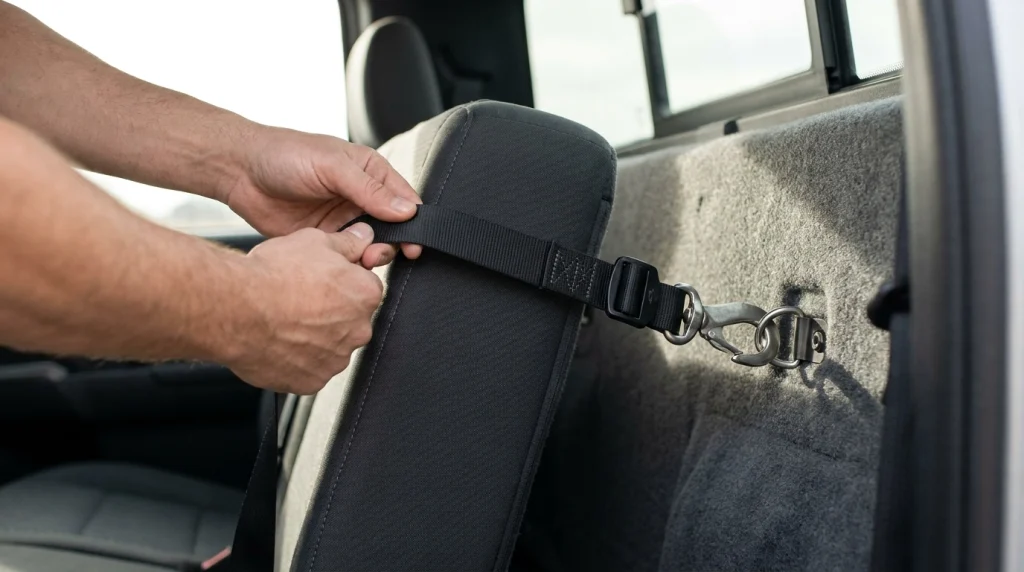
Truck tether anchors hide in places sedan owners never look. You will usually find them behind the rear seat, on the back wall of the cab, or under a small cover on the seatback.
Your truck manual has a diagram for your exact cab. Find it before you start routing the strap, because the anchor for the center seat is not always in the center.
In many crew cabs, the tether anchors sit in a row behind the rear bench. The center anchor may sit behind the center seat, or it may sit offset to one side.
In some extended cabs, the anchor is a metal loop on the back of the seat or on the cab wall. You may need to fold the seatback forward a little to reach it, then set the seatback upright again.
Route the strap exactly as both manuals show. In a truck, the strap often goes over the top of the seatback, not around the side of a headrest.
Never hook the tether to a cargo tie-down, a headrest post, or a luggage hook. Those parts look strong, and they are not tether anchors.
Hook it, pull the slack out, and check the seat again. Tightening the tether can shift the car seat, so do the inch test after the tether is tight, not before.
For a rear-facing seat, the top tether usually stays unused unless your car seat maker allows a specific rear-facing tether setup. Follow your car seat manual on that point.
See how to install a forward-facing car seat for the full forward-facing sequence, since the tether is only one part of that install. Edmunds vehicle guides can also help you find anchor locations for a specific truck year and cab.
Pro tip: If you cannot find the tether anchor in your truck, check the NHTSA recall and vehicle information pages or ask a certified child passenger safety technician to show you in person.
Section Takeaway: Truck tether anchors usually sit behind the rear seat or on the cab wall, and the center anchor is not always centered, so use your truck manual diagram.
When Is a Side Seat Better Than the Middle Seat in a Truck?
A side seat wins whenever the middle will not install tight. That is the whole rule, and it beats every seating-position chart.
Move outboard if the center base rocks on the hump, the buckle lifts the base, or the belt will not lock and stay tight. A tight side install protects your child better than a loose center one.
Move outboard if the car seat is too wide for the center. A wide convertible or all-in-one seat can overhang the narrow center cushion and lose the support its maker requires.
Move outboard if you carry two or three car seats. A center seat that touches the side seats can push them out of position, and each seat must pass its own inch test on its own.
Move outboard if the center tether routing is wrong for your seat. A long, angled tether run can pull a forward-facing seat sideways instead of holding its top back.
Check whether your car seat is installed correctly after any move, center or side. The inch test, the recline angle, and the harness fit all need a fresh check in the new spot.
Section Takeaway: Use a side seat when the center rocks, overhangs, will not lock tight, or crowds the other seats, and recheck the install in its new spot.
Frequently Asked Questions
Can a rear-facing car seat go in the middle seat of a truck?
Yes, when the truck manual allows a rear-facing seat in the center and the base fits flat with the correct recline angle. Check front seat clearance in an extended cab, since a rear-facing seat needs room behind it.
Can a forward-facing car seat go in the middle seat of a truck?
Yes, when the center position is approved and you can reach the correct top tether anchor. Hook the tether to the truck anchor for that seating position, remove the slack, and recheck the inch test.
Is the middle seat of a truck safer than the side seats?
The center can be safer because it sits farther from both doors, but only when the install is correct. A properly installed side seat is safer than a loose or tipping center seat every time.
Can I use LATCH in the middle seat of a truck?
Only if your truck has dedicated center lower anchors and your car seat manual allows their use. Do not borrow one anchor from each side seat unless both manuals approve that exact setup in writing.
What if my truck center seat has only a lap belt?
Some older trucks have a lap-only center belt. Check your car seat manual to see whether it allows a lap-belt install for your seat, and follow its belt path and locking instructions exactly.
Can a car seat go in the middle front seat of a regular cab truck?
That is a different question from a rear middle install, and it needs extra checks on airbags, truck manual approval, and local law. Never put a rear-facing seat in front of an active frontal airbag.
How do I know my truck middle install is tight enough?
Grab the car seat at the belt path and push it side to side and front to back. It must not move more than one inch in either direction.
If it moves more, reinstall it or move it to an approved side seat.
Still unsure after the inch test? Get the install checked in person.
A certified child passenger safety technician can spot a tether routing or belt locking problem in a minute, and most checks are free. Consumer Reports also publishes car seat fit and installation guidance worth reading before you buy a new seat for a narrow truck bench.
So, can a car seat be installed in the middle seat of a truck? Yes, when your truck allows it, your seat fits the center bench, and the belt and tether install tight.
Check both manuals, do the inch test, and use a side seat without hesitation if the middle will not lock down right.

Daniel Brooks is an automotive writer and product researcher focused on car accessories, car tech, maintenance, and practical driving guides. At Plug-in Car World, he helps drivers make smarter automotive decisions through honest reviews and research-driven content.
