
Can a Car Seat Base Hang Over the Vehicle Seat? 20% Rule, 5 Checks & When to Move It
Quick Answer
Yes, a car seat base can hang over the vehicle seat a little, but only if your car seat manual allows it. Many manuals use the 80 percent rule: at least 80 percent of the base must sit on the vehicle seat, so up to 20 percent can hang over the front edge. Some manuals allow no overhang at all, so your manual wins every time. Learn how to install an infant car seat before you judge the fit by eye alone.
Check these first
- Front edge only: A small front overhang is the only kind many manuals allow.
- Measure, do not guess: Measure the base and the part that hangs past the seat cushion.
- Check side fit too: The base should not hang off the side of the vehicle seat.
- Test for movement: The base should move less than one inch side to side at the belt path.
- Try another spot: If the overhang is too much, try the centre seat or the other side.
When to stop and get help
- If the base rocks, tips forward, or will not stay tight, do not drive with it like that.
- Book a check with a certified child passenger safety technician before your next trip.
Can a car seat base hang over the vehicle seat? I have stared at this exact problem in a driveway more than once.
The base looked close to right, yet the front edge hung past the cushion by a thumb or two.
That small gap matters. A base needs full support under it to stay put in a sudden stop, and a base that tips forward can change the recline angle too.
This guide walks through what overhang means, how much is allowed, how to measure it, and what to do when it is too much. You will leave with a clear yes or no for your own car and seat.
In This Guide
What Does Car Seat Base Overhang Mean?
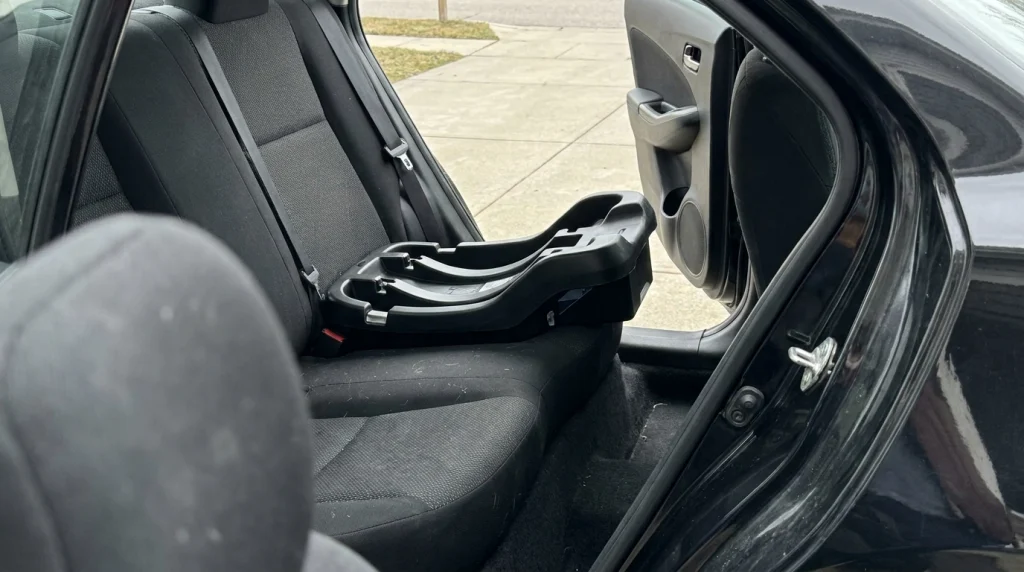
A car seat base overhang is the part of the base that hangs past the edge of the vehicle seat cushion. It usually shows up at the front edge, nearest the front seats.
Picture an infant carrier base sitting on a rear seat. The back of the base sits against the seat back, and the front of the base reaches toward the front of the car.
If the vehicle seat is short, the base can run out of cushion before it runs out of length. That extra length then floats in the air with nothing under it.
A base can feel tight at the belt path and still have too much overhang. The belt or lower anchors hold the back of the base down, while the front end has no support.
In a crash or a hard stop, that unsupported front can dip or tip. The carrier can then shift more than it should, and the recline angle can change.
Overhang can also show up on the side. That happens when a wide base sits on a narrow seat, or when two seats crowd each other in the back row.
Side overhang is a different problem. Most manuals do not allow it, because the base needs support across its full width as well as its length.
I first ran into this in a small sedan with short rear cushions. The infant base fit fine in my larger family car, yet it hung over by a clear margin in the sedan.
The seat had not changed. The car had, and that was the whole problem.
Section Takeaway: Overhang means part of the base has no vehicle seat under it, and front overhang is the kind you will see most often.
Can a Car Seat Base Hang Over the Vehicle Seat? How Much Is Allowed?
There is no single limit that fits every car seat. Your manual sets the limit for your seat, and it wins over any general rule you read online.
Many infant seat manuals allow up to 20 percent overhang at the front edge. In plain terms, at least 80 percent of the base must rest on the vehicle seat cushion.
Some manuals are stricter. A few allow no overhang at all, and a few set a different limit for a specific base or carrier.
That is why you cannot copy a limit from a friend’s seat. Two bases can look alike and still have different rules in their manuals.
Check the install section of your manual first. Look for the words overhang, edge, or percent, and look at the diagrams near the base install steps.
The diagram often shows the base from the side. It marks the part that must sit on the cushion and the part that may hang past it.
If the manual says nothing about overhang, treat that as a warning sign. Do not assume a large overhang is fine just because the manual stays quiet.
Call the car seat maker or ask a certified technician in that case. A short call beats a long drive with a base you are not sure about.
NHTSA points parents to the car seat manual and the vehicle manual for install limits like this. Those two books together decide what fits your car.
| Overhang amount | What it usually means | What to do next |
|---|---|---|
| No overhang | The full base sits on the cushion | Check tightness and recline, then you are set |
| Up to 20 percent | Allowed by many manuals, if the manual says so | Measure it and confirm the manual allows it |
| More than 20 percent | Too much for most manuals that use the 80 percent rule | Move the seat or try another seating spot |
| Side overhang | The base hangs past the side of the cushion | Do not use that spot unless the manual clearly allows it |
Check car seat compatibility with your vehicle before you buy a new seat or move a base to a second car. A quick fit check can save a return trip.
Section Takeaway: Many manuals allow up to 20 percent front overhang, but some allow none, so measure it and follow your own manual.
How Do You Measure Base Overhang?
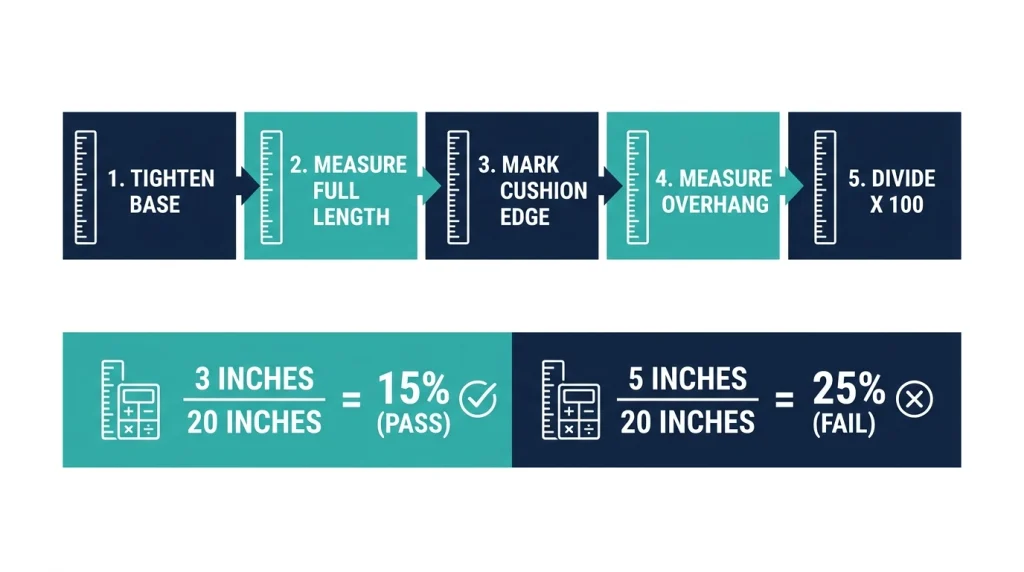
Measuring overhang takes two minutes and a tape measure. Guessing by eye is where most parents go wrong, because a small gap can look bigger or smaller than it is.
Install the base first, without the carrier on it. A tight base gives you a true reading, while a loose base can shift as you measure.
Use the belt path test as you go. Learn how tight a car seat should be so you know what a solid install feels like before you measure.
Then follow these steps in order:
- Measure the base length: Measure the flat bottom of the base from back to front, in inches or centimetres.
- Find the cushion edge: Find where the vehicle seat cushion ends at the front, and mark that line with your finger.
- Measure the hanging part: Measure from that cushion edge to the front tip of the base.
- Do the maths: Divide the hanging length by the full base length, then multiply by 100 to get the percent.
- Compare it to the manual: Check the result against the limit in your manual, not against a general rule.
Here is a simple example. A base that is 20 inches long with 3 inches hanging past the cushion has 15 percent overhang.
That would pass under a manual that allows up to 20 percent. A base with 5 inches hanging past the same cushion would sit at 25 percent, and that would fail the same limit.
Check the recline angle after you measure. A base that tips forward because of overhang can sit too upright for a newborn, even if the belt feels tight.
Pro tip: If the numbers sit close to the limit, check the vehicle owner’s manual and the car seat manual together, or ask a certified technician to confirm the fit in person.
Section Takeaway: Measure the base length and the hanging length, work out the percent, and compare it with your manual.
When Is Overhang Not Safe?
Overhang is not safe when it passes the limit in your manual. That is the clearest line, and it applies even if the base feels tight.
Can a car seat base hang over the vehicle seat in a small car? Yes, but only within the limit in your manual.
It is also not safe when the base rocks or tips. A base that pivots on the cushion edge can change angle during a trip, and that can put a newborn’s head in a poor position.
Watch for a base that lifts at the back when you press the front down. That lift shows the base is balancing on the edge, not resting flat on the cushion.
Watch for a carrier that will not click in level. If the carrier sits tilted after it clicks, the base angle may be off because of the overhang.
Side overhang is a separate red flag. A base that hangs off the side has less support across its width, and it can shift sideways in a turn or a stop.
Do not fix overhang with a rolled towel or a pool noodle unless your manual allows that exact fix for that exact problem. Those aids can help with recline in some manuals, but they do not add support under a hanging base.
Do not push the base further back to hide the overhang if that changes the recline angle. A base pressed hard into the seat back can sit too upright, and that creates a new problem.
If the overhang is too much in one spot, try another spot first. The centre seat often has a longer cushion, while the side seats can vary a lot in the same car.
See what to do when a car seat does not fit in your vehicle if no seating spot gives you a safe fit. That guide covers the next steps, including a different seat or a technician check.
If no spot works, do not drive with the base as it is. A different car seat with a shorter base may fit better, and a technician can help you test that before you buy.
Section Takeaway: Overhang is unsafe when it passes your manual limit, when the base rocks or tips, or when it hangs off the side.
Does the Rule Change by Car Seat Type?
Yes, the rule can change by seat type. An infant base, a convertible seat, and a booster do not share the same base shape or the same manual.
Infant carrier bases are the seats where overhang comes up most. They have a long, flat base that must sit on the cushion, and many manuals spell out the 80 percent rule for them.
Convertible seats can also overhang, but the shape is different. The seat shell itself sits on the cushion, and the manual may talk about the shell rather than a separate base.
Some convertible manuals allow a small amount of the shell to hang past the front edge in rear-facing mode. Others require full contact, so you must read the section for your mode and direction.
Booster seats work differently again. A booster must sit flat on the vehicle seat, and the child must sit fully on the booster with the belt in the right place.
A booster that hangs over the front edge can tip forward, and a child who slides forward can lose the belt fit. That is why booster manuals are often strict about full contact.
Baseless infant installs follow a different check. Without a base, the carrier itself must sit on the cushion, and the manual will show how much of the carrier must make contact.
Consumer Reports notes that car seat fit varies by vehicle, so a seat that fits one car well may not fit another. That is true for overhang as well as for width and recline.
Learn how to check whether your car seat is installed correctly after any change of seat type, direction, or seating spot. A fresh check catches a fit problem that a quick swap can hide.
Section Takeaway: Infant bases most often use the 80 percent rule, convertibles vary by mode, and boosters usually need full contact.
What Mistakes Make Overhang Worse?
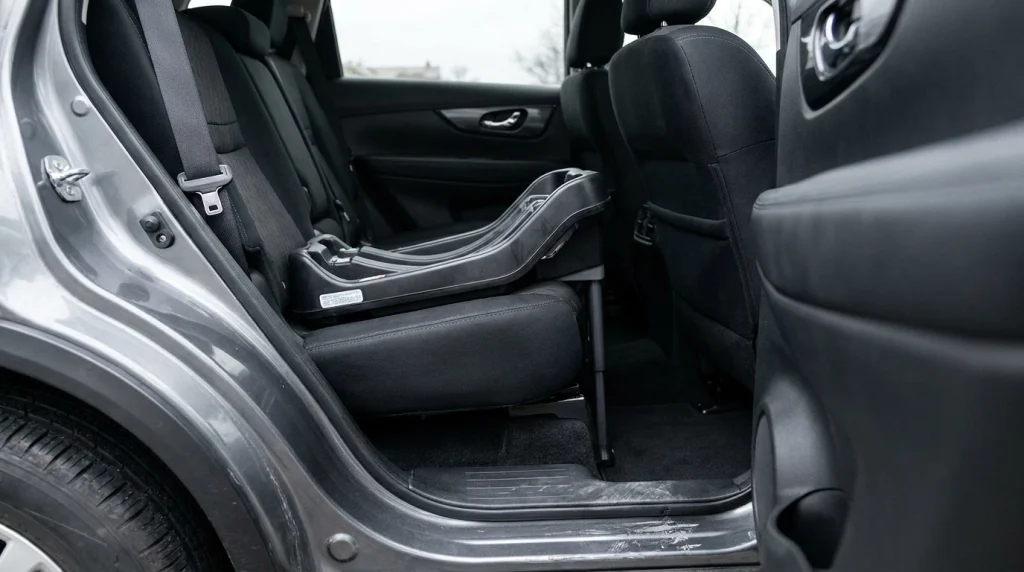
The most common mistake is judging overhang before the base is tight. A loose base slides forward as you push on it, and that makes the overhang look worse than it is.
Tighten the base first, then measure. That order gives you a true reading and stops you from moving a seat that would have passed.
Another mistake is ignoring the seat bight. The bight is the crease where the seat back meets the seat cushion, and a deep bight can push the base forward.
If the base sits on top of the bight instead of in it, the front end can lift and hang further forward. Seat the base fully into the bight before you tighten it.
A fourth mistake is fitting the base with the front seats pushed too far back. The front seat can press on the carrier handle or the base, and that pressure can shift the base forward over time.
Move the front seat forward enough to clear the carrier, then recheck the base. A small change up front can change the fit in the back row.
A fifth mistake is treating a wobble as normal. A base that moves more than one inch at the belt path is not tight enough, and that movement can make overhang worse on the road.
Find out why a car seat moves side to side if the base will not stay still after you tighten it. The cause is often the belt route, the anchor, or the cushion shape.
Pro tip: For any install doubt, use the vehicle owner’s manual and the car seat manual together, or ask a certified technician to check the fit in person.
Section Takeaway: Tighten first, seat the base fully into the bight, and recheck after a few trips.
Frequently Asked Questions
Can a car seat base hang over the vehicle seat at all?
Yes, if your manual allows it. Many manuals allow up to 20 percent front overhang, while some allow none at all.
How do I know if my base has too much overhang?
Measure the full base length and the length that hangs past the cushion. Divide the hanging length by the full length and multiply by 100.
Compare that percent with the limit in your manual, and move the seat if it sits over that limit.
Can the base hang over the side of the vehicle seat?
Usually no. Most manuals require the base to sit fully on the cushion from side to side.
Does overhang matter if the base feels tight?
Yes, it still matters. A base can feel tight at the belt path while the front end has no support under it.
Can I use a towel to fix base overhang?
Not unless your manual allows it for that problem. A towel or pool noodle can help with recline in some manuals, but it does not add support under a hanging base.
Try another seating spot or a different seat if the overhang stays too large.
What should I do if no seat in my car fits the base?
Try every seating spot, including the centre seat and the other side. Check the recline and tightness again in each spot, because fit can vary across one row.
If no spot works, ask a certified technician for help, and test a seat with a shorter base before you buy a new one. Edmunds has general car fit guides that can help you compare rear seat space before a test fit.
So, can a car seat base hang over the vehicle seat? A small front overhang can be fine, but only within your manual limit and only when the base stays tight, level, and fully supported across its width.
Measure it, check your manual, and try another spot if the numbers do not pass. That three-step check takes a few minutes, and it gives you a clear answer you can trust on every trip in 2026.

Daniel Brooks is an automotive writer and product researcher focused on car accessories, car tech, maintenance, and practical driving guides. At Plug-in Car World, he helps drivers make smarter automotive decisions through honest reviews and research-driven content.
