
How Tight Should a Car Seat Be After Installation?
Quick Answer
A car seat is properly tightened when it moves less than one inch side-to-side or front-to-back along the belt path. You should always test this tightness at the belt path using the strength of one hand, according to guidance from the National Highway Traffic Safety Administration.
Core Rules for a Secure Install
- The one-inch test: Grab the seat base firmly at the belt path and ensure it shifts under an inch in any direction.
- Single hand grip: Use only one moderate hand pull rather than violently shaking the shell with your whole body.
- Belt path focus: Check movement strictly where the seatbelt or lower anchor strap threads through the seat frame.
- Top movement normal: Expect the top of a rear-facing shell to rebound naturally toward the vehicle seat back.
- Seat cover check: Verify aftermarket seat protectors do not introduce slack, slip hazards, or artificial thickness beneath the base.
Quick Verification Step
- Place one hand flat inside the car seat, press your weight down firmly, and pull the belt slack before testing movement.
Installing a child restraint can quickly turn into an exhausting wrestling match with vehicle upholstery and stubborn webbing. I have spent hours sweating in cramped backseats troubleshooting car seat installs, and the same nagging doubt hits almost every parent: is this tight enough?
This guide explains exact safety thresholds, demonstrates the standardized testing technique, and covers how vehicle leather protectors affect base tension. You will learn how to secure the base correctly without damaging your car seats.
How Do You Perform the Car Seat One-Inch Test?
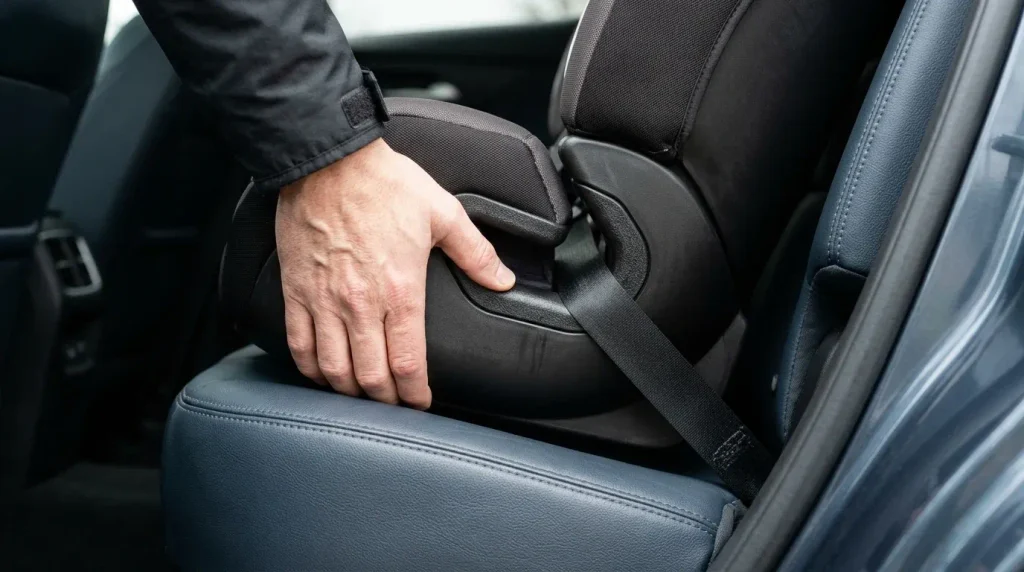
The one-inch test is the universal safety benchmark used by certified Child Passenger Safety Technicians (CPSTs) to verify installation tension. A compliant installation allows less than one inch of total movement along the belt path when pulled with moderate force.
Many caregivers test tension incorrectly by grabbing the top of the car seat shell. That mistaken grip creates false alarms and leads to over-tightening mistakes.
Here is how to execute the test correctly:
- Locate the belt path where either your vehicle seatbelt or the lower LATCH anchor webbing threads through the restraint shell.
- Grip the seat base directly at that belt path using your non-dominant hand.
- Apply moderate force to pull the base side-to-side, toward the car doors.
- Push the base forward and backward along the direction of vehicle travel.
- Measure the travel distance against your thumb knuckle, which measures roughly one inch on most adults.
If the base shifts less than an inch in any direction, your installation tension meets crash-safety standards. Movement exceeding that threshold requires releasing the latch, compressing the seat cushion again, and removing remaining slack.
Why Does the Top of a Rear-Facing Car Seat Still Move?
The top of a rear-facing car seat often pivots or rotates easily toward the back of the vehicle seat, which is completely normal. Federal Motor Vehicle Safety Standards intentionally permit this motion to absorb crash energy during frontal collisions.
Physics dictates that an unrestrained pivot point will lift and rotate into the vehicle seat back during an impact. This motion cradles your child and distributes crash forces across the entire shell.
Never test tightness at the headrest end of a rear-facing seat. Testing from the top applies extreme leverage, making an otherwise rock-solid base feel dangerously loose.
Restraints engineered with European-style anti-rebound bars or rigid load legs reduce this rotational movement significantly. Standard rear-facing infant carriers and convertibles, however, will naturally pivot when lifted by the head end.
Can You Make a Car Seat Too Tight?
You can make a car seat too tight, and doing so introduces distinct safety hazards and equipment risks. Cranking ratchets or jumping with full body weight onto a car seat can stress plastic components beyond their engineered tolerances.
Child safety seats feature hollow blow-molded or injection-molded plastic hulls designed to flex predictably during severe collisions. Excessive installation pressure causes hairline structural cracks, warps internal belt guides, or damages vehicle retractor springs.
Watch for these common signs of an over-tightened car seat:
- Buckle release failure: The vehicle seatbelt release button jams completely under tension and cannot pop open by hand.
- Plastic stress marks: White discoloration or stress lines appear along the molded belt routing channels.
- Recline angle distortion: The internal bubble or ball level indicator shifts out of its designated zone because the base is jammed too deep into the cushion.
- Permanent foam indentation: Your vehicle seat upholstery sustains torn seams or permanently crushed substructure foam.
Tightness should come from eliminating belt slack, not from brute mechanical distortion. Firm hand pressure combined with deliberate body weight produces a secure fit without overtaxing structural materials.
How Do Car Seat Covers and Mats Impact Installation Tightness?
Thick vehicle seat protectors, padded liners, and aftermarket car seat covers often create a dangerous illusion of tight installation. While these accessories protect leather and fabric from spills, thick materials compress dangerously under high crash loads.
During everyday handling, a plush mat grips the car seat base, making it feel solid and immovable during the one-inch test. In a crash, however, extreme deceleration compresses soft padding flat instantly, leaving dangerous slack in the restraint harness.
The American Academy of Pediatrics warns against using unapproved accessories not crash-tested directly by the seat manufacturer. Slippery vinyl surfaces can also cause the base to slide abruptly during evasive driving maneuvers.
The table below outlines how various vehicle seat protection methods influence car seat base stability and passenger safety:
| Cover / Protector Type | Base Movement Impact | Crash Compression Risk | Safety Recommendation |
|---|---|---|---|
| Bare Vehicle Upholstery | Optimal friction; no added travel | Zero added slack | Gold standard for safety |
| Thin, Grippy Seat Mat | Minimal displacement | Very low compression risk | Acceptable if manual allows |
| Thick Padded Foam Mat | Feels tight; masks belt slack | High (creates 1-2″ slack) | Not recommended |
| Loose Towel or Blanket | Causes unpredictable slippage | Moderate to high | Do not use under base |
Always verify whether your specific car seat brand permits vehicle seat protectors in their instruction manual. Some brands, such as Britax and Diono, allow specific branded crash-tested mats, while others strictly prohibit any barrier between seat and upholstery.
What Are the Best Techniques to Get a Rock-Solid Installation?
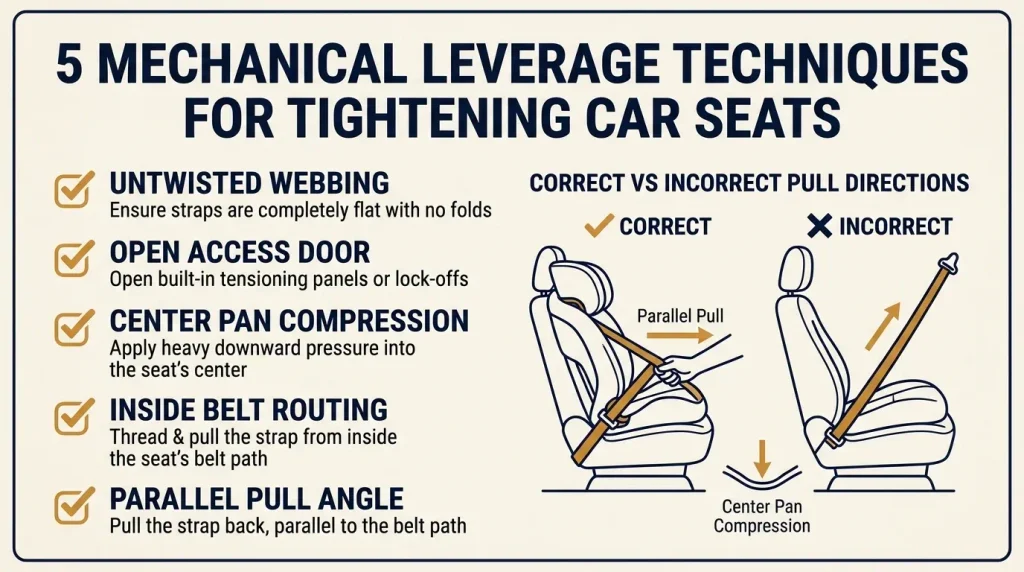
Achieving a snug car seat install does not require gym-level strength. Success relies on leverage, weight placement, and pulling the adjustment strap from the correct angle.
I frequently see parents pulling tightening straps outward, away from the car seat shell. That outward angle fights against the built-in plastic clamp and creates friction that stops the belt from sliding.
Follow these field-tested installation steps to eliminate slack effortlessly:
- Thread the belt or lower anchor webbing through the correct path without any twists.
- Open your vehicle car seat cover panel or pull back the fabric flap to expose the internal belt routing chamber.
- Place one knee or hand firmly in the center of the seat pan to compress vehicle seat springs.
- Route the free tail of the adjustment strap back through the belt path hole into the seat interior.
- Pull the strap parallel to the belt path from inside the shell rather than tugging outward toward the vehicle door.
Pulling the strap inside the seat housing directs force in a straight line, removing stubborn slack instantly. Modern seats equipped with built-in tensioning lockoffs, like the Britax ClickTight or Graco SnugLock, close over loose webbing and clamp it tight automatically.
Seatbelt vs. LATCH: Which System Provides a Tighter Fit?
Both seatbelts and lower LATCH anchors provide identical crash protection when installed properly. Neither system is inherently safer or tighter than the other in modern passenger vehicles.
LATCH often provides a quicker, simpler installation in small compact cars where vehicle belt geometries are awkward. However, lower anchors feature strict weight limits established by federal motor vehicle safety rules.
Consult non-profit safety guidance from organizations like Safe Kids Worldwide regarding combined child-and-seat weight limits. Once your growing child hits the designated threshold (typically 65 pounds combined weight), you must switch to the vehicle seatbelt.
Never connect both the lower LATCH anchors and the vehicle seatbelt simultaneously unless the manufacturer explicitly permits dual installation. Using both systems concurrently exerts untested crash loads on the seat shell and can cause unexpected brittle fractures.
If you need reliable accessories or seats engineered for effortless tightening, here are my top equipment picks:
🏆 BEST OVERALL TIGHTENING SYSTEM
Britax One4Life ClickTight All-in-One
★★★★★
Patented ClickTight door functions as a mechanical tensioner that clamps webbing tight with zero muscle. In my installs, this mechanism guarantees zero-inch movement every time across almost every vehicle seat profile.
🛡️ BEST CRASH-TESTED SEAT PROTECTOR
Diono Ultra Mat Car Seat Protector
★★★★☆
High-density molded panels shield upholstery without introducing compressible mush under your car seat base. It features grippy backing that stays put without degrading installation tension or belt path geometry.
💰 BEST VALUE EASY-TIGHTEN SEAT
Graco TriRide 3-in-1 Car Seat
★★★★☆
Equipped with clear open belt paths and built-in level indicators that take the guesswork out of installation angles. It provides an exceptionally rigid seatbelt lockup on budget-friendly terms.
Frequently Asked Questions
Where exactly should I measure the one inch of movement?
Measure movement strictly at the belt path where the vehicle seatbelt or LATCH strap passes through the plastic seat base. Never measure movement from the top headrest or the outer edges of the seat shell.
Is it safer to use both LATCH and a seatbelt together?
No, you should never use both systems together unless your car seat instruction manual explicitly instructs you to do so. In an accident, using two restraint methods simultaneously subjects safety anchor points to unnatural, uncertified stresses.
How tight should the child harness straps be on the baby?
Harness webbing must be snug enough to pass the pinch test at the child’s collarbone. If you can pinch excess horizontal strap webbing between your thumb and forefinger, pull the harness adjustment strap tighter.
Why does my car seat loosen up on leather vehicle seats over time?
Smooth leather upholstery allows seat bases to shift during normal vehicle vibration, which gradually introduces belt path slack. Inspect base tightness monthly and wipe leather clean to eliminate slick conditioner residues.
Do I need a locking clip if my vehicle seatbelts lock automatically?
You do not need a separate locking clip if your vehicle features switchable retractor belts that lock when pulled completely out. Modern vehicles made after 1996 include automatic locking retractor systems designed specifically for child seats.
Final Safety Checklist for Caregivers
Getting your child safety seat tight enough does not require endless frustration or damaged vehicle cushions. Focus your inspection entirely on the belt path, keep travel under an inch, and avoid bulky aftermarket seat protectors that compromise stability.
Double-check your manual, perform the one-hand test, and schedule a free in-person review with a local certified technician if you ever feel uncertain.

Daniel Brooks is an automotive writer and product researcher focused on car accessories, car tech, maintenance, and practical driving guides. At Plug-in Car World, he helps drivers make smarter automotive decisions through honest reviews and research-driven content.
