
Infant Car Seat vs. Convertible Car Seat: What’s the Difference?
Quick Answer
An infant car seat is designed exclusively for rear-facing travel and usually includes a carrying handle and removable base. A convertible car seat works rear-facing first, then changes to forward-facing when your child reaches the manufacturer’s rear-facing limits. For the official safety recommendations, see the NHTSA car seat guidance.
The Main Differences
- Age and size: Infant seats accommodate smaller babies, while convertible seats accommodate infants and growing toddlers.
- Travel convenience: Infant seats detach from their bases for easier carrying.
- Extended use: Convertible seats typically offer higher rear-facing weight and height limits.
- Installation: Infant seats commonly use a separate vehicle base, while convertible seats install directly in the vehicle.
- Forward-facing: Convertible seats can transition to forward-facing mode when the child outgrows the rear-facing limits.
- Portability: Infant seats can move between compatible bases, while convertible seats generally stay installed.
A Simple Buying Tip
- Choose an infant seat if carrying your baby between the car and stroller matters most.
- Consider a convertible seat if you prefer one seat that accommodates several growth stages.
- Always check newborn fit, vehicle compatibility, and the manufacturer’s instructions before buying.
Choosing your baby’s first car seat can feel surprisingly complicated. Both infant and convertible seats protect young passengers, but they serve different everyday needs.
In this guide, I’ll explain how these seats differ, when each makes sense, and what to consider before buying. I’ll also cover installation, replacement covers, and common mistakes that parents can avoid.
What Is an Infant Car Seat?

An infant car seat is a rear-facing child restraint designed specifically for babies. It usually has a carrying handle and a detachable base that remains installed in the vehicle.
The seat clicks into its base, allowing parents to remove the carrier without uninstalling the entire system. This makes everyday trips and transfers between compatible strollers more convenient.
Most infant-only models accommodate babies from approximately 4 pounds to 30–35 pounds, although exact limits vary by model. Some models have different minimum and maximum height requirements.
Here are the features commonly found on infant car seats:
- Rear-facing design: The seat faces the back of the vehicle throughout its approved use.
- Carrying handle: A handle makes transporting the carrier easier.
- Detachable base: The base stays secured in the vehicle while the carrier clicks in and out.
- Newborn support: Manufacturer-provided inserts help position smaller babies when approved for their size.
- Stroller compatibility: Some models connect to compatible strollers or travel systems.
One important limitation is portability outside the car. Although the carrier is removable, parents should not treat it as a regular sleeping space.
What Is a Convertible Car Seat?
A convertible car seat is a child restraint that supports rear-facing and forward-facing travel. It adjusts as a child grows, allowing parents to use the same seat across multiple developmental stages.
Unlike an infant carrier, a convertible seat usually stays installed in the vehicle. It doesn’t normally have a carrying handle or a detachable infant carrier.
Many convertible seats offer rear-facing weight limits around 40–50 pounds, depending on the model. Their forward-facing limits also vary, so parents must follow the specific seat’s instructions.
Common features include:
- Two-direction use: The seat supports rear-facing and forward-facing configurations.
- Five-point harness: Straps secure the child at the shoulders, hips, and crotch.
- Adjustable headrest: Many models allow the headrest and harness height to change.
- Recline settings: Different positions help achieve the required installation angle.
- Higher rear-facing limits: Many models accommodate larger babies and toddlers for longer.
Some convertible seats also include additional features, such as extended legroom, easier harness adjustments, and removable washable seat covers.
Infant Car Seat vs. Convertible Car Seat: What’s the Difference?
The biggest difference is how each seat fits into everyday family life. Infant seats prioritize portability, while convertible seats prioritize longer-term use.
Both can provide appropriate protection when parents select the correct size, install the seat properly, and follow the manufacturer’s instructions.
| Feature | Infant Seat | Convertible Seat |
|---|---|---|
| Direction | Rear-facing only | Rear-facing and forward-facing |
| Typical weight range | Approximately 4–30/35 lb | Often 4–40/50 lb rear-facing, depending on model |
| Carrying handle | Usually included | Usually absent |
| Detachable carrier | Yes | No |
| Vehicle base | Usually separate | Integrated installation structure |
| Stroller connection | Often available | Generally unavailable |
| Long-term use | Limited to infant-stage restrictions | Can accommodate several growth stages |
| Best suited for | Parents prioritizing portability | Parents prioritizing extended use |
Important: These weight ranges are examples, not universal specifications. The exact height and weight limits printed on the individual seat determine when your child must transition.
Which Car Seat Is Better for a Newborn?
Both infant-only and convertible seats can accommodate newborns when the manufacturer approves the seat for the baby’s size and the harness fits correctly. An infant-only seat offers carrying convenience, while a convertible seat can provide a longer period of use.
However, newborn fit deserves special attention. A seat that technically accepts a baby’s weight might not provide the correct fit for a particularly small newborn.
Before choosing, check these details:
- Minimum weight: Confirm that your baby’s weight meets the seat’s minimum requirement.
- Minimum height: Check the manufacturer’s stated height range.
- Harness position: Rear-facing harness straps should sit at or below the baby’s shoulders.
- Recline angle: Follow the manufacturer’s newborn recline instructions.
- Head support: Use only inserts supplied with or approved for the particular seat.
Some newborns need extra attention to positioning, especially if they were born prematurely. Ask a qualified healthcare professional about special transportation needs when appropriate.
How Long Can a Baby Use an Infant Car Seat?
A baby can use an infant car seat until reaching its maximum approved height or weight limit, whichever comes first. There isn’t one universal age when every child outgrows an infant carrier.
For example, one seat might allow a maximum weight of 30 pounds, while another permits 35 pounds. Height restrictions can also differ.
Watch for these important limits:
- Weight limit: Your child reaches the maximum permitted weight.
- Height limit: Your child exceeds the maximum permitted standing height or other stated measurement.
- Head clearance: The manufacturer specifies how much space must remain above the baby’s head.
Don’t rely on appearance alone. A baby’s legs touching the vehicle seat or bending at the knees doesn’t automatically mean the infant seat has been outgrown.
Check the instruction manual for the exact transition requirements. Once your baby outgrows the infant-only seat, move to an appropriate convertible or all-in-one seat in rear-facing mode.
Can You Skip the Infant Car Seat and Start With a Convertible Seat?
Yes. Parents can start with a convertible car seat from their baby’s first vehicle ride if the seat is approved for the newborn’s size and provides a proper fit.
This approach avoids purchasing a separate infant carrier. It can also reduce the number of seat transitions during the early years.
However, there are practical trade-offs.
- Less carrying convenience: You cannot remove the entire seat and carry it like an infant carrier.
- No carrier transfer: Moving a sleeping baby between the car and stroller requires transferring the child.
- Newborn positioning: You must carefully check harness fit and recline settings.
- Longer initial installation: The seat remains in the vehicle rather than clicking into a separate base.
I would focus on fit and installation before convenience or the number of years advertised on the packaging. A convertible seat is a practical starting point when it accommodates your newborn correctly.
Is an Infant Car Seat Safer Than a Convertible Car Seat?
Neither category is automatically safer simply because of its design. A properly selected and correctly installed infant seat or convertible seat can provide appropriate protection for a child who fits within its approved limits.
The most important factor is using the correct seat for your child’s current size and developmental stage.
Rear-facing travel is especially important for infants and young toddlers. The American Academy of Pediatrics recommends keeping children rear-facing as long as possible, until they reach the highest height or weight allowed by their particular seat.
Here’s what matters most:
- Correct installation: Secure the seat using an approved installation method.
- Proper harness fit: Keep the straps flat and snug against the child.
- Correct orientation: Use rear-facing mode until the child reaches the seat’s rear-facing limits.
- Vehicle compatibility: Make sure the seat fits the vehicle’s seating position.
- Seat condition: Check expiration information, damage, and recall status.
The American Academy of Pediatrics car seat guidance provides additional information about choosing and using child restraints.
What About Car Seat Covers and Replacement Seat Covers?
Car seat covers are worth discussing because parents often want to protect their baby’s seat from spills, food, and everyday wear. However, not every cover or protective accessory is suitable for use with a child restraint.
A car seat cover can refer to the original fabric covering on a child restraint, a replacement cover, or an aftermarket accessory. These products serve different purposes and shouldn’t be treated as interchangeable.
Can You Put an Aftermarket Cover on an Infant or Convertible Car Seat?
You shouldn’t add a third-party cover unless the car seat manufacturer specifically approves it for your exact model. An unapproved cover can interfere with the harness fit, buckle operation, or other parts of the restraint.
The same caution applies to both infant and convertible seats.
Before purchasing a replacement or protective cover, check these points:
- Model compatibility: The cover must be approved for your exact car seat model.
- Harness access: It must not obstruct the harness slots, buckle, or adjustment mechanism.
- Fabric requirements: Use materials and replacement components approved by the manufacturer.
- Installation: The cover must not change how the seat attaches to the vehicle.
The NHTSA car seat glossary explains aftermarket products and why manufacturers’ approval matters.
Can You Replace a Damaged Car Seat Cover?
Yes, if the manufacturer offers an approved replacement for your particular model. You should contact the manufacturer rather than buying a visually similar cover from an unrelated seller.
Replacement fabric should match the seat’s approved design. Don’t assume that a cover advertised as universal will fit safely.
Cleaning also matters. Follow the seat manual because some covers can be machine-washed while other components require surface cleaning.
How Do You Install an Infant vs. Convertible Car Seat?
Both seat types require careful installation, but their installation arrangements differ. Infant-only seats commonly use a separate base, whereas convertible seats attach directly to the vehicle.
Installing an Infant Car Seat
- Read both manuals: Review the car seat instructions and vehicle owner’s manual.
- Position the base: Place it in an approved rear seating position.
- Secure the base: Use the permitted lower-anchor system or vehicle seat belt method.
- Check movement: The installed base should not move more than one inch side-to-side or front-to-back when tested at the belt path.
- Check the recline: Follow the manufacturer’s angle indicator.
- Attach the carrier: Confirm that it locks securely into the base.
Installing a Convertible Car Seat
- Choose the correct direction: Start in rear-facing mode for an infant.
- Find the correct belt path: Follow the rear-facing installation markings.
- Secure the seat: Use the vehicle seat belt or approved lower-anchor system.
- Adjust the recline: Set the angle according to the child’s age and seat instructions.
- Check movement: Test the seat at its installation belt path.
- Fit the harness: Confirm correct strap height and snugness for your child.
Never assume that a seat installs the same way in every vehicle. The NHTSA rear-facing installation instructions provide additional guidance.
When in doubt, arrange an inspection with a certified Child Passenger Safety Technician (CPST). A trained technician can help identify installation and harness-fitting problems.
What Should You Consider Before Buying Either Type?
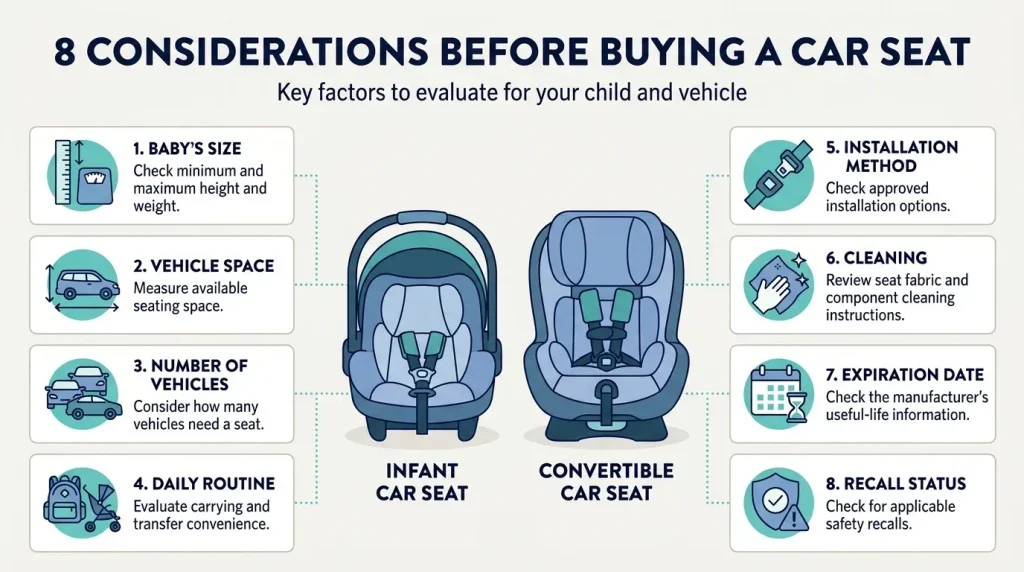
Price and appearance matter, but they shouldn’t be your only buying criteria. A car seat needs to fit your child, your vehicle, and your family’s daily routine.
Consider these factors before making a decision:
- Your baby’s size: Check the minimum and maximum height and weight requirements.
- Vehicle space: Measure the available space, especially when installing a rear-facing seat.
- Number of vehicles: Consider whether you need multiple compatible infant bases or separate convertible seats.
- Daily routine: Think about whether carrying a removable infant seat would make trips easier.
- Installation method: Check which approved installation options work with your vehicle.
- Cleaning: Review how the seat fabric, buckle, and harness can be cleaned.
- Expiration date: Check the seat’s manufacturing label and useful-life information.
- Recall status: Check for applicable recalls before using a seat.
Also consider whether you want a seat that later becomes a booster. Some convertible models offer only two modes, while all-in-one models include an additional booster stage.
Infant Car Seat vs. Convertible Car Seat: Which One Should You Choose?
The right option depends on which features matter most to your family. Neither type is the correct choice for every household.
Here are some situations where each option makes sense.
Choose an Infant Car Seat If:
- You want to carry your baby between the vehicle and home.
- You frequently transfer the carrier between compatible vehicles.
- You plan to use a compatible stroller travel system.
- You prefer leaving a base installed in the vehicle.
- You value convenience during the newborn stage.
Choose a Convertible Car Seat If:
- You want one seat for rear-facing and later forward-facing use.
- You don’t need a removable infant carrier.
- You want higher rear-facing weight or height limits.
- You prefer avoiding a separate infant-to-convertible transition.
- You have confirmed that the seat fits your newborn and vehicle.
One final consideration: some families choose both. They begin with an infant carrier and later purchase a convertible seat when the baby reaches the infant seat’s limits.
Others start directly with a convertible seat and avoid that additional purchase. Both approaches can work when the seat fits correctly and follows current safety recommendations.
Product Recommendations: Infant and Convertible Car Seats
If you’re comparing actual models, I’d start by looking at their approved size ranges, installation features, and manufacturer support. These two examples illustrate the different approaches.
🏆 INFANT SEAT OPTION
Chicco KeyFit 35 Infant Car Seat
★★★★★ 4.8/5
A rear-facing infant carrier with a detachable base, carrying handle, and compatibility with selected Chicco strollers. Its published customer rating is 4.8/5 on Chicco’s website. I’d consider this style when portability and carrier convenience are priorities.
💰 EXTENDED REAR-FACING OPTION
Graco Extend2Fit Convertible Car Seat
★★★★☆ 4.5/5
This convertible model supports rear-facing use up to 50 pounds and includes an adjustable extension panel for additional legroom. Graco reports a 4.5/5 customer rating on its product listing. I’d consider it when extended rear-facing capacity is a priority.
Ratings reflect the manufacturers’ published customer ratings available during research, not independent crash-test scores. Specifications, availability, and prices can change. Verify the exact model and instructions before purchasing.
Frequently Asked Questions
Can a convertible car seat be used from birth?
Yes. Many convertible car seats accommodate newborns when the baby’s weight and height meet the manufacturer’s minimum requirements. The harness and recline must also provide a proper fit. Always verify newborn compatibility before using a convertible seat for your baby’s first ride.
Do infant car seats come with a base?
Most infant-only car seats include a compatible base that remains installed in the vehicle. The carrier clicks into and out of that base. Some models offer additional bases separately, making transfers between compatible vehicles more convenient.
When should I switch from an infant car seat to a convertible seat?
Switch when your child reaches the infant seat’s maximum height or weight limit, whichever comes first. Check the manufacturer’s head-clearance requirements, too. The next seat should accommodate your child’s current size and remain rear-facing when appropriate.
Can I use the same car seat cover on an infant and convertible seat?
Not automatically. Car seat covers are designed for specific seat models and may differ in their shape, harness openings, and attachment points. Use only original replacement covers or accessories explicitly approved by the manufacturer for your particular restraint.
Is a convertible car seat cheaper in the long run?
It can reduce the need to purchase a separate infant carrier, but the actual cost depends on the models and features you choose. Some families prefer the convenience of an infant seat despite the additional purchase. Compare the complete costs rather than assuming one option always saves money.
Final Takeaway: Infant or Convertible Car Seat?
Infant and convertible car seats serve different needs, but both can be suitable for protecting babies during vehicle travel. Infant seats make carrying and transferring your baby easier, while convertible seats offer longer use as your child grows.
My main advice is to prioritize proper fit, correct installation, and rear-facing use over convenience or marketing claims. Check the manufacturer’s instructions carefully, and never add an unapproved car seat cover or accessory.
Whether you choose an infant carrier or start with a convertible seat, the best decision is the one that fits your child, works in your vehicle, and can be used correctly on every trip.

Daniel Brooks is an automotive writer and product researcher focused on car accessories, car tech, maintenance, and practical driving guides. At Plug-in Car World, he helps drivers make smarter automotive decisions through honest reviews and research-driven content.
