
Common Car Seat Safety Myths Parents Should Know
Quick Answer
Most car seat myths fail on the same point: they judge safety by age, price, or appearance instead of fit. A child should stay in each stage until the seat’s height or weight limit is reached, the harness fits snugly, and the vehicle belt fits correctly without a booster. Learn the difference in this guide to rear-facing vs. forward-facing car seats, and check your manual before you move a child up.
Myths that cause the most confusion
- Birthday rule: A birthday alone does not make a child ready for the next seat.
- Price equals safety: A higher price can add features, but it does not by itself prove a better fit.
- Loose harness: A loose harness can let a child move too far in a crash.
- Front seat shortcut: The back seat stays the safer place for children through age 12.
- Clean secondhand seat: A clean look cannot show crash history, expiry, or a recall.
- Booster finish line: A booster ends when the vehicle belt fits, not at one set age.
Check before every trip
- Pinch the harness at the shoulder. No slack should gather between your fingers.
- Place the chest clip at armpit level, not on the belly or neck.
- Confirm the seat moves less than one inch at the belt path.
Parents hear conflicting advice about child car seats, and much of it sounds reasonable at first. This guide sorts the common myths from the checks that actually protect a child on a real trip.
You will find clear answers for rear-facing use, harness fit, secondhand seats, front-seat rides, and booster seats. Use the manual for your exact seat and vehicle, because limits and approved positions vary by model.
In This Guide
- What Does “Car Seat” Mean Here, and Why Do Myths Spread?
- Is Age Alone Enough to Turn a Child Forward-Facing?
- Does a Higher Price Mean a Safer Seat?
- Can a Loose Harness, Bulky Coat, or Add-On Insert Be Safe?
- Is the Front Seat or a Secondhand Seat Safe If It Looks Fine?
- When Can a Child Safely Stop Using a Booster Seat?
- How Can You Check a Car Seat in Five Minutes?
- Frequently Asked Questions
- The Takeaway for Parents
What Does “Car Seat” Mean Here, and Why Do Myths Spread?
A child car seat is a restraint made to hold a child in a crash, with its own harness or a belt-positioning design. It is not the same as a decorative vehicle seat cover, and a cover must never change how a restraint fits.
Confusion grows because the words overlap in everyday talk. One parent may mean a child restraint, while another may mean a cover that protects vehicle upholstery.
Keep the two jobs separate in your mind. A restraint protects the child, while a cover protects the vehicle seat underneath it.
- Rear-facing seat: The child faces the rear of the vehicle, and the seat shell supports the head, neck, and back.
- Forward-facing seat with harness: The child faces forward, with a harness and a top tether.
- Booster seat: The seat raises the child so the vehicle lap and shoulder belt fit correctly.
- Vehicle seat belt: The adult belt becomes the restraint only when it fits the child correctly.
Myths also spread because children grow at different rates. A rule that worked for an older sibling may not fit a younger child yet.
Short trips add another trap. A quick school run can feel low risk, yet the same harness, belt, and seating rules apply.
| Myth | Safer check | Why it matters |
|---|---|---|
| Turn forward at a set birthday | Check the seat’s rear-facing height and weight limits | Limits reflect the seat design, not the calendar alone |
| A pricier seat is always safer | Check fit for the child, the vehicle, and correct use | A poor fit can undo a good feature list |
| A loose harness is fine for a short trip | Use the pinch test at the shoulder | Slack lets the child move forward in a crash |
| The front seat is fine if the trip is short | Keep children in the back seat through age 12 | The back seat keeps a child farther from a frontal airbag |
| A clean secondhand seat is safe | Confirm history, expiry, recall status, and all parts | Damage and missing parts often hide under a clean cover |
| A booster ends at one age | Use the five-step belt-fit test in your vehicle | Belt fit depends on the child and the vehicle seat |
Section takeaway: Judge a seat by fit, limits, and correct use, not by age, price, or appearance alone.
Is Age Alone Enough to Turn a Child Forward-Facing?
No, age alone is not enough. A child should stay rear-facing until the child reaches the top height or weight limit allowed by that seat’s maker.
Many convertible seats allow rear-facing use up to 40 or 50 pounds, depending on the model. That range means many children can stay rear-facing well past age two.
State rules set minimums, and those minimums vary. Your seat manual sets the limit for your exact seat, so read both before you switch.
- Check the label: Find the rear-facing height and weight limits printed on the seat.
- Check headroom: Follow the manual rule for head position, not a guess from the side view.
- Check the vehicle: Confirm the seat still installs at the correct recline angle.
- Check the law: Confirm your state minimum, then keep the stricter manual limit if it is higher.
Legs touching the vehicle seat back do not by themselves mean a child has outgrown a rear-facing seat. Children can bend their legs, and the manual limit still controls the decision.
When a child does outgrow the rear-facing limit, move to a forward-facing seat with a harness and top tether. Learn when to turn a car seat forward-facing before you make that change.
Section takeaway: Stay rear-facing as long as the seat allows, and let the manual limit, not a birthday, decide the switch.
Does a Higher Price Mean a Safer Seat?
No, a higher price does not by itself mean a safer seat. Child seats sold in the United States must meet the same federal safety standard, FMVSS 213.
Price often reflects extra features, lighter weight, easier install aids, or premium fabric. Those features can help, but they do not replace a correct fit.
A seat that fits your child and your vehicle, and that you can use correctly every time, beats a costly seat that fits poorly. Ease of use matters because a seat must work on tired mornings too.
- Fit the child: Match height, weight, and harness slot rules to your child today.
- Fit the vehicle: Test the install in your car, not only in a store display.
- Fit the routine: Choose buckles, harness adjusters, and install steps you can repeat correctly.
- Check the manual: Confirm approved seating positions and install methods for that model.
For broad safety guidance, start with the NHTSA car seat pages and your seat manual. Use those sources to confirm stages and install steps, rather than a price tag.
Section takeaway: Buy for fit and correct use first, and treat price as a feature question, not a safety rating.
Can a Loose Harness, Bulky Coat, or Add-On Insert Be Safe?
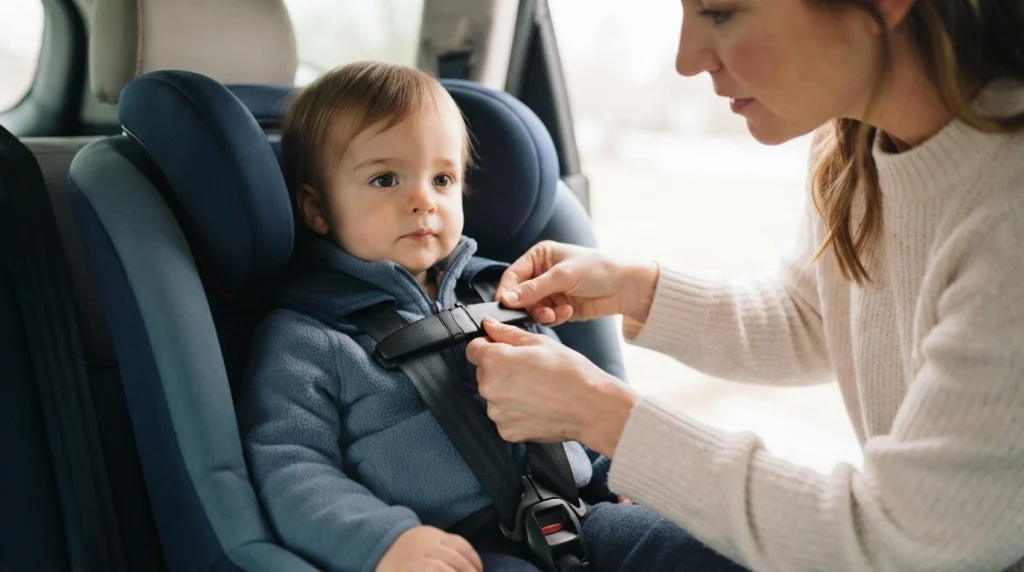
No, none of these shortcuts is safe as a general rule. A harness must stay snug, a bulky coat must come off for buckling, and an add-on must be maker-approved.
Use the pinch test after you buckle the harness. Try to pinch the webbing at the shoulder, and tighten until no slack gathers.
Place the chest clip at armpit level. A clip on the belly can let straps slide, while a clip near the neck can press the wrong area.
- Thin layers first: Dress the child in thin, close-fitting layers for the ride.
- Buckle, then cover: Buckle the harness snugly, then place a blanket over the harness.
- Test the coat: Buckle without the coat, then check the fit again if you add layers.
- Skip loose padding: Do not place thick padding behind the child unless the manual allows it.
Aftermarket inserts, strap covers, and head supports can change harness fit or crash performance. Use only accessories that the seat maker approves for that exact model.
If a harness still feels loose after correct tightening, stop and check the manual for routing and slot height. Learn how tight a car seat should be before your next trip.
Section takeaway: Keep the harness snug on thin layers, and skip any add-on the seat maker has not approved.
Is the Front Seat or a Secondhand Seat Safe If It Looks Fine?
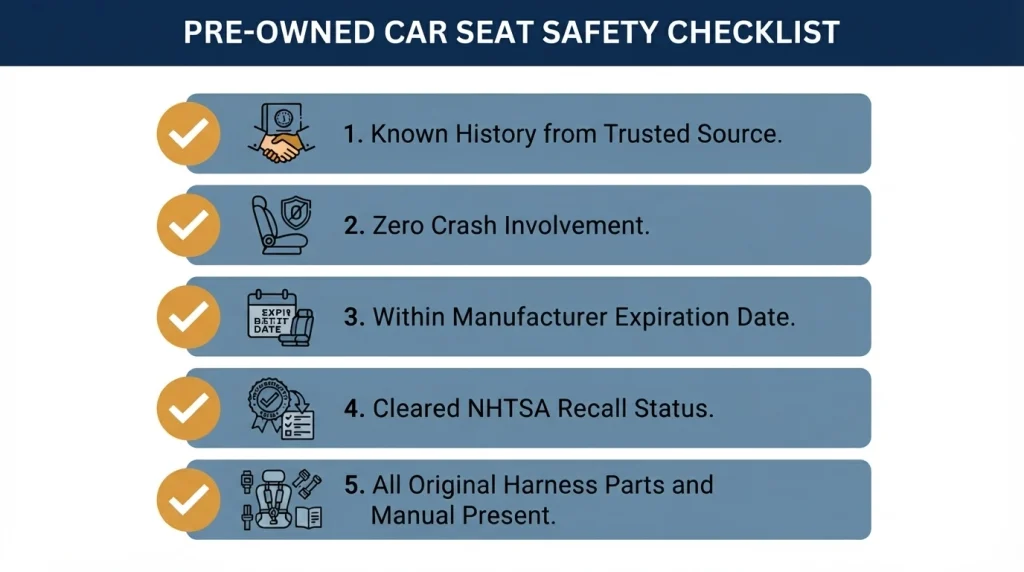
No, a good look cannot settle either question. The front seat carries airbag risk, and a secondhand seat can hide crash, expiry, or recall problems.
Children should ride in the back seat at least through age 12, under current national guidance. A frontal airbag deploys with great force, and a child sits closer to it in front.
Some vehicles have no back seat, and some manuals allow a specific front-seat setup. Follow the vehicle manual and the seat manual together in that rare case.
Pro tip: Check the vehicle owner’s manual, the NHTSA recall lookup, or a certified child passenger safety technician before you use a front-seat setup or a seat with an unknown history.
For the back-seat rule in plain terms, read why children should ride in the back seat. It helps explain the risk without turning a short trip into an exception.
- Known history: Accept a used seat only from a trusted source with a full crash history.
- No crash: Do not use a seat that has been in a crash, unless the manual states a clear exception.
- Not expired: Find the expiry date on the label, and do not use a seat past that date.
- Not recalled: Check the model and date of manufacture against the current recall list.
- Complete parts: Confirm every part, strap, buckle, and manual is present and correct.
If any answer is unknown, treat that unknown as a stop sign. Learn is it safe to use a secondhand car seat before you accept one from another family.
Section takeaway: The back seat is the default for children, and an unknown secondhand history is a reason to say no.
When Can a Child Safely Stop Using a Booster Seat?

A child can stop using a booster seat when the vehicle belt fits correctly without it, in that vehicle. Age and height help as guides, but belt fit decides the answer.
Many children reach a good belt fit between ages 8 and 12, often near 4 feet 9 inches tall. Your child and your vehicle seat shape still matter more than that average.
A booster does not have its own harness. It raises the child so the lap belt sits low on the hips and the shoulder belt crosses the chest and shoulder.
- Back against the seat: The child sits with the back flat against the vehicle seat back.
- Knees bend naturally: Knees bend at the seat edge without slouching forward.
- Lap belt low: The lap belt rests low on the hips and upper thighs, not on the belly.
- Shoulder belt centred: The shoulder belt crosses the middle of the chest and shoulder, not the neck or face.
- Stays seated: The child can stay in that position for the whole trip.
If any step fails, keep the booster. Test the fit again after a growth spurt, and test it in each vehicle the child rides in.
High-back boosters can help with head support and belt routing, especially in vehicles with low seat backs. Backless boosters need a vehicle head restraint behind the child, so check that detail too.
For child health guidance, the American Academy of Pediatrics site offers general stage guidance. Learn when a child can stop using a booster seat and run the five-step test in your own car.
Section takeaway: End booster use only when all five belt-fit steps pass, in the vehicle your child actually rides in.
How Can You Check a Car Seat in Five Minutes?
You can check the basics in five minutes, without tools. Work from the belt path outward, and fix one problem before you drive.
Start with the install, then the harness, then the child position. A calm, same-order check helps you catch drift after cleaning or a vehicle swap.
- Push at the belt path: The seat should move less than one inch side to side or front to back.
- Check the install method: Use the vehicle belt or lower anchors as the manual allows, not both unless the manual allows both.
- Check the tether: Attach the top tether for a forward-facing seat, and route it as the manual shows.
- Check recline: Confirm the recline indicator matches the manual for rear-facing use.
- Check harness slots: Confirm rear-facing slots sit at or below the shoulders, as the manual directs.
- Do the pinch test: Tighten the harness, set the chest clip at armpit level, and recheck.
As of 2026, keep this check as a habit after any reinstall, cleaning, or growth change. A seat that was tight last month can loosen after straps, covers, or vehicle seats shift.
An illustrative example helps here, without claiming a tested case: a parent reinstalls a seat after cleaning, then finds more than one inch of movement at the belt path. That parent should reinstall and recheck, rather than drive and hope the slack settles.
Section takeaway: A short, same-order check catches most fit drift before it becomes a trip problem.
Frequently Asked Questions
At what age should a child turn forward-facing?
There is no single safe birthday for the switch. Keep a child rear-facing until the child reaches the seat maker’s height or weight limit, and check your state minimum as well.
Is a secondhand car seat ever safe?
It can be safe only with a known, crash-free history and a complete, unexpired, unrecalled seat. If the history, expiry, recall status, or any part is unknown, do not use that seat.
Can my child wear a winter coat in a car seat?
Do not buckle a harness over a bulky coat, because the coat can compress and leave slack in a crash. Use thin layers under the harness, then place a blanket over the buckled harness for warmth.
Does turning off the front airbag make the front seat safe?
No, switching off an airbag does not make the front seat the safer choice for a child. Keep children in the back seat through age 12, and follow both manuals if no back seat exists.
When can my child stop using a booster seat?
Your child can stop when the vehicle belt passes all five fit steps without a booster, in that vehicle. Many children reach that point between ages 8 and 12, often near 4 feet 9 inches tall.
Do vehicle seat covers affect a child car seat?
A decorative vehicle seat cover is not a child restraint, and it must not block anchors, tethers, belt paths, or airbags. If a cover changes the install or harness fit, remove it and check both manuals before you drive.
The Takeaway for Parents
Myths feel easy because they offer one simple rule. Safety needs a slightly longer check, but that check fits into a normal routine.
Start with the manual, confirm the stage limit, and test the harness and belt fit in your vehicle. When a detail is unknown, get help from a certified technician rather than guessing.
For general safety information, Safe Kids Worldwide offers parent-facing guidance on child passenger safety. Use it alongside your manuals, not as a replacement for them.
Keep your child in the stage that fits today, and move up only when the limit and the fit test both say yes. That habit matters more than any single product choice.

Daniel Brooks is an automotive writer and product researcher focused on car accessories, car tech, maintenance, and practical driving guides. At Plug-in Car World, he helps drivers make smarter automotive decisions through honest reviews and research-driven content.
