
LATCH vs. Seat Belt: Which Car Seat Installation Method Should You Use?
Quick Answer
Both LATCH and vehicle seat belts are equally safe when installed correctly according to safety guidelines from the National Highway Traffic Safety Administration. LATCH simplifies setup for infants, but seat belts support higher child weights and fit every seating position.
Core Decision Factors
- Weight limits: Lower LATCH anchors stop being safe when combined child and seat weight exceeds 65 pounds.
- Seating position: Seat belts work in every row and middle seat, while center LATCH anchors are rare.
- Tether requirement: Forward-facing car seats always require the top tether strap regardless of which belt system secures the base.
- Simultaneous use: Never use both LATCH connectors and a seat belt at the same time unless the manufacturer allows it.
Quick Verification Check
- Test movement by grabbing the seat at the belt path; it should not budge more than one inch side-to-side or front-to-back.
Every parent remembers the sweat and frustration of wrestling their first car seat into the back row. You want total peace of mind that your little passenger is completely secure before pulling out of the driveway.
I have spent years testing vehicle child restraints, passenger geometry, and interior protection setups. This guide breaks down the real mechanical differences, strict weight cutoffs, and daily trade-offs so you can install your car seat with absolute confidence.
What Is the Difference Between LATCH and Seat Belt Installation?
The core difference lies in how the child seat physically anchors to the steel frame of your vehicle. LATCH uses dedicated hardware built into the car, while a seat belt uses the vehicle’s standard passenger webbing.
LATCH stands for Lower Anchors and Tethers for Children. Regulators introduced this system in 2002 to simplify installation and reduce widespread human error.
A vehicle seat belt relies on an active or switchable retractor lock to clamp the seat into place. Both systems pass the exact same crash safety testing under federal motor vehicle safety standards.
Neither system is inherently safer than the other during a crash. The safest installation method is simply the one you can install rock-solid every single time.
Crucial Rule: Do not attach both lower LATCH anchors and the vehicle seat belt together. Combining them can exert unintended crash forces on the child seat shell unless your manual explicitly permits dual installation.
How Does the LATCH System Work?
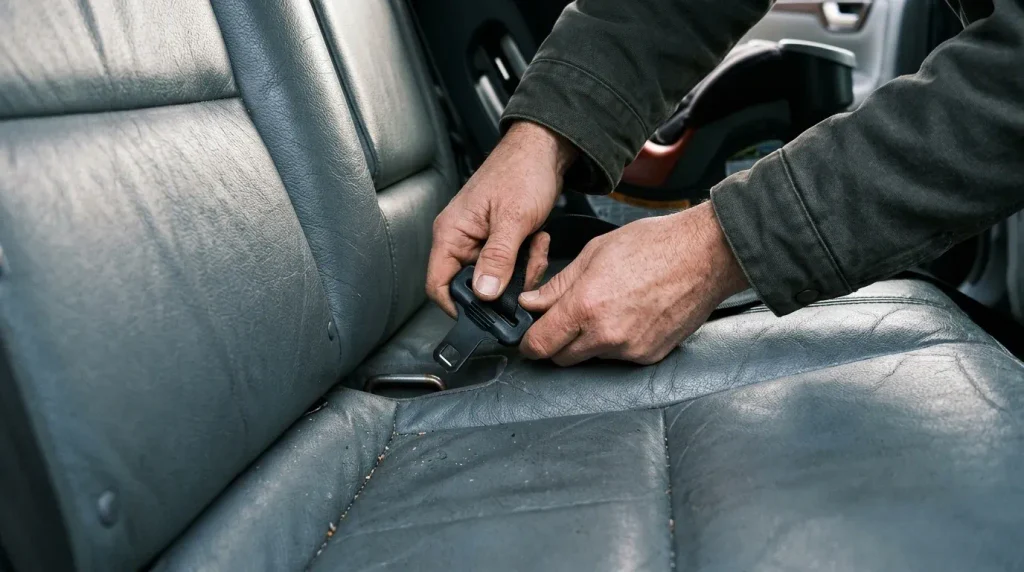
The LATCH system connects rigid or flexible hooks from the child safety seat directly to steel anchor bars built into your car’s bight. That bight is the tight crease where the seatback cushion meets the bottom seat cushion.
A complete LATCH setup consists of three distinct parts:
- Lower anchors: Two horizontal steel bars hidden inside the vehicle seat crease spaced 11 inches apart.
- Lower connectors: Flexible webbing straps or rigid steel arms extending from the car seat base that snap onto those anchors.
- Top tether: A dedicated strap running from the top of forward-facing car seats that hooks to an anchor point behind the seat.
Lower anchors handle bottom stabilization, preventing the base from shifting laterally during travel. They make early infant bucket seat bases remarkably fast to snap in and release.
However, lower anchors have a strict mechanical weight limit. Federal regulations cap combined child and car seat weight on lower anchors at 65 pounds.
Once your child outgrows that rating, the steel anchors risk bending or failing during high-energy collisions. At that threshold, you must transition to the vehicle seat belt.
How Does Seat Belt Installation Work?
Seat belt installation uses your car’s standard three-point lap-and-shoulder belt threaded through the designated belt path of the child restraint. It accommodates higher child weights without structural limits on the vehicle’s anchor points.
To secure a car seat with a seat belt, the belt retractor must be locked into child restraint mode. You achieve this by pulling the shoulder belt all the way out until it clicks, engaging the switchable retractor.
As the webbing feeds back into the mechanism, it ratchets tight and refuses to yield slack. Some vehicle models feature lightweight locking latchplates on the buckle tongue instead of retractor locks.
Seat belts work across every vehicle seat equipped with an approved belt path. This gives you freedom to mount child seats in center positions that lack lower steel anchors.
Modern car seats often feature built-in belt-tensioning lockoffs. These clamps eliminate the arm-breaking struggle once required to compress vehicle cushions.
Comparing LATCH vs. Seat Belt Installation
Choosing between these two methods comes down to child weight, vehicle layout, and your specific seat design. Review the side-by-side comparison below to evaluate your daily requirements.
| Feature | LATCH System | Vehicle Seat Belt |
|---|---|---|
| Maximum Weight Capacity | 65 lbs combined weight (child plus car seat) | Rated for full adult occupant weights |
| Ease of Installation | Very straightforward with audible click connectors | Requires engaging retractor lock or seat lockoff |
| Center Seat Availability | Rare; borrowing outboard anchors is often forbidden | Universal in almost all modern center seats |
| Top Tether Requirement | Mandatory on forward-facing seats | Mandatory on forward-facing seats |
| Crash Protection Level | Identical when properly tightened | Identical when properly tightened |
The table reveals an essential truth for growing families. Lower anchors provide unbeatable convenience during the infant stage, but seat belts remain the long-term solution.
Can You Install a Car Seat in the Center Position?
The center rear seat is statistically the safest location in a passenger car because it maximizes survival space away from side-impact collisions. However, installing a car seat in the center position frequently requires using the seat belt.
Most vehicles provide dedicated LATCH anchors only for the outboard left and right rear seats. Attempting to use the inner anchors from both sides to mount a center seat is called anchor borrowing.
You must never borrow outboard anchors unless both your vehicle owner’s manual and car seat manual explicitly state it is tested and permitted. Incorrect spacing alters crash loads dramatically.
The standard spacing for dedicated lower anchors measures exactly 280 millimeters, or roughly 11 inches. Borrowing anchors across the middle creates non-standard angles that can snap connectors under stress.
If you want your child positioned safely in the center rear, use the vehicle seat belt instead. It provides exceptional stability without guessing anchor load ratings.
Why Is the Top Tether Non-Negotiable on Forward-Facing Seats?
The top tether is the single most critical safety component on any forward-facing car seat. It connects the upper shell of the child restraint directly to a dedicated anchor hook on the vehicle structure.
During a collision, a forward-facing child seat without a tether whips violently forward. This forward movement is known as head excursion.
A properly cinched top tether reduces forward head movement by four to six inches during a collision. That margin prevents catastrophic head impact against front seatbacks or hard vehicle pillars.
You must connect and tighten the top tether whether you secure the seat bottom with lower LATCH anchors or the seat belt. Many parents mistakenly assume switching to seat belts means abandoning the tether strap entirely.
According to child safety observational research from the Safe Kids Worldwide coalition, tether non-use remains one of the most common installation mistakes on the road today.
Pro Tip: Do not confuse vehicle cargo tie-down rings on trunk floors with structural tether anchors. Consult your vehicle manual to locate the designated top tether symbol—an anchor stamped inside a child seat graphic.
Protecting Vehicle Upholstery Under Tightly Installed Seats
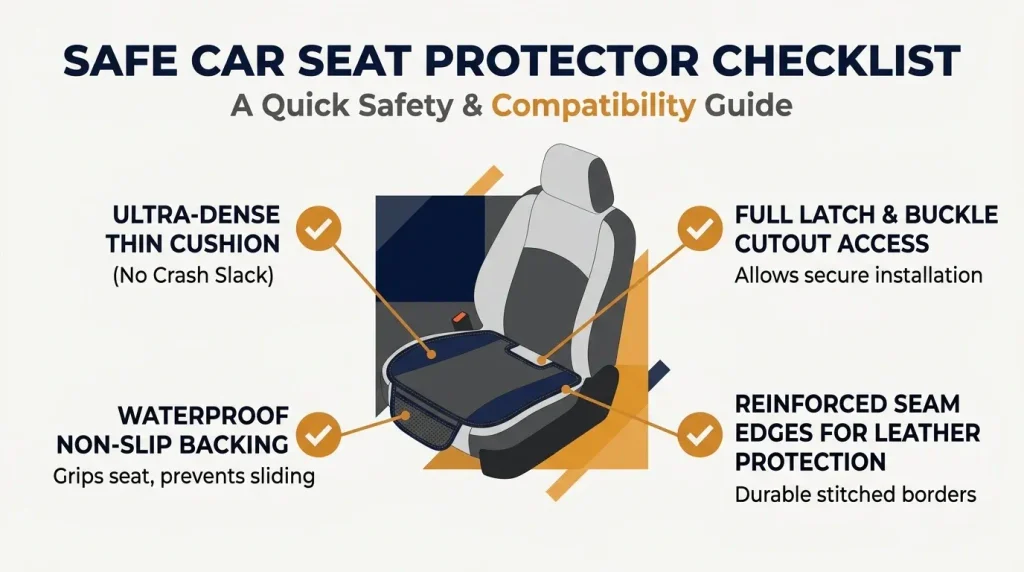
Achieving a safe car seat installation requires compressing vehicle foam cushions until there is less than one inch of play at the belt path. That immense clamping pressure, combined with dropped snacks and grit, takes a heavy toll on leather and fabric upholstery.
However, safety advocates warn against placing thick, plush mats under a child restraint. Thick padding introduces artificial slack into the system, which compresses during a crash and leaves the car seat loose.
If you use seat protection, choose an ultra-dense, low-profile barrier approved by child passenger safety technicians. Look for non-slip surfaces and cutout slots that maintain full, unobstructed access to both your lower LATCH anchor bars and seat belt buckles.
If you are looking for dependable seat protection that prevents upholstery gouges without compromising installation safety, here are three proven options:
🏆 BEST OVERALL PROTECTION
Diono Ultra Mat Car Seat Protector
★★★★★
Features dense high-density foam panels that guard leather from deep pressure indentations, paired with grippy surfaces and full LATCH cutout clearance. I have used this specific mat across multiple test vehicles without introducing any slack into tight installations.
💰 BEST VALUE HEAVY DUTY
Lusso Gear Heavy Duty Seat Cover
★★★★☆
Constructed with waterproof 600D fabric, reinforced corners, and convenient lower storage pockets that catch crushed crackers and spilled drinks. It offers great all-around spill resistance for busy families on a sensible budget.
🛡️ BEST CONTOURED RIGID FIT
Munchkin Brica Elite Seat Guardian
★★★★☆
Boasts molded dual-grip traction technology with raised perimeter walls to contain melted crayons and liquid messes completely away from upholstery seams. The semi-rigid profile sits flat against deep bucket seat contours without slipping.
Frequently Asked Questions
Is LATCH safer than using a seat belt for infant car seats?
No, neither method is inherently safer in crash tests. Both pass the exact same federal safety performance thresholds when installed correctly. LATCH simply minimizes early installation mistakes on infant bases, while seat belts provide equal crash protection.
When should I stop using LATCH and switch to the seat belt?
You must stop using lower LATCH anchors when the combined weight of your child and car seat exceeds 65 pounds. Check your car seat’s side warning labels for its exact child weight cutoff, which usually falls between 35 and 45 pounds.
Can I use LATCH and the vehicle seat belt together for extra security?
No, you should never use lower LATCH connectors and a seat belt at the same time unless both manufacturers explicitly allow it. Dual installation changes collision dynamics unpredictably and can place unexpected stress fractures on the restraint shell.
Do booster seats require LATCH or a seat belt?
Booster seats require the vehicle seat belt to restrain the child across their pelvis and shoulder. Some booster seats offer lower LATCH connectors purely to keep the empty seat from sliding around when unoccupied, but the seat belt provides restraint.
Final Takeaway: Which Method Should You Choose?
Do not stress over whether lower LATCH anchors or vehicle seat belts provide superior safety. The design that yields the tightest, most consistent fit in your vehicle is the right one to use.
Use lower LATCH connectors while your child is small if your car’s anchor bars are easily accessible. Transition smoothly to the vehicle seat belt once your child grows heavier or whenever you place the car seat in the middle position.
Above all, always secure the top tether strap on every forward-facing installation. Double-check your belt path tightness before every journey, and your child will ride protected every mile of the way.

Daniel Brooks is an automotive writer and product researcher focused on car accessories, car tech, maintenance, and practical driving guides. At Plug-in Car World, he helps drivers make smarter automotive decisions through honest reviews and research-driven content.
