
What Is a Top Tether on a Car Seat? A Complete Safety Guide
Quick Answer
A top tether on a car seat is an adjustable safety strap that connects the upper back of a child safety seat to a designated anchor in your vehicle. It helps prevent excessive forward movement during a crash, protecting the child’s head and neck. According to the National Highway Traffic Safety Administration (NHTSA), the tether should be used with forward-facing harnessed car seats whenever permitted by the car seat and vehicle manufacturers.
Five Important Things to Know
- Extra crash protection: The tether limits forward rotation of a forward-facing child restraint.
- Designated anchor: The hook attaches to a vehicle tether anchor, not an ordinary cargo hook or headrest post.
- Two installation methods: A top tether works with either a seat-belt installation or lower anchors.
- Correct routing: The strap must follow the vehicle and car seat manufacturers’ instructions.
- Proper tightening: Remove slack without changing the approved position of the child restraint.
Safety reminder: Never assume every metal loop behind a vehicle seat is a tether anchor. Confirm the correct location in your vehicle owner’s manual.
If you’ve noticed a long strap hanging from the back of a child car seat, you might wonder what it does. That strap is one of the most important parts of a forward-facing installation.
I recommend understanding the tether before attempting an installation. This guide explains where to find it, how it works, and how to avoid common mistakes.
In This Guide
What Is a Top Tether on a Car Seat, and How Does It Work?
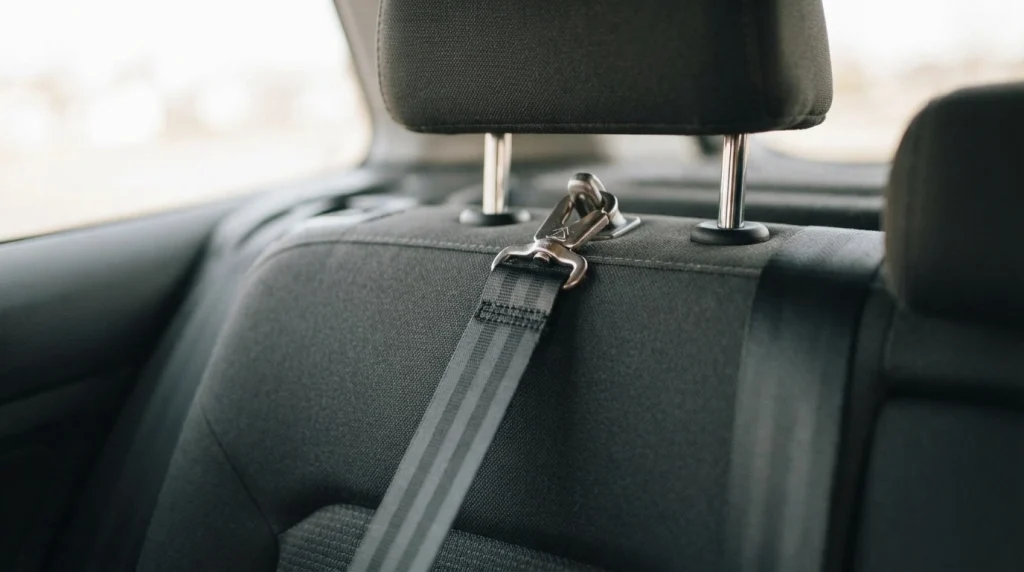
A top tether is a strong webbing strap attached near the top rear of a child safety seat. It has an adjustable length and a metal hook that connects to an approved vehicle anchor.
The tether creates an additional connection between the child restraint and the vehicle. Its primary purpose is to limit forward movement of a forward-facing car seat during a collision.
What Happens During a Frontal Crash?
During a frontal collision, occupants and unsecured objects continue moving forward until something restrains them. A properly installed child car seat helps control that movement.
Without a tether, the upper portion of a forward-facing restraint may rotate farther forward. That movement can increase the distance the child’s head travels.
The tether helps control this rotation by securing the upper part of the restraint.
- Seat belt or lower anchors: Secure the car seat at its designated installation points.
- Top tether: Restrains additional movement near the upper back of the car seat.
- Five-point harness: Holds the child within the restraint and distributes crash forces across stronger parts of the body.
These components have different jobs. They work together to provide protection when installed and used correctly.
What Parts Make Up a Top Tether System?
A typical top tether system includes three components:
- Tether strap: The webbing attached to the child car seat.
- Tether hook and adjuster: Hardware used to connect the strap and remove slack.
- Tether anchor: The reinforced attachment point built into the vehicle.
The tether anchor belongs to the vehicle, while the strap and hook belong to the child restraint. Both components must be compatible and used as their manufacturers direct.
Section Takeaway: A top tether provides an additional upper attachment that controls forward movement. It does not replace a properly installed seat belt or lower-anchor connection.
Where Is the Top Tether Anchor Located in a Car?
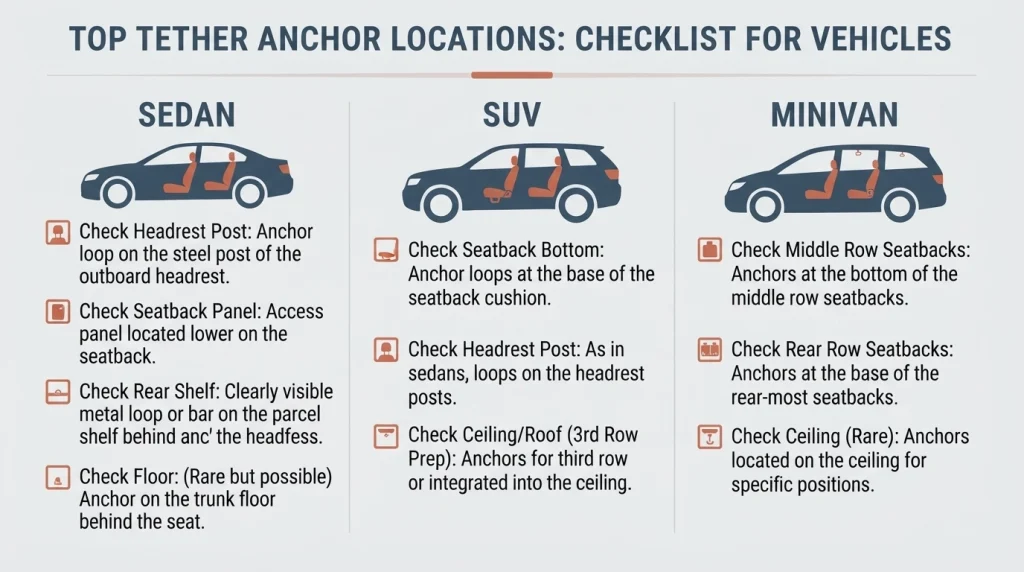
A top tether anchor is usually located behind the vehicle seating position. Its exact location depends on the vehicle’s design and seating layout.
It may look like a small metal bracket or loop. Many vehicles identify the correct location with a child restraint anchor symbol.
Common Top Tether Anchor Locations
- Sedans: Often on the rear parcel shelf behind the back-seat head restraints.
- SUVs: Commonly on the back of the rear seatback or another manufacturer-designated location.
- Hatchbacks: May have anchors on the rear seatbacks or cargo-area structure.
- Minivans: May have anchors behind individual seats or on designated floor or seat structures.
- Pickup trucks: May use special loops or routing arrangements behind the rear seats.
These examples are only general location guides. Never select an anchor based on appearance alone.
How Can You Identify the Correct Anchor?
Start with the child restraint section of your vehicle owner’s manual. It should explain which seating positions have tether anchors and how to reach them.
Use this checklist before attaching the hook:
- Find the vehicle’s child restraint installation instructions.
- Identify the seating position where you plan to install the car seat.
- Locate the corresponding tether anchor shown in the manual.
- Check the approved routing around or through the head restraint.
- Confirm that the anchor is permitted for your intended installation.
Not every seating position necessarily has its own tether anchor. A center seating position may lack one even when both outboard positions have anchors.
Do not borrow an adjacent position’s anchor unless the vehicle manufacturer explicitly permits that arrangement.
Can You Use a Cargo Hook Instead?
No. A cargo tie-down is not automatically a child restraint tether anchor.
Although both may look like metal loops, their intended uses and specifications differ. Attaching a tether to the wrong hardware can compromise the installation.
The Safe Kids car seat glossary explains the distinction between a top tether and its designated vehicle anchor.
Pro tip: If your car’s tether anchor is difficult to identify, consult the vehicle manufacturer or a certified Child Passenger Safety Technician before installing the forward-facing restraint.
When Should You Use a Top Tether on a Car Seat?
Use the top tether whenever you install a forward-facing harnessed car seat and both manufacturers permit its use. This recommendation applies whether the primary installation uses a seat belt or lower anchors.
As of 2026, this remains consistent with U.S. child passenger safety guidance. The American Academy of Pediatrics also emphasizes tether use with forward-facing installations.
Forward-Facing Car Seats
Forward-facing convertible, combination, and all-in-one car seats commonly have top tether straps. These restraints are designed to protect children who have outgrown the rear-facing limits of their seats.
Keep children rear-facing until they reach the maximum rear-facing height or weight allowed by their car seat manufacturer.
After transitioning to forward-facing, the harness and top tether become important parts of the approved installation.
The American Academy of Pediatrics car seat guidance recommends using the top tether regardless of whether the car seat is installed using a seat belt or lower anchors.
Rear-Facing Car Seats
Most rear-facing car seats used in the United States do not require a conventional top tether. However, some specific child restraints allow or require additional anchoring arrangements.
Never connect or reroute a tether for rear-facing use unless the car seat and vehicle instructions explicitly authorize it.
Booster Seats
A booster seat positions a child so the vehicle’s lap-and-shoulder belt fits correctly. It generally does not use a top tether in the same way as a forward-facing harnessed restraint.
Some booster models permit additional attachments to stabilize the empty seat or support installation requirements. Always follow the instructions for the specific booster and its operating mode.
When Should You Stop Using the Tether?
Do not automatically stop using the top tether when your child outgrows the lower-anchor weight limit. These are separate components with potentially different manufacturer requirements.
Consult both manuals for tether restrictions. If the seat remains suitable for harnessed use, you may be able to switch from lower anchors to a seat-belt installation while continuing to use the tether.
How Do You Attach a Top Tether Correctly?
To attach a top tether, first secure the forward-facing car seat using its approved primary installation method. Then connect the tether hook to the correct vehicle anchor and tighten the strap.
The following process is a general checklist. Your car seat and vehicle manuals take priority whenever their instructions differ.
Step 1: Read Both Instruction Manuals
Locate the forward-facing installation section in your car seat manual. Check your vehicle manual for the tether anchor position and required strap routing.
Pay special attention to head restraint instructions. Some installations require routing the tether over, under, or around the head restraint.
Step 2: Position the Child Car Seat
Place the restraint on the approved rear vehicle seating position. Set its forward-facing recline or installation angle according to the car seat instructions.
Make sure no unsupported accessory or thick seat protector interferes with its placement.
Step 3: Install the Car Seat Using the Seat Belt or Lower Anchors
Choose a permitted primary installation method. Most car seats use either the vehicle seat belt or the lower anchors, not both simultaneously.
Follow the appropriate belt path, locking mechanism, and tightening procedure. Using both installation methods together requires express permission from both manufacturers.
Step 4: Locate the Top Tether Strap
Find the tether attached to the top rear of the child restraint. Release enough webbing from the adjuster to reach the approved anchor.
Check that the strap is free of twists or damage before routing it.
Step 5: Route and Connect the Tether
Follow the vehicle’s prescribed path around the head restraint. Attach the tether hook directly to the designated tether anchor.
Some vehicles and car seats have special routing instructions, particularly in pickup trucks and vehicles with unusual rear seating arrangements.
Step 6: Tighten the Tether Strap
Pull the adjustment strap to remove slack according to the manufacturer’s instructions. The tether should be appropriately tightened without twisting the strap or displacing the restraint.
Do not substitute excessive tether tension for a secure primary installation.
Step 7: Check Car Seat Movement
Hold the child restraint at its seat-belt or lower-anchor belt path. Gently test movement from side to side and front to back.
The seat should move no more than 1 inch in either direction at that belt path.
This measurement applies at the installation belt path, not at the top of the child restraint.
Step 8: Check the Harness and Final Fit
Seat your child and adjust the harness according to the car seat manufacturer’s instructions.
- Place forward-facing shoulder harness straps at or above the child’s shoulders, as required by the seat.
- Keep the harness webbing flat and free of twists.
- Tighten the harness so excess webbing cannot be pinched at the shoulder.
- Position the chest clip at armpit level when the car seat includes one.
- Confirm the tether hook remains attached and the strap remains properly routed.
For a manufacturer-neutral demonstration, see the NHTSA forward-facing car seat installation instructions.
Pro tip: A child restraint installation is not finished simply because the tether hook is connected. Verify the primary installation, tether routing, and harness fit separately.
Section Takeaway: Secure the restraint first, connect the approved top tether, and check movement at the belt path. Correct routing and tightening matter as much as finding the anchor.
Top Tether vs. LATCH vs. Seat Belt: What’s the Difference?
A top tether, lower anchors, and vehicle seat belt are different parts of a child restraint installation. They serve related but distinct purposes.
LATCH stands for Lower Anchors and Tethers for Children. This system includes lower anchors in the vehicle and designated tether anchors.
| Component | Location | Main Purpose | Can It Replace the Others? |
|---|---|---|---|
| Top tether | Upper back of child restraint | Limits forward rotation and head movement | No; it supplements the primary installation |
| Lower anchors | Between the vehicle seat cushions | Secure the lower portion of the child restraint | May be used instead of the seat belt within approved limits |
| Vehicle seat belt | Vehicle seating position | Secures the restraint through its designated belt path | May replace lower anchors, but not a required top tether |
Can You Use a Top Tether Without Lower Anchors?
Yes. A forward-facing car seat can commonly use a correctly installed vehicle seat belt together with its top tether.
In fact, changing to a seat-belt installation is often necessary when a child exceeds the lower-anchor weight limit.
Do Lower Anchors and Top Tethers Have the Same Weight Limit?
No. Lower-anchor limitations and top tether limitations must be checked separately.
Under U.S. guidance, the commonly used lower-anchor calculation is a combined child-and-seat weight of 65 pounds. The car seat’s stated lower-anchor child-weight limit determines when you must stop using that installation method.
Do not assume that this 65-pound combined limit is automatically the top tether limit. Follow the tether-specific instructions and limits provided by the car seat and vehicle manufacturers.
What Are the Most Common Top Tether Mistakes?
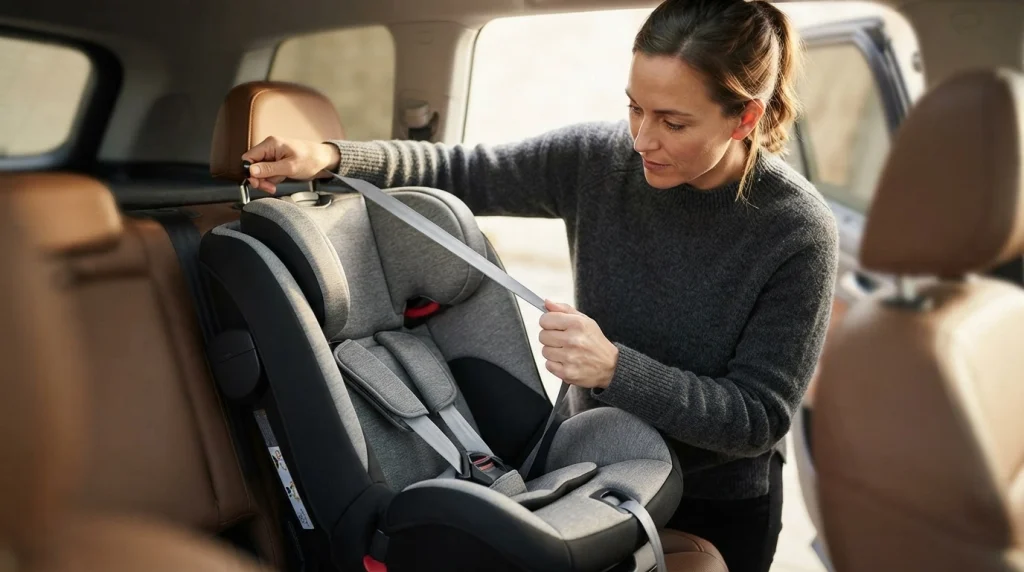
Top tether errors often happen because the strap is hidden behind a car seat or the anchor is difficult to recognize. An installation can look secure while still having a serious routing problem.
Seven Mistakes to Avoid
- Leaving the tether disconnected: A forward-facing harnessed restraint loses important upper restraint support when an intended tether is not used.
- Attaching it to cargo hardware: Use only the approved child restraint tether anchor.
- Using the wrong anchor: Match the anchor to the intended seating position and approved routing instructions.
- Leaving excessive slack: Adjust the tether until it meets the manufacturer’s tightening requirements.
- Twisting the webbing: Route the strap flat unless the instructions specify otherwise.
- Guessing the head restraint routing: Follow the exact approved path instead of improvising.
- Ignoring damage: Do not use worn straps, damaged hooks, or questionable anchor hardware without manufacturer guidance.
Can a Car Seat Cover Interfere With the Top Tether?
Yes. Some aftermarket vehicle seat covers can obstruct anchor access or interfere with a child restraint’s installation.
A thick cover or protector placed beneath a child car seat may also affect stability or installation compatibility.
Use a cover or protector beneath a child restraint only when the child restraint and vehicle manufacturers permit it. Never modify, cut, or reroute an approved installation component to accommodate a cover.
What If Your Vehicle Does Not Have a Top Tether Anchor?
First, confirm that an anchor is genuinely absent rather than hidden. Older vehicles and certain seating positions may have different anchor arrangements.
If your chosen position lacks an approved tether anchor, take these steps:
- Check whether another rear seating position has a suitable tether anchor.
- Consult the vehicle manufacturer about an approved retrofit, if available.
- Review the child restraint manual for its specific installation requirements.
- Ask a certified Child Passenger Safety Technician to evaluate compatible options.
Do not drill holes, install generic metal hooks, or fabricate a tether anchor. Any retrofit must follow vehicle-manufacturer-approved instructions.
How Often Should You Check the Top Tether?
Check the connection whenever you move or reinstall the car seat. A quick visual check before travel can also catch accidental disconnection or strap interference.
Inspect the webbing and hardware periodically for wear. Follow manufacturer guidance after any collision, because child restraints may need replacement even when damage is not obvious.
Section Takeaway: The most important checks are correct anchor selection, approved strap routing, and adequate tension. Never compensate for missing installation hardware with improvised attachments.
Frequently Asked Questions About Car Seat Top Tethers
1. Is a Top Tether Required for Every Car Seat?
No. Top tether requirements depend on the type of child restraint and its installation mode. Forward-facing harnessed car seats should use their top tethers whenever permitted, while most conventional U.S. rear-facing installations do not use one.
Always check your specific car seat and vehicle instructions.
2. Can I Install a Forward-Facing Car Seat Without a Top Tether?
Some child restraints may allow particular installations without a tether, but this does not make untethered installation the preferred choice. NHTSA recommends using the tether whenever manufacturers permit it.
If your vehicle lacks an approved anchor, consult both manuals and a certified technician before deciding on an installation.
3. Does a Top Tether Make a Car Seat Safer?
Yes. A correctly attached top tether helps reduce forward rotation of a forward-facing child restraint and limits head movement during a crash.
It works alongside the primary installation and internal harness. It cannot compensate for incorrect installation or an improperly secured child.
4. Can I Attach the Tether Hook to a Headrest?
No. A headrest or its metal support posts must not be treated as a substitute for a designated tether anchor.
The tether may need to pass around or under a head restraint, but the hook must connect to the approved anchorage point according to the vehicle manual.
5. Can a Top Tether Be Too Tight?
Follow the car seat manufacturer’s tightening instructions rather than applying maximum possible force. The goal is to remove slack while preserving the approved installation position.
If tightening the tether shifts the restraint or causes an unusual fit, stop and recheck both manuals.
6. Can I Use a Top Tether With a Seat Belt Installation?
Yes. A seat-belt installation and top tether are a common, recommended combination for forward-facing harnessed restraints.
The seat belt holds the car seat in its approved belt path, while the tether controls additional forward movement. Always lock and tighten the seat belt as instructed.
7. What Should I Do if the Top Tether Strap Is Missing?
Check the car seat manual to confirm where the tether should be stored. Some models have dedicated storage compartments or clips.
If the strap is genuinely missing or damaged, contact the car seat manufacturer for an approved solution. Never substitute an ordinary strap or aftermarket hook.
Final Takeaway: Make Every Forward-Facing Installation Count
Understanding what a top tether does is an important step toward safer child car seat use. The strap may look simple, but its role in controlling forward movement is significant.
Always identify the correct tether anchor, secure the primary installation, route the strap properly, and follow both manufacturers’ instructions.
If you’re uncertain about your installation, arrange an inspection through the NHTSA car seat safety and inspection resources. A certified Child Passenger Safety Technician can help you verify the installation and learn how to check it yourself.
Before your next drive: Check that your child’s forward-facing car seat is securely installed, its tether is correctly connected, and its harness fits properly.

Daniel Brooks is an automotive writer and product researcher focused on car accessories, car tech, maintenance, and practical driving guides. At Plug-in Car World, he helps drivers make smarter automotive decisions through honest reviews and research-driven content.
