Can You Use LATCH and a Seat Belt Together to Install a Car Seat?
Quick Answer
In almost all cases, no, you cannot use lower LATCH anchors and a vehicle seat belt at the same time. Doing so can overload the car seat shell or alter crash energy absorption paths, increasing injury risk during a collision. While government testing standards outlined by the National Highway Traffic Safety Administration evaluate both systems rigorously, dual installation is only permitted when both the car seat maker and your vehicle manufacturer explicitly approve it in writing.
Core Safety Rules at a Glance
- Rule of one system: Choose either the lower LATCH anchors or the vehicle seat belt, never both simultaneously.
- Top tether is required: Always connect the top tether on forward-facing seats regardless of which lower system you select.
- Check manual exceptions: Only select car seat models (such as specific Nuna or Clek seats) allow dual-belt routing under limited, explicit criteria.
- Mind anchor weight limits: Lower anchors standardly max out when the combined weight of child and seat hits 65 pounds.
Best Practice Check
- Test your installation at the belt path by pulling firmly with one hand; movement must not exceed one inch in any direction.
Every parent wants the tightest, most secure car seat installation possible. You might assume that doubling up on safety systems provides twice the protection during an emergency stop.
I have spent years inspecting family car setups and testing child passenger gear. This guide walks through the physical risks of dual installation, the few rare exceptions, and how to verify that your seat remains rock-solid.
Why Is Dual Installation Usually Prohibited?
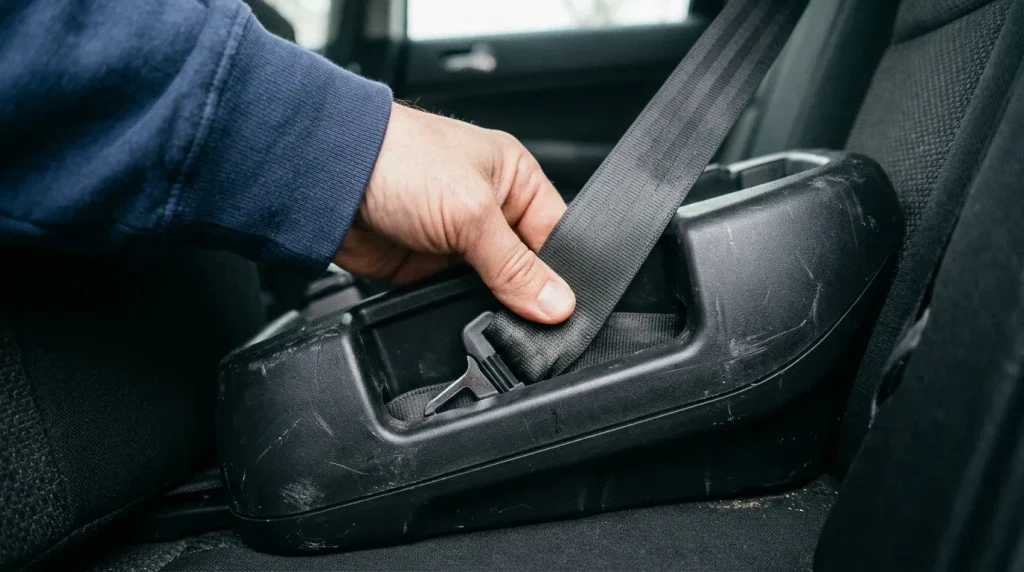
Dual installation is prohibited by most manufacturers because car seats are engineered and crash-tested using only one primary attachment method at a time. Combining both systems changes how crash forces transfer through the car seat shell into the vehicle frame.
Child restraint systems rely on calculated “give” to cushion impact forces. Rigidly securing a child seat with two separate restraint points introduces competing stress vectors that can cause unexpected mechanical failures.
Here are the primary mechanical hazards created by using LATCH and a seat belt together:
- Unintended stress concentration: Dual tension loads crash energy into structural points not designed to handle high shearing forces simultaneously.
- Impaired energy management: Modern car seats flex slightly to absorb impact, but double anchoring stiffens the base and transfers harsh crash loads directly to your child.
- Belt interference and friction: Passing both belts through the same tight plastic belt channel causes them to rub against each other, potentially causing webbing degradation or buckle release under load.
- False sense of security: Having two loose systems does not equal one properly tensioned anchor, leaving excessive play at the belt line.
Federal motor vehicle safety standards establish strict protocols for crash tests. Those standardized sled tests verify performance for single-path installations, not mixed setups.
What Does LATCH Stand For?
LATCH stands for Lower Anchors and Tethers for Children. It is a standardized hardware system introduced in vehicles to simplify car seat installation without relying on standard seat belts.
A complete LATCH setup consists of two built-in lower metal bars nestled in your vehicle seat bight and an upper tether anchor point mounted behind the seat back. Lower anchors secure the base of the child seat, while the top tether manages head excursion during sudden deceleration.
Vehicle owners should understand the functional components of the system:
- Lower horizontal bars: Two steel loops set exactly 11 inches apart inside the vehicle seat crease.
- Flexible or rigid lower connectors: Straps or steel arms extending from the car seat base that snap securely onto those vehicle bars.
- Top tether strap: A critical upper webbing strap that attaches to a designated metal ring behind the vehicle seat headrest or cargo floor.
The system was designed to reduce common seat belt routing errors. When adjusted correctly, lower anchors provide a fast, secure connection.
LATCH vs. Seat Belt Installation: How Do They Compare?
Neither system is inherently safer than the other when installed properly. Both methods meet identical federal crash safety thresholds when tested according to official standards.
Your choice depends on your child’s weight, your vehicle seating position, and which system delivers a tighter fit. The following table highlights the operational differences between the two methods.
| Feature | Lower LATCH System | Vehicle Seat Belt System |
|---|---|---|
| Weight Capacity | Strict 65-lb combined limit (child weight + car seat weight) | Full harness weight limit specified by seat maker |
| Center Seat Availability | Rare; requires dedicated anchors or approved “borrowing” | Almost universally available across standard passenger rows |
| Top Tether Requirement | Mandatory on all forward-facing harnessed seats | Mandatory on all forward-facing harnessed seats |
| Locking Mechanism | Integrated internal ratchets or manual cam buckles | Vehicle retractor switch (ALR) or car seat lock-off clip |
| Installation Complexity | Simple click-and-pull setup in outboard seats | Requires manual belt routing and engaging the retractor lock |
Remember that the weight limit for lower anchors is not just your child’s body weight. You must subtract the car seat’s own mass from that total limit.
Once your child outgrows lower anchor limits, you must transition directly to the vehicle seat belt. The seat belt supports growing kids up to the restraint harness ceiling.
Are There Any Exceptions That Allow Both Systems?
Yes, but exceptions are extremely limited and depend on strict, explicit manufacturer testing approvals. You must verify that both your car seat manual and your vehicle manual endorse dual installation for your exact configuration.
As of 2026, only a handful of restraint models feature dual installation clearance under specified operating conditions:
- Clek Foonf: Allows the rigid lower LATCH arms to be locked into place while routing the vehicle seat belt in forward-facing mode.
- Nuna Exec and Rava: Feature integrated tension doors, but follow strict manual guidelines regarding when secondary anchor attachments can assist stability.
- Select Booster Seats: Many high-back boosters allow lower LATCH connectors to secure the unoccupied seat base while the vehicle lap-and-shoulder belt restrains the child.
In booster setups, the lower anchors are not protecting the child from crash momentum. They merely anchor the empty booster so it does not become a flying projectile when unoccupied.
If your car seat documentation does not explicitly print the phrase “dual installation allowed,” assume the practice is strictly banned. Guessing puts your child at risk.
Why Is the Top Tether Always Required?
The top tether is the single most critical component of forward-facing car seat safety. It stabilizes the top of the car seat shell, reducing forward head movement by up to eight inches during a high-speed collision.
Those few inches make the difference between a child’s head striking a hard front seatback or remaining safely restrained. The top tether must be used whether you install the lower portion using LATCH or the vehicle seat belt.
Take these steps to locate and secure the top tether correctly:
- Inspect your vehicle manual to distinguish real tether anchors from cargo tie-down hooks.
- Route the tether strap over or around the vehicle headrest as instructed in your owner guide.
- Hook the metal clip directly into the designated tether anchor plate.
- Pull the webbing tail firmly until all slack disappears and the indicator shows proper tension.
Never attach a top tether hook to an unrated cargo tie-down loop or luggage bar. Cargo rings are built from thin sheet metal and will shear under collision pressures.
How Do You Perform the “One-Inch” Movement Test?
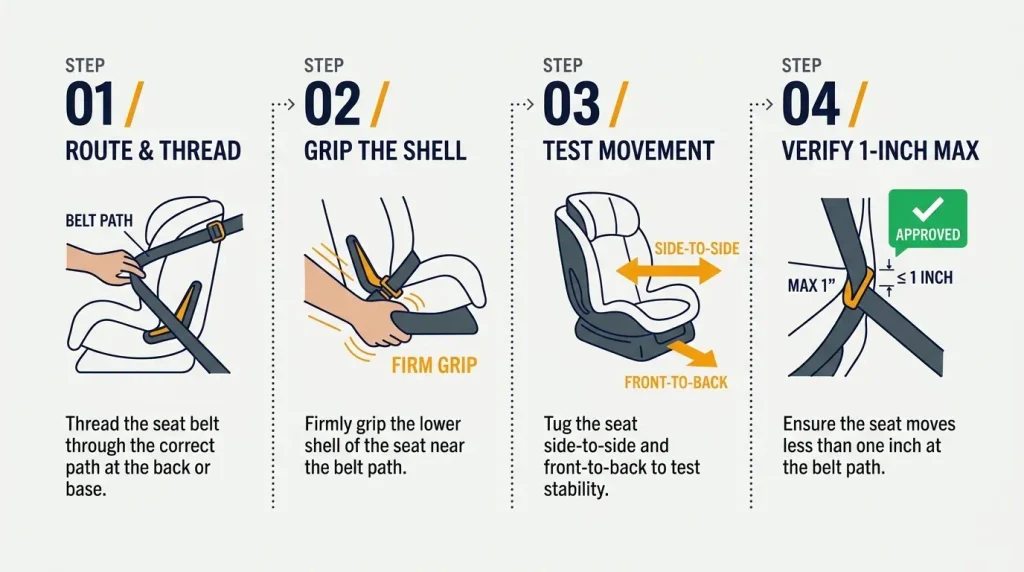
The one-inch test is the universal safety benchmark used by certified Child Passenger Safety Technicians (CPSTs) to verify a secure installation. It confirms that your chosen attachment method holds firm without excessive play.
Testing takes less than thirty seconds once the car seat straps are tensioned down. Here is the exact procedure to follow:
- Place your non-dominant hand directly at the designated belt path of the car seat.
- Grip the base firmly near the entry slot where the belt or anchor webbing passes through.
- Pull firmly from side-to-side and front-to-back using moderate pressure.
- Check the total displacement against the vehicle seat cushion beneath it.
If the seat moves less than one inch along the belt path, the installation is secure. Never test for movement by grabbing the very top of the headrest, as that leverage point naturally flexes.
Can Car Seat Covers or Protectors Interfere with Installation?
Heavy padded seat covers and thick protectors placed beneath a car seat can compromise installation stability during a severe impact. Thick foam mats create artificial compression that feels tight initially but compacts violently in a crash, leaving the seat dangerously loose.
If you need to protect upholstery, use only thin, manufacturer-approved vehicle seat mats designed not to interfere with anchor geometry. Slipcovers placed over the child restraint itself must never obstruct the internal harness paths or buckle release latches.
Before installing your restraint, inspect your seating surface and child gear to ensure no foreign fabric impedes the anchor straps or buckle hardware.
If you are outfitting your family vehicle with protective accessories and certified travel gear, here are my top field-tested recommendations:
🏆 Best Seat Protector Mat
Diono Ultra Mat Car Seat Protector
★★★★★
High-density molded panels prevent upholstery indentations while leaving latch channels accessible. This mat provides surface defense without introducing spongy thickness that ruins belt tension.
💰 Best Value Seat Cover
Lusso Gear Heavy Duty Seat Cover
★★★★☆
Waterproof oxford fabric construction with non-slip backing and reinforced corner cutouts. I use this in our second vehicle to keep pet hair and juice spills off leather benches.
🛡️ Best Premium All-in-One Seat
Clek Foonf Convertible Car Seat
★★★★★
Rigid-LATCH steel substructure with patented energy-absorbing crumple technology. It is one of the rare seats engineered to permit dual belt routing in forward-facing installations.
Frequently Asked Questions
Can you “borrow” LATCH anchors from side seats to install in the center?
You cannot borrow lower anchor hooks from outer seats for center placement unless both your vehicle owner manual and car seat manual explicitly state it is permitted. Most vehicles space center anchors differently than the standard 11-inch width, compromising structural integrity.
What should you do if your car seat moves more than an inch?
Unbuckle the system and re-route the belt, placing firm downward knee pressure into the center of the seat bight while pulling the belt slack through the lock-off. If you cannot eliminate movement, switch to the other approved installation method or relocate to another seat position.
At what child weight must you stop using lower LATCH anchors?
Most manufacturers require switching to a vehicle seat belt once the child and seat reach a combined weight of 65 pounds. Check your car seat’s side stickers for the exact standalone child weight threshold, which is typically between 35 and 45 pounds.
Does a top tether count as using LATCH and a seat belt together?
No, using a top tether alongside a vehicle seat belt is not considered dual lower installation. The top tether is mandatory on forward-facing seats regardless of whether you choose the vehicle lap-and-shoulder belt or lower LATCH bars.
Child passenger safety hinges on proper execution rather than doubling up on restraint hardware. Pick either the lower anchors or the vehicle seat belt, lock your top tether, and confirm your seat passes the one-inch movement test before driving.
Daniel Brooks is an automotive writer and product researcher focused on car accessories, car tech, maintenance, and practical driving guides. At Plug-in Car World, he helps drivers make smarter automotive decisions through honest reviews and research-driven content.