
What Is the Car Seat LATCH System? A Complete Safety Guide
Quick Answer
The car seat LATCH system stands for Lower Anchors and Tethers for Children. It is a U.S. child restraint installation system that connects compatible car seats to built-in vehicle anchors without using the vehicle seat belt for the main attachment. The system includes lower anchors and, for most forward-facing installations, a top tether that helps limit forward movement during a crash. You can review the components in the NHTSA car seat parts guide.
Five essential LATCH facts
- Lower anchors: Two metal bars in the vehicle seat crease connect to compatible child seat attachments.
- Top tether: A separate strap helps reduce forward head movement in forward-facing installations.
- Installation choice: Properly installed LATCH and seat belt systems are both safe options.
- Weight limits: Lower anchor use depends on the child’s weight, car seat weight, and manufacturer instructions.
- Secure fit: An installed car seat should move no more than one inch when checked at the belt path.
Important safety reminder
- Always check both manuals: Never assume that every seating position supports LATCH or that every installation follows identical instructions.
Understanding what the car seat LATCH system is can make child restraint installation less confusing. I like to start with the hardware because the difference between lower anchors and top tethers matters.
In this guide, I’ll explain how LATCH works, where to find the anchors, and how to install a car seat correctly. We’ll also cover weight limits, common mistakes, and when a seat belt is the better choice.
In This Guide
What Does LATCH Mean and How Does It Work?
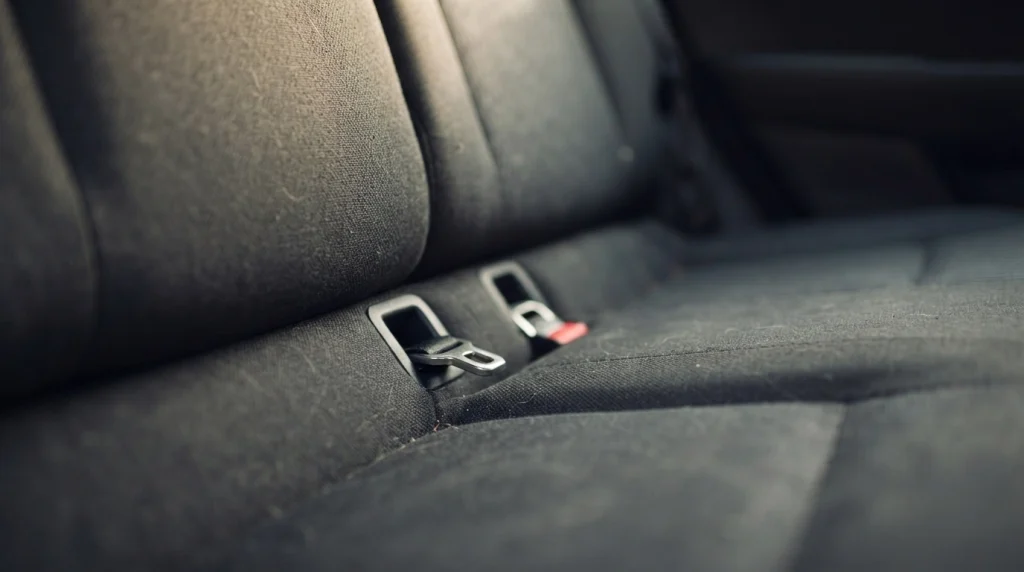
LATCH means Lower Anchors and Tethers for Children. It provides designated attachment points for installing compatible child safety seats in vehicles.
The system became standard equipment in nearly all U.S. passenger vehicles and child safety seats manufactured on or after September 1, 2002. Its purpose is to offer an alternative to seat belt installation.
The three main components of LATCH
Understanding each component helps prevent installation mistakes. The hardware serves different purposes depending on the child’s restraint and its direction.
- Vehicle lower anchors: Two small metal bars built into a designated vehicle seating position.
- Lower anchor connectors: Hooks, clips, or rigid attachments on the child restraint that connect to those bars.
- Top tether system: A strap and hook on the car seat that connect to a designated vehicle tether anchor.
Lower anchor connectors secure the car seat at its base. The top tether provides additional control over forward rotation when used with a forward-facing harnessed restraint.
Flexible versus rigid LATCH connectors
Not all LATCH connectors look alike. Most use flexible straps, while some car seats have rigid connectors.
- Flexible connectors: Attach through adjustable webbing straps that must be tightened according to the car seat manual.
- Rigid connectors: Connect through fixed hardware designed to engage compatible lower anchors.
Neither type eliminates the need for a correct installation. Vehicle compatibility and the manufacturer’s instructions remain essential.
Section takeaway: LATCH is an attachment system, not a separate child safety harness. The seat’s internal harness still restrains the child.
Where Are LATCH Anchors Located in a Vehicle?
Lower LATCH anchors are usually located where the rear seat cushion meets the seatback. This junction is often called the seat bight.
Top tether anchors are located behind designated seating positions. Their exact placement depends on the vehicle’s design.
Finding the lower anchors
Start by checking the vehicle owner’s manual for approved LATCH positions. Some vehicles also have symbols or labels near the lower anchor locations.
- Identify an approved rear seating position.
- Look along the crease between the backrest and seat cushion.
- Locate the two small metal anchor bars.
- Verify that both anchors belong to the same approved seating position.
Some lower anchors sit deep inside the seat crease. A deeply recessed anchor can be harder to reach but is not necessarily unsafe.
Finding the top tether anchor
Top tether locations vary among sedans, SUVs, hatchbacks, and pickup trucks. Do not confuse a tether anchor with a cargo hook.
- Sedans: Often on the rear parcel shelf behind the back seat.
- SUVs and hatchbacks: Often on the back of the rear seat or another manufacturer-designated location.
- Minivans: May have anchors on seatbacks, floors, or other designated mounting points.
- Pickup trucks: May use special tether routing arrangements described in the vehicle manual.
Can you use LATCH in the center seat?
Some vehicles provide dedicated center lower anchors, but many do not. You must never assume that the two nearest outboard anchors form an approved center LATCH position.
Using lower anchors from neighboring seating positions is sometimes called anchor borrowing. It is acceptable only when both the vehicle and car seat manufacturers permit that arrangement.
The Insurance Institute for Highway Safety LATCH information explains how anchor accessibility and placement affect installation ease.
Pro tip: If the center position lacks approved lower anchors, a correctly installed car seat using the vehicle seat belt may be an appropriate choice.
How Do You Install a Car Seat With LATCH?
To install a car seat with LATCH, connect its lower anchor attachments to the designated vehicle anchors and tighten the installation. Forward-facing seats generally also require a properly attached top tether.
These are general instructions, not a replacement for your specific manuals. Installation procedures vary between rear-facing and forward-facing models.
Step-by-step LATCH installation
- Read both manuals. Confirm the approved seating position, installation method, and lower anchor weight limit.
- Position the restraint. Place the car seat in the back seat, facing the correct direction for the child.
- Locate the correct anchors. Identify the two vehicle lower anchors intended for that seating position.
- Connect the attachments. Fasten the lower anchor connectors according to the car seat instructions.
- Check the straps. Make sure flexible attachment straps are routed correctly and are not twisted.
- Tighten the installation. Apply pressure as directed while removing slack from the lower anchor straps.
- Check movement. Pull at the belt path to confirm less than one inch of side-to-side and front-to-back movement.
- Complete direction-specific checks. Verify the rear-facing recline angle or connect and tighten the forward-facing top tether.
- Secure the child. Adjust the internal harness according to the seat’s instructions.
The belt path is the designated route for the seat belt or lower anchor strap through the child restraint. Test movement there rather than at the top of the seat.
Installing a rear-facing car seat
Rear-facing child restraints support the child’s head, neck, and back during a crash. Keep children rear-facing until they reach their seat’s rear-facing height or weight limit.
- Use the correct rear-facing lower anchor attachment path.
- Follow the manufacturer’s recline indicator.
- Keep the harness straps at or below the child’s shoulders.
- Do not use a rear-facing tether unless that specific installation is permitted.
The recline angle matters, especially for infants who need appropriate head and airway positioning. Follow the seat’s angle indicator rather than estimating by sight.
Installing a forward-facing car seat
A forward-facing harnessed car seat should use its top tether whenever the car seat and vehicle manufacturers permit it. The tether limits forward head movement during a collision.
This recommendation applies whether the main installation uses lower anchors or a seat belt. Follow the specific tether routing instructions, including any required headrest position.
For an additional installation checklist, see the NHTSA car seat installation tips.
Pro tip: A certified Child Passenger Safety Technician can inspect your installation and demonstrate how to tighten the seat correctly.
Is LATCH Safer Than a Seat Belt?
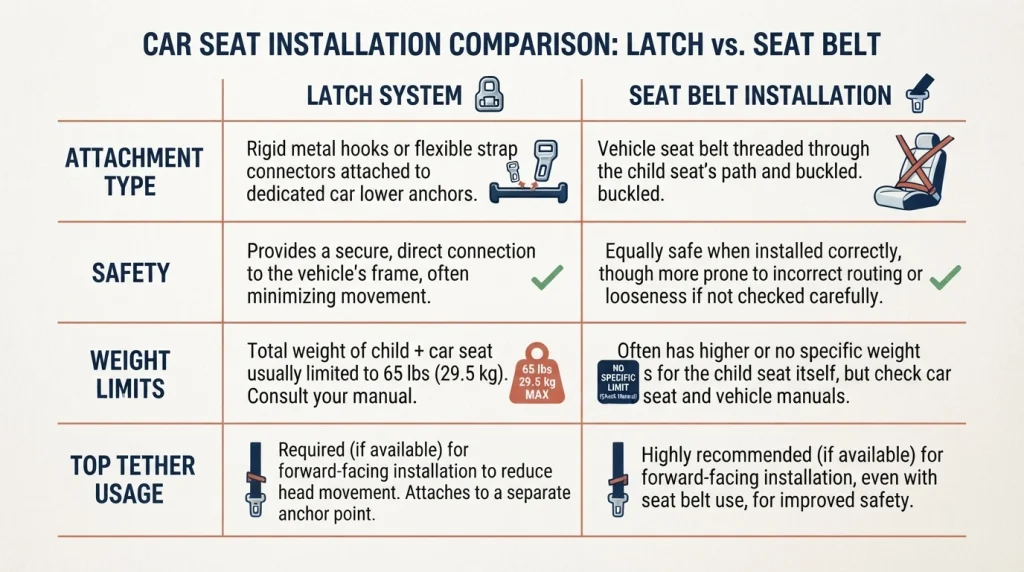
LATCH is not inherently safer than a correctly installed seat belt. Both methods can provide effective crash protection when used according to manufacturer instructions.
The better option is the one that achieves a secure installation in your specific vehicle. Convenience alone should not determine the choice.
LATCH versus seat belt comparison
| Feature | LATCH installation | Seat belt installation |
|---|---|---|
| Primary attachment | Lower anchors and connectors | Vehicle seat belt |
| Safety | Effective when correctly installed | Effective when correctly installed |
| Weight restrictions | Specific lower anchor limits apply | Not subject to the lower anchor limit |
| Installation process | Connect and tighten attachments | Route, buckle, and lock belt |
| Top tether | Use for forward-facing seats as directed | Use for forward-facing seats as directed |
| Center position | Only where approved anchors are available | Possible with an appropriate belt and approved installation |
Can you use LATCH and a seat belt together?
Generally, no. You should use one primary installation method unless both the car seat manufacturer and vehicle manufacturer specifically permit simultaneous use.
Using both does not automatically create a stronger installation. The American Academy of Pediatrics installation guidance explains why both methods are acceptable when used correctly.
Remember that the top tether is separate from this choice. A forward-facing tether is generally used with either permitted primary attachment method.
Section takeaway: Choose the method approved for your car seat, vehicle, and child’s weight. Correct installation matters more than which attachment method you select.
What Are the LATCH Weight Limits?
Lower anchors have weight limits, and those limits must not be ignored. In U.S. guidance, the combined child and car seat weight is generally limited to 65 pounds for lower anchor use, subject to manufacturer restrictions.
The child’s allowed weight therefore depends partly on how much the car seat itself weighs. Always check the printed car seat label and both instruction manuals.
How to calculate the lower anchor weight limit
When the applicable guidance uses the standard 65-pound combined limit, you can calculate the child’s maximum lower-anchor weight by subtracting the car seat’s weight.
Formula: 65 pounds minus car seat weight equals the calculated maximum child weight for lower anchor use.
| Car seat weight | Calculated child weight limit |
|---|---|
| 15 lb | 50 lb |
| 20 lb | 45 lb |
| 25 lb | 40 lb |
| 30 lb | 35 lb |
Note: These are mathematical examples, not universal product ratings. A manufacturer’s stated limit may be lower and always takes priority.
What happens when your child exceeds the limit?
Stop using the lower anchor attachments once the applicable limit is reached. If the child still fits the harnessed car seat, reinstall it using the approved vehicle seat belt method.
Continue using the forward-facing top tether if both manuals permit it. Lower anchor limits and tether usage instructions are not necessarily the same.
Does the same rule apply to booster seats?
Booster seats operate differently because the vehicle’s lap-and-shoulder belt restrains the child. Some boosters also have lower anchor attachments to keep the booster positioned.
Follow the booster’s instructions regarding connectors, weight restrictions, and unoccupied-seat security. Never treat the lower anchor connectors as a replacement for the child’s seat belt.
Section takeaway: The car seat’s harness capacity and lower anchor capacity are separate limits. Reaching the lower anchor limit does not automatically mean your child has outgrown the car seat.
What LATCH Mistakes Should You Avoid?
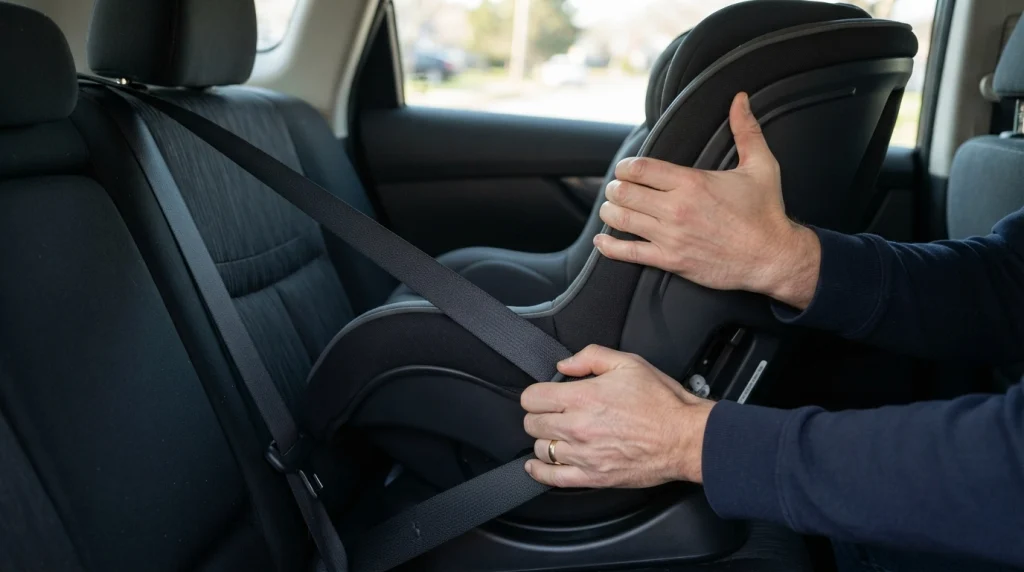
Many LATCH problems involve using the wrong anchor, leaving straps loose, or misunderstanding installation limits. A short inspection can identify several common issues.
Common mistakes and corrections
- Using incorrect anchors: Verify the designated lower anchors and tether locations in the vehicle manual.
- Leaving lower straps loose: Tighten according to the car seat instructions and check movement at the belt path.
- Skipping the top tether: Use it for forward-facing harnessed seats when permitted.
- Using unauthorized center anchors: Never borrow outboard anchors without permission from both manufacturers.
- Ignoring weight limits: Switch to an approved seat belt installation when lower anchors are no longer permitted.
- Connecting two seats to one anchor: Never share an anchor unless the vehicle manufacturer explicitly authorizes that arrangement.
Can car seat covers interfere with LATCH?
Yes, some aftermarket vehicle seat covers may obstruct anchor access or affect how a child restraint sits against the vehicle seat. This makes cover compatibility important.
Likewise, unapproved replacement covers or extra padding on the child’s car seat may interfere with its harness or protective design. Avoid products that the child restraint manufacturer has not approved.
- Keep the designated lower anchor openings accessible.
- Do not put an unapproved pad between the child restraint and vehicle seat.
- Use only replacement child seat covers approved for the exact model.
- Check vehicle seat cover compatibility with side airbags and the vehicle owner’s manual.
When should you get professional installation help?
Get assistance if the seat moves excessively, the anchor configuration is unclear, or the manuals appear to conflict. A certified technician can help identify an approved installation method.
You can find inspection resources through the NHTSA car seat safety center.
Pro tip: Recheck installation after moving the car seat, changing its recline setting, or switching installation methods.
Frequently Asked Questions About LATCH
Do all cars have the LATCH system?
No. Nearly all U.S. passenger vehicles manufactured on or after September 1, 2002, have LATCH equipment, but older vehicles may not. Anchor availability also varies by seating position and vehicle configuration, so always confirm compatibility in the owner’s manual.
Can LATCH be used with rear-facing car seats?
Yes. Many rear-facing car seats and infant seat bases can connect using lower anchors. Most U.S. rear-facing installations do not use a top tether, although specific models may have different instructions. Always verify the required attachment method and recline angle.
Is ISOFIX the same as LATCH?
ISOFIX and LATCH are related child restraint anchorage systems used in different markets. Their attachment designs and regional requirements can differ. Never assume that an imported ISOFIX child seat is automatically approved or compatible with a U.S. vehicle.
Can you install a car seat without LATCH?
Yes. Many child restraints can be installed with a vehicle seat belt instead of lower anchors. The belt must be routed and locked correctly, and the installation must meet the manufacturer’s instructions. Use the top tether for forward-facing seats when permitted.
How tight should a LATCH installation be?
A properly installed car seat should move less than one inch from side to side or front to back when checked at its belt path. Movement at the top of a rear-facing seat can be normal, so check the correct location.
Does LATCH work for children of every weight?
No. Lower anchor use is limited by the vehicle and car seat manufacturers’ instructions. Once the child exceeds the applicable lower anchor limit, switch the harnessed car seat to an approved seat belt installation if the child remains within the seat’s limits.
Can I move a LATCH car seat between different vehicles?
Usually, yes, if the car seat is compatible with both vehicles. However, anchor positions, tether routing, seating angles, and installation instructions can differ. Treat every transfer as a new installation and perform the required safety checks before travel.
Final takeaway:
The car seat LATCH system offers a practical way to attach compatible child restraints without using the vehicle belt for the main connection. It works best when you understand the lower anchors, use the top tether correctly, and respect the installation limits.
Before your next drive, check both manuals, verify the seat’s movement at the belt path, and confirm the harness fits your child. If anything is uncertain, have the installation checked by a certified Child Passenger Safety Technician.

Daniel Brooks is an automotive writer and product researcher focused on car accessories, car tech, maintenance, and practical driving guides. At Plug-in Car World, he helps drivers make smarter automotive decisions through honest reviews and research-driven content.
