
When to Switch to a Convertible Car Seat: Signs Your Baby Is Ready
Quick Answer
Switch from an infant car seat to a convertible car seat when your baby reaches the infant seat’s maximum height or weight limit, or no longer fits according to its instructions. You don’t need to wait until your baby reaches a particular age. Install the new convertible seat in the rear-facing position and continue rear-facing until your child reaches that seat’s maximum rear-facing height or weight limit. See the NHTSA rear-facing car seat guidance.
Signs It’s Time to Switch
- Weight limit reached: Your baby reaches the infant seat’s maximum permitted weight.
- Height limit reached: Your baby reaches the seat’s maximum permitted height.
- Head position: Your baby’s head no longer meets the manufacturer’s required clearance.
- Poor fit: Your baby no longer fits within the seat’s approved instructions.
- Manufacturer rules: The seat’s manual identifies another condition that means you must stop using it.
Before Making the Switch
- Check both height and weight limits, even if your baby has reached only one.
- Choose a convertible seat that fits your child and vehicle.
- Install it rear-facing and follow both instruction manuals.
Choosing your baby’s next car seat can feel like a bigger decision than you expected. The infant carrier that once made every trip easier eventually becomes too small, too heavy, or less practical to carry.
I’ve put together this guide to explain when to make the transition, which signs matter, and how to choose the next seat without accidentally moving your child into the wrong stage.
What Is a Convertible Car Seat?
A convertible car seat is a child safety seat that can be installed rear-facing for infants and younger children, then changed to forward-facing when the child outgrows the rear-facing limits.
Unlike an infant-only carrier, most convertible seats stay installed in the vehicle. They generally don’t have a detachable carrying handle or a separate infant-carrier base.
Most models offer several features:
- Rear-facing installation: Supports infants and toddlers while they remain within the seat’s rear-facing limits.
- Forward-facing installation: Provides a harnessed option after the child outgrows the rear-facing limits.
- Adjustable harness: Allows the restraint to accommodate a growing child.
- Recline adjustment: Helps achieve the manufacturer’s required installation angle.
Some all-in-one seats also convert into booster seats. However, a standard convertible seat doesn’t necessarily include a booster function.
When Should You Switch From an Infant Car Seat?
You should switch when your baby reaches the maximum height or weight limit of the infant seat, or another manufacturer-defined outgrowth condition. There is no universal age that determines the correct transition date.
Some babies outgrow their infant carriers relatively early. Others remain within the approved limits considerably longer.
1. Your Baby Reaches the Weight Limit
Every infant car seat has a maximum permitted child weight. Depending on the model, some infant-only seats accommodate children up to approximately 22 pounds, while others allow higher weights.
Check the label and instruction manual rather than relying on a general age or weight estimate. Once your child reaches the maximum weight, stop using that seat.
Don’t assume that a baby who looks comfortable can safely exceed the manufacturer’s limit. The weight restriction is part of the seat’s approved use.
2. Your Baby Reaches the Height Limit
Height can become a limiting factor before weight does. A baby might weigh considerably less than the maximum but already be too tall for the infant seat.
Check the manufacturer’s stated height measurement and positioning requirements. Some seats also specify how much clearance must remain between the child’s head and the top of the seat shell or another reference point.
Follow the exact measurement method in your manual. Don’t substitute a general rule about how many inches should remain above the baby’s head.
3. Your Baby’s Head Reaches the Seat’s Outgrowth Limit
Head clearance is another important measurement. Some infant seats require a minimum amount of space between the top of the child’s head and the top of the restraint.
For example, a particular seat might require at least one inch of clearance. That requirement isn’t universal, so check your model’s instructions.
Remember that your baby doesn’t need to touch the top of the seat to have outgrown it. The manufacturer’s stated clearance rule determines whether the seat remains suitable.
4. Your Baby No Longer Fits According to the Manual
Pay attention to the complete fit requirements, not just the numbers printed on the seat. Harness positioning, head clearance, and approved body positioning all matter.
A baby’s legs touching the vehicle seat or bending at the knees isn’t, by itself, a reason to switch. Rear-facing children commonly have bent legs as they grow.
How Old Should a Baby Be Before Switching to a Convertible Car Seat?
There isn’t a required age for switching from an infant carrier to a convertible seat. The right time depends on your baby’s size and the specific limits of the infant restraint.
Some parents make the transition during the first year. Others wait longer because their babies still fit comfortably within the approved limits.
Here’s a useful distinction:
- Infant seat: Use until the child reaches an applicable height, weight, or fit limit.
- Convertible seat: Use rear-facing after the infant seat is outgrown.
- Forward-facing seat position: Wait until the child outgrows the convertible seat’s rear-facing limits.
The American Academy of Pediatrics recommends keeping infants and toddlers rear-facing as long as possible, until they reach the highest weight or height allowed by their particular seat.
Many convertible seats allow rear-facing use for two years or longer, depending on the child and model.
Source: American Academy of Pediatrics rear-facing guidance.
Infant Car Seat vs. Convertible Car Seat: What’s the Difference?

Both seats protect young children when properly selected and installed. Their main differences involve portability, installation, and how long they can accommodate a growing child.
| Feature | Infant Seat | Convertible Seat |
|---|---|---|
| Direction | Rear-facing only | Rear-facing and forward-facing |
| Carrying handle | Usually included | Generally not included |
| Separate base | Usually available | Generally not used |
| Rear-facing capacity | Varies by model | Often higher |
| Forward-facing use | No | Yes, within approved limits |
| Portability | Designed to be removable | Designed to stay installed |
| Useful life | Until applicable outgrowth limit | Across multiple growth stages |
The biggest practical difference is portability. An infant carrier lets you remove your baby from the vehicle without unbuckling the child from the carrier.
A convertible seat usually stays in the car, but its higher rear-facing limits can provide more room for growth.
Should You Switch Before Your Baby Outgrows the Infant Seat?
You can switch to a convertible seat before your infant carrier reaches its limits. There’s no requirement to use every available day of the infant seat’s approved lifespan.
For example, you might prefer a convertible seat because you no longer want to carry a heavy infant carrier between the house and vehicle. You might also want one seat that stays installed in the family car.
However, there’s no safety benefit in rushing the transition solely because your baby looks bigger. If the infant seat still fits correctly and remains within its limits, continuing to use it is perfectly reasonable.
Reasons Parents Choose an Earlier Transition
- Portability concerns: Carrying a growing baby in an infant carrier becomes uncomfortable.
- Vehicle arrangements: A convertible seat may work better with the family’s available seating positions.
- Long-term planning: Parents may prefer purchasing a seat designed for multiple growth stages.
- Daily convenience: A permanently installed seat can simplify regular vehicle routines.
One thing I would avoid is buying a convertible seat based on appearance alone. Its approved size limits and compatibility with your vehicle matter much more than extra padding or attractive fabric.
How Do You Choose the Right Convertible Car Seat?
The right convertible car seat must accommodate your child’s current size, support extended rear-facing use, and fit correctly in your vehicle. A more expensive model isn’t automatically a better match.
1. Check the Rear-Facing Weight and Height Limits
This should be your first comparison point. Many convertible seats have higher rear-facing limits than infant-only carriers.
Some models accommodate rear-facing children up to 40 or 50 pounds, but the exact height requirements vary. Always check both limits.
2. Check Vehicle Compatibility
A convertible seat can look compact in a product photograph but take up considerable space when reclined rear-facing.
Before purchasing, check:
- The vehicle manufacturer’s approved seating positions.
- The available space between the front and rear seats.
- Whether the required recline angle can be achieved.
- Whether the seat can be installed securely using an approved installation method.
3. Look at Harness Adjustments
A five-point harness uses straps at both shoulders, both hips, and between the legs. It should fit snugly and remain correctly positioned as your child grows.
Some seats include no-rethread harness adjustments. These let you change the headrest and harness height together without manually moving the straps through different slots.
4. Check Installation Features
Look for clear instructions, accessible belt paths, and useful recline indicators. These features can make correct installation easier.
Don’t assume that a LATCH connection is always the best installation method. Follow the car seat and vehicle manuals, including their rules about lower-anchor weight limits.
5. Check Expiration and Crash History
Car seats have expiration dates or defined useful lives. Their materials and components can deteriorate, so an old seat isn’t automatically suitable just because it looks clean.
Avoid a used seat if you cannot verify its complete history. Never use a seat that has been involved in a crash when its manufacturer says it must be replaced.
How Do You Install a Convertible Car Seat After Switching?
Install the convertible seat in the rear-facing position and follow the exact instructions supplied with the restraint and vehicle. Correct installation matters just as much as selecting the appropriate seat.
- Read both manuals: Review the car seat instructions and vehicle owner’s manual before installation.
- Choose an approved position: Select a rear seating position permitted by your vehicle manufacturer.
- Set the recline: Adjust the seat to the angle specified for your child’s age and size.
- Secure the installation: Use the approved lower-anchor or vehicle-seat-belt method.
- Check movement: At the belt path, confirm that the installation meets the manufacturer’s movement requirements.
- Adjust the harness: For rear-facing use, position the straps at or below the child’s shoulders as directed by the manual.
- Tighten the harness: Remove slack until you cannot pinch excess webbing at the shoulder.
- Position the chest clip: If your seat has one, place it at armpit level.
Never add aftermarket cushions, head supports, or thick padding unless the car seat manufacturer approves them for that specific seat.
For installation instructions, see the NHTSA convertible car seat installation guide.
When Should You Turn a Convertible Car Seat Forward-Facing?
Don’t turn the seat forward-facing simply because your baby has moved out of the infant carrier. Continue rear-facing until your child reaches the convertible seat’s maximum rear-facing height or weight limit.
This distinction is important because the infant-to-convertible transition and the rear-facing-to-forward-facing transition are two separate decisions.
For example, imagine your infant carrier allows rear-facing use up to 30 pounds. Your baby reaches that limit, so you purchase a convertible seat with a rear-facing limit of 50 pounds.
Your child should continue riding rear-facing in the new seat until reaching its applicable limit. The first seat’s weight limit doesn’t determine when the second seat must face forward.
Once your child outgrows the rear-facing limits, use a forward-facing seat with a harness and top tether, following the manufacturer’s instructions.
Common Mistakes to Avoid When Switching Car Seats
Parents sometimes make the transition more complicated by focusing on age or appearance instead of the seat’s instructions. A few simple checks can prevent common mistakes.
- Switching based on age alone: A birthday doesn’t determine whether your child has outgrown an infant seat.
- Moving forward-facing too early: A convertible seat should initially remain rear-facing when replacing an infant carrier.
- Ignoring height limits: A child can exceed the height limit without reaching the weight limit.
- Guessing head clearance: Use the manufacturer’s exact measurement rule.
- Installing without reading instructions: Every model has different requirements.
- Using unapproved accessories: Extra inserts and padding can interfere with harness fit.
- Buying an expired seat: Always check the manufacture date and useful-life information.
Product Recommendations: Convertible Car Seats to Consider
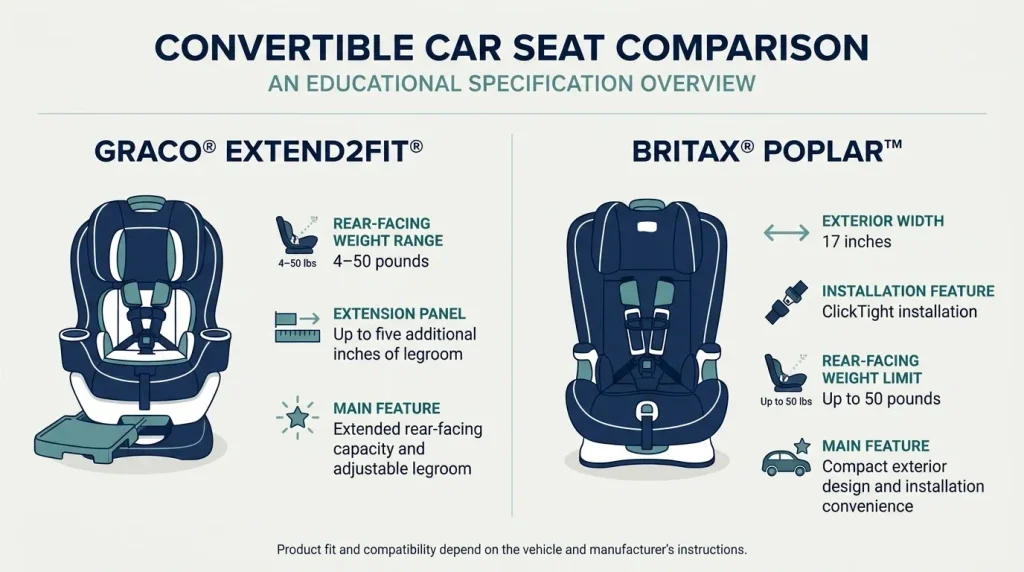
If your baby is approaching the infant seat’s limits, comparing convertible models can help you prepare for the transition. I’d start with rear-facing capacity, vehicle fit, installation instructions, and the child’s current measurements.
🏆 Extended Rear-Facing Option
Graco Extend2Fit Convertible Car Seat
Offers a rear-facing weight range of 4–50 pounds and an adjustable extension panel providing up to five inches of additional legroom. I’d consider this model when extended rear-facing capacity is a priority. Check the individual model’s head-clearance and installation requirements.
🚗 Space-Conscious Option
Britax Poplar Convertible Car Seat
Features a 17-inch exterior width, ClickTight installation, and rear-facing use up to 50 pounds. I’d compare it when rear-seat space and installation convenience are important. Actual three-across compatibility depends on the vehicle and installation.
Product note: These are examples to research, not independently tested rankings or guaranteed fits. Product specifications can change, and neither model should be purchased without checking its current manual and your vehicle compatibility.
Frequently Asked Questions
Can I switch to a convertible car seat at 6 months?
Yes. You can switch at six months if you prefer, provided the convertible seat is approved for your baby’s size and developmental needs. Install it rear-facing and follow its instructions. You don’t need to wait until the infant carrier reaches its maximum weight or height.
How do I know if my baby has outgrown an infant car seat?
Check the seat’s maximum weight, maximum height, and head-clearance requirements. Your baby has outgrown the seat when an applicable manufacturer limit or fit requirement is exceeded. Consult the manual rather than relying on appearance or age alone.
Can my baby go straight from an infant car seat to a forward-facing seat?
No. Outgrowing an infant-only carrier doesn’t automatically make a child ready for forward-facing travel. Move your baby into a suitable convertible or all-in-one seat installed rear-facing, then maintain that position until the rear-facing limits are reached.
Is a convertible car seat safer than an infant car seat?
Neither type is automatically safer when both are appropriate for the child and correctly installed. The important factors are correct fit, approved use, proper installation, and continued rear-facing travel. A convertible seat often provides higher rear-facing limits as a child grows.
Do I need to replace the infant car seat when switching?
You don’t necessarily need to discard an infant seat immediately. You can keep it for another child if it remains within its expiration date, has no disqualifying crash history, and meets all manufacturer requirements. Never use it again for a child who has outgrown it.
Final Takeaway: Make the Switch at the Right Time
The best time to switch from an infant car seat to a convertible car seat depends on your baby’s size and the manufacturer’s instructions, not a fixed birthday.
Check both height and weight limits, confirm the required head clearance, and select a convertible seat that fits your vehicle. After switching, keep your child rear-facing for as long as the new seat allows.
My biggest recommendation is simple: don’t rush the transition to forward-facing. Choosing a suitable convertible seat gives your growing baby more room to remain rear-facing while following established child passenger safety guidance.
Before your next drive, take a few minutes to check the seat label, review the manual, and confirm the harness fit. Those small checks make a meaningful difference to everyday car seat safety.

Daniel Brooks is an automotive writer and product researcher focused on car accessories, car tech, maintenance, and practical driving guides. At Plug-in Car World, he helps drivers make smarter automotive decisions through honest reviews and research-driven content.
