
When Can You Turn a Car Seat Forward-Facing?
Quick Answer
You can turn your child’s car seat forward-facing after your child outgrows the seat’s rear-facing height or weight limit, provided the child also meets the forward-facing requirements. Don’t rush the change because of age, legroom, or a birthday. The NHTSA car seat guidelines recommend keeping children rear-facing as long as possible within the manufacturer’s limits.
What to check before turning the seat
- Rear-facing weight: Check whether your child has reached the maximum weight for rear-facing use.
- Rear-facing height: Check the maximum standing height and any head-clearance requirements.
- Age requirements: Follow the minimum age specified by the seat manufacturer and applicable local laws.
- Forward-facing limits: Confirm that your child meets the minimum weight, height, and age requirements for that position.
- Installation instructions: Check the car seat manual and your vehicle owner’s manual before changing the installation.
- Harness and tether: Use the forward-facing harness and top tether as instructed by both manufacturers.
One important reminder
- A child’s legs touching the vehicle seat or looking uncomfortable does not automatically mean the child has outgrown rear-facing use.
Watching your toddler grow brings plenty of exciting milestones, and changing car seat positions can seem like another one. But knowing when to turn a car seat forward-facing is a safety decision worth taking slowly.
I’ve put together this guide to explain the age recommendations, seat limits, warning signs, and installation checks parents should understand before making the switch. You’ll also learn what to do if your child seems cramped in a rear-facing seat.
When Can You Turn a Car Seat Forward-Facing?
You can turn a car seat forward-facing once your child outgrows the manufacturer’s rear-facing height or weight limit and meets the requirements for forward-facing use. Until then, keeping your child rear-facing provides better protection for the head, neck, and spine.
The American Academy of Pediatrics (AAP) and the National Highway Traffic Safety Administration (NHTSA) both recommend keeping children rear-facing as long as possible within their car seat’s limits.
Importantly, reaching one limit is enough to outgrow a particular rear-facing mode. For example, a child who reaches the maximum rear-facing weight limit has outgrown that mode even if the child remains below its height limit.
However, this doesn’t mean every child should turn forward-facing immediately after outgrowing an infant carrier. A convertible or all-in-one seat may provide higher rear-facing limits.
What does forward-facing mean?
A forward-facing car seat is a child restraint installed so the child faces the front of the vehicle. It normally uses a built-in five-point harness and a top tether to help limit movement during a crash.
Unlike a rear-facing seat, which supports the child’s head, neck, and back against the seat shell, a forward-facing seat restrains the child from the front using its harness system.
What Age Should a Child Be Before Facing Forward?
There isn’t one universal birthday when every child should switch to forward-facing. The right timing depends on the child’s development, the car seat’s limits, and applicable safety recommendations.
In the United States, the CDC describes rear-facing use as generally lasting from birth until around ages 2–4, depending on when a child reaches the seat’s maximum height or weight limit.
The AAP recommends rear-facing for as long as possible, rather than switching automatically at age two.
- Under age one: Children should always ride in a rear-facing car seat.
- Around ages one to two: Continue rear-facing unless the child outgrows the particular seat’s limits.
- Around ages two to four: Some children may outgrow their rear-facing seats during this period, depending on their size and seat model.
- After outgrowing rear-facing: Move to an appropriate forward-facing seat with a harness and top tether.
These are general developmental ranges, not automatic switching dates. Always follow the specific car seat instructions and your local child passenger safety laws.
Why Is Rear-Facing Safer for Toddlers?
Rear-facing seats help distribute crash forces across a child’s back, head, and neck. This support matters because young children’s heads are relatively large compared with their bodies, and their necks and spines are still developing.
During a frontal collision, a rear-facing seat cradles the child’s body as the vehicle rapidly slows. This helps reduce the stress placed on the head and neck.
A forward-facing harness restrains the child’s body differently. Although it provides important protection, the transition changes how crash forces affect the child’s body.
How does rear-facing protection work?
Think about the difference between being supported by a wide surface and being held by straps during sudden movement. A rear-facing car seat provides broad support across the child’s back and head.
Its protective design helps in several ways:
- Head support: The seat shell supports the child’s head during sudden deceleration.
- Neck protection: The seat helps distribute forces rather than allowing the head to move forward independently.
- Back support: The child’s torso remains supported by the seat shell.
- Crash-force distribution: The restraint spreads forces across a larger area of the child’s body.
This is why experts recommend delaying the forward-facing transition until the child reaches the rear-facing limits.
How Do You Know Your Child Has Outgrown a Rear-Facing Car Seat?
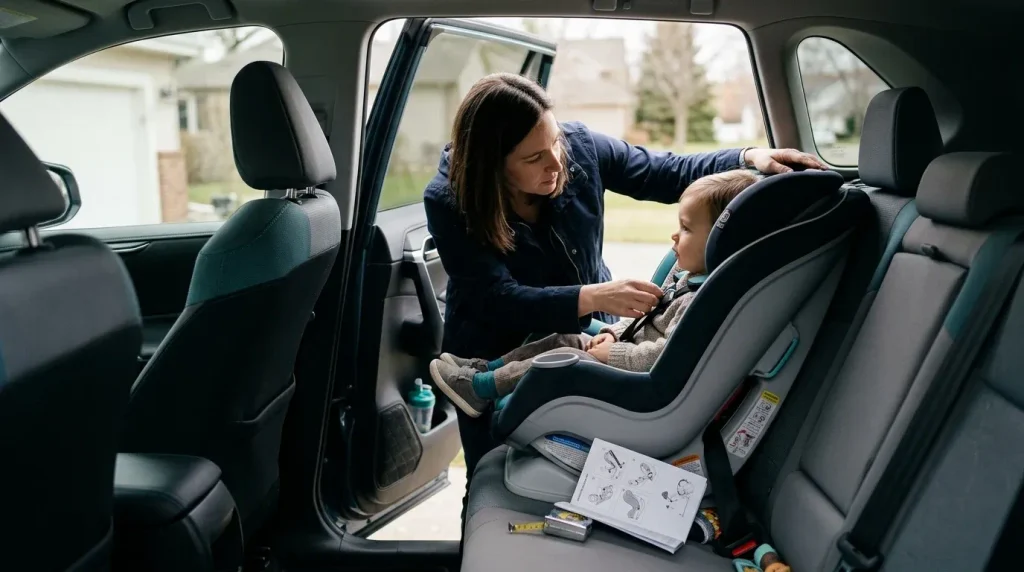
Your child has outgrown rear-facing use when they exceed the manufacturer’s maximum rear-facing weight or height limit, or fail another required fit condition in the manual. Check the actual seat specifications rather than relying on appearance alone.
Here are the most important things to inspect.
1. Your child reaches the maximum rear-facing weight
Every car seat has a maximum weight for rear-facing use. Some convertible models allow considerably more weight than infant-only seats.
For example, a convertible seat with a 40-pound rear-facing limit cannot be used rear-facing once a child weighs more than 40 pounds. Its separate forward-facing limits must also be checked.
2. Your child reaches the maximum rear-facing height
Height limits vary by manufacturer and model. Some seats use a maximum standing-height measurement, while others include specific head-clearance requirements.
A child may exceed the height limit before reaching the weight limit. If that happens, the child has outgrown rear-facing use in that seat.
3. Your child’s head reaches the seat’s clearance limit
Some manufacturers require a minimum amount of space between the child’s head and the top of the car seat shell or another designated reference point.
Don’t assume that every model uses the same one-inch rule. Follow the exact measurement and reference point described in your manual.
4. The manufacturer identifies another fit restriction
Some car seats have additional positioning or fit requirements. These may involve harness placement, head position, or specific child measurements.
Review the warning labels and user guide before deciding that your child can continue riding rear-facing.
Does a Child Need to Turn Forward-Facing at Age Two?
No. Turning two doesn’t mean a child must face forward, and many toddlers can safely remain rear-facing beyond their second birthday.
Many convertible car seats have rear-facing limits that accommodate children for two years or longer. Some models allow rear-facing use up to 40 or 50 pounds, depending on the specific product.
Consider this example:
- A two-year-old weighs 27 pounds.
- The child’s convertible seat allows rear-facing use up to 40 pounds.
- The child remains within the seat’s height and head-clearance requirements.
- The child can continue riding rear-facing.
The birthday alone doesn’t justify changing the seat direction. The manufacturer’s limits matter more.
Rear-Facing vs. Forward-Facing: What’s the Difference?
Both positions can provide important protection when used correctly, but they support a child’s body differently. Rear-facing is recommended for as long as possible, while forward-facing becomes appropriate after the child outgrows rear-facing use.
| Feature | Rear-Facing | Forward-Facing |
|---|---|---|
| Direction | Faces the back of the vehicle | Faces the front of the vehicle |
| Restraint | Built-in harness | Built-in harness and top tether |
| Typical stage | Infants and toddlers | Children who outgrow rear-facing |
| Body support | Supports the head, neck, and back | Harness restrains the torso and pelvis |
| Recommended timing | As long as possible within seat limits | After rear-facing limits are reached |
| Next transition | Forward-facing harness seat | Booster after harness limits are reached |
The comparison shows why the safest approach isn’t to choose a direction based on convenience. Each stage has a specific purpose and appropriate size limits.
What If Your Toddler’s Legs Touch the Back of the Vehicle Seat?
Legs touching the vehicle seat don’t automatically mean your child has outgrown rear-facing use. Children can bend their knees, cross their legs, or rest their feet against the vehicle seat while remaining within their car seat’s approved limits.
Parents sometimes worry that their toddler looks cramped. I would check the manufacturer’s height, weight, and positioning requirements before considering a change.
Look at these factors instead:
- Weight: Is your child below the rear-facing maximum?
- Height: Does your child meet the seat’s height requirements?
- Head clearance: Is the required space still available?
- Harness fit: Can the harness still be adjusted and secured correctly?
If all the requirements are satisfied, leg position alone isn’t a reason to switch. Children often find comfortable positions as they grow.
How to Turn a Convertible Car Seat Forward-Facing Safely
Once your child has outgrown rear-facing use and meets the forward-facing requirements, follow the car seat and vehicle manuals carefully. Changing direction involves more than simply rotating the seat.
Use this checklist before your next trip.
Step 1: Confirm your child’s eligibility
Check the forward-facing minimum age, weight, and height requirements. Make sure your child has outgrown rear-facing use according to the manufacturer’s instructions.
Step 2: Read both instruction manuals
Your car seat manual explains the correct forward-facing belt path, recline settings, harness position, and tether requirements. Your vehicle manual identifies approved seating positions and tether-anchor locations.
Step 3: Install the seat in the back
Place the car seat in an approved rear seating position. Follow the correct installation method using either the vehicle seat belt or lower anchors, as permitted by both manufacturers.
Step 4: Attach the top tether
Connect the car seat’s top tether to the approved tether anchor in the vehicle. Tighten it according to the instructions.
The tether helps limit forward movement of the child’s head during a crash. NHTSA recommends using it with forward-facing installations whenever the car seat and vehicle manufacturers permit it.
Step 5: Adjust the harness
Move the harness straps to the forward-facing shoulder position specified in your manual. For many seats, the straps must come from at or above the child’s shoulders.
Make sure the straps lie flat and aren’t twisted. Tighten the harness until you cannot pinch excess webbing at the shoulder.
Step 6: Check the installation
At the belt path, the installed car seat should not move more than one inch from side to side or front to back when tested according to NHTSA’s installation guidance.
Confirm that the seat reclines at the permitted angle and that the tether remains properly connected. If anything looks uncertain, arrange a check with a certified Child Passenger Safety Technician (CPST).
Common Mistakes Parents Make When Switching Car Seat Positions
Even careful parents can misunderstand car seat requirements. These mistakes are worth avoiding before making the transition.
- Switching at the second birthday: Age two isn’t an automatic reason to turn forward-facing.
- Ignoring height limits: A child can outgrow rear-facing use by height before reaching the weight limit.
- Assuming all seats have identical limits: Each model has its own approved measurements and restrictions.
- Skipping the top tether: The tether is an important part of forward-facing installation.
- Using an incorrect belt path: Rear-facing and forward-facing installations often use different paths.
- Moving to a booster too early: Children should remain in a forward-facing harness seat until they reach its approved limits.
- Adding unapproved accessories: Extra inserts, padding, or harness covers may interfere with proper restraint use.
A few minutes spent checking the manual can prevent avoidable installation mistakes. Don’t rely on instructions from another car seat model.
What Type of Car Seat Should You Use After Rear-Facing?
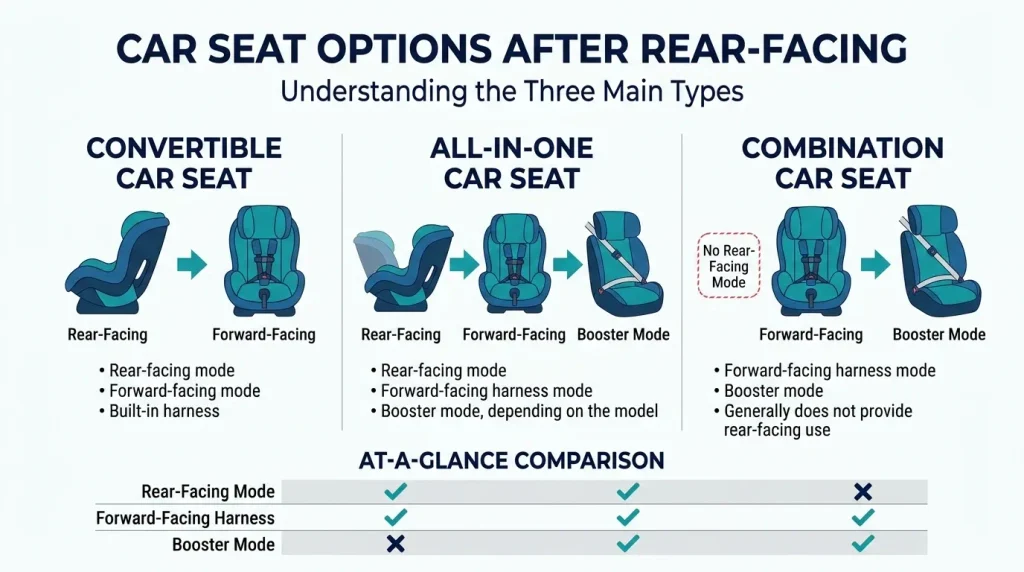
When your child outgrows rear-facing use, the next stage is a forward-facing car seat with a built-in harness and top tether. Many convertible and all-in-one models support both positions.
You don’t necessarily need to purchase another seat if your existing convertible model supports forward-facing use and your child meets its requirements.
Here are the main options:
- Convertible car seat: Changes from rear-facing to forward-facing with a harness.
- All-in-one car seat: May support rear-facing, forward-facing harness, and booster modes, depending on the model.
- Combination car seat: Generally starts with a forward-facing harness and later converts to a booster, rather than providing rear-facing use.
Choose a seat that fits your child, vehicle, and installation needs. A model with higher rear-facing limits can also be useful if you’re purchasing before your child outgrows the current seat.
When Should a Child Move From a Forward-Facing Seat to a Booster?
A child should move to a booster only after outgrowing the forward-facing harness seat’s height or weight limits. The child must also meet the booster manufacturer’s minimum requirements.
The AAP recommends keeping children in a forward-facing seat with a harness for as long as possible, until they reach the seat’s maximum limits.
After that, a belt-positioning booster helps position the vehicle’s seat belt correctly across the child’s body.
Before stopping booster use, check that the vehicle belt fits properly:
- The lap belt rests across the upper thighs, not the stomach.
- The shoulder belt crosses the middle of the shoulder and chest.
- The child can sit with their back against the vehicle seat.
- The knees bend naturally at the seat edge.
- The child can maintain this position throughout the trip.
Children should continue riding in the vehicle’s back seat until at least age 13 under AAP and NHTSA safety recommendations.
Product Recommendations: Convertible Car Seats for Growing Toddlers
If you’re shopping for a seat that supports extended rear-facing use, compare the approved weight and height limits before considering convenience features. These examples have published specifications that make them worth researching.
🏆 Extended Rear-Facing Option
Graco Extend2Fit Convertible Car Seat
★★★★½ 4.5/5
Supports rear-facing use from 4–50 pounds and forward-facing harness use from 26.5–65 pounds, up to 49 inches. Its adjustable extension panel provides additional legroom. I’d shortlist it when extended rear-facing capacity is a priority.
🚗 Slim Design Option
Britax Poplar Convertible Car Seat
Rating varies by retailer
Accommodates rear-facing use from 5–50 pounds and forward-facing harness use from 30–65 pounds, with a 49-inch maximum height. Its 17-inch design and ClickTight installation system are useful features to compare. I’d consider it when back-seat space and installation convenience matter.
⭐ Extended-Use Alternative
Chicco NextFit Max ClearTex
★★★★½ 4.6/5
Provides rear-facing harness use from 4–50 pounds and forward-facing harness use from 22–65 pounds. Its rear-facing height limit is 43 inches, with a forward-facing height limit of 49 inches. I’d compare it for its extended-use specifications and installation features.
Important: Product ratings and availability can change. These examples are not a substitute for checking current manuals, vehicle compatibility, product recalls, and your child’s measurements. Never choose a car seat based on its features or reviews alone.
Frequently Asked Questions
Can I turn my one-year-old forward-facing?
No. Children under one year old should always ride rear-facing. Continue rear-facing after the first birthday, too, until your child reaches the car seat manufacturer’s rear-facing height or weight limit and meets all applicable forward-facing requirements.
Is it safe to turn a two-year-old forward-facing?
It can be appropriate if the child has outgrown the rear-facing limits and meets the forward-facing requirements. However, turning two doesn’t automatically make the switch necessary. Many toddlers can continue riding rear-facing in convertible seats.
Should I turn the car seat when my child’s feet touch the vehicle seat?
No. Feet touching the vehicle seat aren’t a reliable sign that a child has outgrown rear-facing use. Check the manufacturer’s height, weight, and head-clearance limits instead. Children can often bend or cross their legs comfortably while remaining rear-facing.
Can a convertible car seat face both directions?
Yes. Most convertible car seats support rear-facing and forward-facing installation, but each position has separate weight, height, and age requirements. Follow the model’s instructions when changing positions, and use the appropriate belt path and top tether.
Does forward-facing require a top tether?
NHTSA recommends using the top tether with a forward-facing car seat whenever the car seat and vehicle manufacturers permit it. The tether helps limit forward movement during a crash. Always connect it to the approved vehicle tether anchor, not an unrelated cargo hook.
Final Takeaway: Don’t Rush the Forward-Facing Transition
The right time to turn a car seat forward-facing isn’t determined by a child’s birthday or how much legroom appears available. It’s determined by the manufacturer’s rear-facing limits and the child’s eligibility for the next position.
Keep your toddler rear-facing as long as possible within the approved limits. When your child outgrows that stage, use a forward-facing harness seat with a properly installed top tether.
Before making the change, check both manuals, inspect the seat labels, and confirm the installation. If you’re unsure, ask a certified Child Passenger Safety Technician for help.
A little extra care today can make every family journey safer.

Daniel Brooks is an automotive writer and product researcher focused on car accessories, car tech, maintenance, and practical driving guides. At Plug-in Car World, he helps drivers make smarter automotive decisions through honest reviews and research-driven content.
