
Are All-in-One Car Seats Worth Buying? Honest Guide
Quick Answer
Yes, for most families, an all-in-one car seat is worth buying if you want one seat that grows from rear-facing to forward-facing to booster mode. It saves you from buying and learning three separate seats, but it is heavier, bulkier, and a weaker fit for a tiny newborn than a dedicated infant carrier.
Buy one if:
- One main car: The seat stays put, so its weight stops mattering after install.
- Long-term value: One purchase can cover birth to booster age, if the limits fit your child.
- Simple routine: You learn one harness, one install, and one set of adjustments.
- Room to grow: Your car has enough back-seat space for a large rear-facing seat.
Skip one if:
- You carry a sleeping baby in and out of the car often, or you drive a very small car.
- Your newborn is small or early, and the seat cannot give a snug harness fit.
I’ve fitted more car seats than I can count, in everything from a tight Honda Civic to a roomy Toyota Highlander. The all-in-one question comes up in almost every garage chat I have with new parents.
They want one honest answer, not a sales pitch. This guide gives you that answer, with the trade-offs I see in real cars, not just on a spec sheet.
An all-in-one car seat is a 3-in-1 seat that works rear-facing, forward-facing with a harness, and then as a booster. Some models are sold as 4-in-1 seats, with a backless booster as the last stage.
Below, I explain what it does well, where it falls short, and how it stacks up against buying separate seats. By the end, you will know if it fits your car, your child, and your daily routine.
In This Guide
What Is an All-in-One Car Seat?

An all-in-one car seat is a single seat that changes mode as your child grows. It starts rear-facing for a baby, turns forward-facing with a five-point harness for a toddler, and ends as a belt-positioning booster for an older child.
That sounds simple on the box. In practice, each change means a new install angle, a new harness height, and sometimes a new crotch-buckle slot.
Most models cover a wide weight range, often from about 5 pounds rear-facing to 100 pounds or more in booster mode. The exact limits change by model, so the label on your seat always beats a general range.
Check those limits against your child’s size before you buy. A seat that looks roomy in the shop can still run out of harness height sooner than you expect.
Here is how the three main modes work in daily use.
- Rear-facing mode: The seat faces the back of the car, with the harness snug at or below the baby’s shoulders.
- Forward-facing mode: The seat faces forward, with the harness at or above the shoulders and the top tether attached.
- Booster mode: The harness comes out, and the car’s seat belt does the work, guided by the booster’s belt guides.
The top tether matters a lot in forward-facing mode. It limits how far the seat tips forward in a crash, so I never skip it when a tether anchor is there.
Pro tip: read your vehicle owner’s manual and the seat manual together before the first install, and check NHTSA for recall and safety guidance.
Section takeaway: An all-in-one car seat is one shell that serves three stages, but each stage still needs its own correct install and harness setup.
Are All-in-One Car Seats Worth Buying?
Yes, an all-in-one car seat is worth buying for most families who drive one main car and want to buy once. It is worth it when the seat fits your car rear-facing, fits your newborn snugly, and has limits that will last until booster age.
It is not worth it as a blind buy. A seat that crowds the front seats, leaves a gap around a small baby, or expires before your child outgrows it will cost you more in stress than it saves in shopping trips.
I think of value in three parts: money, time, and fit. Money is the easiest part to see, because one seat replaces three purchases.
Time is the part parents forget. You learn one manual, one install path, and one way to tighten the harness.
Fit is the part that decides everything. If the seat does not fit your car or your child at the stage you are in now, its later stages do not help you.
That is why I always test the rear-facing fit first. A newborn will spend the longest stretch in that mode, and a bad angle there is hard to fix with padding or hope.
Ask yourself three quick questions before you decide.
- Does it fit now? Sit in the front seat with the all-in-one installed rear-facing behind you.
- Does it fit your baby? Check the lowest harness slots and the infant insert, if the model has one.
- Will it last? Compare the harness height and weight limits with age, height, and weight requirements for each stage.
If all three answers are yes, you have found good value. If even one is no, a dedicated infant seat first, then a convertible later, may serve you better.
Section takeaway: Worth buying means worth it for your car and your child right now, not just on paper for the next ten years.
All-in-One vs. Separate Car Seats: How Do They Compare?
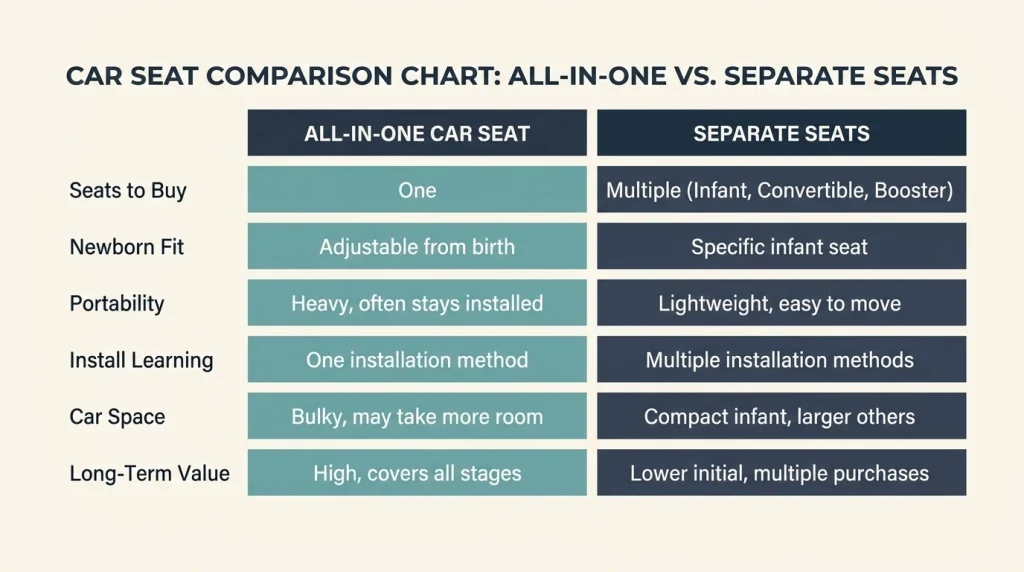
How does an all-in-one car seat compare with buying separate seats? The all-in-one wins on simplicity and long-term value, while separate seats win on newborn fit, portability, and a better match at each stage.
Separate seats usually mean an infant carrier first, then a convertible, then a booster. Each seat is built for one job, so each one tends to fit that stage a little better.
I have carried a sleeping baby from a Civic to a front door in an infant carrier, and that convenience is real. An all-in-one cannot do that, because it stays bolted in the car.
On the other hand, I have also watched parents juggle three manuals, three installs, and three resale listings. One seat removes that whole cycle.
Use the table below to weigh the trade-off in one glance.
| Factor | All-in-One Car Seat | Separate Seats |
|---|---|---|
| Seats to buy | One seat for three stages | Three seats over time |
| Newborn fit | Good on many models, loose on some small babies | Best fit, with a snug carrier made for newborns |
| Portability | Stays in the car, heavy to move | Infant carrier lifts out with the baby |
| Install learning | Learn once, adjust as the child grows | Learn a new install at each stage |
| Car space | Large and wide, tight in small cars | Carrier is compact, later seats vary |
| Long-term value | Strong, if the limits and expiry date last | Lower, with three purchases and handovers |
The infant vs. convertible choice is the closest version of this same decision. An all-in-one is, in effect, a convertible that keeps going into booster mode.
That extra stage is where the value lives. A convertible alone still leaves you buying a booster later, while an all-in-one may not.
Check the booster limits closely, though. Some all-in-one seats make a tall, narrow booster that older kids outgrow by height before weight.
Section takeaway: Choose the all-in-one for simplicity and long-term value, and choose separate seats when newborn fit and portability matter more.
What Are the Pros and Cons of an All-in-One Car Seat?
What are the pros and cons of an all-in-one car seat? The main pros are one purchase, one install to learn, and years of use, while the main cons are bulk, weight, and a newborn fit that is not as snug as a dedicated carrier.
Start with the pros, because they are the reason this seat sells so well.
The pros
- One purchase: You buy once and skip two later shopping rounds.
- One install to learn: You get good at one seat instead of starting over twice.
- Long use: Many models serve a child from birth to booster age.
- Fewer handovers: No mid-stage swap means no gap while you shop for the next seat.
- Consistent harness: Your child gets used to one buckle, one chest clip, and one tightening routine.
That consistency helps on busy mornings. A child who knows the routine climbs in, and you can check the harness in seconds.
Now the cons, because they decide whether the pros actually apply to you.
The cons
- Heavy and bulky: Moving it between cars is a real job, not a quick lift.
- Tight in small cars: Rear-facing, it can push the front seats too far forward.
- Newborn fit varies: Some small babies swim in the lowest harness slots, even with the insert.
- Booster fit varies: The booster stage can feel narrow or short for taller kids.
- One expiry date: If the seat expires before your child is done with it, the long-term value drops.
Weight is the con I hear about most after the first month. Parents love the seat at home, then dread moving it to a grandparent’s car.
If you swap cars often, keep a second, lighter seat in mind. An all-in-one works best as the main seat in the main car.
Rear-facing time also shapes the pros and cons. A seat that supports extended rear-facing gives you more safe years in the mode experts recommend most for toddlers.
Read the rear-facing vs. forward-facing guide before you turn the seat around. Height and weight limits, not age alone, should drive that call.
Section takeaway: The pros are real, but they only count if the seat fits your car, your baby, and your daily driving pattern.
When Is an All-in-One Car Seat Not the Best Choice?
When is an all-in-one car seat not the best choice? It is not the best choice for a very small newborn, for a very small car, for frequent car swaps, or for families who need to carry a sleeping baby in a carrier.
Start with the newborn case. A baby under about 7 pounds, or a preemie, may not reach the lowest harness slots snugly.
Do the pinch test at the shoulder after you tighten the harness. If you can pinch a fold of webbing, the harness is too loose, and no insert fixes a slot that sits too high.
Next, check your car. I once tried an all-in-one rear-facing in a compact sedan, and the front passenger had to sit with knees near the dash.
That is not a safe or liveable setup. Measure the back seat, install the seat, then sit in front of it before you commit.
Frequent swaps are the third warning sign. If the seat moves between two cars every week, its weight becomes a weekly chore.
A lighter convertible for the second car, or a second all-in-one that stays put, is often the calmer answer. Two seats that stay installed beat one seat that is always half-installed.
Travel is the fourth case to weigh. An all-in-one is hard to carry through an airport, and it may not fit well in a rental car or a taxi.
An infant carrier or a light travel seat is easier there. Keep the all-in-one at home, where it does its best work.
Finally, think about the booster stage. If your child is tall for their age, check the booster height limit now, not in five years.
A seat that tops out early in booster mode is not a bad seat. It is just a seat whose value ends sooner than the box suggests.
If any of these cases sounds like you, start with a dedicated infant seat. You can still move to an all-in-one later, when your baby is bigger and the fit is clearer.
The guide to switching from an infant seat helps you time that move by height and weight, not by a birthday.
Section takeaway: Skip the all-in-one for now if the newborn fit, the car fit, or the daily routine fights against it.
How Do You Choose the Right All-in-One Car Seat?

How do you choose the right all-in-one car seat? Start with fit, then check limits, install, and cleaning, and only then compare comfort extras.
Fit comes first because no feature rescues a seat that does not fit. Bring your car, your child if you can, and your patience to the shop.
Work through this short checklist in order.
- Rear-facing fit: Install it rear-facing and check front-seat legroom and the recline angle.
- Harness height: Find the lowest and highest slots, and picture your child at each stage.
- Weight limits: Note the rear-facing, forward-facing, and booster limits, and check the expiry date.
- Install method: Try both LATCH and seat-belt install, and see which gives a tighter fit in your car.
- Top tether: Find the tether anchor in your car and confirm the strap reaches it easily.
- Cleaning: Check if the cover removes and washes without a fight, because spills will happen.
LATCH has weight limits of its own, so read both manuals on this point. Many parents switch to a seat-belt install once the child grows heavier, and that is normal.
Comfort extras come last, but they still matter on long drives. Look for plush padding, cup holders your child can reach, and a headrest that moves without rethreading the harness.
A no-rethread harness saves real time as your child grows. You slide the headrest up, and the harness moves with it, instead of taking the seat apart.
Check the expiry date and the manufacture date on the box. A seat made a year ago has a year less of use left, even if it is brand new to you.
Also check for recalls before you buy, new or used. Consumer Reports, Edmunds, and Car and Driver all publish car-seat guidance, and the seat maker’s own site lists recalls for its models.
Finally, plan the booster years. A seat that works well as a booster needs good belt guides and a shape your child will still sit in happily at age six or seven.
The guide to switching to a booster seat explains the five-step belt fit test to use when that day comes.
Section takeaway: Fit first, limits second, install third, and extras last, and you will pick a seat that lasts.
Frequently Asked Questions
Can a newborn use an all-in-one car seat?
Yes, many all-in-one seats accept a newborn from about 5 pounds, with an infant insert. Check the lowest harness slots and the pinch test first, because a small baby may fit a dedicated carrier better.
How long does an all-in-one car seat last?
Most models last from birth to booster age, often until the child is 8 to 10 years old by size. The seat’s expiry date, usually 7 to 10 years from manufacture, sets the hard limit.
Is an all-in-one car seat as safe as separate seats?
Yes, when it is installed correctly and used in the right mode for the child’s size. Safety comes from correct install, harness fit, and following the limits, not from buying three seats instead of one.
Do all-in-one car seats work in small cars?
Some do, and some do not. Measure your back seat, install the seat rear-facing, and sit in front of it before you buy, because rear-facing depth is the usual problem.
Can you use an all-in-one car seat on an airplane?
Some models are approved for aircraft use in harness mode, but they are heavy to carry. Check the label and the airline’s rules first, and consider a lighter travel seat for flying.
Is a 3-in-1 seat the same as a 4-in-1 seat?
Almost. A 3-in-1 covers rear-facing, forward-facing, and high-back booster modes, while a 4-in-1 adds a backless booster as the final stage.
When should you switch an all-in-one seat to booster mode?
Switch only when your child passes the forward-facing harness limits for height or weight. Use the five-step belt fit test in booster mode, and keep the harness as long as it still fits.
As of 2026, the honest answer has not changed: buy the all-in-one if it fits your car, your baby, and your routine today. If it does not, start smaller and move up when the fit is right.
Check the fit, read both manuals, and get the install checked by a certified technician if you are unsure. That one check is worth more than any feature list.

Daniel Brooks is an automotive writer and product researcher focused on car accessories, car tech, maintenance, and practical driving guides. At Plug-in Car World, he helps drivers make smarter automotive decisions through honest reviews and research-driven content.