Are Graco Car Seats Good? What Parents Should Know Before Buying
Quick Answer
Yes, Graco car seats are good for most families — they meet US federal safety standards, cover every stage from newborn to booster, and fit a wide range of cars without a premium price tag. The right choice still depends on your child, your car, and a correct install, so check the model limits and how to install a Graco car seat before you buy.
What makes Graco a safe bet
- Safety standards met: Every Graco seat sold in the US must meet Federal Motor Vehicle Safety Standard 213.
- Every stage covered: Graco makes infant carriers, convertibles, all-in-one seats, and boosters.
- Long rear-facing: The Extend2Fit allows rear-facing up to 50 pounds.
- Easy install help: Many seats use level indicators, push-button LATCH, and belt lock-offs.
- Wide car fit: Slim models help in smaller cars and three-across setups.
- Strong value: Long use, washable covers, and spare parts without a luxury price.
Check before you buy
- Match the seat to your child’s weight and height, not just age.
- Try the seat in your car first if you can, and check the recline angle.
- Read the manual for your exact model, and check the expiry date on the label.
I’ve fitted Graco seats in family hatchbacks, three-row SUVs, and a tight pickup truck rear seat. Most of the time, the install was quick and the seat stayed put.
This guide goes past the short answer. You’ll see where Graco shines, where it falls short, and which model fits your child and your car.
A Graco car seat is a child restraint made by Graco Children’s Products, covering infant carriers, convertibles, all-in-one seats, and boosters.
In This Guide
Are Graco car seats safe?
Yes, Graco car seats are safe when you choose the right model and install it correctly. Every new Graco seat sold in the US must pass the same federal crash-test standard as every other major brand.
That standard is Federal Motor Vehicle Safety Standard 213. It sets the minimum crash performance for child restraints, and Graco designs and tests its seats to meet it.
Safety does not stop at the test lab. A seat that fits your child badly or moves more than an inch at the belt path will not protect as well in a crash.
What safety features should you look for?
The list below covers the features I check first on any Graco seat.
- Five-point harness: Two shoulder straps, two hip straps, and a crotch buckle hold a small child in place.
- Top tether: This strap anchors the top of a forward-facing seat and cuts forward head movement.
- Side-impact protection: Padded headrests and shell shapes help shield the head in a side crash.
- Level indicator: A bubble or line shows the correct recline angle for a newborn.
- LATCH connectors: Push-button lower anchors click in and release more easily than older hooks.
- Belt lock-off: This clamp holds the vehicle belt tight on a seat belt install.
Graco also tests beyond the federal minimum to its own internal standards.
Do Graco seats have recalls?
Yes, like every large car seat maker, Graco has had recalls over the years. A recall means a specific model, batch, or part had a fault, not that the whole brand is unsafe.
Check the model name and date of manufacture before you buy, especially for a used seat.
Pro tip: Check any seat on the NHTSA recall lookup before you buy or accept a hand-me-down, and register your new seat with Graco so recall notices reach you direct.
Use the NHTSA site for recall checks and child-seat safety guidance.
Section takeaway: Graco meets the same federal safety standard as its rivals, so safety comes down to the right model, the right fit for your child, and a tight, correct install.
Which Graco car seat is best for your child?
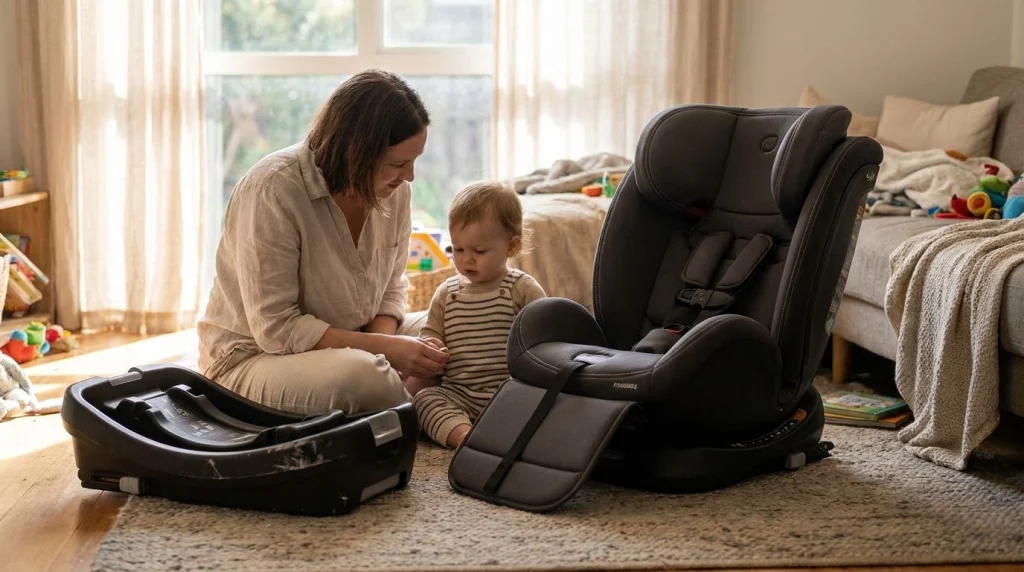
There is no single best Graco seat. The best one fits your child today and still fits them in a year.
Age alone is a poor guide. Weight, height, and torso length matter more, and Graco prints those limits on every seat label.
Infant carriers: SnugRide 35 Lite and SnugRide 35 Lite LX
An infant carrier clicks in and out of a base, so you can carry a sleeping baby without waking them. The SnugRide 35 Lite is one of the lightest carriers Graco makes.
It is rear-facing only, for babies from 4 to 35 pounds. The Lite LX adds extra padding and a different canopy, but the core fit is the same.
Choose an infant carrier for the first year, then move on when your baby passes the weight or height limit.
Pair it with covers made for the Graco SnugRide if you want extra fabric protection, but check first that the cover does not sit under the harness or change the fit.
Convertibles: Extend2Fit and Contender
A convertible seat starts rear-facing and later turns forward-facing. The Extend2Fit is Graco’s best-known convertible for longer rear-facing.
It allows rear-facing from 4 to 50 pounds, thanks to a four-position extension panel that gives tall toddlers more legroom. That panel is the main reason many parents pick it.
The Contender is a simpler, lighter convertible. It is easier to move between cars, and it takes up less room front to back in some cars.
Pick the Extend2Fit for longer rear-facing, or the Contender for a lighter second seat.
All-in-one seats: 4Ever DLX and SlimFit3 LX
An all-in-one seat changes from rear-facing to forward-facing to high-back booster to backless booster. The 4Ever DLX is built to last for 10 years of use.
It starts rear-facing from 4 to 40 pounds, then moves through the later stages. The seat is wide and heavy, so it suits a larger car where it will stay put.
The SlimFit3 LX is the slim answer to the same idea. It is designed to fit three across in many mid-size cars, and it still covers rear-facing, forward-facing, and booster use.
Choose an all-in-one for one purchase over many years, or the SlimFit3 LX for three across.
Boosters: Nautilus and TurboBooster
A booster lifts an older child so the adult seat belt sits on the strong hip bones and across the chest. The Nautilus is a three-in-one harness booster that later becomes a high-back and backless booster.
The TurboBooster is a simpler booster for older kids who are ready to use the vehicle belt with help. It is light, easy to move, and easy for a child to buckle.
Use a booster only when your child has outgrown the harness limits of their last seat.
Section takeaway: Start with your child’s weight and height, then pick the Graco type that covers that stage with room to grow, and you will avoid buying the wrong seat twice.
How does Graco compare with other car seat brands?
Graco sits in the middle of the market. It is not the cheapest brand, and it is not the most premium one either.
That middle spot is the point. You get solid safety basics, wide availability, and a lot of choice, without paying for luxury fabric or a designer label.
| Graco model | Type | Best for | Rear-facing limit | Standout feature |
|---|---|---|---|---|
| SnugRide 35 Lite | Infant carrier | Newborns, light carry | 4 to 35 pounds | Lightweight, clicks out of base |
| Extend2Fit | Convertible | Longer rear-facing | 4 to 50 pounds | Four-position legroom panel |
| 4Ever DLX | All-in-one | One seat for 10 years | 4 to 40 pounds | Four modes, from infant to booster |
| TurboBooster | Booster | Older kids, belt fit | Not rear-facing | Light, easy to move between cars |
Graco vs Chicco
Chicco is known for smooth install systems and premium-feeling fabric. Its KeyFit infant carrier is a favourite with many parents for its easy base install.
Graco wins on choice and value. It offers more models at more price points, and its all-in-one seats cover a longer span of use.
Graco vs Britax
Britax is known for heavy, solid shells and click-tight install systems. Many parents like the firm feel and the clear belt-path design.
Graco seats are usually lighter and easier to move. They also fit better in narrow rear seats in some cars, especially the SlimFit3 LX.
Graco vs Evenflo
Evenflo is the closest rival on price and value. Its rotating seats and all-in-one models give Graco real competition, especially for parents who want an easier load-in.
Read independent reviews on Consumer Reports for the exact models on your shortlist, because ratings change with each new version.
Section takeaway: Graco rarely wins on luxury feel, but it often wins on range, fit in more cars, and value over the full life of the seat.
What do parents like, and what do they complain about?
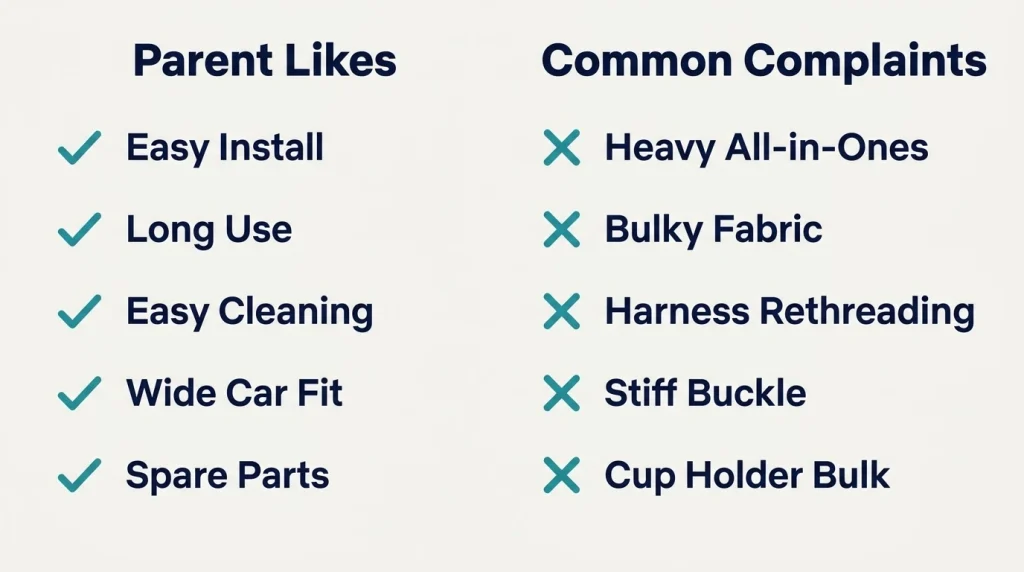
Parent feedback follows a clear pattern. The same strengths come up again and again, and so do the same gripes.
What parents like most
- Easy install: Push-button LATCH, clear level lines, and belt lock-offs cut install time.
- Long use: All-in-one seats stay useful from baby to booster, so you buy once for years.
- Easy cleaning: Many covers are machine-washable, and the harness wipes clean after spills.
- Good fit in many cars: Slim models and adjustable recline help in small cars and three-across setups.
- Spare parts: Bases, covers, and inserts are easy to find for two-car families.
I have seen that small win on school mornings: a carrier that clicks into a base in each car in seconds.
What parents complain about
- Heavy all-in-one seats: The 4Ever DLX is hard to lift and move, especially with a child in your arms.
- Bulky fabric: Thick padding looks cosy, but it can make a small car feel tighter.
- Harness adjustment: Some models need rethreading to move the harness height, which takes longer than no-rethread.
- Buckle stiffness: New buckles can feel stiff at first, and some parents find them hard with one hand.
- Cup holder bulk: Large cup holders are handy, but they add width in a three-across fit.
Most of these gripes are about daily use, not safety. A stiff buckle is annoying, but it does not make the seat unsafe if it still clicks and holds.
Section takeaway: Parents praise Graco for easy installs, long use, and washable covers, and they complain most about weight, bulk, and fiddly harness adjustment on some models.
Will a Graco car seat fit in your car?
A good seat that does not fit your car is a bad buy. Graco makes slim and wide models for a reason, so check the fit before you commit.
Start with the space you have. Measure the rear seat width, check the front seat position, and note the shape of the seat base.
How do you check the fit?
Use this short check in the car park or driveway. It takes ten minutes.
- Put the front seats where you normally drive, then try the car seat behind them.
- Check the recline angle with the level indicator, and adjust the base if needed.
- Install with LATCH or the seat belt, then push and pull at the belt path.
- Check that the seat moves less than one inch side to side or front to back.
- Check that the top tether can reach its anchor when forward-facing.
- Check that the harness sits at or below the shoulders for rear-facing, and at or above for forward-facing.
If you need three seats in one row, test the SlimFit3 LX first in your exact car.
Read our guide to whether a car seat will fit in your car for the full check, including headrest, door angle, and seat belt length.
Also check how to check car seat compatibility with your vehicle if your car has unusual anchors, a non-removable headrest, or a short belt.
Section takeaway: Fit is car-specific, so test the exact Graco model in your exact car, with the front seats in your normal driving position, before you buy.
How do you install a Graco car seat safely?

A correct install matters more than the brand on the label. Most car seat misuse comes from a loose install, a loose harness, or the wrong recline angle.
Read the Graco manual and your car manual together. The car manual shows where the LATCH and top tether anchors are, and it sets the LATCH weight limit for your car.
What are the key install steps?
The steps below are a general guide, not a replacement for your manuals.
- Choose LATCH or seat belt, not both, unless the manual for your model says otherwise.
- Set the recline angle for your child’s age and direction, using the level indicator.
- Thread the belt or LATCH strap through the correct belt path for rear-facing or forward-facing.
- Push down on the seat with your knee or hand while you tighten the strap.
- Check for less than one inch of movement at the belt path.
- Attach the top tether for forward-facing, and pull it snug.
- Tighten the harness until you cannot pinch slack at the shoulder, and put the chest clip at armpit level.
Check your work with our guide to how car seats are installed if you want a step-by-step refresher.
Do not add aftermarket inserts, strap covers, or bulky coats under the harness. They can create slack in a crash, and Graco only approves the inserts that come with the seat.
If you are unsure, ask a certified child passenger safety technician to check the install.
Pro tip: Check your car manual for the LATCH weight limit and top tether anchor location.
Section takeaway: Use one install method, set the recline right, get less than one inch of movement, and tighten the harness until you cannot pinch slack.
Are Graco car seats worth it?
For most families, yes. Graco gives you a safe, practical seat that lasts for years, without the premium price of a luxury brand.
The value is strongest in the all-in-one and convertible seats. One seat can cover rear-facing, forward-facing, and booster use, so the cost per year of use is low.
Value is weaker if you buy the wrong type. A wide all-in-one that does not fit your car, or a heavy seat you need to move every day, will frustrate you even if the price was fair.
Think about your real use: one car or two, three across, or frequent flying with a light carrier? Answer those questions first, then pick the Graco model that matches.
Check reviews on Edmunds for the exact model and year. As of 2026, the Extend2Fit and 4Ever DLX remain the most popular picks for long use.
Run through the essential car seat safety checklist for parents before your first trip with a new seat.
Section takeaway: Graco is worth it when the model matches your child, your car, and your daily routine, and that match matters more than the brand name alone.
Frequently asked questions
Are Graco car seats good for newborns?
Yes, the SnugRide infant carriers are made for newborns from 4 pounds. Use the correct recline angle, keep the harness snug, and move on when your baby passes the weight or height limit.
Are Graco car seats safe in a crash?
Graco seats must meet Federal Motor Vehicle Safety Standard 213, the same standard as other major brands. A correct install, a snug harness, and the right fit matter as much as the seat itself.
Which Graco car seat lasts the longest?
The 4Ever DLX all-in-one is built for 10 years of use, from rear-facing infant to backless booster. Check the expiry date on the label, and do not use a seat past that date.
Are Graco car seats good for small cars?
Yes, if you pick a slim model like the SlimFit3 LX or a compact convertible. Test it in your car with the front seats in your normal position.
Can you use a Graco car seat on a plane?
Many Graco infant carriers and convertibles are approved for aircraft use with the belt, but approval varies by model. Check the label and your airline before you fly.
How long do Graco car seats last?
Most Graco seats expire 7 to 10 years after the date of manufacture, depending on the model. Check the exact expiry on the seat label before you buy a used seat.
So, are Graco car seats good? For most parents, the answer is yes, with one condition: pick the model that fits your child and your car, install it tight, and check it as your child grows.

Daniel Brooks is an automotive writer and product researcher focused on car accessories, car tech, maintenance, and practical driving guides. At Plug-in Car World, he helps drivers make smarter automotive decisions through honest reviews and research-driven content.