
Are Aftermarket Car Seat Accessories Safe? What Drivers Need to Know
Quick Answer
Are aftermarket car seat accessories safe? Some are, but safety depends on the accessory, your vehicle, and manufacturer approval. Seat covers, cushions, and other add-ons can interfere with airbags, occupant sensors, seat belts, or child restraint systems. The National Highway Traffic Safety Administration (NHTSA) warns that aftermarket seat covers must not compromise vehicle safety systems.
Five Safety Factors to Check
- Airbag compatibility: Covers must not interfere with seat-mounted side airbags.
- Occupant detection: Thick accessories may affect passenger weight or occupant classification sensors.
- Seat belt access: Accessories must not obstruct buckles, anchors, or proper belt positioning.
- Child restraint safety: Unapproved inserts and harness accessories can reduce crash protection.
- Secure installation: Loose covers and cushions may shift and affect driving posture.
The Safest Approach
- Check both manuals: Follow your vehicle manufacturer’s instructions and the accessory manufacturer’s fitment requirements.
- Avoid uncertain products: If compatibility cannot be confirmed, leave the accessory off.
Aftermarket car seat accessories can make a vehicle more comfortable, protect upholstery, and help organize the cabin. Yet a product that looks harmless can sometimes affect an important safety feature.
When I evaluate a seat accessory, I look beyond the fabric, padding, and product description. This guide explains the risks, what manufacturers recommend, and how to make a safer buying decision.
In This Guide
- What Are Aftermarket Car Seat Accessories?
- Can Aftermarket Seat Covers Affect Airbags?
- Which Car Seat Accessories Pose Safety Risks?
- Are Aftermarket Child Car Seat Accessories Safe?
- How Can You Check Whether an Accessory Is Safe?
- What Are Safer Alternatives to Seat Accessories?
- Frequently Asked Questions
What Are Aftermarket Car Seat Accessories?
Aftermarket car seat accessories are products added to vehicle seats or child safety seats after the original purchase. They may improve comfort, appearance, storage, or upholstery protection.
Unlike factory-installed parts, these accessories are not necessarily designed or tested with your vehicle’s particular seating system.
Definition: An aftermarket car seat accessory is an add-on or replacement product installed after manufacture that changes or supplements a seat’s original equipment, appearance, or function.
Common Types of Aftermarket Seat Accessories
Products sold as car seat accessories cover several different needs.
- Seat covers: Fabric, neoprene, synthetic leather, or leather covers that protect the original upholstery.
- Seat cushions: Foam, gel, or inflatable pads intended to change sitting comfort or support.
- Lumbar support pillows: Additional back support placed against the seatback.
- Headrest pillows: Cushions designed to support the neck or head.
- Heated seat pads: Electrically powered accessories that add warmth.
- Seat-back organizers: Storage accessories attached behind a front seat.
- Seat belt accessories: Pads, clips, adjusters, and extenders intended to change belt comfort or positioning.
- Child safety seat accessories: Additional inserts, harness pads, protectors, and other items used with infant or child restraints.
These products do not all carry the same risks. A loose cushion directly beneath a passenger creates different concerns from a storage organizer secured behind a seat.
Are OEM and Aftermarket Accessories Different?
OEM means original equipment manufacturer. An OEM accessory comes from the vehicle manufacturer or an authorized supplier for a specified application.
That distinction matters because compatibility depends on the actual seat design. Even a genuine manufacturer’s accessory may be unsuitable for another model or production year.
Some aftermarket manufacturers provide vehicle-specific fitment instructions. Others market one-size-fits-most products that may not account for every safety component.
Neither branding nor price alone proves an accessory is safe. The relevant approval, instructions, and intended use matter more.
Why Do Vehicle-Specific Designs Matter?
Modern seats may contain airbags, electrical wiring, heaters, ventilation systems, and occupant detection components. Changes to the seat surface can affect some of these systems.
A replacement cover for an older vehicle without seat-mounted airbags may raise different concerns than a full cover for a newer vehicle with integrated airbags.
As of 2026, the safest purchasing approach remains specific compatibility verification rather than relying on generic safety labels.
Can Aftermarket Seat Covers Affect Airbags?
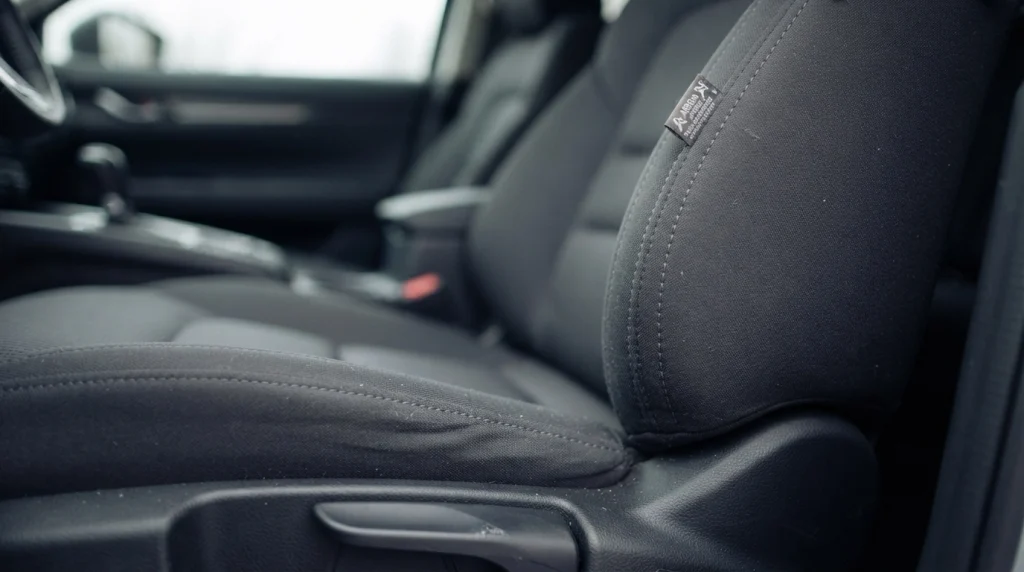
Yes. An incompatible aftermarket car seat cover can interfere with seat-mounted side airbags or certain occupant detection systems.
These are two distinct safety concerns. A cover might affect one system without visibly affecting the other.
How Seat-Mounted Side Airbags Work
Many vehicles contain side airbags inside their front seatbacks. During certain crashes, these airbags deploy through specially designed openings or seams.
The factory seat trim forms part of that deployment design. Adding another layer over the deployment area may create an obstruction.
Potential problems include:
- Strong fabric restricting the intended opening.
- Extra stitching or straps crossing the deployment area.
- Incorrectly positioned airbag openings.
- Loose material becoming entangled during deployment.
- Replacement upholstery lacking the required construction.
An airbag can deploy with considerable force. A cover that appears flexible during normal use may behave differently during a crash.
Does an Airbag-Compatible Label Guarantee Safety?
No. The words “airbag compatible” alone do not establish that a particular product works safely with your vehicle.
Some covers feature special seams or openings designed to accommodate side airbags. Their effectiveness still depends on the product design and correct fitment.
Look for clear documentation identifying your vehicle’s make, model, year, and seating configuration. Ask the manufacturer what compatibility assessment supports its claims.
A generic airbag symbol on the packaging is not enough evidence.
For example, the Tesla Model Y owner’s manual warns against seat covers because they may restrict seat-mounted airbag deployment. That warning applies even when a third-party seller advertises a cover as compatible.
Can Seat Covers Affect Passenger Weight Sensors?
Yes. Some vehicles use an occupant classification system, or OCS, to determine how the passenger airbag should operate.
Depending on the vehicle, the system may use sensors or other detection technology to classify seat occupancy.
Additional padding, pressure, or material can interfere with certain systems. The exact effect varies by vehicle design.
Potential warning signs include:
- An unexpected passenger airbag status indication.
- An airbag or supplemental restraint system warning light.
- An occupant detection warning after installing an accessory.
- Changes in seat operation or unusual pressure beneath the cushion.
The supplemental restraint system, or SRS, includes airbags and related crash protection components.
Importantly, the absence of a warning light does not prove compatibility. A cover may obstruct an airbag without triggering a dashboard fault.
Pro tip: Follow your vehicle owner’s manual before adding anything to an airbag-equipped seat. Have unexpected restraint system warnings diagnosed by a qualified technician.
Are Aftermarket Seat Covers Legal?
In the United States, NHTSA has explained that no federal motor vehicle safety standard directly applies to aftermarket seat covers. This does not mean every cover is safe or approved.
NHTSA also does not issue product-specific approval certificates for these covers. Manufacturers remain responsible for safety-related defects in their products.
Federal restrictions on knowingly making safety equipment inoperative apply to certain commercial businesses. State laws and other requirements may also apply.
Vehicle owners should avoid modifications that reduce safety, regardless of whether a specific installation is prohibited.
Section Takeaway: Never assume a seat cover is safe because it fits or carries an airbag-compatible label. The vehicle manufacturer’s instructions should decide whether you use it.
Which Car Seat Accessories Pose Safety Risks?
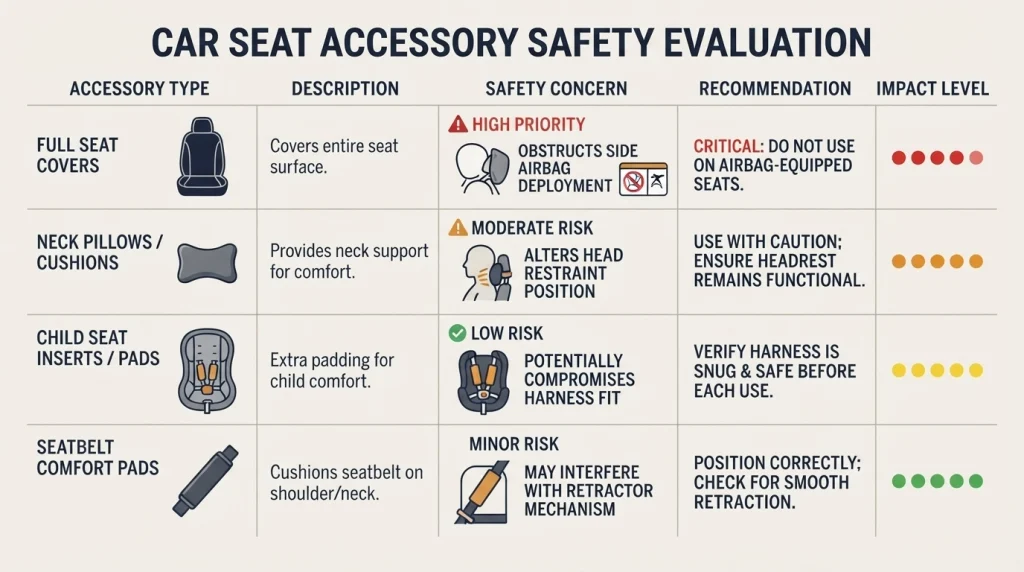
The highest-risk accessories are those that change a seat’s restraint function, interfere with airbags, or alter seat belt positioning. Products that move unexpectedly can also create hazards.
The following comparison separates common accessories by their main safety concerns.
Aftermarket Car Seat Accessory Safety Comparison
| Accessory | Main Safety Concern | Recommended Approach |
|---|---|---|
| Full seat covers | Side airbags and occupant detection | Use only when vehicle and accessory manufacturers permit them. |
| Thick seat cushions | Sensor interference and posture changes | Check vehicle restrictions before use. |
| Lumbar pillows | Driving position and seat belt fit | Avoid anything that shifts or changes restraint positioning. |
| Heated seat pads | Electrical heat, wiring, and sensor interference | Verify electrical and vehicle compatibility. |
| Seat belt adjusters | Incorrect belt geometry or added slack | Avoid unapproved belt-routing accessories. |
| Child seat inserts | Harness slack and added compression | Use only inserts specifically permitted by the child seat manufacturer. |
| Seat-back organizers | Loose objects and attachment interference | Use securely attached organizers that do not obstruct safety components. |
This table describes potential hazards, not a universal safety rating. The same accessory may be acceptable in one seating position and unsuitable in another.
Seat Cushions and Lumbar Supports
Extra padding may help some drivers feel more comfortable. However, it also changes the position of the body relative to the seat and belt.
A thick cushion can raise the hips or move the driver forward. A bulky lumbar pillow can alter the distance between the body and the seatback.
Watch for these problems:
- The lap belt rides upward instead of resting low across the hips.
- The shoulder belt no longer crosses the middle of the shoulder and chest.
- The driver cannot comfortably reach the pedals and steering wheel.
- The cushion slides during braking or cornering.
- The added material interferes with passenger seat sensors.
A useful way to assess support is to inspect your normal driving position before adding anything. If a cushion changes safe belt positioning, it is not a suitable solution.
Heated Seat Pads and Electrical Accessories
Portable heated pads introduce electrical equipment and additional materials to the seat. Their safety depends on wiring, power requirements, placement, and vehicle compatibility.
Damaged cables or poorly routed wiring can create electrical hazards. Added heating elements may also affect components that were not designed for them.
Do not route cables through seat mechanisms or near SRS wiring. Avoid electrical modifications unless they follow manufacturer instructions.
Seat Belt Clips, Adjusters, and Extenders
Seat belts rely on correct positioning and controlled movement. An accessory that changes the belt path can reduce its effectiveness.
Improvised extenders and aftermarket adjusters can introduce slack or position the lap belt over the abdomen.
Never use a seat belt clip to silence a warning while traveling unbuckled. If an extender is necessary, ask your vehicle manufacturer about an appropriate solution.
Seat-Back Organizers and Hanging Accessories
Storage organizers do not necessarily affect the sitting surface. However, they can still create problems if attached incorrectly.
Heavy items may become dangerous during sudden braking or a collision. Straps can also interfere with seat movement or components around the headrest.
Choose lightweight contents and secure mounting points. Avoid attaching organizers to seat belts, airbag areas, or child restraint hardware.
Section Takeaway: Assess every accessory by what it changes, not what it promises. Comfort and convenience should never come at the expense of restraint performance.
Are Aftermarket Child Car Seat Accessories Safe?
Unapproved aftermarket child car seat accessories can be dangerous. Items placed beneath a child, behind the body, or around a harness may alter crash protection.
This is different from adding a decorative cover to an ordinary vehicle seat. A child safety seat is a complete restraint system designed around a particular shell, harness, and padding arrangement.
Why Extra Padding Can Be Dangerous
Child restraint harnesses must hold the child securely during a collision. Extra compressible material can reduce effective harness tightness when crash forces compress the padding.
For example, a thick insert may make the harness feel snug while the vehicle is stationary. During a collision, compression can create unwanted movement.
Transport Canada’s aftermarket child restraint guidance identifies concerns involving extra padding, harness covers, and other third-party products.
Which Child Car Seat Accessories Should You Avoid?
Unless specifically permitted by the child restraint manufacturer, avoid adding these products:
- Extra infant inserts: Unapproved inserts may affect positioning and harness fit.
- Thick harness pads: Added covers can affect chest clip placement and harness adjustment.
- Aftermarket head supports: Extra pillows can change head position or interfere with harness routing.
- Seat belt positioning clips: Unapproved adjusters may alter the intended restraint path.
- Seat protector mats: Extra material beneath a child restraint may affect installation or stability.
- Bulky padded seat covers: These can create additional layers between a child and the restraint.
- Hard attached toys: Unapproved objects can introduce impact hazards.
Some child restraint manufacturers offer replacement pads or accessories specifically approved for their models. Follow the exact product instructions rather than assuming every branded accessory is interchangeable.
Can You Put a Seat Protector Under a Child Car Seat?
Only when the vehicle and child restraint manufacturers permit the specific arrangement. Some child seat instructions allow certain protective materials, while others prohibit added layers.
A protector can affect grip, contact with the vehicle seat, or restraint installation. Its appearance cannot establish whether it is appropriate.
After installing any permitted protector, check the child restraint exactly as its manual directs. Confirm that the installation remains secure at the specified belt path.
What Do Child Passenger Safety Experts Recommend?
The American Academy of Pediatrics discourages extra child restraint products unless supplied or specifically approved by the restraint manufacturer.
Its car seat safety guidance for families also explains why correct harness and seat belt positioning matter.
When in doubt, use the child restraint as originally designed. A certified child passenger safety technician can help evaluate installation and correct use.
Pro tip: Use the exact child restraint model number when contacting its manufacturer. Ask for written confirmation before adding any padding, harness accessory, or seat protector.
Section Takeaway: Child restraint systems deserve extra caution because small changes can affect crash protection. Manufacturer-permitted components are the safer choice.
How Can You Check Whether an Accessory Is Safe?
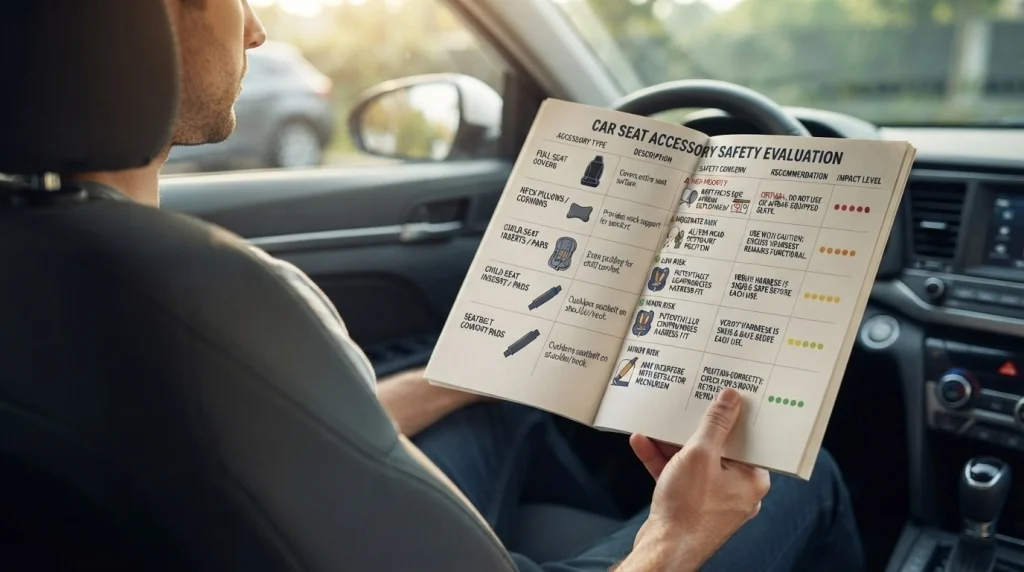
Start with the vehicle’s instructions, then verify the accessory’s intended application. A seller’s compatibility claim should not override a restriction in the owner’s manual.
I recommend following a consistent checklist before purchasing or installing any seat accessory.
Step 1: Read Your Vehicle Owner’s Manual
Look for sections covering airbags, seats, occupant detection, child restraints, and interior accessories. Pay attention to explicit warnings against added seat covers or cushions.
If the manual prohibits a product type, do not install it. A third-party seller’s reassurance does not cancel the restriction.
Step 2: Identify Your Seat’s Safety Features
Check which systems are present in your specific seating position.
- Seat-mounted side airbags.
- Passenger occupant detection.
- Seat belt anchors or buckles integrated into the seat.
- Built-in heating or ventilation.
- Power seat movement and electrical components.
- Child restraint anchor points.
Some features may not be obvious from a visual inspection. Use manufacturer documentation rather than guessing.
Step 3: Confirm Exact Product Compatibility
Check whether the accessory manufacturer identifies your vehicle and seat configuration. Universal sizing is not the same as confirmed safety compatibility.
Ask for the following information:
- Supported vehicle makes, models, and years.
- Applicable front or rear seating positions.
- Side airbag compatibility documentation.
- Restrictions involving occupant detection systems.
- Installation instructions and safety warnings.
- Relevant product testing information, where available.
Be cautious when the product listing lacks a manufacturer name, detailed instructions, or verifiable support information.
Step 4: Check for Recalls and Safety Concerns
Check the product manufacturer for relevant warnings or recalls. For U.S. vehicles and equipment, the NHTSA recall search provides official safety information.
Remember that the absence of a recall does not prove a product is safe. It only means you have not identified a relevant recall through that search.
Step 5: Follow the Approved Installation Method
Install only accessories that both the vehicle and product instructions permit. Never modify airbag seams, wiring, seat frames, or restraint hardware to make an accessory fit.
For a permitted seat cover, check these basic installation points:
- Park the vehicle safely and follow the accessory instructions.
- Identify prohibited attachment areas and safety components.
- Position the cover exactly as the instructions require.
- Secure the approved fasteners without modifying seat hardware.
- Confirm that buckles, controls, and seat movement remain unobstructed.
- Check that the cover stays stable under ordinary seat adjustment.
These checks supplement manufacturer instructions. They cannot establish airbag compatibility through a home test.
Step 6: Inspect the Seat After Installation
Check the seating position before driving. The added material should not force the occupant into an unsafe posture.
Confirm these conditions:
- The lap belt rests low across the hips.
- The shoulder belt crosses the chest correctly.
- The seatback and head restraint remain adjustable.
- No accessory obstructs the seat buckle or anchors.
- No new airbag or restraint warning appears.
- Seat controls operate without snagging straps or fabric.
Do not continue using an accessory if it shifts unexpectedly, obstructs a safety component, or causes an abnormal warning.
Remove the accessory when safe to do so, following the manufacturer’s instructions. Have persistent warning lights inspected by a qualified technician.
Red Flags When Shopping Online
Online descriptions often focus on style and comfort instead of safety documentation. Treat unsupported promises carefully.
- Universal safety claims: The seller promises compatibility with every vehicle.
- No model information: The listing lacks a verified fitment guide.
- No installation manual: Important restrictions are missing.
- Unclear airbag claims: Safety labels appear without supporting details.
- Unverified certifications: The seller displays unspecified approval logos.
- Altered safety equipment: Installation requires changes to seat wiring or restraint components.
A trustworthy listing should help you establish whether the product suits your application. Attractive photographs and customer ratings cannot replace technical compatibility information.
Section Takeaway: Read the manual, verify fitment, examine safety documentation, and inspect the installation. If a critical compatibility question remains unanswered, choose another solution.
What Are Safer Alternatives to Seat Accessories?
The safest alternative depends on why you wanted the accessory. Often, you can solve the underlying problem without adding anything to a restraint-sensitive area.
For Upholstery Protection
Instead of covering an airbag-equipped seat, consider the cleaning and maintenance methods approved by your vehicle manufacturer.
- Vacuum seats regularly using a suitable attachment.
- Clean spills using approved interior products.
- Use manufacturer-permitted upholstery care methods.
- Repair damaged factory trim through an appropriately qualified service provider.
- Use a vehicle-specific protective cover only when expressly permitted.
Cleaning the original upholstery preserves its design without introducing additional fabric over safety components.
For Back Support and Driving Comfort
Start with your existing seat adjustments. Seat height, backrest angle, and steering wheel position can influence comfort significantly.
Try the following adjustments before buying extra padding:
- Set the seat distance for comfortable pedal operation.
- Adjust the backrest so your shoulders receive suitable support.
- Use the factory lumbar adjustment, if available.
- Set the head restraint according to the owner’s manual.
- Confirm that your seat belt fits correctly.
If discomfort persists, consider professional guidance on driving ergonomics. Avoid assuming a thick cushion will improve posture for every driver.
For Seat Heating and Cooling
Use factory-installed heating or ventilation systems when available. These systems are integrated into the vehicle’s original seat design.
If your car lacks these features, ask a qualified automotive specialist about manufacturer-permitted options. Avoid unverified heating pads and improvised wiring.
For Better Interior Organization
Use existing storage compartments before attaching organizers to safety-sensitive seat areas. Door pockets, center consoles, and secured cargo storage may meet your needs.
Keep heavy objects secured rather than hanging them behind a passenger’s head or near restraint components.
For Child Seat Comfort
Use the padding and adjustment features supplied or specifically approved by the child restraint manufacturer. Correct harness height, recline, and positioning matter more than decorative accessories.
For cold weather, consider covering the child with a blanket over a correctly secured harness when permitted. Avoid bulky material underneath the harness.
Pro tip: Consult the child seat manual and a certified child passenger safety technician before making changes intended to improve a child’s seating comfort.
Section Takeaway: Factory features, proper adjustment, and approved maintenance often provide safer solutions than additional seat accessories.
Frequently Asked Questions About Aftermarket Car Seat Accessories
1. Are aftermarket car seat covers safe with side airbags?
Only when their use is permitted by the vehicle manufacturer and the product is appropriate for that specific seat. Some vehicles prohibit aftermarket seat covers entirely. An airbag-compatible label does not guarantee proper deployment, so always verify the manufacturer’s restrictions first.
2. Can an aftermarket seat cushion affect airbag sensors?
Yes. Certain passenger occupancy systems can be affected by additional seat materials or padding. The effect depends on the vehicle and its detection technology. Check the owner’s manual before placing a cushion on an airbag-equipped passenger seat.
3. Are universal car seat covers safe?
Universal covers are not automatically unsafe, but their fit alone cannot establish compatibility. A product may fit the seat dimensions while interfering with airbags or controls. Verify whether your vehicle manufacturer permits covers and whether the product has suitable application documentation.
4. Is it safe to use aftermarket accessories with a baby car seat?
Avoid additional child restraint accessories unless the seat manufacturer specifically permits them. Extra inserts, harness covers, and padding can change harness fit or crash performance. Use the original components and follow the child restraint manual for any replacement or approved accessory.
5. Do aftermarket seat covers void a car warranty?
Installing an aftermarket accessory does not automatically void every vehicle warranty in the United States. However, coverage for related damage can depend on the circumstances and applicable warranty law. Review the warranty terms and ask the manufacturer about your specific installation.
6. How do I know if a car seat accessory is safe?
Check the vehicle owner’s manual, accessory instructions, fitment information, and any relevant manufacturer approval. Look for credible technical documentation rather than relying on marketing labels. If a product could interfere with airbags, seat belts, sensors, or child restraints, avoid it until compatibility is confirmed.
7. Are expensive aftermarket seat accessories safer than cheap ones?
Price alone does not determine safety. An expensive cover can still be incompatible with your vehicle, while a simpler product may present fewer concerns. Prioritize manufacturer instructions, documented compatibility, construction quality, and correct installation rather than cost or appearance.
Final Verdict:
Aftermarket car seat accessories are not all unsafe, but they should never be treated as harmless decorations. Covers, cushions, heating pads, and child restraint add-ons need particular attention because they may affect crash protection systems.
Before buying an accessory, identify exactly what it changes and check whether your vehicle manufacturer permits it. If safety compatibility remains uncertain, keep the original seat configuration.
Ready to improve your car’s comfort or appearance? Start with the owner’s manual, prioritize manufacturer-approved solutions, and protect the safety systems your vehicle already provides.

Daniel Brooks is an automotive writer and product researcher focused on car accessories, car tech, maintenance, and practical driving guides. At Plug-in Car World, he helps drivers make smarter automotive decisions through honest reviews and research-driven content.
