
Understanding Car Seat Safety Standards: A Complete Guide for Safer Driving
Quick Answer
Understanding car seat safety standards means knowing how vehicle seats, child restraints, seat belts, airbags, and interior materials contribute to occupant protection. In the United States, federal safety standards establish requirements for these systems, while NHTSA car seat safety guidance helps families select and install appropriate child restraints.
Essential Safety Standards to Understand
- Crash protection: Child restraints must meet applicable federal performance requirements for occupant protection.
- Airbag compatibility: Aftermarket seat covers must not interfere with seat-mounted airbags or other safety features.
- Seat belt access: Covers must preserve buckles, belt routing, and restraint operation.
- Material safety: Federal flammability requirements apply to specified materials in new vehicles.
- Child seat compatibility: Replacement padding and covers should have the child restraint manufacturer’s approval.
- Correct installation: Even compliant safety equipment cannot provide its intended protection when used incorrectly.
My Practical Safety Rule
- Check compatibility first: Confirm the vehicle manual, restraint instructions, product fitment, and airbag restrictions before adding any cover.
Car seat safety involves much more than choosing comfortable upholstery or buying a child seat with impressive marketing claims. Every component around a passenger can influence protection during a collision.
When I evaluate interior accessories, I start with compatibility and safety before considering appearance. This guide explains the major regulations, what they mean in everyday driving, and how to recognize potentially unsafe seat covers.
In This Guide
What Are Car Seat Safety Standards?
Car seat safety standards are regulatory requirements that address how seating and restraint equipment must perform under specified conditions. They help reduce injury risks by establishing measurable requirements for vehicle components and child restraint systems.
One important distinction often gets overlooked. A vehicle’s factory seat, a child’s safety seat, and a removable seat cover are different products with different regulatory obligations.
Understanding the Three Types of Car Seat Equipment
The word “car seat” describes several products, but their purposes are not interchangeable.
- Vehicle seats: Factory-installed driver and passenger seats designed to support occupants and work with vehicle restraint systems.
- Child restraint systems: Infant seats, convertible restraints, forward-facing harness seats, and booster seats designed for children.
- Aftermarket seat covers: Removable upholstery accessories used to protect, change, or improve the feel of vehicle seats.
A child restraint is specialized crash-protection equipment. A decorative cover does not become a certified child restraint simply because both products carry the words “car seat.”
What Do Safety Standards Evaluate?
Regulators use defined testing procedures to assess whether equipment meets applicable requirements. The relevant tests depend on the product and the standard.
- Impact performance: How a child restraint manages occupant movement and specified injury measurements during testing.
- Structural strength: Whether designated seating and anchorage components satisfy required strength tests.
- Restraint performance: Whether seat belt assemblies and attachment systems meet their applicable specifications.
- Fire resistance: How covered interior materials behave during prescribed flammability tests.
- Labeling and instructions: Whether required installation information, warnings, and identification markings appear on the product.
These requirements improve consistency across manufacturers. However, passing a standard does not mean a product prevents every possible injury.
Does Meeting a Standard Guarantee Safety?
No safety standard can eliminate every collision risk. Crash direction, vehicle design, occupant position, and correct equipment use all affect outcomes.
Consider a compliant child restraint installed with a loose seat belt. Its tested performance cannot be assumed when its installation differs from the manufacturer’s instructions.
The same principle applies to vehicle seat covers. A well-made cover can still create hazards if it blocks an airbag seam or prevents a buckle from latching.
Government Approval Versus Manufacturer Certification
In the United States, child restraint manufacturers generally certify their own products to applicable Federal Motor Vehicle Safety Standards. NHTSA can independently test products, investigate defects, and require recalls when necessary.
That system differs from the government individually approving every seat before sale. Claims such as “NHTSA approved” deserve scrutiny because NHTSA does not issue individual product approvals in that manner.
In my view, clear manufacturer instructions and traceable product identification matter more than impressive-looking safety badges. A trustworthy product should explain its exact purpose and compatibility.
Section Takeaway: Safety standards establish performance requirements, but correct selection, installation, and continued compatibility determine whether equipment can provide its intended protection.
Which U.S. Car Seat Safety Standards Apply in 2026?
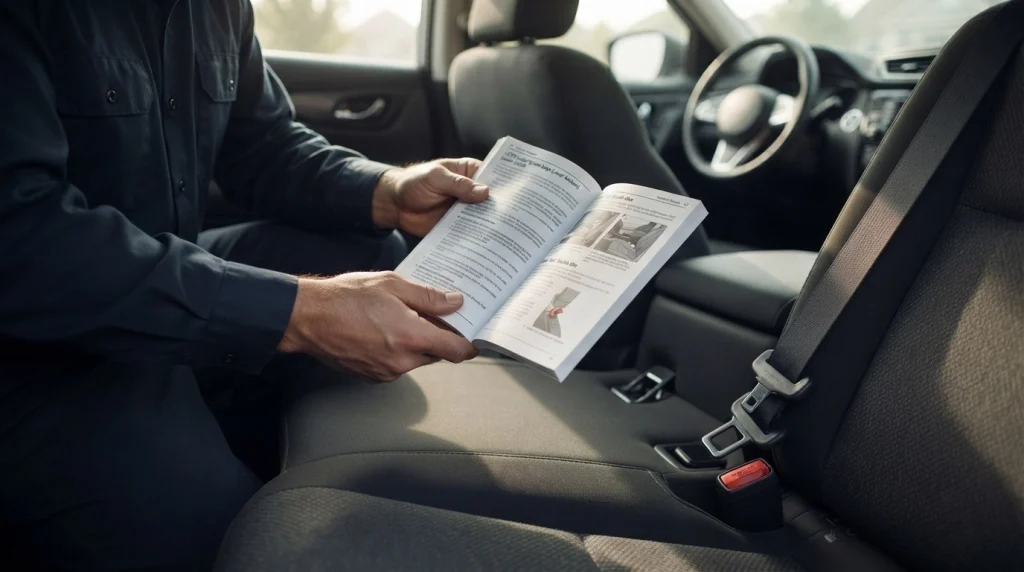
Several federal regulations influence vehicle seating safety in the United States. The most relevant standards address seating structures, belts, airbags, child restraints, anchorages, and interior materials.
As of November 2026, an important child restraint regulatory transition is approaching. The updated FMVSS No. 213b and the side-impact requirements under FMVSS No. 213a have a December 5, 2026 compliance date.
Federal Motor Vehicle Safety Standards Explained
The following comparison identifies major standards and their practical relevance.
| Standard | Main Requirement | Why It Matters |
|---|---|---|
| FMVSS 207 | Seating systems | Addresses seat and attachment strength. |
| FMVSS 208 | Occupant crash protection | Covers specified occupant protection requirements, including relevant airbag systems. |
| FMVSS 209 | Seat belt assemblies | Sets performance requirements for belt components. |
| FMVSS 210 | Seat belt anchorages | Addresses anchorage strength and location. |
| FMVSS 213 / 213b | Child restraint systems | Sets child restraint performance, construction, and labeling requirements. |
| FMVSS 213a | Child restraint side-impact protection | Adds specified side-impact performance requirements for covered child restraints. |
| FMVSS 225 | Child restraint anchorage systems | Addresses designated vehicle anchorage systems. |
| FMVSS 302 | Flammability of interior materials | Sets burn-resistance requirements for specified vehicle interior materials. |
FMVSS 213, 213a, and 213b: What Is Changing?
FMVSS 213 has long governed child restraint performance, including frontal-impact requirements. The newer FMVSS 213b updates the regulatory framework for child restraints.
FMVSS 213a introduces specific side-impact protection requirements for covered child restraint categories. It is not simply a new label that manufacturers may place on any seat.
Under NHTSA’s September 2026 final rule, mandatory compliance with FMVSS 213b and the applicable FMVSS 213a requirements begins December 5, 2026. The rule also includes particular exemptions and labeling provisions for school bus child restraints.
Manufacturers may comply early under the rule’s conditions. For exact regulatory details, consult the U.S. Department of Transportation’s 2026 final rule.
Why Does FMVSS 302 Matter for Seat Covers?
FMVSS 302 addresses the burning behavior of specified materials in vehicle occupant compartments. The standard includes original seat upholstery among the components covered by its requirements.
Its familiar test threshold limits flame spread to 4 inches per minute under specified test conditions, with additional provisions for materials that stop burning. This is a laboratory requirement, not a claim that upholstery is fireproof.
However, the federal standard does not directly certify every removable aftermarket seat cover sold to consumers. Commercial installers also face restrictions against knowingly making compliant vehicle safety features inoperative.
For shoppers, material test documentation is useful when available. Still, a claim about flame resistance cannot establish airbag compatibility or correct fitment.
Are All Seat Covers Federally Safety-Certified?
No. NHTSA has explained that no FMVSS directly applies to ordinary aftermarket slip-on seat covers as a separate product category.
Manufacturers remain responsible for safety-related defects in motor vehicle equipment. That distinction means buyers should evaluate product-specific evidence rather than assume every cover received an official government safety approval.
Pro tip: Consult your vehicle owner’s manual and the applicable NHTSA information before modifying seating or restraint components.
Section Takeaway: U.S. seating standards cover different equipment and risks. A removable cover does not automatically inherit the original seat’s compliance or prove its own airbag compatibility.
Are Aftermarket Car Seat Covers Safe?
Aftermarket car seat covers can be suitable when they are compatible with the vehicle and installed correctly. The main concerns involve airbags, seat belts, electrical equipment, child restraints, and unintended interference with seat controls.
I would never judge safety from appearance alone. A cover that looks perfectly fitted can still conceal a critical deployment seam or pull against an important component.
Why Is Side Airbag Compatibility So Important?
Many vehicles contain side airbags inside the front seatbacks. These airbags may deploy through specially designed portions of the factory upholstery during a collision.
A tightly sewn aftermarket cover can obstruct that deployment path. Even a small difference in seam construction may matter when an airbag must open rapidly.
Look for these details before purchasing:
- Vehicle-specific compatibility: The manufacturer lists the exact year, make, model, and relevant seat configuration.
- Side airbag provisions: The product addresses the seat’s actual airbag location and deployment requirements.
- Documented design: The seller can explain the compatibility basis rather than merely displaying an airbag icon.
- Correct installation: The cover instructions identify how the product must be positioned and secured.
- Manufacturer restrictions: The vehicle owner’s manual does not prohibit the proposed accessory.
The phrase “airbag compatible” is not enough by itself. NHTSA has explained that there is no general federal requirement for aftermarket seat cover manufacturers to perform airbag compatibility testing.
Its guidance concerning seat covers and side airbags explains the safety concerns and relevant legal obligations.
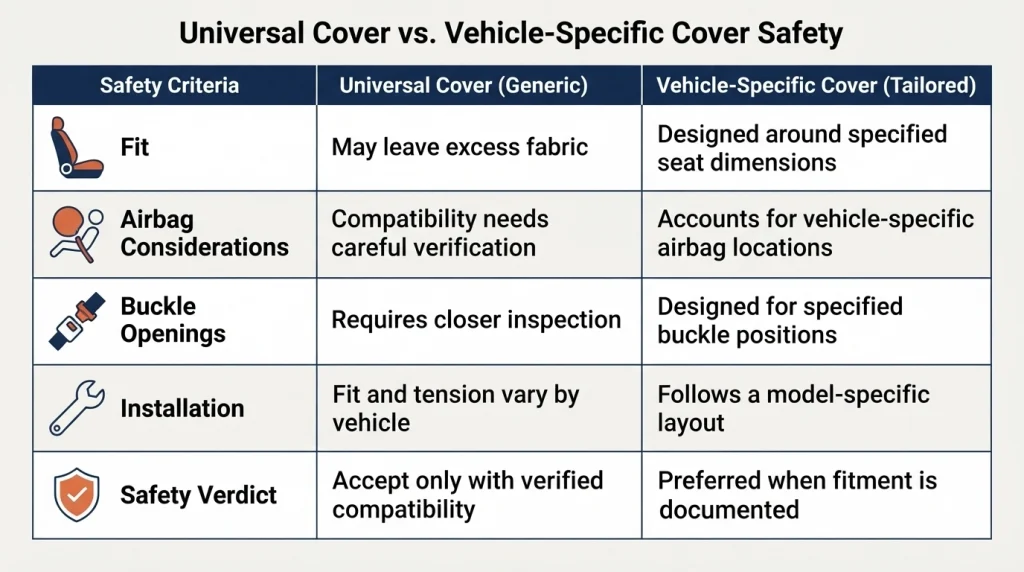
Universal Covers Versus Custom-Fit Covers
Universal covers are designed to accommodate many vehicles. Custom-fit covers target specific seating shapes, headrests, and equipment configurations.
Neither category guarantees safety. A custom-fit label must still be supported by accurate vehicle compatibility information.
| Consideration | Universal Cover | Vehicle-Specific Cover |
|---|---|---|
| Fit | May leave excess fabric or require adjustments. | Designed around specified seat dimensions. |
| Airbag considerations | Compatibility needs careful verification. | May account for vehicle-specific airbag locations. |
| Buckle openings | May require closer inspection. | Often designed for specified buckle positions. |
| Installation | Fit and tension vary by vehicle. | Usually follows a model-specific layout. |
| Safety verdict | Accept only with verified compatibility. | Prefer when fitment and safety requirements are documented. |
Can Seat Covers Affect Seat Belts?
Yes. A loose cover can bunch around a buckle or interfere with an integrated belt system.
Check that the lap belt sits correctly across the occupant’s pelvis and the shoulder belt crosses the chest. A cover must not force the belt into an incorrect position.
Also inspect rear seating positions. Some rear covers hide buckle receivers, child restraint anchor access points, or openings needed for split-folding seats.
What About Heated Seats and Occupant Sensors?
Heated and ventilated seating systems may have accessory restrictions in the vehicle manual. Additional material can alter how heat or airflow reaches the occupant.
Some passenger seats also contain sensors that help determine occupant classification for airbag operation. A cover or added cushion may interfere with these systems in certain vehicles.
Do not assume that a cover is acceptable merely because it includes heating or ventilation claims. Follow the vehicle manufacturer’s accessory guidance.
Which Materials Are Safest?
No upholstery material is universally safest for every vehicle. Construction, flame-resistance characteristics, fit, airbag provisions, and the manufacturer’s instructions all matter.
- Polyester blends: Common in washable covers, with performance depending on the particular material and construction.
- Neoprene-style materials: Often selected for moisture protection, but thickness and compatibility require evaluation.
- Genuine leather: Offers a distinctive surface and appearance, although it does not establish airbag safety.
- PU leather: Provides a leather-like finish with durability and temperature behavior that vary by quality.
- Mesh fabrics: Can improve airflow, provided the complete cover remains suitable for the seat.
Material marketing should never replace compatibility evidence. My preference is a clearly documented, properly fitted cover over an attractive product with vague safety claims.
Section Takeaway: Airbag compatibility, unrestricted restraint operation, and accurate fitment matter more than price, appearance, or a generic safety label.
How Can You Check Child Car Seat Safety?
A child car seat should meet the regulations applicable where it is sold and used. It must also accommodate the child’s size and fit the vehicle correctly.
The easiest starting point is the product’s permanent labeling and manual. Missing identification, unclear instructions, or conflicting claims are reasons to investigate before use.
Check the Manufacturer’s Certification Label
For a U.S.-market child restraint, look for a certification statement identifying compliance with applicable Federal Motor Vehicle Safety Standards. Also locate the model number, manufacture date, and manufacturer information.
Check that all important information remains readable. A seller’s online description is not a substitute for proper product labeling.
Useful details include:
- Model identification: The exact restraint model and any relevant version information.
- Manufacture date: Used with the manufacturer’s instructions to determine the permitted service life.
- Child size limits: The approved height and weight ranges for each available use mode.
- Installation instructions: Approved belt paths, anchorage arrangements, and required accessories.
- Safety warnings: Important restrictions about positioning, airbags, and correct use.
What Is the Difference Between Rear-Facing and Forward-Facing Seats?
Rear-facing restraints support a young child’s head, neck, and body during a crash. Children should remain rear-facing until reaching the applicable height or weight limit of their restraint.
Forward-facing harness seats are intended for children who have outgrown rear-facing use under the seat manufacturer’s limits. Many forward-facing installations require use of the top tether for maximum protection.
Booster seats serve a different purpose. They position the vehicle’s lap-and-shoulder belt correctly on a child who has outgrown a harnessed restraint.
What Is LATCH, and Does It Improve Safety?
LATCH means Lower Anchors and Tethers for Children. It provides designated attachment points for compatible child restraint installations in U.S. vehicles.
A correctly used seat belt installation can also be safe. The important factor is following both manuals and achieving the required fit, rather than assuming one installation method is always superior.
Do not combine lower anchors and a seat belt unless both manufacturers specifically permit that arrangement. Observe the stated lower-anchor weight limits.
How Do You Test Installation Tightness?
For a typical U.S. child restraint installation, check movement at the designated belt path. NHTSA advises that the installed restraint should move no more than 1 inch from side to side or front to back there.
That is approximately 2.5 centimeters. Movement elsewhere on the seat is not the same measurement.
Also check the following:
- Rear-facing angle: Follow the restraint’s recline indicator and instructions.
- Harness routing: Use the specified shoulder-height position for the child’s direction of travel.
- Harness tightness: Remove slack until excess webbing cannot be pinched at the shoulder.
- Chest clip: Where supplied, position it according to the manufacturer’s instructions, typically at armpit level.
- Top tether: Attach and tighten it where required for the restraint’s forward-facing configuration.
Can You Put an Aftermarket Cover on a Child Car Seat?
Do not add an unapproved cover or extra padding to a child restraint. Components placed under or behind a child may change harness fit or introduce unintended compression during a crash.
Even an attractive replacement fabric may differ from the tested original. The safest approach is to use the original cover or a replacement explicitly approved for that exact restraint model.
A removable cover for the vehicle’s rear bench is a separate accessory. It must still preserve access to child restraint anchorages, belts, and the correct installation position.
What About Used or Previously Crashed Child Seats?
Before using a secondhand restraint, establish its complete history and inspect its condition. Verify that the model has not been recalled and that all required components are present.
Follow the manufacturer’s expiration and crash-replacement instructions. NHTSA recommends replacement after moderate or severe crashes and provides specific criteria for evaluating minor crashes.
Pro tip: If a restraint’s history or installation is uncertain, seek help from a certified Child Passenger Safety Technician rather than guessing.
Section Takeaway: Child seat compliance begins with trustworthy labeling, but proper child fit, vehicle compatibility, and manufacturer-approved accessories are equally important.
How Do International Safety Standards Compare?
Car seat safety regulations differ by country. A restraint legally sold in one market does not automatically satisfy the requirements of another.
This is especially important when buying imported child seats online. Familiar-looking certifications may refer to different testing systems.
United States: FMVSS Requirements
U.S. child restraints must meet applicable federal standards, including requirements under FMVSS 213 or 213b during the regulatory transition. The relevant standards include crash-performance testing and mandatory product information.
Manufacturers certify compliance, while NHTSA oversees enforcement. Local child passenger laws separately determine requirements for children traveling in individual states.
Europe: UN Regulation No. 129
UN Regulation No. 129, often associated with i-Size seats, provides a framework for child restraint approval in Europe and other participating markets. It emphasizes height-based classifications and includes side-impact requirements.
Not every R129 seat carries the specific i-Size vehicle-compatibility designation. Buyers must check the approval label and the restraint’s vehicle fitment information.
In the European Union, older R44 child restraints can no longer be newly placed on the market under the September 2024 transition. Consumers should check national rules concerning any previously purchased seats.
The European Commission’s 2026 child car seat testing update reinforces the need to verify markings and product conformity.
Canada: CMVSS Requirements
Canadian child restraints use Canadian Motor Vehicle Safety Standards, including applicable CMVSS 213-series requirements. Approved products carry the appropriate National Safety Mark.
The Canadian marking is important when purchasing restraints for the Canadian market. An imported seat with only a different country’s approval should not be assumed to meet Canadian requirements.
Quick International Comparison
| Market | Relevant Standard | What Buyers Should Check |
|---|---|---|
| United States | FMVSS 213 / 213b and applicable 213a | Federal compliance certification and manufacturer instructions. |
| European Union | UN R129 | Valid approval label, child height range, and vehicle compatibility. |
| Canada | CMVSS 213-series | Canadian National Safety Mark and approved use instructions. |
Different approval systems should not be treated as interchangeable without official confirmation. When moving between countries, verify the rules applicable at your destination.
Also distinguish child restraint regulations from ordinary upholstery requirements. An international certification for a child seat does not automatically certify a separate aftermarket vehicle seat cover.
How Do You Install and Maintain Seat Covers Safely?
Safe seat cover installation starts before stretching fabric over the seat. You need to confirm that the accessory is permitted and identify everything it could obstruct.
My approach is to inspect the seat with the cover completely removed. It makes the original belt routing, controls, and airbag warning labels easier to identify.
Step-by-Step Seat Cover Safety Checklist
- Read the vehicle manual. Find the sections covering seat-mounted airbags, occupant sensors, seat heating, restraint systems, and approved accessories.
- Confirm exact fitment. Match the cover to the vehicle year, model, seat type, headrest configuration, and other applicable equipment.
- Identify airbag locations. Check manufacturer markings and documentation before covering any seatback side.
- Follow the cover instructions. Position the fabric and fastening components exactly as specified, without altering safety-related seat parts.
- Keep belt hardware accessible. Make sure buckles, belt paths, and child restraint anchorages remain unobstructed.
- Check seat movement. Confirm that the cover does not catch on tracks, reclining mechanisms, folding releases, or headrest adjustments.
- Inspect electrical functions. Confirm that permitted seat controls work normally and that no new warning lights appear.
- Repeat the inspection. Check for shifting, bunching, damaged seams, or loose straps after regular use.
Never cut a new opening through an airbag deployment area to make a cover fit. Do not modify an airbag seam or attempt to verify compatibility by triggering an airbag.
Where Should You Attach Cover Straps?
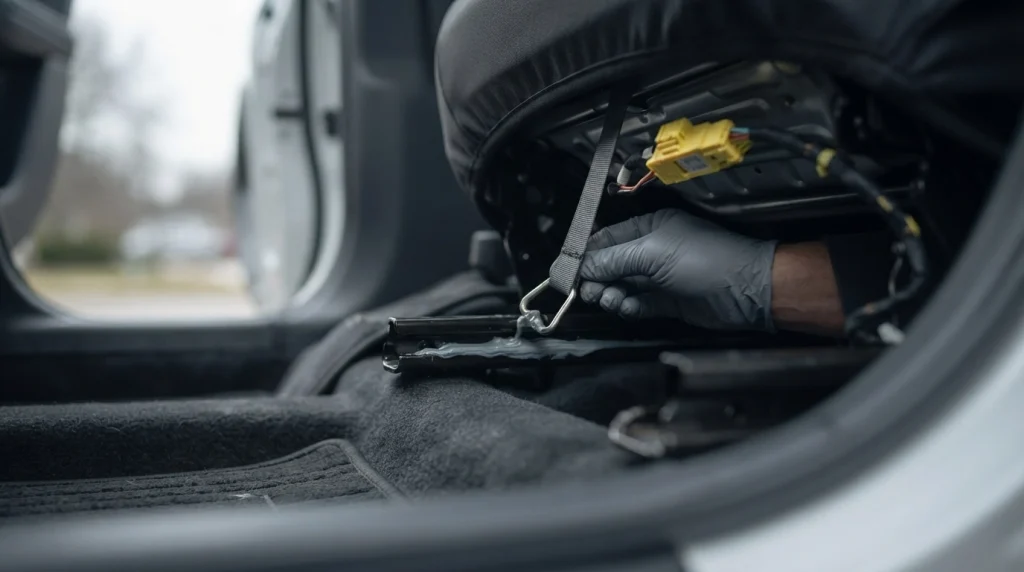
Use only the attachment points described in the cover manufacturer’s instructions and permitted by the vehicle manufacturer. Never route straps around seat wiring, yellow SRS connectors, belt tensioners, or moving mechanical parts.
SRS means Supplemental Restraint System, which includes equipment such as airbags and certain crash-related components. These systems require special care during service.
If installation requires disconnecting wiring or removing a seat, stop and consult the factory service information. A qualified technician should handle work involving sensitive restraint components.
Can Seat Covers Change Child Seat Installation?
Yes. An added layer under a child restraint may alter positioning, grip, or belt-path access.
Some child restraint manufacturers permit certain vehicle seat protectors, while others restrict or prohibit them. Only use a protector or cover when both the child restraint and vehicle instructions allow it.
If permitted, reinstall and verify the child seat after fitting the cover. Do not assume the previous installation remains tight.
How Often Should You Inspect Seat Covers?
A brief visual check before driving can reveal obvious shifting or buckle interference. Inspect more thoroughly after washing, reinstalling, or adjusting a cover.
Pay attention to these warning signs:
- Excess fabric: Material gathers around the seat belt or seating controls.
- Damaged seams: Stitching separates near a designated airbag provision.
- Loose fasteners: Straps move into seat tracks or surrounding mechanisms.
- Blocked access: Buckles or child restraint anchors are harder to use.
- Unexpected warnings: A new airbag or occupant-detection warning appears.
- Unusual heating: An approved heated-seat arrangement behaves abnormally.
Remove a questionable cover rather than ignoring the problem. If the vehicle displays an SRS warning, arrange an appropriate professional inspection.
How Should You Clean Covers Without Damaging Them?
Follow the material manufacturer’s washing instructions. Excessive heat, harsh chemicals, or incorrect drying can damage fabrics, coatings, elastic components, and stitching.
For removable covers, inspect every attachment and safety-related opening after cleaning. A changed fit may be just as important as visible fabric damage.
For child restraints, use only the cleaning procedures and removable components authorized by their manufacturer. Never soak harness webbing or apply unapproved chemicals when the manual prohibits them.
When Should You Contact a Professional?
A qualified technician is appropriate when seat covers conflict with airbag locations, electrical equipment, or complicated seat structures. A certified child passenger safety technician can assist with child restraint installation questions.
Before purchasing replacement equipment, check the vehicle and relevant products through the NHTSA recall lookup. The database covers vehicles, car seats, tires, and other automotive equipment.
Pro tip: Never disconnect, remove, or modify airbag equipment merely to install an accessory. Follow factory service procedures and seek a trained professional when required.
Section Takeaway: A safe cover must preserve the original seat’s intended functions. Installation quality, periodic inspections, and proper cleaning all help maintain that compatibility.
Frequently Asked Questions About Car Seat Safety Standards
1. What is the main safety standard for child car seats in the United States?
FMVSS 213 governs child restraint systems during the current transition, with updated FMVSS 213b becoming mandatory on December 5, 2026. Applicable side-impact requirements under FMVSS 213a also have that compliance date.
Manufacturers must certify their products to the requirements applicable to them.
2. Are aftermarket car seat covers required to be crash-tested?
There is no general U.S. federal motor vehicle safety standard requiring every aftermarket slip-on seat cover to undergo a specific crash test. However, manufacturers remain responsible for safety-related defects.
Drivers should seek documented vehicle compatibility, especially for seats containing side airbags.
3. Can I use a universal seat cover with side airbags?
Only when the cover is compatible with the exact vehicle and the vehicle manufacturer’s instructions permit its use. Universal sizing alone does not establish airbag compatibility.
If the manufacturer cannot confirm suitability, avoid installing the cover on that seat.
4. Does FMVSS 302 mean a seat cover is fireproof?
No. FMVSS 302 establishes a specified flammability performance requirement for covered vehicle interior materials.
Meeting its test criteria does not mean a material cannot ignite under any circumstances. It also does not establish crash performance or airbag compatibility.
5. Is an expensive child car seat safer than a cheaper one?
Price alone does not prove better protection. A properly certified restraint that fits the child, fits the vehicle, and is installed correctly can be an appropriate choice.
Focus on applicable safety standards, clear instructions, usable features, and the manufacturer’s size limits.
6. Can I replace my child’s car seat cover with a different brand?
Do not use a third-party replacement unless the child restraint manufacturer explicitly approves it for that specific model. Unapproved fabric or padding may change harness positioning, compression, or other safety characteristics.
Original or manufacturer-approved replacement covers are the safer choice.
7. How do I know whether my car seat or cover has been recalled?
Use the official safety recall database for your market and check the exact model information. In the United States, NHTSA provides recall searches for child restraints, vehicles, and certain equipment.
Register eligible products with their manufacturers so you can receive relevant safety notifications.
Final Thoughts: Put Safety Before Appearance
Understanding car seat safety standards helps you make smarter decisions about child restraints, vehicle upholstery, and interior accessories. The central lesson is simple: compliance, compatibility, and correct installation must work together.
Before buying a new seat cover, check your owner’s manual, confirm the product’s fitment, and identify any airbag or seat belt restrictions. If the safety information is unclear, choose a better-documented product or consult a qualified professional.
Protect the safety features your vehicle already has. A comfortable, attractive interior should never come at the expense of reliable occupant protection.

Daniel Brooks is an automotive writer and product researcher focused on car accessories, car tech, maintenance, and practical driving guides. At Plug-in Car World, he helps drivers make smarter automotive decisions through honest reviews and research-driven content.
