
How Child Car Seats Reduce Injury Risk: The Science Behind Crash Protection
Quick Answer
Child car seats reduce injury risk by distributing crash forces across stronger parts of a child’s body, limiting dangerous movement, and supporting the head, neck, and spine. Rear-facing seats protect young children by cradling their entire body, forward-facing harnesses control movement, and booster seats position vehicle seat belts correctly. Choosing the right seat and installing it correctly are essential for effective protection. The CDC’s child passenger safety guidance explains these protective stages.
How car seats help prevent injuries
- Crash force distribution: Spreads impact forces across stronger areas of the body.
- Head support: Helps control head movement and reduce stress on the neck.
- Body restraint: Keeps children securely positioned during sudden deceleration.
- Movement control: Reduces excessive forward movement during a collision.
- Seat belt positioning: Helps prevent adult seat belts from crossing a child’s stomach or neck.
One important safety check
- Check the seat’s height and weight limits, installation, harness tightness, and expiration date before every trip.
A sudden collision can expose a child’s body to powerful forces in a fraction of a second. Even a relatively short journey can involve serious risks when a child isn’t properly restrained.
I approach child passenger safety by looking at three things: how a seat supports a child’s body, how it controls movement, and how securely it connects to the vehicle. Understanding these details makes it easier to see why choosing the correct restraint matters.
In this guide, I’ll explain how child car seats reduce injury risk, what happens during a crash, and which everyday safety checks make the biggest difference.
What Is a Child Car Seat and How Does It Protect Children?
A child car seat is a specially designed restraint system that holds a child in a position suited to their size and developmental stage. It works with the vehicle’s safety structure to help reduce injuries during sudden stops and collisions.
Unlike an adult seat belt, which assumes a larger body shape, a child restraint provides support where a young passenger needs it most.
Children have different body proportions from adults. Their heads are relatively large, their necks are less developed, and their bones and body structures are still growing.
A properly selected car seat addresses these differences through several protective features:
- Protective shell: Surrounds and supports the child’s body.
- Internal harness: Holds the child securely in the seat.
- Energy management materials: Help absorb or manage crash energy, depending on the seat design.
- Reclining positions: Help maintain an appropriate position, particularly for infants.
- Vehicle attachment points: Connect the restraint to the vehicle through an approved installation method.
The important distinction is that a car seat doesn’t stop a collision from happening. It helps manage what happens to the child’s body when the vehicle experiences an impact.
How Do Child Car Seats Reduce Injury Risk During a Crash?
Child car seats reduce injury risk by controlling how a child’s body moves and how crash forces affect different body parts. Several protective mechanisms work together rather than relying on one individual feature.
1. They distribute crash forces across the body
During a collision, a moving vehicle can slow down extremely quickly. An unsecured child continues moving forward because of inertia.
A properly fitted restraint helps distribute the resulting forces across stronger areas of the child’s body instead of concentrating them in vulnerable areas.
For example, a five-point harness spreads restraint forces across the shoulders, hips, and pelvis. This helps avoid relying on a single narrow section of the body to control movement.
That distribution matters because concentrated forces can increase the likelihood of serious injuries.
2. They support the head, neck, and spine
Young children have relatively large heads compared with their bodies. Their neck muscles and spinal structures are also still developing.
Rear-facing car seats provide particularly important support because the seat’s back supports the child’s head, neck, and torso together during a frontal collision.
Instead of allowing the head to move forward independently, the restraint helps distribute movement across the entire supported body.
3. They limit dangerous forward movement
During a frontal crash, an unrestrained child can move toward the dashboard, front seats, or other interior surfaces. A properly installed child seat helps keep the child within the protective seating area.
Forward-facing seats use an internal harness to control the child’s movement. A top tether also helps limit forward rotation of the restraint when used as instructed.
These features work together to reduce excessive movement during an impact.
4. They help prevent ejection
Being thrown from a vehicle during a collision creates an additional risk of severe injury or death. A properly installed restraint and correctly secured harness help keep the child inside the vehicle.
However, protection depends on using the correct restraint, securing it properly, and following the vehicle and seat manufacturer’s instructions.
Why Are Rear-Facing Car Seats Safer for Young Children?
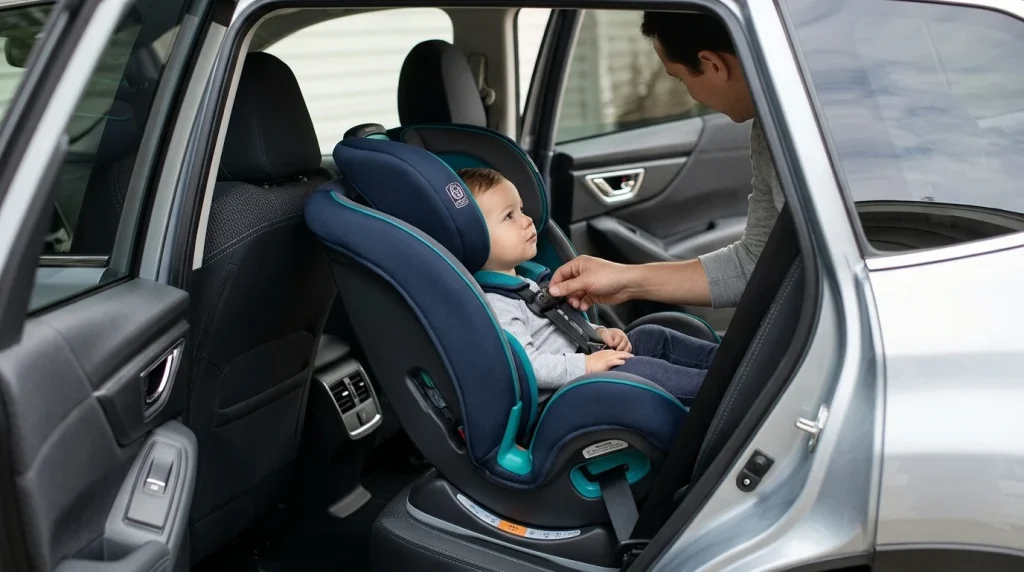
Rear-facing seats provide important protection for infants and toddlers because they support the head, neck, and back together. This arrangement helps reduce stress on a young child’s developing neck and spinal structures during a frontal collision.
In this position, the child faces the back of the vehicle rather than the windshield. The seat’s shell helps distribute crash forces over a larger area of the body.
How rear-facing protection works
Imagine a vehicle experiencing a sudden frontal impact. The vehicle slows down, but the child’s body naturally continues moving forward.
A rear-facing restraint supports the child’s back and head as the body moves into the seat. This reduces the need for the neck to control the movement of a relatively large head independently.
Several design features contribute to this protection:
- Supportive shell: Provides a protective structure around the child’s body.
- Rear-facing harness: Holds the child in the appropriate seating position.
- Recline adjustment: Helps maintain the manufacturer’s recommended seating angle.
- Energy management: Certain designs include additional materials or components that manage crash energy.
The American Academy of Pediatrics recommends keeping infants and toddlers rear-facing for as long as possible, until they reach the highest height or weight allowed by their particular seat.
That means parents shouldn’t switch to forward-facing simply because a child reaches a particular birthday.
For more details, see the American Academy of Pediatrics’ family car seat guidance.
How Do Forward-Facing Car Seats Reduce Injuries?
Forward-facing car seats reduce injury risk through an internal harness and, where provided, a top tether. These components help control the child’s movement during a collision.
Children generally move into this stage after reaching the rear-facing seat’s maximum permitted height or weight.
How the five-point harness works
A five-point harness has five restraint points: two shoulder positions, two hip positions, and one buckle between the legs.
This arrangement helps hold the child’s body in place and distribute restraint forces across several areas.
Its main protective functions include:
- Keeping the child’s upper body secured.
- Preventing excessive forward movement.
- Reducing the chance of sliding out of the restraint.
- Maintaining the child’s position during sudden deceleration.
Why the top tether matters
A top tether is a strap that connects the forward-facing car seat to a designated anchor in the vehicle.
It helps limit forward movement of the seat and reduces forward head movement during a crash.
When the manufacturer provides a tether and the vehicle permits its use, follow the instructions for connecting and tightening it.
Using the lower anchors or vehicle seat belt correctly doesn’t replace the need for the top tether when the seat and vehicle instructions require it.
How Do Booster Seats Protect Older Children?
Booster seats protect children by raising their seating position so the vehicle’s adult seat belt fits across the stronger areas of their body. They are designed for children who have outgrown their forward-facing harness seat but aren’t yet large enough for a proper seat belt fit.
An adult seat belt may not fit a smaller child correctly. The lap belt can ride across the stomach, while the shoulder belt may cross the neck or face.
A booster seat helps correct these positioning problems.
How booster seats reduce injury risk
A properly used booster positions the lap belt across the upper thighs and the shoulder belt across the center of the chest and shoulder.
This matters because the seat belt needs to interact with the child’s body in the intended way during a collision.
Booster seats help by:
- Keeping the lap belt away from the soft abdominal area.
- Positioning the shoulder belt across the chest.
- Helping children maintain a suitable seating position.
- Improving the fit of the vehicle’s existing restraint system.
The CDC reports that booster seat use reduces the risk of serious injury by 45% among children ages 4–8 compared with seat belt use alone.
Children should continue using a booster until the vehicle seat belt fits correctly without one. In US guidance, this commonly happens between ages 9 and 12.
Which Car Seat Type Provides Protection at Each Stage?
Different car seat types address different developmental needs. The most suitable option depends on the child’s height, weight, and the limits specified by the manufacturer.
| Restraint type | Main protection | When to use |
|---|---|---|
| Rear-facing seat | Supports the head, neck, and back together. | Until the rear-facing height or weight limit is reached. |
| Forward-facing harness seat | Controls forward movement through a harness and tether. | After outgrowing the rear-facing stage. |
| High-back booster | Helps position the lap and shoulder belts correctly. | After outgrowing the forward-facing harness seat. |
| Backless booster | Raises the child to improve seat belt positioning. | When the child meets the booster manufacturer’s requirements and the vehicle provides appropriate head support. |
| Vehicle seat belt | Restrains a sufficiently large child using the vehicle’s lap and shoulder belt. | When the belt fits correctly without a booster. |
These stages aren’t interchangeable. Moving a child into the next stage before they reach the previous seat’s limits can reduce the protection available to them.
The AAP also emphasizes delaying transitions because each move to a less restrictive restraint can reduce some protection.
How Much Do Car Seats Reduce the Risk of Child Injuries?
Research shows that correctly used child restraints can substantially reduce injuries and fatalities. However, the exact benefit depends on the child’s age, restraint type, crash circumstances, and correct use.
According to the CDC’s published child passenger safety guidance:
- Car seats: Reduce the risk of injury by 71–82% for children compared with seat belt use alone.
- Booster seats: Reduce the risk of serious injury by 45% for children ages 4–8 compared with seat belt use alone.
- Seat belts: Reduce the risk of death and serious injury by about half for older children and adults.
These figures describe population-level findings, not a guarantee that a particular child will avoid injury in every collision.
They also don’t mean every restraint provides identical protection. The child’s size, correct installation, and the type of crash all matter.
For additional research context, the National Highway Traffic Safety Administration’s child restraint evidence discusses estimated reductions in fatalities and injuries.
Can an Incorrectly Installed Car Seat Increase Injury Risk?
Yes. An incorrectly installed car seat can lose some of its intended protective effectiveness because the restraint may not control movement as designed.
A seat can have excellent safety features and still provide inadequate protection if it’s loose, incorrectly angled, or poorly fitted to the child.
The CDC identifies several common car seat mistakes:
- Installing the seat too loosely.
- Using an incorrect rear-facing recline angle.
- Leaving the harness too loose.
- Placing harness straps behind the child’s arms, legs, or back.
- Positioning booster seat belts incorrectly.
How to check whether the installation is secure
Start with the car seat manual and the vehicle owner’s manual. Both documents matter because installation requirements differ between models and vehicles.
Use this practical checklist:
- Check the belt path: Pull the seat near its designated belt path. Under NHTSA guidance, it should not move more than one inch from side to side or front to back.
- Check the recline: Confirm that a rear-facing seat uses the correct angle indicated by its manufacturer.
- Check the harness: Remove slack so the harness fits snugly against the child’s body.
- Check the chest clip: For seats equipped with a chest clip, position it at armpit level according to the instructions.
- Check the tether: Use the top tether for a forward-facing seat as directed by the manufacturer and vehicle instructions.
A useful harness check is the pinch test. If you can pinch excess harness webbing vertically at the child’s shoulder, the harness needs tightening.
For installation instructions, visit NHTSA’s official car seat installation guide.
Why Should Children Ride in the Back Seat?
The back seat is generally the safer location for children because front passenger airbags can create serious risks for smaller occupants.
A deploying frontal airbag can strike a young child with considerable force. This is especially dangerous when a rear-facing seat is placed in front of an active passenger airbag.
For this reason, a rear-facing child seat should never be installed in front of an active frontal passenger airbag.
US CDC and NHTSA guidance recommends keeping children in the back seat until at least age 13. Local vehicle laws and safety recommendations may differ.
Parents should also make sure that every passenger wears an appropriate restraint. Adults setting a good example can help children develop consistent seat belt habits.
What Other Factors Affect Car Seat Protection?
Installation isn’t the only factor that determines how effectively a car seat protects a child. The seat’s condition, compatibility, fit, and everyday use also matter.
Car seat expiration dates
Car seats have manufacturer-defined expiration periods. Materials can deteriorate over time, and manufacturers may no longer support older designs with replacement parts or updated instructions.
Check the expiration date printed on the seat or specified in its manual. Don’t assume an older seat remains safe simply because it looks undamaged.
Previous crash involvement
A car seat involved in a crash may have damage that isn’t immediately visible. Whether it can be reused depends on the crash circumstances and the manufacturer’s replacement instructions.
Follow the manufacturer’s guidance and applicable local requirements rather than making a visual judgment alone.
Recalls and product registration
A recall may identify a problem affecting a seat’s performance or safe use. Registering the product with its manufacturer helps caregivers receive important safety notices.
For US-market products, the NHTSA recall database provides a way to check for relevant safety recalls.
Bulky clothing and harness fit
Heavy jackets can compress during a collision, leaving unexpected slack between the harness and the child’s body.
Buckle the child securely without bulky clothing underneath the harness. A blanket or coat can be placed over the secured harness when needed.
Which Car Seat Features Should Parents Look For?
The best car seat isn’t necessarily the most expensive model or the one with the greatest number of extra features. It should fit the child, fit the vehicle, meet applicable safety standards, and allow correct installation.
Before choosing a model, consider these features:
- Suitable size limits: Look for height and weight ranges that match your child’s current measurements.
- Reliable harness adjustment: Choose a design that allows you to achieve a snug, appropriate fit.
- Clear installation instructions: Simple, understandable instructions make correct use easier.
- Suitable recline positions: Particularly important for infants using rear-facing seats.
- Vehicle compatibility: Confirm that the seat can be installed correctly in your particular vehicle.
- Product certification: Check compliance with the safety regulations applicable in your country.
- Manufacturer support: Look for accessible manuals, recall information, and replacement-part guidance.
Extra features should never distract from the basics. Correct fit and installation remain essential.
Common Car Seat Safety Mistakes That Parents Should Avoid
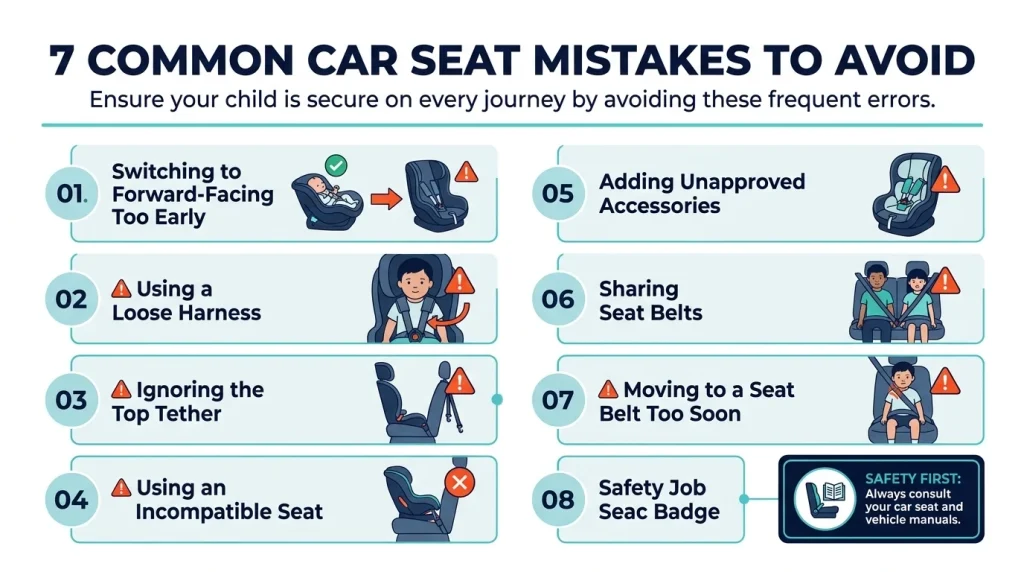
Some everyday habits can reduce the protection a car seat is designed to provide. Paying attention to a few common mistakes can make regular journeys safer.
- Switching to forward-facing too early: Keep children rear-facing until they reach the seat’s permitted limits.
- Using a loose harness: Remove excess slack and follow the manufacturer’s fitting instructions.
- Ignoring the top tether: Connect it when required for a forward-facing installation.
- Using an incompatible seat: Check that the restraint fits both the child and vehicle.
- Adding unapproved accessories: Avoid aftermarket inserts, padding, or harness accessories not approved by the manufacturer.
- Allowing children to share seat belts: Each passenger needs an individual appropriate restraint.
- Moving to a seat belt too soon: Check the actual belt fit rather than relying on age alone.
One additional point deserves attention: children should use their restraint on every trip, including short journeys. A familiar route doesn’t eliminate crash risk.
Product Examples: Car Seats That Illustrate Important Safety Features
Understanding the protective mechanisms makes it easier to evaluate different seat designs. The following products are examples of restraint features, not independently ranked safety winners.
Product availability, certification, and specifications vary by country. The examples below are US-market models, so check local approval and vehicle compatibility before considering a purchase.
Extended rear-facing example
Graco Extend2Fit Convertible Car Seat
This model offers rear-facing harness use from 4–50 lb and forward-facing harness use from 26.5–65 lb, subject to its detailed fit requirements. Its adjustable extension panel provides additional rear-facing legroom. It illustrates why extended rear-facing capacity can be useful when selecting a seat.
Older-child positioning example
Graco TurboBooster 2.0 Highback Booster
This belt-positioning booster is designed for children who have outgrown an appropriate harnessed seat. Its high-back design helps position the vehicle’s shoulder belt, while the booster raises the child for improved lap and shoulder belt fit. Always check the specific model’s height and weight requirements.
Neither product should be selected based on marketing claims alone. Compare the manufacturer’s instructions, applicable safety certification, vehicle fit, and your child’s measurements before making a decision.
Frequently Asked Questions About How Child Car Seats Reduce Injury Risk
1. Do child car seats really reduce the risk of serious injuries?
Yes. Research summarized by the CDC indicates that car seats reduce injury risk by 71–82% for children compared with seat belt use alone. However, this protection depends on selecting the correct restraint and using it properly during every journey.
2. Why are rear-facing car seats safer for babies?
Rear-facing seats support an infant’s head, neck, and back together during a frontal collision. This helps distribute crash forces across the body and reduces stress on the developing neck and spinal structures.
3. When should a child switch from a rear-facing to a forward-facing seat?
A child should remain rear-facing until reaching the maximum height or weight permitted by the specific seat. After outgrowing those limits, the child can move to an appropriate forward-facing seat with a harness and tether.
4. Can a car seat protect a child if it isn’t installed correctly?
An incorrectly installed car seat may not provide its intended level of protection. A loose installation, incorrectly positioned harness, or incorrect recline angle can interfere with how the restraint controls movement during a collision.
5. How long should children use booster seats?
Children should use a booster until the vehicle’s lap and shoulder belt fits correctly without assistance. The lap belt should cross the upper thighs, while the shoulder belt should cross the center of the chest and shoulder.
Final Takeaway: Proper Car Seat Use Makes Every Journey Safer
Child car seats reduce injury risk by controlling body movement, distributing crash forces, and supporting vulnerable areas such as the head, neck, and spine. Each restraint stage provides protection suited to a child’s changing size and development.
The most important decision isn’t simply buying a car seat. It’s choosing an appropriate model, installing it according to the instructions, and keeping the child correctly secured throughout every journey.
Take a few minutes to check your child’s seat today. Confirm its limits, inspect the harness, review the installation, and check for applicable recalls.
Remember: A correctly selected and properly used child restraint is one of the most important safety measures you can take when traveling with children.

Daniel Brooks is an automotive writer and product researcher focused on car accessories, car tech, maintenance, and practical driving guides. At Plug-in Car World, he helps drivers make smarter automotive decisions through honest reviews and research-driven content.
