
Are Baby Car Seat Mirrors Safe to Use? Risks, Expert Advice, and Safer Alternatives
Quick Answer
Are baby car seat mirrors safe to use? They may help parents see a rear-facing baby, but they are not essential safety equipment and can introduce risks. A mirror could detach during a crash, strike a passenger, or distract the driver, as reflected in NHTSA’s guidance on infant observation mirrors.
The Main Safety Concerns
- Crash hazards: A loose mirror can become a dangerous object during sudden braking or a collision.
- Driver distraction: Looking repeatedly at your baby takes attention away from traffic.
- Unverified accessories: Aftermarket mirrors are not necessarily tested with your specific car seat and vehicle.
- Mounting problems: Poorly positioned straps or attachments can interfere with vehicle safety features.
- Limited protection: A mirror cannot confirm that your baby is breathing normally or safely positioned.
Safest Practical Approach
- Avoid unnecessary accessories, keep your baby correctly restrained, and stop somewhere safe whenever your baby needs attention.
When you’re driving with a newborn, not being able to see their face can feel unsettling. A baby car seat mirror promises a convenient solution, especially when your child rides rear-facing.
However, convenience and crash safety aren’t always the same thing. I believe parents deserve to understand both before adding accessories to their vehicles.
This guide explains the real risks, what safety organizations recommend, and how to make safer travel decisions.
In This Guide
What Is a Baby Car Seat Mirror?
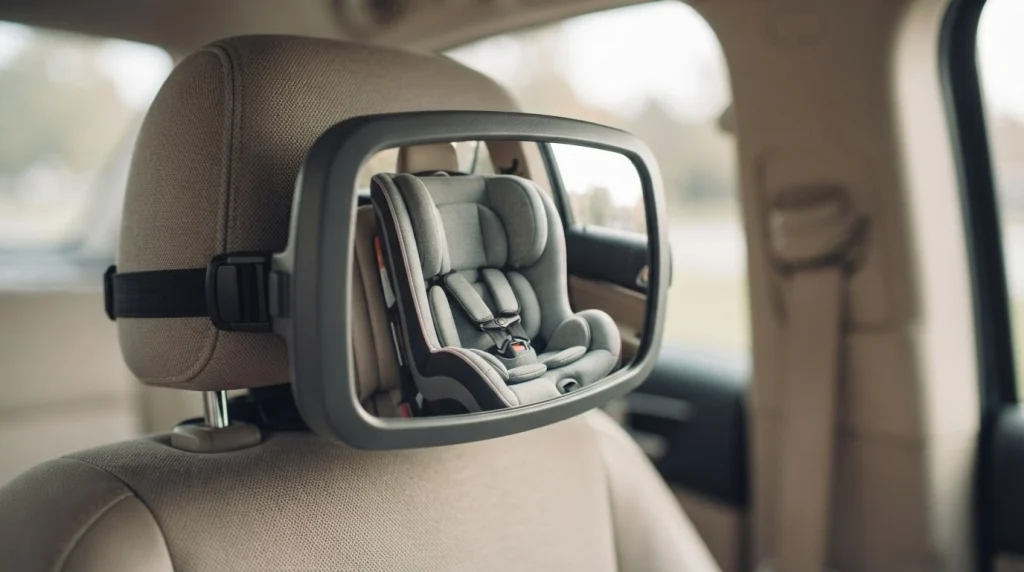
Definition: A baby car seat mirror is an accessory that helps drivers see a child sitting in a rear-facing car seat. It usually attaches to a vehicle’s rear headrest and reflects the child’s image toward the driver’s interior rearview mirror.
Rear-facing car seats support a baby’s head, neck, and spine during a crash. Their design also makes it difficult for drivers to see the baby’s face directly.
How Do Rear-Facing Baby Mirrors Work?
Most products use two reflective surfaces to provide a view of the baby. The driver looks into the vehicle’s existing rearview mirror, which reflects the additional mirror positioned behind the child.
Common designs include:
- Headrest-mounted mirrors: Attach to a rear vehicle headrest using straps or adjustable fasteners.
- Convex mirrors: Use a curved reflective surface to provide a wider viewing angle.
- Flat mirrors: Provide a less distorted reflection but usually cover a narrower area.
- Adjustable mirrors: Allow the viewing angle to change through a swivel or rotating joint.
Some models also include lights or electronic displays. These additions may introduce further distractions and mounting concerns.
Why Do Parents Consider Using Them?
The main attraction is reassurance. Parents want to know whether their baby is awake, crying, sleeping, or visibly uncomfortable.
A mirror may provide a limited view without requiring the driver to turn around. Still, seeing your baby’s face is not the same as assessing their health or safety.
For example, a reflection cannot reliably reveal breathing difficulties. A sleeping baby may also appear comfortable despite an unsafe sitting position.
My approach is to treat the mirror as an optional convenience, never as a monitoring or protective device.
Are Baby Car Seat Mirrors Actually Safe?
Baby car seat mirrors involve safety trade-offs rather than a simple yes-or-no guarantee. The biggest concerns are potential crash projectiles, driver distraction, and interference with safety equipment.
1. Can a Baby Mirror Become Dangerous During a Crash?
Yes. An accessory that detaches during a crash or abrupt stop can strike a child or another vehicle occupant.
Even a seemingly lightweight object may cause injury when it moves suddenly. A rigid mirror positioned near a rear-facing baby deserves particular caution.
Potential problems include:
- Attachment straps loosening or breaking under force.
- A rigid mirror housing striking an occupant.
- Reflective material cracking or separating from its frame.
- Mounting components detaching from the headrest.
- The mirror moving into the child’s space during a collision.
A firmly attached mirror may seem stable during everyday driving. That observation does not establish how it will behave in a serious collision.
2. Do Baby Car Seat Mirrors Distract Drivers?
They can. Every unnecessary glance toward a baby mirror takes some visual attention away from the road.
The National Highway Traffic Safety Administration’s distracted-driving guidance explains that non-driving activities can interfere with the attention required for safe driving.
A parent might intend to check the mirror briefly. However, a crying baby or an unclear reflection can encourage repeated or prolonged glances.
Common distraction scenarios include:
- Repeatedly checking whether the baby has fallen asleep.
- Adjusting the interior rearview mirror to improve the baby’s reflection.
- Trying to determine why a baby is crying while driving.
- Watching the reflection instead of monitoring nearby traffic.
One important distinction matters here. Your vehicle’s main rearview mirror should remain positioned for proper visibility behind your car.
Never compromise that view to see a child more clearly.
3. Can a Mirror Interfere With the Car Seat?
Some mirrors attach to vehicle headrests rather than the child restraint itself. That arrangement avoids direct attachment to the car seat but does not eliminate safety concerns.
Problems can arise when a mirror or its mounting system touches:
- The child restraint shell or its moving parts.
- Car seat harness straps or adjustment mechanisms.
- Vehicle head restraints that require a specific position.
- Areas needed for seat installation or proper movement during a crash.
Never drill into, modify, or attach unapproved accessories directly to a child restraint. Follow the instructions supplied by both the vehicle and car seat manufacturers.
Pro tip: Check the vehicle owner’s manual and child restraint instructions before placing anything around a headrest or car seat.
Section Takeaway: A baby mirror may improve visibility, but it does not provide crash protection. Loose mounting and distracted driving can introduce additional hazards.
What Do Child Passenger Safety Experts Say?
Several child passenger safety sources urge caution about aftermarket accessories. Their recommendations focus on avoiding unnecessary objects and preserving the protection provided by correctly installed car seats.
What Does NHTSA Say About Baby Car Seat Mirrors?
In a published interpretation involving an infant observation mirror, NHTSA explained that the relevant federal child restraint standard did not directly cover that particular aftermarket mirror. The agency also identified potential head-injury concerns during a crash.
That historical interpretation should not be mistaken for approval or certification of today’s products. A manufacturer claiming that its mirror is “NHTSA approved” deserves close scrutiny.
More importantly, NHTSA’s broader child passenger safety recommendations prioritize:
- Choosing a car seat appropriate for the child’s size.
- Installing the child restraint according to instructions.
- Keeping young children rear-facing within the manufacturer’s limits.
- Using the harness correctly on every trip.
What Does the American Academy of Pediatrics Recommend?
The American Academy of Pediatrics emphasizes properly selected and installed child restraints. Its car seat guidance for families also warns against extra products that are not supplied or specifically approved by the child restraint manufacturer.
This advice is especially important for accessories placed inside or directly on a car seat. A separate headrest-mounted mirror still requires an independent assessment of its mounting and distraction risks.
What Do Child Passenger Safety Programs Recommend?
The New Hampshire Child Passenger Safety Program takes a cautious position on aftermarket accessories, including mirrors. Its child passenger safety FAQ identifies potential projectile hazards and the absence of testing alongside the original restraint.
These warnings explain why some safety professionals advise avoiding baby mirrors altogether. They do not establish that every mirror will fail during a crash.
Are Baby Car Seat Mirrors Legally Approved?
There is no universal approval that makes every aftermarket baby mirror safe for every vehicle. Products may be sold without demonstrating compatibility with your specific car seat installation.
Safety regulations also vary between countries and jurisdictions. Availability in a store or a manufacturer’s marketing claim should never substitute for verified safety information.
As of 2026, I would not treat labels such as “safety tested” or “crash tested” as guarantees. Ask which test was performed, by whom, and under what conditions.
Which Mirror Features Affect Safety?
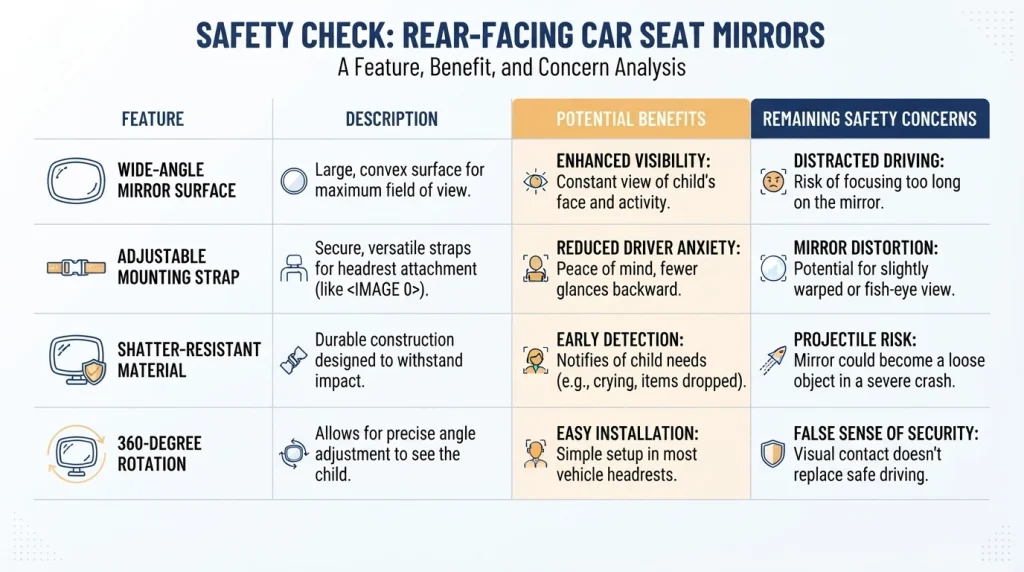
If you’re evaluating a baby car mirror, focus on its construction and mounting system rather than appearance. No single design feature guarantees crash safety.
Baby Mirror Design Comparison
| Feature | Potential Benefit | Remaining Concern |
|---|---|---|
| Plastic reflective surface | May avoid glass fragments | Housing can still cause injury |
| Rigid glass mirror | Clear reflection | Potential breakage and sharp fragments |
| Adjustable mounting straps | May improve attachment fit | Can loosen or fit incorrectly |
| Wide-angle convex surface | Wider view of the rear seat | Distorted image and distraction |
| Soft, lightweight housing | May reduce impact severity | Not proof of crash safety |
These differences describe possible design advantages, not verified product rankings. Actual performance depends on construction, attachment strength, vehicle geometry, and collision conditions.
What Should You Check Before Considering a Mirror?
- Manufacturer compatibility: Confirm whether the vehicle and child restraint instructions allow the intended arrangement.
- Mounting location: Look for a dedicated, compatible vehicle headrest rather than improvising an attachment.
- Material: Prefer avoiding glass, sharp edges, and unnecessary rigid components.
- Attachment security: Check for slipping straps and loose swivel joints.
- Viewing angle: Never obstruct the driver’s normal mirrors or rearward visibility.
- Product information: Look for clear installation instructions and meaningful testing documentation.
Be especially careful with products advertising universal compatibility. Vehicle headrests differ substantially between sedans, SUVs, minivans, and pickup trucks.
A mirror designed around two adjustable headrest posts may not fit an integrated headrest. An improvised installation is a reason to skip the product.
How Can You Reduce Risks if You Use a Baby Car Seat Mirror?
The most conservative safety choice is to avoid unnecessary accessories. If you still choose to use a mirror, take precautions to reduce foreseeable risks.
These steps cannot guarantee that an aftermarket mirror will remain attached during a collision.
Step 1: Review Both Owner’s Manuals
Start with the vehicle manual and the child restraint instructions. Check headrest requirements, accessory restrictions, and any relevant manufacturer warnings.
Do not use a mirror if the required mounting arrangement conflicts with either set of instructions.
Step 2: Check the Mounting Area
Examine the rear headrest and nearby seat components before installing anything. The mirror must not interfere with the headrest’s intended function or the child restraint.
Avoid positioning hard objects unnecessarily close to the baby’s head.
Step 3: Follow the Mirror Manufacturer’s Instructions
If the installation is permitted, follow the supplied directions exactly. Do not substitute improvised hooks, adhesive strips, clips, or additional straps.
Check that the mirror remains stable under gentle hand pressure. Remember that this simple inspection does not simulate crash forces.
Step 4: Set the Viewing Angle Before Driving
Adjust the mirror only while the vehicle is parked. Keep your normal rearview and side-mirror visibility unobstructed.
If seeing the baby’s reflection requires changing your main rearview mirror away from its driving position, stop using the accessory.
Step 5: Inspect the Mirror Regularly
Mounting hardware can loosen during routine vehicle use. Check the installation before journeys, especially after moving a seat or adjusting a headrest.
Remove the accessory if you notice:
- Loose, damaged, or stretched straps.
- Cracks in the reflective surface or frame.
- A swivel joint that no longer holds its position.
- Interference with a seat belt or child restraint.
- Unwanted glare or obstruction of driver visibility.
Step 6: Never Use the Mirror Instead of Stopping
If your baby cries unexpectedly or appears uncomfortable, find a safe place to pull over. Park before checking the harness, clothing, body position, or other possible problems.
A mirror should never encourage you to diagnose a problem while operating the vehicle.
Pro tip: A certified Child Passenger Safety Technician can evaluate your car seat installation, but a routine car seat inspection does not certify an aftermarket mirror’s crash performance.
Section Takeaway: Careful installation may reduce everyday mounting problems, but it cannot eliminate crash or distraction hazards. Stopping safely remains the correct response when your baby needs attention.
What Are Safer Alternatives to Baby Car Seat Mirrors?
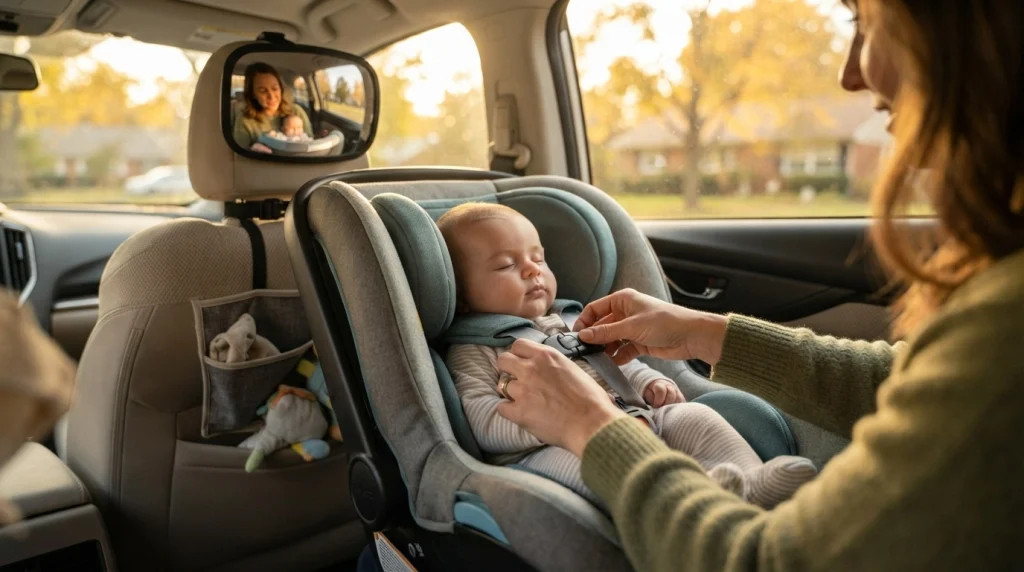
You don’t need a baby mirror to travel safely with a rear-facing child. The strongest alternatives emphasize correct restraint use, undistracted driving, and checking the baby while parked.
1. Check Your Baby Before Starting
A careful pre-trip inspection can address many avoidable problems. Make this a consistent part of your routine.
- Confirm that the car seat is installed correctly.
- Position the harness according to the seat instructions.
- Tighten the harness and check its fit.
- Check the required recline angle.
- Remove bulky clothing that interferes with harness fit.
- Make sure the baby’s face and airway are unobstructed.
Use the NHTSA car seat installation and safety resources for additional guidance. Your specific restraint manual remains essential.
2. Have Another Adult Sit in the Back
When practical, a second adult can monitor a baby without distracting the driver. This can be particularly helpful during longer trips or when extra observation is needed.
The adult must wear their own seat belt correctly. They should never remove the baby from the restraint while the vehicle is moving.
3. Schedule Safe Stops
Plan breaks around your baby’s feeding, changing, and comfort needs. A parked vehicle allows you to assess your child properly instead of relying on a small reflection.
For newborns, premature babies, or infants with medical concerns, ask your pediatrician whether any travel-duration precautions are appropriate.
4. Use Audio Cues Without Losing Road Awareness
You can often hear ordinary crying or other sounds without installing additional equipment. However, silence does not prove that an infant is safe or breathing normally.
Any suspected emergency requires stopping safely and checking directly.
5. Are Baby Car Seat Cameras a Safer Replacement?
Not automatically. Camera systems may remove the need for a headrest mirror, but they introduce screens, wiring, mounting hardware, and potential distraction.
Some cameras may also provide a misleading impression of continuous safety monitoring. They cannot replace proper restraint installation or direct checks when needed.
For most everyday trips, the simplest approach is also the least distracting: secure your child correctly and focus on driving.
Frequently Asked Questions
1. Are Baby Car Seat Mirrors Safe for Newborns?
Baby mirrors are not essential for newborn safety and may create projectile or distraction hazards. Newborns need a correctly installed rear-facing car seat, an appropriate recline angle, and a properly fitted harness. If you need to check a newborn’s breathing or position, stop safely and inspect the baby directly.
2. Can a Baby Car Seat Mirror Break During an Accident?
Yes. A mirror may crack, break, or separate from its mounting system during a collision. Plastic reflective surfaces may avoid some glass-related hazards, but the housing can still cause injury. No particular material guarantees that a mirror will be safe in every crash.
3. Are Shatterproof Baby Mirrors Completely Safe?
No. Shatter-resistant materials may reduce the risk of sharp fragments, but they do not eliminate projectile hazards. The mirror could still detach or distract the driver. Evaluate the entire product, including its frame, attachment system, and vehicle compatibility, rather than relying on a single safety claim.
4. Do Pediatricians Recommend Baby Car Seat Mirrors?
Parents should not assume that pediatricians universally recommend these accessories. The American Academy of Pediatrics emphasizes correct car seat use and cautions against unapproved aftermarket products. Ask your pediatrician about medical monitoring concerns and a qualified child passenger safety technician about restraint installation.
5. Can I Attach a Baby Mirror Directly to the Car Seat?
Avoid attaching an aftermarket mirror directly to the child restraint unless its manufacturer expressly approves that specific accessory and installation. Modifying the shell, harness, or structural parts may interfere with crash protection. A vehicle-headrest-mounted mirror also carries risks and is not automatically safe.
6. Are Baby Car Seat Mirrors Illegal?
There is no single rule covering every baby mirror in every jurisdiction. Legal requirements and product regulations differ by location, and a product’s availability does not establish safety approval. Review applicable local rules and the vehicle and restraint manufacturers’ instructions before considering an accessory.
7. Is It Better to Drive Without a Baby Car Seat Mirror?
Driving without an unnecessary mirror avoids the specific projectile and distraction hazards that accessory introduces. Parents can instead check their baby before departure, use a properly restrained adult passenger when available, and stop safely when attention is needed. Correct car seat use remains the top priority.
Final Thoughts: Should You Use a Baby Car Seat Mirror?
Baby car seat mirrors can provide convenience, but their benefits should not overshadow potential safety concerns. They are optional accessories, not substitutes for correct child restraint use or responsible driving.
My recommendation is to avoid unnecessary accessories when possible. If you consider a mirror, assess manufacturer guidance, mounting security, and driver distraction before making your decision.
Most importantly, never compromise your baby’s rear-facing restraint or your attention to the road. When something seems wrong, pull over safely and check your child directly.
Before your next family trip: Review your car seat instructions, confirm the harness fits correctly, and make sure your driving position provides an unobstructed view of the road.

Daniel Brooks is an automotive writer and product researcher focused on car accessories, car tech, maintenance, and practical driving guides. At Plug-in Car World, he helps drivers make smarter automotive decisions through honest reviews and research-driven content.
