
How to Check Whether a Car Seat Has Been Recalled
Quick Answer
To check whether a car seat has been recalled, locate its brand, model number, and manufacture date. Then visit the official NHTSA recall lookup, select the car seats category, and search for your seat. Compare any recall notice with your seat’s exact model and manufacturing dates to determine whether it is affected.
Five Steps to Check Your Car Seat
- Find the label: Locate the manufacturer’s identification sticker on the seat shell, back, side, or underside.
- Record the details: Write down the brand, model number, date of manufacture, and serial number if available.
- Search for recalls: Check the National Highway Traffic Safety Administration’s car seat recall database.
- Confirm the match: Compare the listed models, production dates, and affected components with your seat.
- Follow official instructions: Contact the manufacturer about any applicable recall and obtain the authorized remedy.
Important Safety Reminder
- Never assume a seat is safe simply because it looks undamaged. Follow any stop-use warning and check with the manufacturer before continuing to use an affected seat.
Learning how to check whether a car seat has been recalled is one of the most important safety checks parents can make. A child restraint can appear perfectly normal while still having a safety defect.
When I review car-seat safety information, I start with the identification label rather than the product’s appearance. This guide explains where to find that information, how to search official records, and what to do if a recall applies.
In This Guide
What Is a Car Seat Recall?
A car seat recall occurs when a manufacturer or safety regulator identifies a defect or safety-standard violation that requires corrective action. Recalls can affect infant car seats, convertible seats, combination seats, booster seats, and specific components.
Definition: A child car seat recall is an official safety action covering particular child restraint products that require an approved repair, replacement, or other remedy.
Why Do Child Car Seats Get Recalled?
Car seats contain several components that must work together during a crash. A defect involving one critical component can affect the restraint’s ability to protect a child.
Examples of potential recall-related problems include:
- Harness defects: Straps or adjusters may not perform as intended.
- Buckle problems: The buckle may fail to latch or release correctly.
- Base attachment defects: An infant carrier may not connect securely to its base.
- Structural problems: A component may not meet required performance standards.
- Labeling errors: Missing or incorrect safety instructions may create improper-use risks.
Not every product complaint results in a recall. Manufacturers and regulators evaluate reported problems to determine whether a safety defect or standards violation exists.
Does a Recall Mean Every Seat From That Brand Is Unsafe?
No. A recall often affects only certain model numbers, production periods, or batches.
Two seats with identical-looking fabric and frames may have different manufacturing dates. One could fall within the affected range while the other does not.
That’s why checking the exact identification information matters more than comparing product photos.
Is a Recall the Same as Car Seat Expiration?
No. A recall concerns an identified safety problem, while expiration relates to the manufacturer’s specified service life.
- Recalled seat: Requires checking the official remedy and safety instructions.
- Expired seat: Has reached the end of the manufacturer’s recommended usable period.
- Crash-involved seat: May need replacement according to the manufacturer and applicable crash guidance.
A seat can be within its expiration period and still be recalled. Likewise, a seat without an active recall can still be unsuitable for use.
Where Can You Find Your Car Seat’s Model Number?
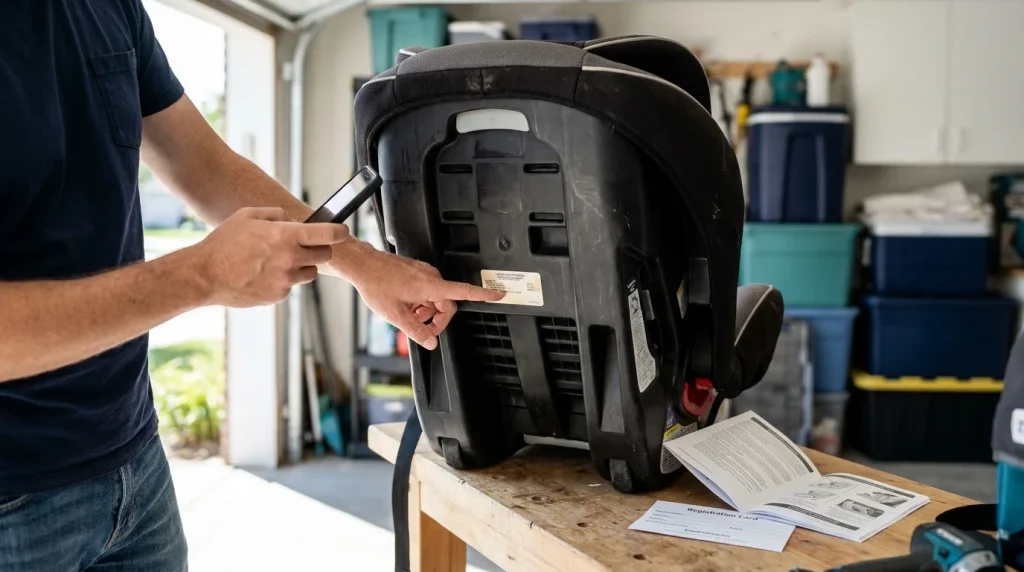
Most child car seats have a manufacturer identification label containing the information needed for recall verification. Look for it on the seat’s shell, back, side, or underside.
Check These Common Label Locations
Start with the seat’s instruction manual if you have it. Manufacturers often show the identification label’s exact location.
If you cannot find the label immediately, check these areas:
- The back of the plastic seat shell.
- The underside or lower edge of the car seat.
- The side of the restraint near the adjustment mechanisms.
- The infant carrier and its detachable base.
- The registration card or original product documentation.
Place the empty seat somewhere stable while inspecting it. Avoid removing harness components or making modifications just to reach a label.
What Information Should You Write Down?
Record the information exactly as the manufacturer printed it. Even a small difference in a model number can matter.
- Brand: The company or product brand.
- Model name: The seat’s marketed product name.
- Model number: The manufacturer’s specific product identifier.
- Date of manufacture: The date the seat was produced.
- Serial or batch number: An additional identifier used by some manufacturers.
Don’t confuse the date of manufacture with the purchase date. A seat could have been manufactured months before it was sold.
I recommend photographing the label and keeping that picture with the car seat manual. It makes future recall checks easier and reduces transcription errors.
What if the Car Seat Label Is Missing?
A missing identification label makes a reliable recall check difficult. Contact the manufacturer for help identifying the model before using the restraint.
You can provide available details such as the product name, purchase documentation, and photographs. However, appearance alone may not establish the production batch.
The American Academy of Pediatrics advises against using seats without a manufacture-date and model-number label. Its car seat safety guidance for families also emphasizes knowing a used seat’s history.
Pro tip: If the original sticker is unreadable, ask the manufacturer whether the seat can be positively identified. Don’t guess the model from its fabric color or shape.
How Do You Check Car Seat Recalls Online?
The most direct method in the United States is searching the National Highway Traffic Safety Administration’s official recall database. NHTSA provides information about recalled child restraints and other vehicle equipment.
Step 1: Open the Official Recall Search
Visit NHTSA’s recall website and find the search option for car seats. Make sure you’re searching child restraint products rather than vehicle recalls.
A vehicle identification number, or VIN, identifies a vehicle. You generally don’t need your car’s VIN to search for a separately purchased child car seat.
Step 2: Select the Car Seats Category
Choose the car-seat search category and enter the manufacturer’s brand or other requested product information. Follow the search interface’s available options.
Search using the manufacturer’s actual name if the marketed product name produces no result.
Step 3: Review the Recall Results
Read any matching recall notices carefully. Search results may include general information covering several models or production ranges.
Look for these details:
- The manufacturer and affected product models.
- Specific model numbers or identifiers.
- The affected manufacturing-date range.
- The reported defect and potential safety consequence.
- The manufacturer’s proposed remedy.
- The recall campaign number and contact information.
Step 4: Cross-Check the Manufacturer
Visit the manufacturer’s official website and look for its recalls or product safety section. Some manufacturers provide additional model-specific checking instructions.
If the notice mentions a serial-number range, contact customer support to confirm whether your individual restraint is included.
For more information about how recalls are organized, consult NHTSA’s recall and investigation resources.
Step 5: Confirm the Result
A matching recall notice does not necessarily mean every seat carrying that model name is affected. Check all listed identifiers before reaching a conclusion.
Likewise, an empty search result is not a permanent guarantee of safety. Newly announced recalls may appear later, so regular checks remain important.
If you cannot confirm the result online, contact the manufacturer or NHTSA’s Vehicle Safety Hotline at 888-327-4236.
How Do You Know Whether a Recall Affects Your Exact Seat?
To confirm whether a recall applies, match your seat’s model number and manufacture date against the official notice. Any additional serial, batch, or component requirements must also match.
Compare the Available Recall Checking Methods
| Checking Method | What It Can Confirm |
|---|---|
| NHTSA car seat search | Lists reported recalls and affected products; you must compare your exact model and manufacturing information. |
| Manufacturer recall lookup | May provide precise batch, serial-number, or remedy information for your particular seat. |
| Manufacturer customer support | Can help interpret affected identifiers and explain available repairs or replacements. |
| Vehicle VIN search | Checks vehicle recall information, not the recall status of a separately purchased child restraint. |
| SaferCar app | Provides recall alerts for saved vehicles and equipment, including registered app entries for car seats. |
What if Only the Base Is Recalled?
Some infant car seat systems include a detachable carrier and separate installation base. A recall may affect one component without necessarily involving the entire system.
Check the identifiers on both pieces when applicable. Follow the manufacturer’s instructions about whether the carrier can be used with another approved installation method.
What if Your Seat Was Made Outside the Affected Dates?
A seat outside the identified production range may not be part of that particular recall. However, verify every condition listed in the notice before deciding it is unaffected.
If the date label is unreadable or the notice leaves you uncertain, request written clarification from the manufacturer.
Section Takeaway: A brand-name match alone is not enough. Confirm the model, production date, and any affected batch or component identifiers.
What Should You Do if Your Car Seat Is Recalled?
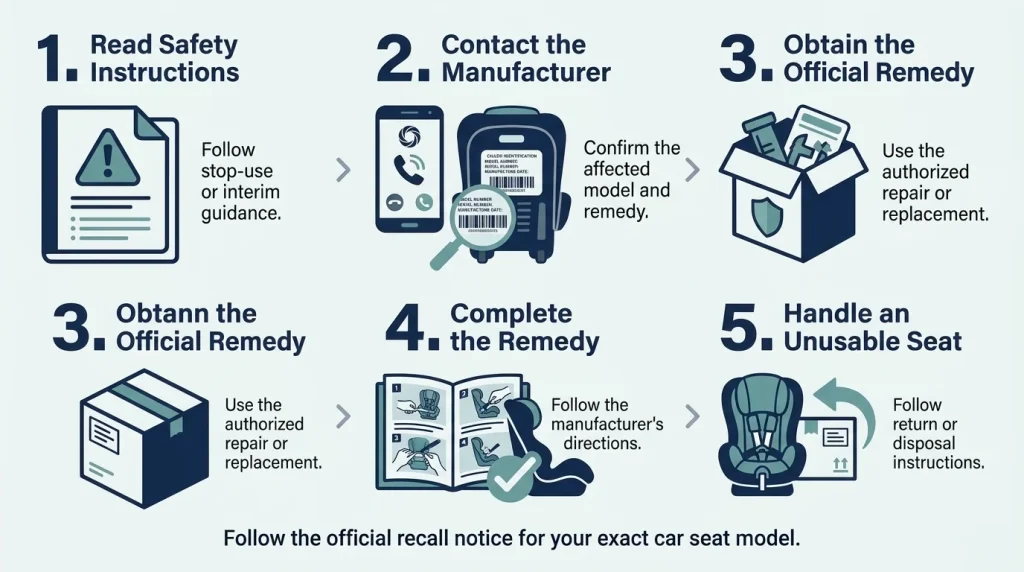
If your car seat is recalled, read the official safety instructions and contact the manufacturer for the approved remedy. Never assume that continuing to use the seat or repairing it yourself is safe.
1. Read the Stop-Use or Interim Safety Instructions
Recall severity and instructions vary. Some notices require owners to stop using the affected seat, while others provide specific temporary precautions.
If the notice says to stop using it, follow that warning immediately. Arrange a suitable alternative child restraint before transporting your child.
Never transport a child without an appropriate restraint because the original seat is unavailable.
2. Contact the Manufacturer
Use the contact information in the official recall notice. Have the seat’s label details ready when you call or submit a request.
Ask the manufacturer these questions:
- Is my exact model and manufacturing batch affected?
- Can I continue using the seat before the remedy arrives?
- Does the recall require a repair kit, replacement part, or replacement seat?
- How will the remedy be delivered?
- What should I do with replaced or unusable components?
Keep a record of the response and any confirmation number. It may help if you need to follow up.
3. Obtain the Official Recall Remedy
For U.S. safety recalls, manufacturers generally must provide an appropriate remedy without charging the consumer. The remedy may involve repair, replacement, or a refund, depending on the recall.
Don’t assume every recall requires replacing the entire car seat. Some defects can be corrected with manufacturer-supplied components and instructions.
Avoid improvised fixes using glue, tape, substitute buckles, or unrelated hardware. Those changes may interfere with safety performance.
4. Complete the Remedy Exactly as Directed
Follow the manufacturer’s procedure if an owner-installed repair kit is authorized. If the instructions require professional service, use the designated provider.
After the repair, review the car seat manual and installation requirements. NHTSA’s child car seat safety resources also explain proper installation and inspection options.
A certified Child Passenger Safety Technician can help you check installation and correct use. However, an installation inspection does not replace confirmation that a recall remedy was completed.
5. Handle an Unusable Seat Responsibly
If the manufacturer tells you to retire the restraint, follow its return or disposal instructions. Do not donate, resell, or pass along a seat that remains unsafe or unrepaired.
Ask whether components must be returned for documentation. Some manufacturers provide specific procedures for preventing an unusable seat from being reused.
Pro tip: Always rely on the official recall notice and the car seat manufacturer’s directions. A repair suitable for one model may be unsafe for another.
Section Takeaway: A confirmed recall requires action, not just awareness. Follow the official safety warning, obtain the authorized remedy, and verify correct installation before returning the seat to service.
How Can You Avoid Missing Future Car Seat Recalls?
The simplest way to avoid missing a future recall is to register your car seat with its manufacturer. Registration allows the company to contact you about relevant safety notices.
Register the Car Seat With Its Manufacturer
Most new child restraints include a registration card. You can generally mail that card or register directly through the manufacturer’s website.
Registration usually requires:
- Your contact information.
- The manufacturer’s name.
- The car seat model number.
- The date of manufacture.
- Any other requested product identifier.
Keep your contact information current, especially after moving. Missing a mailed safety notice can delay an important recall remedy.
Use the NHTSA SaferCar App
NHTSA offers a free app for monitoring vehicle and equipment recalls. The app allows users to save vehicles and items such as child car seats.
After you add the relevant equipment, the app can notify you about matching recalls. You can learn more through the official SaferCar app information page.
Registration and app notifications complement each other. Neither should replace checking the manufacturer’s instructions when a safety concern arises.
Check Recalls at Least Twice a Year
NHTSA recommends checking safety recalls twice yearly. A six-month reminder is an easy way to build that habit.
I suggest checking at these additional times:
- Before using a secondhand car seat.
- When moving a seat between family members.
- After receiving a product safety notice.
- When preparing a stored seat for a younger sibling.
- Before selling, donating, or transferring a child restraint.
Don’t Overlook Covers and Other Accessories
Child car seat covers, harness pads, and inserts deserve attention during safety checks. Aftermarket accessories may affect harness fit or restraint performance.
Use only accessories supplied with the seat or expressly approved by its manufacturer. A replacement cover cannot correct an unrelated structural or harness defect.
Also distinguish a child restraint recall from a recall involving your vehicle’s original seats. They are separate products with different identifying information.
Section Takeaway: Register the seat, retain its model information, and check official recalls regularly. These simple habits help keep safety information from being overlooked.
Frequently Asked Questions About Car Seat Recalls
Can I check a car seat recall using its serial number?
Some manufacturers allow recall verification using a serial or batch number, but NHTSA’s public car-seat searches generally provide product-level results. Start with the brand and model, then contact the manufacturer if the recall requires a more precise identifier.
Are car seat recall repairs free?
Yes, applicable U.S. safety recalls generally require the manufacturer to provide the designated remedy at no charge. The specific solution may involve repair, replacement, or a refund. Contact the manufacturer using the official recall notice to confirm the procedure.
Can I use a recalled car seat until the replacement arrives?
That depends on the recall’s instructions. Some notices permit continued use under specified conditions, while others require immediate discontinuation. Follow the manufacturer’s interim guidance, and use a suitable alternative restraint if your seat must not be used.
How do I check a used car seat for recalls?
Find the original model number and manufacturing date, then compare them against official recall records. Also verify its expiration, crash history, missing parts, and installation instructions. If you cannot establish the seat’s identity or history, don’t assume it is safe.
Does registering a car seat mean it has never been recalled?
No. Registration helps the manufacturer contact you about safety notices, but it does not prove the seat has no past recalls or unresolved remedies. Check the recall database and confirm any applicable repairs directly with the manufacturer.
How often should I check for new car seat recalls?
Check at least twice a year and whenever you receive a safety alert. You should also check before using a secondhand or previously stored restraint. Registering with the manufacturer and using recall alerts can help between manual checks.
What if my car seat was purchased outside the United States?
NHTSA’s recall database primarily addresses products covered by U.S. safety regulation. For seats purchased in another country, check the relevant national product-safety authority and the manufacturer serving that market. Recall coverage and remedies can differ by country.
Final Takeaway: Checking whether a car seat has been recalled starts with three details: its brand, model number, and manufacture date. Compare those details with official safety notices, follow any applicable remedy instructions, and keep the seat registered for future alerts.
Make this part of your regular family vehicle safety routine. A short check today can help you identify an important safety issue before your next journey.

Daniel Brooks is an automotive writer and product researcher focused on car accessories, car tech, maintenance, and practical driving guides. At Plug-in Car World, he helps drivers make smarter automotive decisions through honest reviews and research-driven content.
