
How to Choose the Correct Car Seat Harness Height
Quick Answer
For a rear-facing seat, choose the slot at or just below the shoulders. For a forward-facing seat, choose the slot at or just above the shoulders. Your seat manual wins if it gives a different rule, so check it first and use the National Highway Traffic Safety Administration (NHTSA) as a starting point for car seat safety guidance.
Check in 30 seconds
- Rear-facing rule: Use the slot at or just below the shoulders.
- Forward-facing rule: Use the slot at or just above the shoulders.
- Snug harness: Tighten until you cannot pinch extra webbing at the collarbone.
- Chest clip: Place the clip level with the armpits, not on the belly.
- Recheck after growth: Recheck the slot after a growth spurt or a change in clothing.
Stop and check the manual if:
- The straps twist, hide behind padding, or will not sit flat.
- The seat is secondhand, missing labels, or missing its manual.
- Your seat uses a headrest adjustment that changes more than one slot at once.
This guide covers the correct car seat harness height for rear-facing and forward-facing seats, plus the checks that catch a wrong slot early. It also explains covers, inserts, and the mistakes that create slack.
Start with your seat manual, then use the shoulder rule below as your check. That order keeps general guidance from overriding a rule written for your exact seat.
In This Guide
- What Is Car Seat Harness Height?
- What Is the Correct Harness Height for Rear-Facing Seats?
- What Is the Correct Harness Height for Forward-Facing Seats?
- How Do You Check and Adjust Harness Height Step by Step?
- Do Car Seat Covers and Inserts Change Harness Height?
- What Are the Common Harness Height Mistakes?
- Frequently Asked Questions
What Is Car Seat Harness Height?
A car seat harness is the strap system that holds a child in a child restraint. Its height is set by the slot the shoulder straps pass through.
That slot controls how the straps sit on the shoulders. A correct slot keeps the straps flat and close to the body.
Why does slot height matter?
Straps spread crash forces across strong parts of the body. A wrong slot can let a child slide up or shift too far.
- Shoulder control: The straps should hold the shoulders down and back in the seat.
- Even tension: Both straps should tighten to the same snug feel.
- Less slack: A correct slot leaves less room for the body to move before the straps catch.
Height matters more than age alone. Two children of the same age can need different slots.
What counts as the shoulder line?
Sit the child upright with the back flat against the seat shell. Remove bulky layers first, so you see the true shoulder top.
- Press the hips back into the seat before you look at the shoulders.
- Find the highest point of the shoulder, not the neck or the arm.
- Compare that point with the slot directly behind the shoulders.
Mark that level with your eye, not with a guess from the side. Then compare it with the slot behind the shoulders.
Section takeaway: Harness height is the slot position relative to the shoulders, not a setting you choose by age or clothing size.
What Is the Correct Harness Height for Rear-Facing Seats?
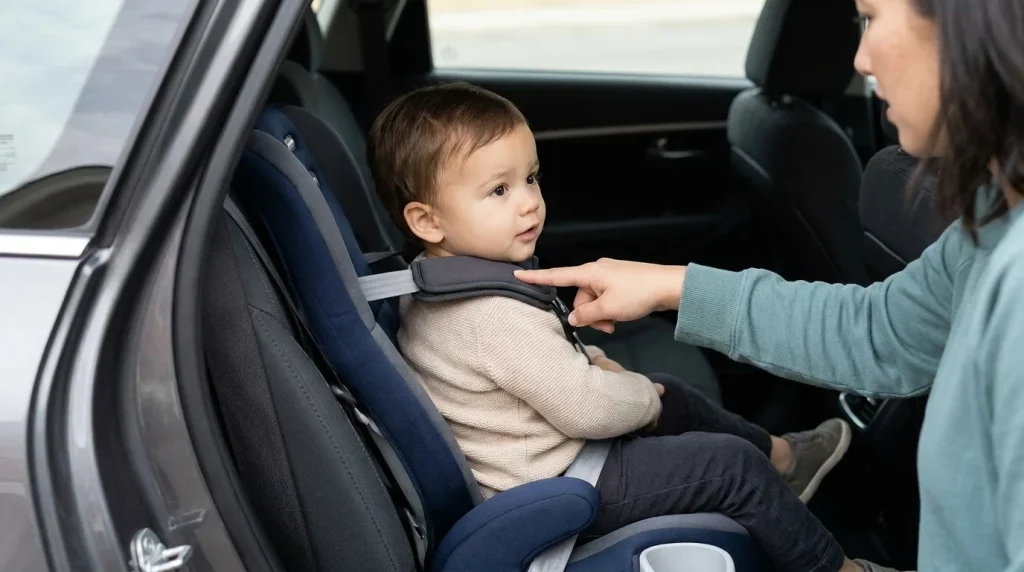
For a rear-facing seat, choose the slot at or just below the shoulders. Check your manual first if it names a different rule for your model.
This rule applies to infant seats and to convertible car seats used rear-facing. It does not change just because the child looks tall in the seat.
How do you find the right slot?
- Seat the child in thin, normal clothing with hips back.
- Look at the slots behind the shoulders, not in front of them.
- Choose the highest slot that still sits at or below the shoulder top.
- Move the straps if the current slot sits above the shoulders.
- Tighten the harness and recheck the shoulder line.
Rethread seats need the straps moved by hand through the shell. No-rethread seats move with a headrest handle or lever.
Both types must end with flat, untwisted straps. Twisted straps can concentrate force on a narrow band.
What if the shoulders fall between slots?
Choose the lower slot for a rear-facing seat. That choice keeps the rule intact until the child grows into the next slot.
Growth can move shoulders past a slot in weeks. Recheck after a growth spurt or a change in clothing.
Section takeaway: Rear-facing means at or below the shoulders, and between slots means the lower slot.
What Is the Correct Harness Height for Forward-Facing Seats?
For a forward-facing seat, choose the slot at or just above the shoulders. Your manual remains the final rule for your seat.
Do not carry the rear-facing rule forward. A slot below the shoulders can allow too much upward movement in a forward-facing seat.
Why does the rule change with direction?
Direction changes how the body moves in a crash. The slot rule changes with that movement.
- Rear-facing: The seat shell supports the back and head during a frontal crash.
- Forward-facing: The harness must restrain the shoulders as the body moves forward.
- Slot position: The slot should match the direction, not the child’s last setting.
Switching direction means rechecking the slot, even if nothing else changed. Treat it as a fresh fit check.
Does a booster use the same rule?
A high-back booster does not use a harness. It positions the vehicle seat belt across the chest and lap instead.
Move to a booster only when your child meets the harness seat limits and the manual allows that step. Belt fit, not harness height, becomes the check then.
Section takeaway: Forward-facing means at or above the shoulders, and a booster replaces the harness rule with a seat belt fit check.
How Do You Check and Adjust Harness Height Step by Step?
A full harness check takes only a few minutes. Do it with the child seated, not with the seat empty.
- Remove bulky coats, blankets, and thick inserts that did not come with the seat.
- Seat the child with hips back and back flat against the shell.
- Find the slot closest to the shoulder rule for your seat direction.
- Move the straps by rethreading them or by adjusting the headrest, as your manual directs.
- Buckle the harness, then pull the adjuster strap until the harness feels snug.
- Do the pinch test at the collarbone and slide the chest clip to armpit level.
- Recheck the seat installation, with less than 1 inch of movement at the belt path.
| Seat type | Harness slot rule | Quick check |
|---|---|---|
| Rear-facing | At or just below the shoulders | If between slots, use the lower slot. |
| Forward-facing | At or just above the shoulders | If between slots, use the upper slot. |
| Booster | No harness slot rule | Check lap and shoulder belt fit instead. |
When should you recheck harness height?
- After a growth spurt, even if the seat still looks right.
- After reinstalling the seat in a new vehicle or seating position.
- After washing the cover, since straps must return to the same slots.
- When seasons change and clothing thickness changes.
Pro tip: Check your seat manual and NHTSA recall lookup before you adjust, reuse, or buy a secondhand seat.
Section takeaway: Check the slot with the child seated, tighten to a pinch-test snug fit, and recheck after growth, reinstalls, and washing.
Do Car Seat Covers and Inserts Change Harness Height?
Vehicle seat covers and child seat inserts are not the same product. Only parts approved by your child seat maker belong on that seat.
A thick vehicle cover under a child seat can change how tightly the seat installs. A thick insert behind a child can change harness slack and slot position.
What can go wrong with unapproved add-ons?
- Forward push: A thick insert can push the child forward and change the shoulder line.
- Hidden slots: A loose cover can hide the slot you need to check.
- Bunched straps: Strap pads can bunch and create slack near the chest clip.
- Loose install: A slippery layer under the seat can let the base shift more than it should.
If an add-on did not come with the seat, treat it as unapproved until the manual says otherwise. Remove it if you cannot confirm approval.
These guides cover vehicle seat covers, not child-restraint accessories. Use them for vehicle cover choices, not as approval for a child seat insert.
- Cooling car seat cover review — a vehicle seat cover guide, not a child seat part.
- Sprints car seat cover review — a vehicle seat cover guide, not a child seat part.
- Astonish car seat cover review — a vehicle seat cover guide, not a child seat part.
Independent testing notes from Consumer Reports can help you compare seats, but they do not replace your manual. As of 2026, the manual for your exact model still controls slot height, weight limits, and approved accessories.
Section takeaway: Keep unapproved covers and inserts off a child seat, because even a thin extra layer can change harness fit.
What Are the Common Harness Height Mistakes?
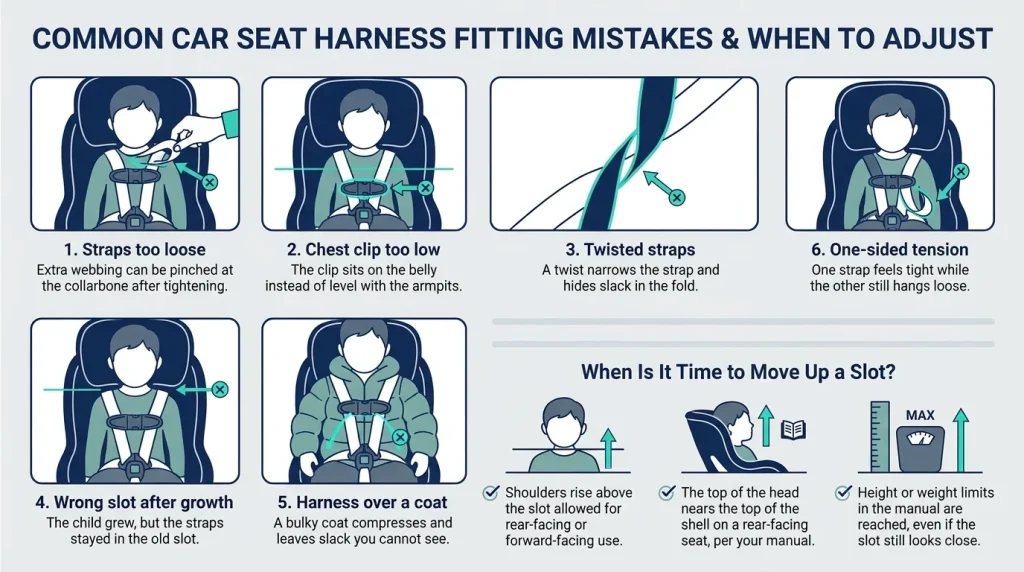
Most harness errors are small and easy to fix. They still matter, because slack and low clips change how straps work.
- Straps too loose: You can pinch extra webbing at the collarbone after tightening.
- Chest clip too low: The clip sits on the belly instead of level with the armpits.
- Twisted straps: A twist narrows the strap and hides slack in the fold.
- Wrong slot after growth: The child grew, but the straps stayed in the old slot.
- Harness over a coat: A bulky coat compresses and leaves slack you cannot see.
- One-sided tension: One strap feels tight while the other still hangs loose.
When is it time to move up a slot?
Move up when shoulders sit clearly above the current allowed slot for your seat direction. Do not wait for the straps to feel tight across the neck.
- Shoulders rise above the slot allowed for rear-facing or forward-facing use.
- The top of the head nears the top of the shell on a rear-facing seat, per your manual.
- Height or weight limits in the manual are reached, even if the slot still looks close.
Child passenger safety resources from Safe Kids Worldwide can help you find general guidance and local check events. A certified child passenger safety technician can also check a fit you feel unsure about.
Section takeaway: Fix slack, clips, twists, and old slots first, then move up only when the shoulder rule or a manual limit calls for it.
Frequently Asked Questions
Should the harness be above or below the shoulders?
For rear-facing seats, use the slot at or just below the shoulders. For forward-facing seats, use the slot at or just above the shoulders, unless your manual states a different rule for that seat.
How often should I check harness height?
Check harness height each time your child grows noticeably, changes clothing thickness, or moves to a new seat. A quick shoulder check before long trips also catches a slot that has become too low after a growth spurt.
Can my child wear a winter coat in a car seat?
Remove bulky coats before buckling, then place the coat over the harness like a blanket if warmth is needed. Bulky fabric can hide slack, so the harness may feel snug in the driveway yet loosen in a crash.
What if my seat has only one slot near the shoulders?
Choose the slot that matches your seat direction rule, not the slot that looks closest. For rear-facing seats, that means the lower slot, and for forward-facing seats, that means the upper slot.
Do strap covers change harness height?
Use only strap covers approved by your child seat maker, because added padding can change strap position and slack. If a cover was not supplied or approved for your seat, remove it and recheck the harness fit.
When does my child outgrow the harness?
Your child may outgrow the harness when shoulders rise above the highest allowed slot or height and weight limits are reached. Check both limits in your manual, because reaching one limit can mean it is time for the next seat stage.
Before your next drive, do the shoulder check, pinch test, and chest-clip check. If any step feels unclear, stop and read your manual or ask a certified child passenger safety technician for help.

Daniel Brooks is an automotive writer and product researcher focused on car accessories, car tech, maintenance, and practical driving guides. At Plug-in Car World, he helps drivers make smarter automotive decisions through honest reviews and research-driven content.
