
Which Car Seat Accessories Are Safe to Use?
Quick Answer
Which car seat accessories are safe to use? For child safety seats, use accessories supplied or specifically approved by the car seat manufacturer for your exact model. Avoid unapproved harness pads, head supports, buckle attachments, and bulky inserts. Some external covers, blankets, and vehicle accessories may be appropriate when used correctly. The NHTSA car seat glossary explains why aftermarket accessories require special caution.
The safest choices
- Approved replacement parts: Use components specifically authorized for your car seat model.
- Warm blankets: Place lightweight blankets over the already-fastened harness, never underneath it.
- External infant covers: Consider only permitted designs that never obstruct breathing or harness operation.
- Vehicle seat protectors: Use only when both the child restraint and vehicle manufacturers permit them.
- Secure sun protection: Choose options that do not interfere with visibility, airbags, or restraint equipment.
Important safety reminder
- Check both manuals: An accessory advertised as universal or crash-tested is not automatically compatible with your vehicle or child safety seat.
Car seat accessories promise extra comfort, cleaner upholstery, and easier family travel. But some seemingly harmless upgrades can interfere with the equipment protecting your passengers.
I’m Daniel Brooks, and I approach seat accessories like any other automotive fitment decision. This guide explains what works, what deserves caution, and how to check compatibility before buying.
In This Guide
What Makes a Car Seat Accessory Safe?
A safe car seat accessory must be compatible with the restraint or vehicle seat and must not interfere with its protective functions. For child restraints, specific manufacturer permission is the starting point.
Definition: An aftermarket car seat accessory is a product added after the original seat purchase, such as extra padding, a protective cover, or a harness attachment. These products may not have been evaluated with the particular seat you own.
There is also an important difference between a child safety seat and an ordinary vehicle seat. Each has different safety requirements.
Manufacturer Approval Matters More Than Marketing
Child restraints undergo testing as complete systems. Adding an unfamiliar component can change how a harness fits or how the seat performs.
A product label alone cannot establish compatibility. Look for written instructions that identify your exact seat model.
- Original equipment: Components included with the seat and used according to its instructions.
- Manufacturer-approved accessories: Extras explicitly permitted for your model and configuration.
- Independent aftermarket products: Products without clear approval that should not be added to a child restraint.
- Vehicle accessories: Products requiring separate checks for airbags, seat belts, and occupant sensors.
How Can an Accessory Change Crash Protection?
Restraints depend on carefully controlled movement during a collision. Extra padding or altered belt routing can change that movement.
Several safety problems deserve attention:
- Harness compression: Soft material can flatten during a crash and leave the harness loose.
- Incorrect belt routing: Accessories can change where a shoulder or lap belt contacts the body.
- Blocked deployment: Vehicle seat covers can obstruct seat-mounted side airbags.
- Unsecured objects: Loose accessories can become hazards during sudden braking or a collision.
- Breathing and overheating: Poorly designed infant covers can restrict airflow or trap heat.
Think of a car seat as an integrated safety device. A change that looks small can affect several parts at once.
Does Crash-Tested Mean Safe?
Not necessarily. A claim about testing does not prove compatibility with every car seat or vehicle.
Some separately sold child restraint accessories are not subject to the same federal performance standards as complete child restraints. The American Academy of Pediatrics discusses this distinction in its car safety seat guidance for families.
For a child restraint, look for a clear statement from the seat manufacturer. General advertising claims are not a substitute.
Section Takeaway: Compatibility means more than physical fit. The accessory must preserve the seat’s intended safety performance.
Which Car Seat Accessories Are Usually Safe?
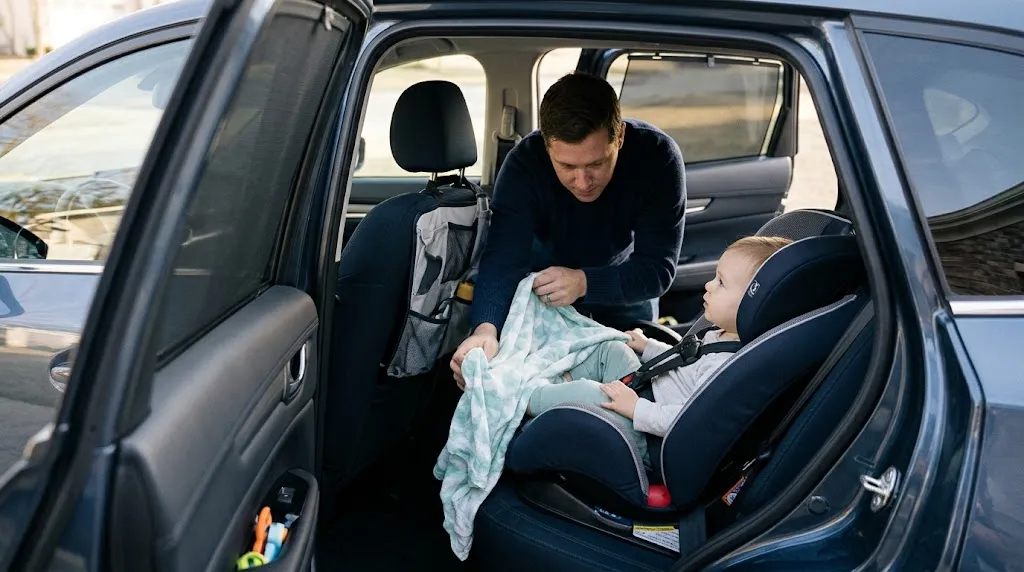
The safest choices generally preserve the original restraint design. Manufacturer-supplied components and appropriately positioned external comfort items are good places to start.
1. Original and Manufacturer-Approved Components
Original equipment is usually the simplest choice when it remains suitable for the child’s current size. Follow the manual when installing or removing each component.
Examples include:
- Infant inserts: Original inserts used within the manufacturer’s stated limits.
- Harness pads: Pads supplied or specifically approved for that seat.
- Replacement covers: Correct replacement fabric assemblies supplied or authorized by the manufacturer.
- Headrest components: Original adjustable parts used in their intended positions.
- Approved buckle replacements: Exact replacement parts supplied through the manufacturer.
Keep the seat’s model number available when requesting replacement parts. Similar-looking components from another model are not automatically interchangeable.
2. Lightweight Blankets Used Over the Harness
A lightweight blanket can help a child stay warm after the harness is properly fastened. It should sit over the secured straps instead of between the child and the restraint.
This is particularly useful during winter travel. Bulky jackets can prevent a snug harness fit.
Follow the American Academy of Pediatrics’ winter car seat safety recommendations for appropriate layers and coverings.
- Dress the child in thin, comfortable clothing.
- Buckle and tighten the harness correctly.
- Add a light blanket over the secured straps.
- Keep the child’s face completely uncovered.
- Remove extra warmth when the vehicle gets hot.
3. Suitable Window Sun Protection
Window shades can reduce direct sunlight without touching the child’s harness. They still need secure attachment and appropriate placement.
Choose a design that cannot easily detach or block the driver’s view. Check local window-visibility rules before applying any covering.
Static-cling products may avoid some hazards associated with hard suction attachments. However, attachment quality and positioning still matter.
4. Properly Secured Vehicle Organizers
A storage organizer can keep small travel essentials within reach. It should never block a restraint anchor, seat belt, or airbag deployment area.
Choose lightweight contents and secure mounting. Avoid heavy objects behind a child’s seating position.
5. Accessories That Make Cleaning Easier
Protecting upholstery is reasonable when the solution does not compromise safety. Removable floor mats, approved seat protectors, and manufacturer-authorized washable covers may be useful.
Floor mats must remain secured and must never interfere with pedal operation. Seat protectors require additional compatibility checks discussed below.
Which Car Seat Accessories Should You Avoid?
Avoid child restraint accessories that alter harness fit, occupant position, or installation unless the seat manufacturer specifically permits them. Convenience cannot justify an uncertain safety tradeoff.
Extra Harness Pads and Strap Covers
Third-party strap cushions may appear comfortable. But added material can change the way harness webbing lies against the child.
Some accessories also make straps harder to tighten or inspect. Use original pads or approved replacements instead.
Aftermarket Head Positioners and Pillows
Infants need appropriate head and neck positioning. Adding an unsupported pillow is not the solution.
Extra head supports can change posture or interfere with proper restraint fit. A rear-facing seat should maintain the recline angle specified by its manufacturer.
If your baby’s head position concerns you, check the installation and seek qualified guidance. Do not improvise padding behind the head or body.
Universal Buckle Clips and Belt Adjusters
Aftermarket chest clips, buckle extenders, and belt-positioning gadgets may change how a restraint holds the occupant. They should not replace the restraint’s original safety components.
Seat belt adjusters also deserve caution when children use booster seats. An incorrect adjustment can move the lap belt onto the abdomen or create shoulder belt slack.
Bulky Inserts and Sleeping Bag Accessories
Thick liners and padded inserts can create extra space between a child and the harness. That space may increase when the material compresses.
Products that pass through harness openings are especially concerning without explicit manufacturer approval. A stroller insert is not automatically suitable for a vehicle car seat.
Unapproved Installation Devices
Avoid improvised anchor extensions, replacement attachment hardware, and positioning wedges not authorized by the car seat manufacturer. These products can interfere with the installation system.
The same caution applies to homemade repairs. Damaged harness webbing or buckles require manufacturer guidance, not general-purpose replacement parts.
Accessories That Create Loose Objects
Hard toys, heavy mirrors, and poorly secured organizers can become hazards during a crash. Keep objects lightweight and properly contained.
Do not attach heavy entertainment screens to a child restraint without specific manufacturer permission. Secure vehicle-mounted equipment according to its instructions.
Pro tip: If you need to change the harness, buckle, or head support, contact the child restraint manufacturer or a certified Child Passenger Safety Technician before using a substitute.
Are Car Seat Covers and Seat Protectors Safe?
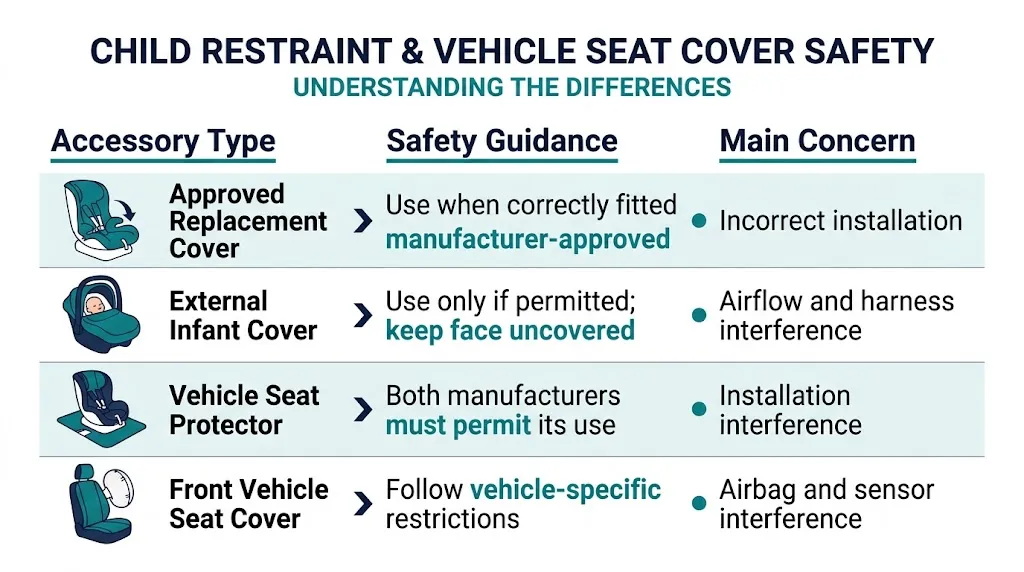
Some car seat covers are appropriate, while others introduce serious safety concerns. The answer depends on whether you mean an infant restraint cover, an upholstery replacement, or a cover for the vehicle’s own seat.
Infant Car Seat Covers
Infant covers commonly come in two designs. Some fit around the outside of a carrier, while others place fabric beneath or around the baby.
The second design deserves particular caution. Extra material beneath a child can affect harness positioning and compression.
A cover that stays outside the seating and harness area may be an option when the manufacturer allows it. The child’s face must remain uncovered, and ventilation must remain adequate.
Never drape an opaque blanket across the infant carrier during travel. Even when the weather is cold, you need to monitor the baby’s breathing and temperature.
Replacement Upholstery Covers
A child restraint’s original fabric cover is part of its tested assembly. Replacing it with an unrelated cover can change fit, padding, and material properties.
When the fabric becomes damaged or stained, ask the manufacturer about replacement upholstery. Use the cleaning method stated in the manual.
A generic cover that happens to fit is not automatically a safe substitute. Correct harness-slot alignment matters.
Protective Mats Beneath Child Safety Seats
Vehicle seat protector mats can help limit scuffs and pressure marks. However, they are acceptable only when the child seat and vehicle instructions allow their use.
Thick or slippery protectors can affect installation stability. Some car seat manufacturers prohibit additional material beneath their products.
Don’t assume that thin material is automatically permitted. Both manuals should support the installation.
Regular Vehicle Seat Covers and Side Airbags
Standard automotive seat covers introduce a separate concern: seat-mounted side airbags. Certain vehicles also use passenger occupancy sensors built into the seat.
An unsuitable cover may restrict airbag deployment or affect occupant detection. Some vehicle manufacturers prohibit aftermarket covers altogether.
Before installing a front-seat cover, read the vehicle’s airbag and seat-cover warnings. NHTSA’s vehicle airbag safety information explains the importance of unobstructed airbag operation.
Labels such as “airbag compatible” are not enough on their own. Choose only products expressly permitted for your vehicle and seating configuration.
Car Seat Accessory Safety Comparison
This table summarizes common accessory categories. The final decision must follow the actual product and vehicle instructions.
| Accessory | Safety Guidance | Main Concern |
|---|---|---|
| Original infant insert | Use within stated limits | Incorrect size or positioning |
| Approved replacement cover | Generally appropriate when correctly fitted | Incorrect installation |
| Third-party harness pads | Avoid without specific approval | Harness interference |
| Aftermarket head pillow | Avoid without specific approval | Posture and airway concerns |
| Blanket over harness | Generally appropriate with precautions | Overheating or face covering |
| Vehicle seat protector | Only when both manufacturers permit | Installation interference |
| Front vehicle seat cover | Follow vehicle-specific restrictions | Airbag and sensor interference |
| Secure window shade | Potentially suitable when positioned correctly | Detached parts or blocked visibility |
Section Takeaway: Child seat covers must preserve harness performance and airflow. Vehicle seat covers must also respect airbag and occupant-sensor restrictions.
Are Mirrors, Toys, and Sunshades Safe?
These accessories do not always touch a child restraint, but their positioning still matters. Choose products that remain secured and do not introduce unnecessary hazards.
Rear-Facing Baby Mirrors
A rear-facing mirror lets a caregiver glance toward a baby without turning around. However, it is not essential safety equipment.
If you choose one, follow the mounting instructions and inspect its security regularly. Never place it where it can interfere with an airbag or contact the child.
Do not continually watch the mirror while driving. Your attention belongs on the road.
Soft Toys and Entertainment Accessories
Lightweight, age-appropriate soft toys are generally preferable to hard, heavy objects. Keep toys from interfering with the harness or face.
Avoid hanging large objects from a child restraint handle without manufacturer approval. Don’t add attachments that change the handle’s required travel position.
Sunshades and Window Covers
Direct sunlight can make a ride uncomfortable. A secure window shade may help without changing how the child restraint works.
Check for:
- Secure attachment without loose, hard components.
- Unobstructed driver visibility.
- No interference with side curtain airbags.
- No sharp edges within the child’s reach.
- Compliance with local window-covering rules.
Backseat Organizers and Tablet Holders
Entertainment equipment should be installed according to vehicle and product instructions. Heavy attachments near passengers create additional risks.
Choose secure mounting locations away from airbag deployment zones. Remove equipment that moves, rattles, or loosens during normal driving.
Heated Cushions and Massage Pads
Powered seat accessories require special caution. They may conflict with a vehicle’s heated-seat system, occupancy sensors, or airbag design.
Do not place aftermarket heating cushions inside a child safety seat. For regular vehicle seats, follow the vehicle manufacturer’s restrictions and the accessory’s electrical instructions.
How Do You Check Car Seat Accessory Safety Before Driving?
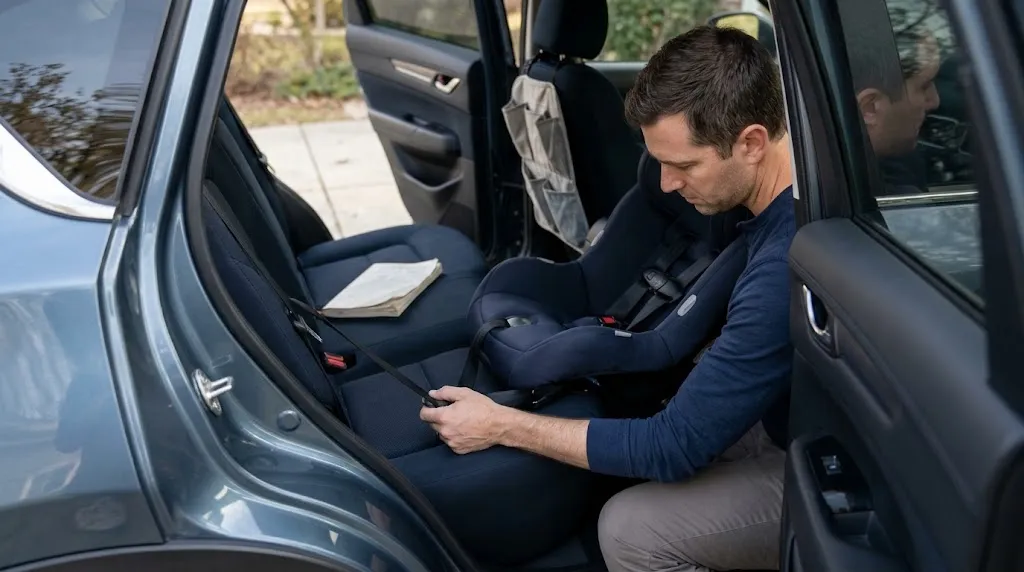
Start by verifying manufacturer permission, then inspect the complete installation. A product should never make the restraint harder to use correctly.
I prefer a repeatable safety checklist over relying on how secure something feels. A few careful checks can reveal problems that appearance alone misses.
Step-by-Step Safety Checklist
- Identify the seat: Find the child restraint’s brand, exact model, manufacture date, and instruction manual.
- Read the accessory instructions: Verify that the manufacturer permits the product for that particular seat.
- Check vehicle restrictions: Review airbag warnings, seating positions, seat belts, and anchor instructions.
- Inspect the harness: Confirm that no extra material changes belt routing or prevents snug contact.
- Check the installation: Verify that the accessory has not changed the installed seat’s stability or recline.
- Inspect surrounding equipment: Confirm that mirrors, covers, and organizers cannot obstruct safety devices.
- Repeat the check: Reinspect after removing covers, cleaning the seat, or changing the vehicle configuration.
Check Child Seat Movement at the Belt Path
A properly installed child restraint should not move more than 1 inch side-to-side or front-to-back when checked at the belt path. This check does not involve pulling on the top of the seat.
Follow the installation method required by the manuals. The vehicle seat belt and LATCH lower anchors are generally alternative methods unless both manufacturers specifically permit simultaneous use.
For a forward-facing harness seat, attach and tighten the top tether when required. Never allow an accessory to interfere with that connection.
The official NHTSA car seat installation instructions explain the belt-path movement test and harness checks.
Verify Harness Fit
Check the harness with the child seated correctly. The straps should lie flat without twists.
- Rear-facing: Position harness straps at or below shoulder level, following the seat instructions.
- Forward-facing: Position straps at or above shoulder level, following the seat instructions.
- Harness tightness: Tighten until you cannot pinch excess webbing at the shoulder.
- Chest clip: Position the clip at armpit level when the seat uses one.
- Extra padding: Remove unapproved inserts or accessories that affect fit.
When Should You Ask a Professional?
Seek expert help when an accessory affects installation, harness routing, or head positioning. Uncertainty is a good reason to stop using the accessory.
A certified Child Passenger Safety Technician can inspect the setup and explain the correct procedure. For product-specific approval, contact the manufacturer directly.
Also request help if your vehicle displays an unexpected airbag or passenger-detection warning. Don’t attempt to bypass a safety sensor to accommodate a seat cover.
What Should You Check When Shopping in 2026?
As of 2026, online listings still require careful compatibility checks. Terms such as “universal fit” and “premium safety” do not establish manufacturer authorization.
Before purchasing, confirm:
- The exact seat models listed as compatible.
- Written approval from the restraint or vehicle manufacturer when required.
- The accessory’s intended location and attachment method.
- Any warnings about airbags, harnesses, or sensors.
- The availability of complete instructions.
- A reasonable return policy if compatibility cannot be confirmed.
Section Takeaway: Test the complete seating setup, not just the accessory. If you cannot establish compatibility, leave the extra product out.
Frequently Asked Questions
1. Are aftermarket car seat accessories safe?
Aftermarket accessories are not automatically safe for child restraints. Use only products that the car seat manufacturer specifically allows for your exact model. Extra harness padding, head supports, and belt attachments can affect restraint performance even when they appear to fit correctly.
2. Can I use a universal car seat cover?
A universal cover is not automatically suitable. On a child restraint, use only manufacturer-authorized covers. For regular vehicle seats, verify seat-mounted airbag compatibility, occupant-sensor restrictions, and installation requirements. Some vehicles prohibit additional seat covers entirely.
3. Can I put a towel under a child’s car seat?
Only when the car seat and vehicle manufacturers permit that specific use. Some manufacturers allow certain positioning materials or protective layers, while others restrict them. Never assume a folded towel is an acceptable substitute for a manufacturer-approved accessory or installation component.
4. Are infant car seat covers safe in winter?
Some external covers may be suitable when permitted by the manufacturer and used without interfering with the harness. Never place bulky fabric beneath the baby or cover the baby’s face. Watch for overheating and remove extra coverings when necessary.
5. Are baby car seat mirrors safe?
A securely mounted mirror may be a reasonable vehicle accessory, but it is not required for safe travel. Avoid heavy or loosely attached mirrors. Follow mounting guidance and keep mirrors away from airbag deployment areas and the child’s reach.
6. Can I add extra head support to a newborn car seat?
Do not add an aftermarket head pillow or insert without specific manufacturer approval. Proper recline and the original restraint design are important for positioning. If your newborn consistently slumps or struggles to maintain a safe position, request professional installation guidance.
7. Are expensive car seat accessories safer than cheap ones?
Price does not establish safety. An expensive aftermarket cushion may still interfere with a harness or airbag. Manufacturer compatibility, correct installation, and clear instructions matter more than branding, appearance, or advertised comfort features.
Final Takeaway: The safest car seat accessories are the ones that preserve the original safety system. For child restraints, prioritize manufacturer-approved parts and keep extra material away from the harness.
For regular vehicle seats, check airbag compatibility before adding covers or cushions. When an accessory’s safety is unclear, skip it until the manufacturer confirms that it is appropriate.
Before your next drive, review your car seat and vehicle manuals, check all attachments, and make sure every passenger’s restraint fits correctly. A clean, comfortable interior should never come at the expense of protection.

Daniel Brooks is an automotive writer and product researcher focused on car accessories, car tech, maintenance, and practical driving guides. At Plug-in Car World, he helps drivers make smarter automotive decisions through honest reviews and research-driven content.
