
How to Stop a Steering Wheel Cover From Slipping Safely
Quick Answer
To stop a steering wheel cover from slipping, remove the cover and degrease both the steering wheel rim and the cover’s inner ring using 70% isopropyl alcohol or a non-greasy interior cleaner to strip away skin oils and silicone protectants. If the cover still rotates after cleaning, line the steering wheel rim with a thin strip of non-slip rubber shelf liner or double-sided automotive grip tape before reinstalling. If the cover can be pulled on and off without strong physical resistance, its internal ring is stretched or oversized and must be replaced immediately.
A steering wheel cover that shifts during a turn is more than an annoyance. Even a half-inch of rotational play between the cover and the factory rim can delay steering input during an emergency lane change or cause your hands to lose purchase mid-corner.
Most slipping covers fail for one of two reasons: chemical lubrication trapped between the surfaces or a loss of radial tension. Fixing the problem safely requires identifying whether your cover is sliding on a slick film or simply lacks the clamping force needed to grip the wheel.
Immediate Safety Check: Can the Cover Be Saved, or Must It Come Off?
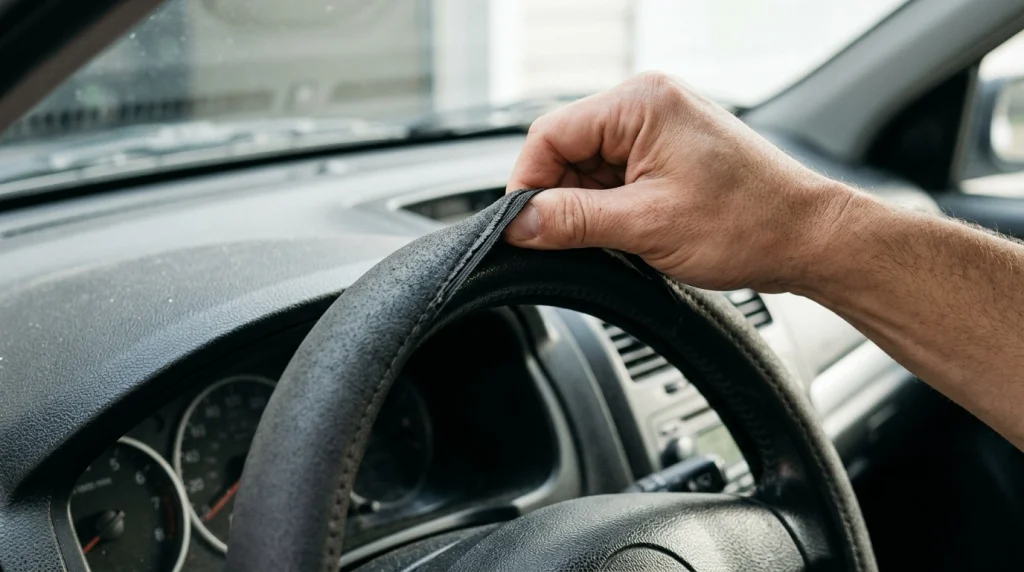
Before adding grip tape or liners, perform a quick tension check while the vehicle is parked. A cover relies on hoop stress—the inward radial squeeze generated when an undersized inner ring is stretched over a larger wheel rim—to stay locked in place.
Use these three checks to decide whether to fix or discard the cover:
- The One-Hand Peel Test: Grab the top edge of the cover with one hand and pull forward toward the windshield. If the cover peels off the rim without requiring two hands and substantial prying force, the internal core has lost its elasticity and cannot be made safe.
- Inner Ring Inspection: Pull the cover off and examine the inside surface. If the inner white or black rubber ring shows dry-rot cracks, chalky crumbling, or permanent waves where it no longer forms a tight circle, discard it.
- Rim Gap Check: Pinch the installed cover at the 10 o’clock and 2 o’clock positions. If you feel an air gap between the inner sleeve and the factory wheel rim, the cover’s cross-sectional channel is too wide for your steering wheel’s thickness.
Warning
Never drive with a steering wheel cover that rotates independently of the wheel rim under moderate hand pressure. If the cover slips while turning across traffic or recovering from a skid, the steering wheel inside remains stationary while your hands move, creating an immediate loss of directional control.
Why Steering Wheel Covers Start Slipping
Understanding why friction failed helps you pick the right remedy instead of masking a bad fit.
1. Silicone Dressings and Hand Oils
The most common cause of a sudden slip on a properly sized cover is surface contamination. Detailers and car washes frequently wipe steering wheels with silicone-based interior protectants (“shine” sprays). These compounds create a microscopic lubricating barrier that prevents the cover’s inner rubber ring from biting into the wheel surface.
Similarly, hand lotions, sunscreen, and natural skin sebum migrate through stitched seams or around the edges of the cover over months of use, creating a slick glaze on the factory leather or urethane.
2. Rim Thickness vs. Outer Diameter Mismatch
Shoppers almost always measure the outside diameter of their steering wheel (typically 14.5 to 15.5 inches) while ignoring rim circumference (how thick the wheel tube is where your fingers wrap around it). A cover can match a 15-inch wheel diameter perfectly, yet slip around the rim tube if the wheel is thinner than the cover’s molded channel.
3. Thermal Expansion and Core Fatigue
Inexpensive covers often use a thermoplastic elastomer (TPE) or rigid PVC inner ring rather than vulcanized natural rubber. When cabin temperatures climb above 120°F in direct summer sun, PVC and low-grade TPE soften and expand. Once stretched under heat, these plastics undergo “creep” and never fully shrink back to their original tight diameter when the cabin cools.
Step-by-Step Fixes to Stop a Steering Wheel Cover From Slipping
If your cover passed the tension test and still requires firm effort to stretch over the rim, work through these steps in order from least invasive to high-grip mechanical reinforcement.
Step 1: Strip Lubricants From Both Contact Surfaces
Removing invisible silicone and oil films often restores 100% of a rubber core’s natural tackiness without adding any tape or liners.
- Remove the cover completely: Peel the cover off the wheel so you can reach the entire inner ring and the full 360-degree factory rim.
- Clean the inner cover ring: Scrub the inside of the cover with warm water and a few drops of grease-cutting dish soap, then wipe it dry with a lint-free microfiber towel.
- Degrease the steering wheel: For synthetic urethane or plastic wheels, wipe the rim thoroughly with a cloth dampened with 70% isopropyl alcohol. For genuine leather wheels, skip strong alcohol (which dries out hides) and use a dedicated pH-neutral leather cleaner that leaves zero conditioning residue.
- Let both surfaces dry fully: Trapped moisture acts as a lubricant during reinstallation. Wait 10 minutes until both surfaces feel dry and slightly tacky to the touch.
Step 2: Add a Non-Slip Rubber Shelf Liner Strip (Best Non-Adhesive Fix)
When a steering wheel rim is slightly too thin for the cover’s channel—or when the factory wheel is made of slick polished wood grain or hard plastic—adding a thin compression layer fills the void and multiplies friction without leaving sticky glue behind.
- Cut strips of gripping material: Cut three or four strips of perforated rubberized non-slip shelf liner (or wide silicone exercise resistance band material) measuring roughly 1.5 inches wide by 4 inches long.
- Position at key torque points: Wrap the strips evenly around the steering wheel rim at the 10, 2, 4, and 8 o’clock positions—the zones where your hands apply the highest rotational force.
- Stretch the cover over the liners: Warm the cover in the sun for 10 minutes so it flexes easily, then work it over the top of the wheel and down the sides, keeping the liner strips flat underneath.
- Verify uniform seating: Ensure the cover edges wrap evenly around the rim without bunching the liner material.
Step 3: Apply Automotive Grip Tape or Self-Fusing Silicone Tape
If shelf liner shifts during installation, self-fusing silicone tape offers a residue-free upgrade. Unlike electrical tape or duct tape, self-fusing silicone tape contains no adhesive glue; it bonds only to itself when stretched and provides a high-friction rubberized surface.
- For leather or heated wheels: Wrap self-fusing silicone tape tightly around the rim at four equidistant points. Because it uses zero adhesive, it peels off cleanly years later without pulling dye or damaging factory leather grain.
- For non-leather plastic/urethane wheels: You can apply three or four short 3-inch strips of double-sided carpet tape or heavy-duty 3M automotive acrylic foam tape along the outer perimeter of the rim before pressing the cover on.
Tip
Instead of wrapping tape around the entire steering wheel, apply four 3-inch strips spaced evenly around the outer edge (12, 3, 6, and 9 o’clock). Spacing the strips creates high-pressure grip nodes while still allowing you to slide the cover’s lip over the rim during installation.
Which Anti-Slip Method Should You Use?
Not every steering wheel material tolerates adhesives. The table below compares the safest anti-slip methods based on your factory wheel’s surface and whether you have a heated steering wheel.
| Fix Method | Best Use Case | Safe for Factory Leather? | Residue Risk |
|---|---|---|---|
| Degreasing (IPA / Leather Cleaner) | Tight covers slipping on oil or detailer spray | Yes (use leather cleaner on hides) | None |
| Non-Slip Shelf Liner Strips | Thin rims or slick wood/plastic wheels | Yes | None (check annually for heat softening) |
| Self-Fusing Silicone Tape | Adding rim thickness without glue | Yes | None (bonds only to itself) |
| Double-Sided Automotive Tape | Hard urethane or worn plastic wheels | No (can peel leather topcoat) | Moderate (requires adhesive remover) |
| Sew-On / Lace-Up Conversion | Permanent zero-slip fit on any wheel | Yes (when laced without glue) | None |
Choose non-adhesive options (degreasing, shelf liner, or self-fusing silicone tape) first whenever working on a modern leather-wrapped or heated steering wheel, as sticky adhesives can delaminate leather finishes upon removal.
Common Mistakes and Unsafe “Fixes” to Avoid
Forum threads and short videos often suggest household adhesives that ruin steering wheels or fail under cabin heat. Avoid these four approaches:
- Never use superglue (cyanoacrylate) or construction adhesive: Liquid glues react chemically with leather coatings and polyurethane foam, permanently melting or hardening the factory wheel surface while creating brittle spots that crack under vibration.
- Avoid standard black vinyl electrical tape: Standard electrical tape uses a rubber-resin adhesive designed for cool indoor wiring. Inside a hot parked car, that adhesive turns into a greasy black slime that actually lubricates the inside of your steering wheel cover and makes slipping worse.
- Do not stuff paper towels or cardboard under the cover: Paper products compress rapidly and absorb humidity, creating lumpy dead spots that slide effortlessly across plastic and leather.
- Watch heated steering wheel thermal limits: Adding thick foam tape or multiple layers of rubber under a cover traps heat against the factory rim. On vehicles with heated steering wheels, excessive insulation blocks warmth from reaching your hands and can overstress the fine heating element wires embedded beneath the factory leather.
How to Measure Your Wheel So the Next Cover Never Slips
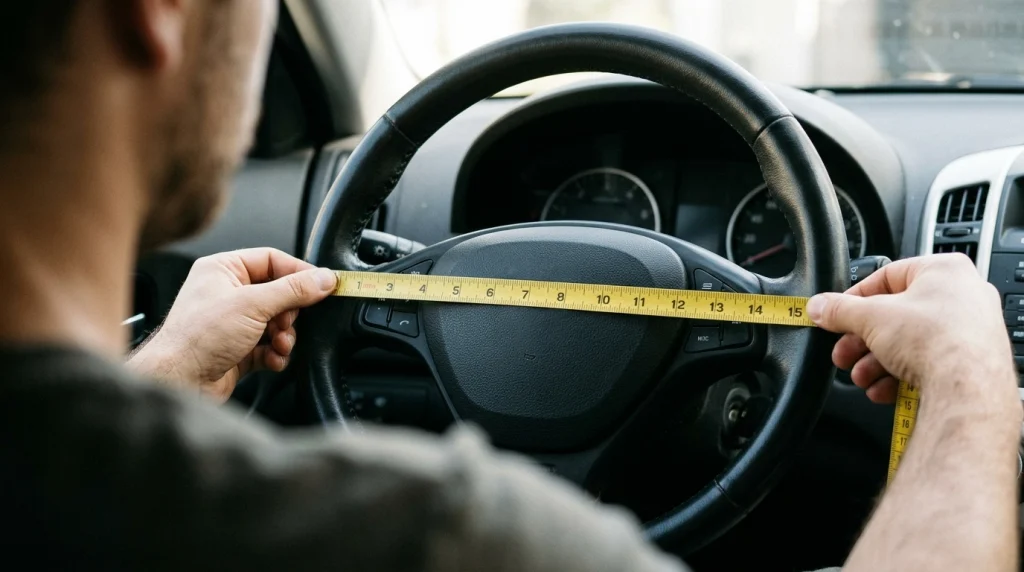
If your current cover is stretched out, replacing it with a properly sized model is the only permanent fix. Rather than buying a “universal fit” cover, take two simple measurements with a flexible tailor’s tape measure:
- Outside Diameter (OD): Measure straight across the center of the steering wheel from the outside left edge to the outside right edge. Standard passenger cars typically measure 14.5 to 15 inches (37 to 38 cm), while pickup trucks and large SUVs often measure 15.5 to 16 inches (39 to 40.5 cm). If your wheel has a flat-bottom (“D-shape”) design, buy a cover explicitly molded for D-shaped wheels, as round covers lose tension across the flat lower segment.
- Rim Grip Circumference: Wrap the flexible tape measure around the thickness of the steering wheel tube itself. Most standard wheels measure 3.75 to 4.25 inches around the tube. If your wheel is thinner than 3.75 inches, a standard slip-on cover will almost certainly rotate unless you choose a lace-up stitch wrap.
Key Insight
What mattered most when evaluating cover materials is the inner core compound: always select a cover with a textured, vulcanized natural rubber inner ring (often white or translucent amber) rather than smooth black PVC plastic, which hardens in winter and stretches permanently in summer heat.
When shopping for a replacement, consider stitched lace-up wraps if you want zero possibility of slippage. Unlike slip-on rings, a stitch-on cover laces tightly around the spokes using waxed thread, mechanically locking the cover so it cannot rotate on the rim.
Related Product
Non-Slip Steering Wheel Covers With Natural Rubber Inner Rings
Replacing a stretched cover with a properly sized model featuring a high-friction natural rubber inner ring restores safe, slip-free steering control without adhesives.
As an Amazon Associate, we earn from qualifying purchases.
Frequently Asked Questions
Can you shrink a stretched steering wheel cover to make it tight again?
No, you cannot reliably shrink a stretched steering wheel cover. Once the internal rubber or thermoplastic elastomer ring has yielded past its elastic limit from cabin heat or installation strain, boiling water or hair dryers will only soften the plastic further and accelerate cracking. A permanently stretched cover must be replaced.
Will double-sided tape ruin a leather steering wheel?
Yes, standard acrylic or foam double-sided tape can pull the clear protective topcoat and dye off a factory leather steering wheel when removed, especially after baking in summer sun. On genuine leather wheels, use non-adhesive rubber shelf liner strips or self-fusing silicone tape instead of sticky adhesives.
Why do silicone and plush steering wheel covers slip more easily?
Ultra-soft floppy silicone sleeves and plush fabric covers lack a rigid internal compression ring. Without inward hoop tension clamping the rim, they rely solely on surface friction, which fails as soon as dust, skin oil, or moisture accumulates underneath.
Can a loose steering wheel cover cause a car to fail a safety inspection?
Yes, in many jurisdictions with periodic motor vehicle inspections, inspectors check that the steering wheel is secure and free of loose coverings that could impede driver control. Even where not explicitly inspected, driving with a slipping cover creates an immediate steering hazard.
Is it safe to put a steering wheel cover on a heated steering wheel?
A thin, tight-fitting cover will not damage a heated steering wheel under normal use, though it will slow down heat transfer by several minutes. However, you should never layer thick foam tape or heavy rubber liners under a cover on a heated wheel, as excessive insulation traps heat against the factory leather and heating grid.
How tight should a steering wheel cover be during installation?
A safe slip-on steering wheel cover should stop roughly two-thirds of the way down the wheel during dry fitting and require strong two-handed pulling force to snap the bottom lip over the lower rim. If a cover slides onto the wheel effortlessly with one hand, it is too large and will slip during hard cornering.
Conclusion
Stopping a steering wheel cover from slipping starts with determining whether the cover still holds structural tension. If the inner ring is tight, stripping away silicone detailer sprays and hand oils with isopropyl alcohol or a residue-free leather cleaner—followed by four short strips of non-slip rubber shelf liner or self-fusing silicone tape—locks the cover firmly against the rim without damaging your wheel. However, if the cover pulls off easily with one hand or has a cracked, stretched inner core, remove it immediately and install a cover matched to both your wheel’s outer diameter and rim thickness.

Daniel Brooks is an automotive writer and product researcher focused on car accessories, car tech, maintenance, and practical driving guides. At Plug-in Car World, he helps drivers make smarter automotive decisions through honest reviews and research-driven content.
