
Can I Drive 8 Hours With a Newborn? Yes — If You Plan It Like a 10-Hour Day, Not an 8-Hour Drive
Quick Answer
Yes, you can drive 8 hours with a newborn, but only if you stop every 2 hours at most. Treat the day as 10 to 11 hours on the road, and check how long a newborn can stay in a car seat before you set your schedule.
The plan in short
- Stop every 2 hours: Take your baby out of the seat, hold them flat, and let them stretch.
- Feed on their clock: Newborns feed every 2 to 3 hours, so plan stops around feeds, not around fuel.
- Keep the seat rear-facing: Check the recline and harness at every stop, because a slumped head can block the airway.
- Start early, finish early: Leave at dawn so the last leg lands before dark and before everyone is worn out.
- Split it if you can: If your baby was born early, has breathing trouble, or is under 1 month old, ask your pediatrician first.
One rule to remember
- If your baby is hard to wake, breathing fast, or going limp in the seat, stop at once and call your pediatrician.
I’ve done the long drive with a newborn in the back, and I’ve also talked myself out of one. This guide covers the honest version: the schedule, the stops, the packing, and the point where splitting the trip is the smarter call.
Can I drive 8 hours with a newborn? Yes, for most healthy, full-term babies, with a strict stop plan.
In This Guide
- Can I drive 8 hours with a newborn?
- How long can a newborn stay in a car seat at one stretch?
- What does an 8-hour drive look like, stop by stop?
- How do I handle feeding, changing, and sleep on the road?
- What should I pack and check before I leave?
- When should I split the trip or not drive at all?
- Frequently asked questions
Can I drive 8 hours with a newborn?
Yes, in most cases, if you plan the day around your baby and not around the map. The drive itself is 8 hours, but the trip is not.
Add four stops of 30 to 45 minutes each, plus fuel and food, and you land at 10 to 11 hours door to door. That math is the whole decision.
I learned this on a 400-mile family trip with my daughter at 6 months old, and the lesson holds even harder for a newborn. The map said 7 hours, and we arrived in 10.
What makes a newborn different on a long drive?
A newborn cannot hold their head up, tell you they are hot, or shift position when they are sore. They depend on you to notice, and a car seat hides a lot.
Your baby also feeds every 2 to 3 hours in the early days. You cannot feed a baby safely in a moving car, and you cannot rush a feed.
So the trip works only when feeds and stops share the same clock. Plan the stops first, then let the driving fit between them.
Is an 8-hour drive safe for a newborn?
For a healthy, full-term newborn, a long drive with regular breaks is widely treated as safe by pediatric guidance. The risk rises when the baby stays in the seat too long without a break.
Long, unbroken seat time can let a newborn slump, overheat, or breathe less well. Breaks fix all three, because the baby lies flat, cools down, and moves.
Pro tip: check your car seat for recalls on the NHTSA site before a long trip, and ask your pediatrician about your baby in particular if they were born early or have breathing trouble.
Section takeaway: An 8-hour drive with a newborn is a 10 to 11 hour day, built around stops every 2 hours, and it works only when you accept that math before you leave.
How long can a newborn stay in a car seat at one stretch?
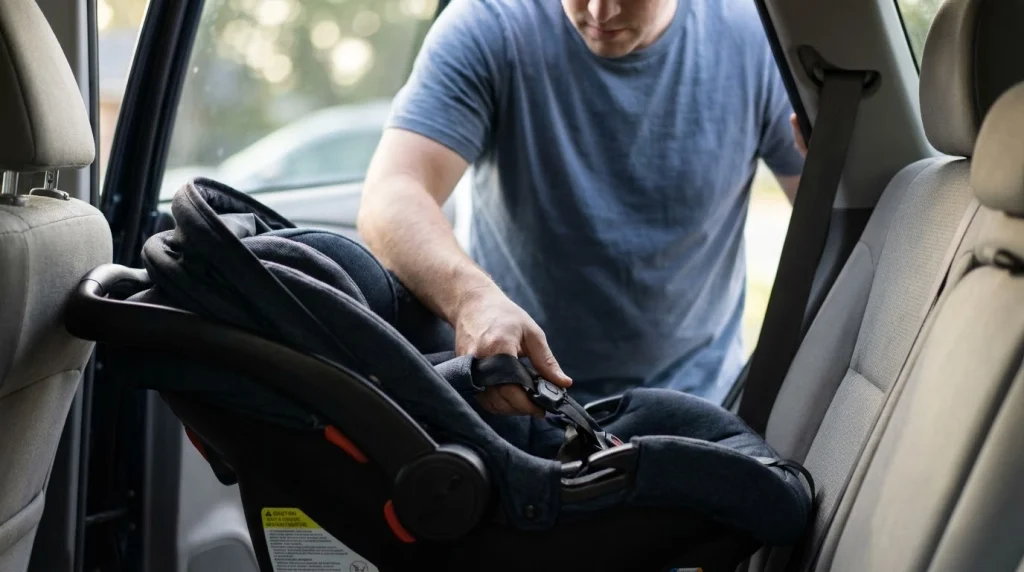
A newborn should stay in a car seat for no more than 2 hours at a time. Many pediatric sources suggest shorter stretches, near 30 minutes, in the first month of life.
A car seat is a travel seat, not a crib. It holds a newborn in a semi-upright pose, and that pose can press the chin to the chest if the recline is wrong.
That chin-to-chest pose is the danger to watch for. It can narrow the airway, and a newborn cannot fix it alone.
What is the 2-hour rule, in plain words?
The 2-hour rule means this: after 2 hours in the seat, take the baby out for a real break. Hold them, lay them flat on a firm surface, and let them move.
For a baby under 1 month old, I plan for 60 to 90 minutes of driving between stops. That sounds slow, and it is.
It also keeps the day calm. Short legs mean fewer cries, fewer rushed feeds, and fewer stops that turn into hour-long resets.
How do I know the seat fit is right before a long drive?
Check three things before you leave the driveway. First, the recline angle must match the newborn setting in your manual.
Second, the harness must sit snug, with no slack you can pinch at the shoulder. Third, the chest clip must sit at armpit level, not on the belly.
If your seat still feels loose after a snug install, re-read the manual for the newborn insert rules. Some inserts must come out at a set weight, and some seats need a rolled towel only where the manual allows it.
A good fit check takes 10 minutes at home and saves a roadside fix. Do it the night before, not in a parking lot with a crying baby.
- Recline: Use the newborn recline mark, and check it again after the base settles.
- Harness: Snug at the shoulders, straps flat, no twists.
- Head: Head stays back, chin off the chest, no slump to one side.
- Seat choice: If the fit is borderline, read how to choose a car seat for a newborn before you buy or borrow a different seat.
- Head position: For the airway checks at each stop, see how to position a newborn’s head safely in a car seat.
Section takeaway: The 2-hour limit is the schedule, not a suggestion, and for a baby under 1 month old, shorter legs of 60 to 90 minutes are the safer plan.
What does an 8-hour drive look like, stop by stop?
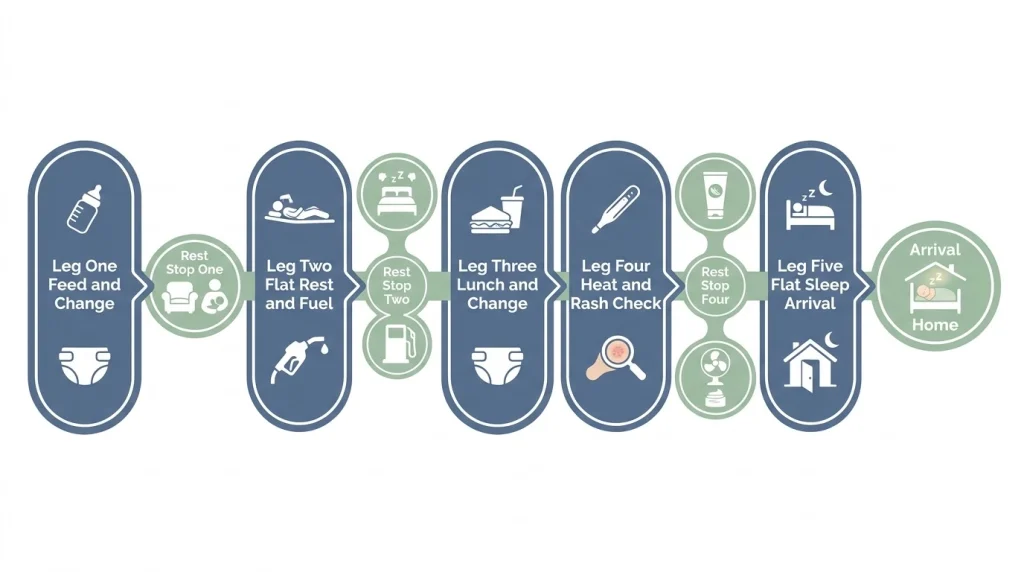
It looks like five short drives, not one long one. Each leg is about 1 hour 30 minutes of driving, then a 30 to 45 minute stop.
Here is the shape I use for an 8-hour drive that starts at 7 in the morning. Your times will shift, but the rhythm should not.
| Leg | Drive | Stop | What happens at the stop |
|---|---|---|---|
| Leg 1 | 7:00 to 8:30 | 8:30 to 9:00 | Feed, change, hold flat, check harness |
| Leg 2 | 9:00 to 10:30 | 10:30 to 11:15 | Feed, change, longer flat rest, fuel |
| Leg 3 | 11:15 to 12:45 | 12:45 to 1:30 | Feed, lunch for adults, flat rest, change |
| Leg 4 | 1:30 to 3:00 | 3:00 to 3:30 | Feed, change, check for heat and rash |
| Leg 5 | 3:30 to 5:00 | Arrive near 5:00 | Flat sleep surface at once, no seat time |
Traffic or a long feed can push arrival past 6 in the evening.
Build in that buffer when you tell family your arrival time.
Where should I stop with a newborn?
Pick stops with shade, a clean changing spot, and room to walk. A rest area with trees beats a busy gas station with no shade.
Look for places with a family restroom or a quiet corner inside. You need a flat surface for a change, and a calm spot for a feed.
Map your stops the night before, and save two backup stops per leg. A closed rest area should never force you to drive an extra hour.
How do I keep the car cool and calm between stops?
Keep the cabin near 68 to 72 degrees Fahrenheit, and shade the rear window.
Check the back of the neck, not the hands, for warmth. Hands feel cool in air conditioning even when the chest is warm.
Section takeaway: Five short legs with real 30 to 45 minute stops turn an 8-hour drive into a calm 10 to 11 hour day, and mapped backup stops keep one closed rest area from breaking the plan.
How do I handle feeding, changing, and sleep on the road?
Feed, change, and sleep share one rule on the road: never do them in a moving car. Pull over, stop the car, and take the baby out of the seat.
That rule sounds obvious, but tired parents bend it. Do not bend it, even for a short stretch.
A bottle in a moving car can choke a newborn, and a loose harness during a feed is a crash risk. The stop is the feed, and the feed is the stop.
How often will my newborn need to feed?
Most newborns feed every 2 to 3 hours, day and night. On a drive day, that means 3 to 4 feeds between stops, plus one at arrival.
Feed at the start of the stop, not at the end, so a full baby settles faster for the next leg.
If you breastfeed, pick a stop with a private corner. If you use formula, pack pre-measured powder and clean water in separate bottles.
How do I change a newborn at a rest stop?
Change the baby at every stop, even if the diaper feels light. A wet diaper on a long leg can cause rash, and rash makes the next leg loud.
Use a portable changing pad on a flat surface, and keep wipes in reach, not buried in the trunk.
Can my newborn sleep in the car seat during the drive?
Yes, a newborn can sleep in the car seat while you drive, if the fit is right and you check them often. Sleep in the seat is normal on a long drive.
Check breathing and head position at every stop. A baby who sleeps with the chin on the chest needs a stop and a refit.
Once you arrive, move the baby to a flat sleep surface at once. The car seat is for travel, not for an overnight sleep.
For the full sleep-safety picture, read can a baby sleep in a car seat before the trip, and set a phone reminder to check the baby every 30 minutes while driving.
Section takeaway: Feed and change at every stop, never in a moving car, and move the baby to a flat sleep surface the moment you arrive.
What should I pack and check before I leave?
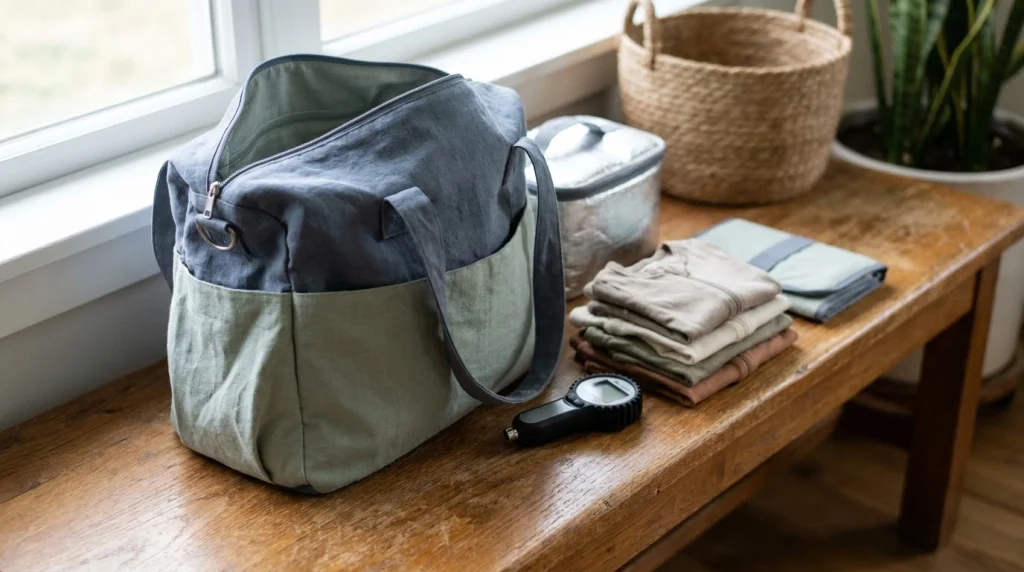
Pack for the car, not for the destination. The cabin bag is your whole nursery for 10 hours, and the trunk is too far away at 70 miles per hour.
I pack the cabin bag the night before, then check it again in the morning. A missing item at dawn is a problem, but a missing item at a rest area is a delay.
- Diapers and wipes: 10 to 12 diapers, wipes, cream, and a changing pad in the cabin.
- Feeds: Bottles, formula or pumped milk in a cooler, burp cloths, and a spare feed.
- Clothes: Two spare outfits, a light blanket, a sun hat, and socks.
- Health: Thermometer, saline drops, pediatrician number saved in your phone, and any medicine your doctor listed.
- Seat: Manual, extra harness pads if your seat uses them, and a window shade.
- Adults: Water, snacks, phone charger, and a paper map in case signal drops.
Check the car the same night. Fuel, oil, tire pressure, lights, and wipers all take 15 minutes, and a flat tire with a newborn is a different job.
Run through the full safety list before you load the baby. The essential car seat safety checklist for parents covers install, harness, and recline in one pass, and it is worth the 10 minutes.
For a broader read on car prep and road-trip gear, the Consumer Reports homepage is a useful starting point for independent car and gear guidance. Check your tire pressure when the tires are cold, not after an hour on the highway.
Section takeaway: Pack the cabin like a nursery, check the car the night before, and run the full seat checklist before the baby goes in.
When should I split the trip or not drive at all?
Split the trip if the 10 to 11 hour day feels too long for your baby, or for you. An overnight stop is not a failure, and it often makes the second day easy.
Do not drive if you slept badly the night before. A tired driver with a newborn in the back is a risk you can avoid by leaving a day later.
Which babies should not do an 8-hour drive?
Ask your pediatrician first if your baby was born early, weighs under 5 pounds, or has breathing, heart, or feeding trouble. Some babies need a car seat challenge, a monitored trial in the seat, before a long trip.
That challenge is a hospital check, not a home drive. It watches oxygen and heart rate while the baby sits in the seat, and it guides whether a long drive is safe yet.
Skip the drive if your baby has a fever, is feeding poorly, or has just had a vaccine reaction. A sick newborn needs rest at home, not 8 hours on the road.
If you must travel without your own car at either end, read how to travel with a child car seat without your own car before you book taxis or rentals. The rules for a borrowed seat are different from the rules for your own.
What if the weather or the road turns bad?
Stop early if rain, fog, or heat builds up. A newborn in a hot car heats up fast, and a driver in heavy rain slows down for a reason.
Keep the Edmunds homepage in mind for car and road-trip planning, and check local road alerts before each leg. If the road closes, the hotel is the plan.
Section takeaway: Split the trip if the day feels too long, skip it if your baby is sick or was born early without a doctor’s go-ahead, and never let a schedule push you through bad weather.
Frequently asked questions
Can I drive 8 hours with a 1-month-old baby?
Yes, for most healthy full-term babies, with stops every 2 hours at most. For a baby under 1 month old, plan legs of 60 to 90 minutes, and ask your pediatrician first if there were birth or breathing concerns.
How often should I stop on an 8-hour drive with a newborn?
Stop at least every 2 hours, and take the baby out of the seat for 30 to 45 minutes each time. Feed, change, and hold them flat at each stop, then check the harness and recline before the next leg.
Can a newborn be in a car seat for 8 hours straight?
No, a newborn should not stay in a car seat for 8 hours straight. The limit is 2 hours at a time, with a real break out of the seat.
Is it safe for a newborn to sleep in a car seat on a long drive?
Yes, sleep in the seat during driving is normal, if the recline and harness are right and you check breathing and head position often. Move the baby to a flat sleep surface as soon as you arrive, and never leave a sleeping baby alone in a parked car.
What is the best time of day to drive with a newborn?
Leave at dawn, so the longest legs land in the morning and you arrive before dark. Early starts also give you buffer for long feeds, traffic, and an extra stop without driving late at night.
Should I fly instead of driving 8 hours with a newborn?
It depends on your baby and your route, because flying is faster but adds airport time, a separate seat decision, and a car seat to carry. Driving gives you control over stops, and for many families that control is worth the longer day.
Plan the day around your baby, stop every 2 hours, and arrive with time to spare. An 8-hour drive with a newborn is doable, and a calm 10-hour day beats a rushed 8-hour one every time.
Leave early, drive slow, and let the baby set the pace.

Daniel Brooks is an automotive writer and product researcher focused on car accessories, car tech, maintenance, and practical driving guides. At Plug-in Car World, he helps drivers make smarter automotive decisions through honest reviews and research-driven content.