
How to Position a Newborn’s Head Safely in a Car Seat
Quick Answer
To position a newborn’s head safely in a car seat, use the correct rear-facing recline, place the harness straps at or below the shoulders, and keep the chest clip at armpit level. The head should rest back against the seat with a clear airway, not flop forward with the chin pressed to the chest. Follow your seat manual first, and check NHTSA’s car seat guidance when you need an official safety reference.
Check these 5 points first
- Recline first: Set the recline to your seat’s indicator for a newborn, because recline controls head support.
- Harness slots: Use the slots at or below your baby’s shoulders for a rear-facing seat.
- Snug straps: Tighten the straps until you cannot pinch slack at the collarbone.
- Chest clip: Place the clip at armpit level, not on the belly or near the neck.
- Clear airway: Look for easy breathing, a relaxed face, and a head that rests back rather than folding forward.
Stop and fix it if
- The chin drops to the chest and stays there.
- The straps feel loose, the clip slides down, or the seat moves more than your manual allows at the belt path.
Welcome to a guide that focuses on one small detail with a large safety payoff. A newborn cannot hold the head steady, so the seat must do that job through recline, harness fit, and correct installation.
This guide covers the safe head position, the checks that protect it, and the covers and inserts you should avoid. You will also find a step-by-step routine, a table for support options, and answers to the questions parents ask most.
In This Guide
- What Does a Safe Newborn Head Position Look Like?
- How Do Recline, Harness, and Chest Clip Protect the Head?
- How Do You Position a Newborn Step by Step?
- What Should You Do If Your Baby’s Head Falls Forward or to the Side?
- Are Car Seat Covers and Head Supports Safe for Newborns?
- When Should You Recheck, Adjust, or Get Expert Help?
- FAQs
What Does a Safe Newborn Head Position Look Like?
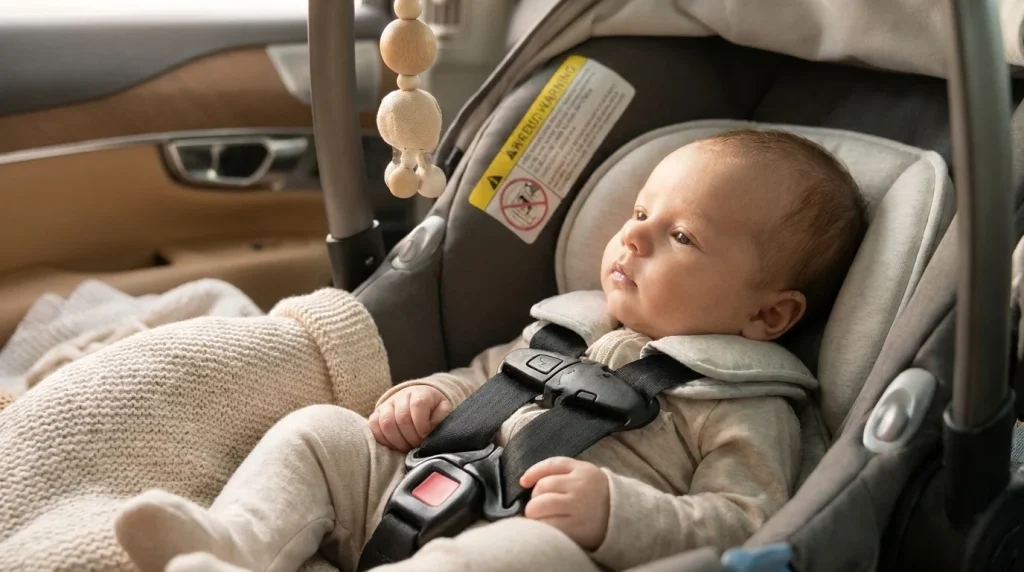
A safe position keeps the head resting back in the seat shell, with the face visible and breathing unblocked. The chin should stay off the chest, and the head should not hang forward over the harness.
Definition: A safe newborn head position is a rear-facing position where recline, harness tension, and head support keep the airway open without forcing the head straight. It looks relaxed, not stiff or propped.
Newborn neck muscles tire fast, so the seat shell carries most of the load. A correct recline lets gravity help the head rest back instead of pulling it forward.
- Head back: The back of the head contacts the seat or the approved infant insert.
- Face clear: No blanket, hood, or strap crosses the nose or mouth.
- Chin lifted: You can see a small gap between chin and chest.
- Body centered: The hips sit back in the seat, and the straps lie flat on the shoulders.
A head that tips to one side often worries parents more than it should. Side tilt alone does not always block breathing, but you still need to check the face, color, and breathing sounds.
Forward flop matters more, because a chin pressed to the chest can narrow a small airway. Stop the car in a safe place and recheck the seat if you see that pattern.
Pro tip: Check your car seat manual for the newborn recline range and insert limits, and ask your pediatrician about any breathing concern that keeps returning.
Section takeaway: Recline and harness fit create the safe head position, and a clear airway matters more than a perfectly straight head.
How Do Recline, Harness, and Chest Clip Protect the Head?
Recline sets the head angle, the harness limits body movement, and the chest clip keeps the straps in place. When one of those three fails, the head loses support and can drop forward during braking or on a long, sleepy ride.
Each seat shows recline in a different way, such as a bubble level, a line, or a color window. Use the indicator for your exact model, and check it on level ground before you tighten the installation.
Do not guess the angle from another seat or another car. A seat that looks close can still sit too upright for a small newborn, and a seat that looks reclined can still pass its own indicator.
- Recline: Adjust the base or recline foot until the newborn indicator shows correct.
- Harness slots: Choose the slots at or below the shoulders for rear-facing use.
- Strap tension: Pull the adjuster until the pinch test shows no slack at the collarbone.
- Chest clip: Slide the clip to armpit level after you tighten the straps.
Harness straps must lie flat, without twists, across the shoulders and hips. Twisted straps can tighten unevenly and let the body shift, which then lets the head shift too.
Bulky coats, snowsuits, and thick blankets under the harness create a hidden gap. The straps may feel snug over the bulk, then loosen once the bulk compresses in a crash.
Dress your baby in thin layers for the ride, then add a blanket over the secured harness if the car feels cold. That order keeps the harness close to the body and keeps the head support stable.
Consumer Reports publishes car seat ratings and fit guidance that can help you compare seats, but your seat manual still rules for your exact model. Use outside ratings for shopping, not as a replacement for the manual.
Section takeaway: Correct recline, low harness slots, snug straps, and an armpit-level clip work as one system to hold a newborn’s head back.
How Do You Position a Newborn Step by Step?
Use the same short routine for every ride, and do it before you start the car. A calm, repeatable order catches loose straps and wrong recline before they become a problem on the road.
- Check the base: Confirm the recline indicator still shows the newborn setting.
- Seat the baby low: Push the hips back into the seat so the back lies flat against the shell.
- Set the straps: Bring the shoulder straps over the shoulders and keep them flat.
- Buckle and tighten: Buckle the harness, then pull the adjuster until the pinch test passes.
- Place the clip: Slide the chest clip to armpit level and check both strap paths.
- Look at the head: Confirm the head rests back, the chin stays off the chest, and the face stays clear.
- Check the install: Grip the seat at the belt path and confirm it moves only within your manual’s limit.
Check the head from the side, not only from the front mirror. A side view shows chin-to-chest folding far better than a quick glance in a rear-view mirror.
Do not adjust straps, clips, or recline while you drive. Pull over in a safe place, fix the fit, and then continue the trip.
Illustrative example: A parent parks, sets the recline indicator, tightens the harness until the pinch test passes, and then notices the chin still drops. That parent rechecks the base angle first, rather than adding a pillow behind the head.
Keep the routine short enough to repeat when you feel tired or rushed. Short routines survive real life better than long checklists, and they still catch the main risks.
Section takeaway: Hips back, straps snug, clip at armpit level, and a side-view head check give you a safe start for every ride.
What Should You Do If Your Baby’s Head Falls Forward or to the Side?
Stop in a safe place, recheck recline and harness fit, and remove any unapproved item behind or beside the head. Do not prop the head with a new pillow, strap, or rolled item until you know your manual allows that exact fix.
Forward flop often points to a seat that sits too upright for a newborn. Recheck the recline indicator, the base angle, and the vehicle seat slope before you change anything else.
Loose straps cause a second common pattern, where the body slides and the head follows. Tighten the harness, redo the pinch test, and reset the chest clip to armpit level.
- Recheck recline: Confirm the newborn indicator, not the toddler setting.
- Recheck harness: Confirm slot height, flat straps, and no pinchable slack.
- Recheck the insert: Confirm your baby still fits the weight and height limits for the included insert.
- Recheck clothing: Remove bulky layers from under the harness and re-tighten.
Side tilt needs a different response, because you should not force a sleeping baby’s head straight by hand. Check breathing, skin color, and whether the face stays clear, then let the seat support the head.
If breathing sounds noisy, pauses, or looks labored, seek medical advice promptly and do not keep driving through the concern. HealthyChildren, from the American Academy of Pediatrics, offers parent guidance on car seat safety and infant health topics.
Never use a head strap, neck pillow, or aftermarket support to hold the head in place unless your seat maker approves it for your model. Those add-ons can change crash performance, push the head forward, or hide a harness problem.
Section takeaway: Fix forward flop with recline and harness checks first, and treat repeated breathing concerns as a reason to get expert advice.
Are Car Seat Covers and Head Supports Safe for Newborns?
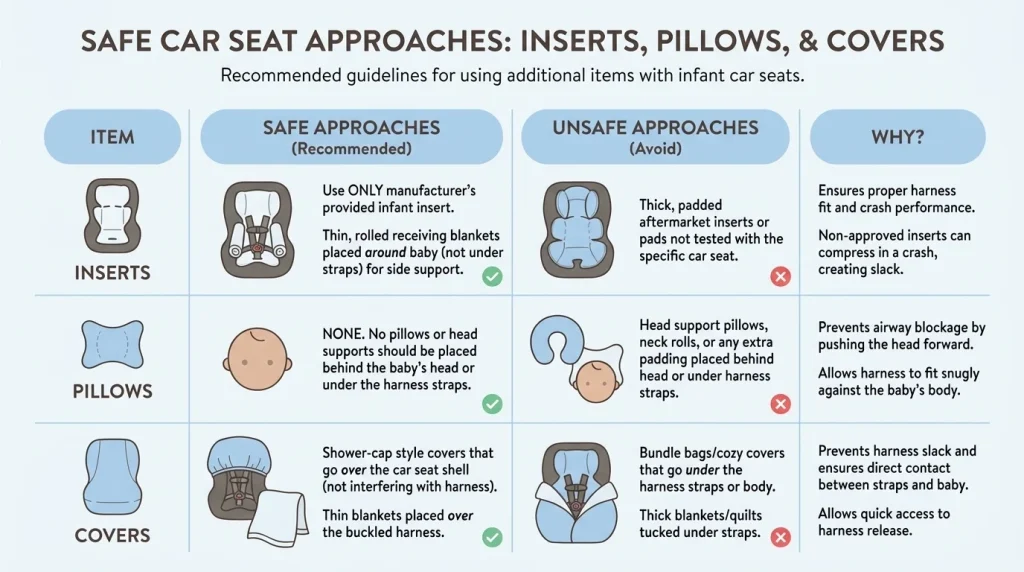
Vehicle seat covers and infant car seat inserts are not the same product, and you must judge them separately. A cover for the adult car seat can still affect an infant seat base, while an insert for the baby must come from the seat maker or gain explicit approval.
Start with the infant seat manual, then check the vehicle manual for the seat and belt or LATCH routing. If either manual warns against a layer under the base, remove that layer before you install.
| Option | What it is | Safe approach |
|---|---|---|
| Manufacturer infant insert | Insert that ships with your seat | Use it only within its stated weight and height limits. |
| Aftermarket head pillow | Separate pillow or support sold for car seats | Avoid it unless your seat maker approves it for your model. |
| Vehicle seat cover under the base | Cover on the adult vehicle seat | Remove it if it changes base tightness, angle, or belt routing. |
| Blanket behind the baby | Blanket placed behind the back or head | Do not place it behind the baby under the harness. |
| Rolled cloth beside the head | Small roll placed beside the head | Use it only if your manual allows that exact method. |
A thick or slick vehicle seat cover can let a base slide or sit at the wrong angle. Reinstall the base after you add or remove any cover, and recheck movement at the belt path.
If you shop for a vehicle seat cover for the adult seat, compare fit, thickness, and grip before you place an infant base on it. A review of cooling car seat covers can help you see how cover materials and fit differ, but it does not turn that cover into an infant insert.
A Sprints car seat cover review also focuses on the adult vehicle seat, so check its thickness and attachment points against your infant base install. Remove the cover if the base feels less stable than it did on the bare vehicle seat.
An Astonish car seat cover review gives you another adult-seat example to compare, and the same rule applies. Keep the infant harness path clear, keep the base tight, and keep the baby’s head support inside the infant seat itself.
Wash a vehicle seat cover only after you remove the infant base, then reinstall and recheck the whole setup. A clean cover still counts as a changed install if it sits differently after washing.
Section takeaway: Use only the insert your seat maker provides, and treat any vehicle seat cover as a possible install change until you recheck the base.
When Should You Recheck, Adjust, or Get Expert Help?
Recheck the fit after growth, after any reinstall, after a crash, and whenever the head position changes. Get expert help when the manual leaves a question unanswered or when a breathing concern keeps coming back.
Growth changes the fit in small steps, so a setting that worked last month may fail this month. Check harness slot height, insert limits, and head clearance at least once a month for a fast-growing newborn.
Any reinstall deserves a full check, even if you moved the seat for cleaning or for another passenger. Reconfirm recline, belt or LATCH tightness, harness slots, and the side-view head position.
- After growth: Recheck slots, insert limits, and strap tension.
- After cleaning: Reinstall the base and cover, then recheck movement and recline.
- After a crash: Follow your seat manual and maker guidance on replacement.
- For preemies: Ask your pediatrician about a hospital car seat check before discharge.
- For repeat flop: Ask a certified child passenger safety technician for a hands-on check.
As of 2026, the core advice stays steady: rear-facing use, correct recline, snug harness fit, and no unapproved add-ons. New seat models may change indicators or insert limits, so read the manual for the seat you own.
A technician check works best when you bring the seat, the baby, the vehicle, and the manual together. That combination lets the technician see the real install, not a photo of it.
Section takeaway: Treat every reinstall and growth change as a new fit check, and get hands-on help when the head position still looks wrong.
FAQs
Should a newborn’s head stay perfectly straight in a car seat?
No, a perfectly straight head is not the goal for a newborn in a car seat. Aim for a head that rests back in the seat shell, with a clear airway and a chin lifted off the chest.
Is it dangerous if my baby’s head falls to the side?
Side tilt alone does not always mean danger, but you still need to check breathing and face clearance. Stop in a safe place if breathing looks labored, color changes, or the face presses into fabric.
Can I use a rolled towel beside my baby’s head?
Use a rolled towel only if your car seat manual allows that exact method for your model. Do not place rolls behind the baby, and remove the roll if it changes harness fit or head angle.
Can I put a blanket behind my newborn in the car seat?
Do not put a blanket behind your newborn under the harness, because it can change harness tension and body position. Dress your baby in thin layers, secure the harness, and place a blanket over the harness instead.
Does a premature baby need a special head support?
A premature baby may need a hospital car seat check and close follow-up, but still needs only maker-approved support. Ask your pediatrician about insert limits, recline, and any breathing test before regular car rides.
Can a car seat cover go under an infant car seat base?
A vehicle seat cover can go under a base only if both manuals allow it and the install stays tight. Reinstall and recheck recline and belt-path movement after you add any cover, and remove it if stability drops.
Final takeaway: A newborn’s head stays safest when recline, harness fit, and a clear airway work together, without extra pillows or layers behind the baby.
Before your next ride, run the side-view check, confirm the pinch test, and keep your seat manual where you can reach it. That small routine protects the head on short trips and long ones alike.

Daniel Brooks is an automotive writer and product researcher focused on car accessories, car tech, maintenance, and practical driving guides. At Plug-in Car World, he helps drivers make smarter automotive decisions through honest reviews and research-driven content.
