
How Long Can a Newborn Stay in a Car Seat? A Safety Guide for Parents
Quick Answer
How long can a newborn stay in a car seat? A widely recommended precaution is no longer than two hours at a time, with regular breaks. For babies in their first weeks, shorter journeys are preferable, and some maternity services recommend about 30 minutes per stretch. These are precautions, not scientifically established universal limits. Follow your baby’s medical advice and the NHS guidance on newborn car travel.
Essential Safety Rules
- First few weeks: Keep journeys short and discuss longer travel with your pediatrician.
- Two-hour precaution: Take your baby out of the seat at least every two hours during longer trips.
- Correct positioning: Use an appropriately reclined, rear-facing car seat.
- Watch breathing: Stop immediately if your baby’s head slumps forward or breathing appears abnormal.
- Safe sleep: Move a sleeping baby to a firm, flat sleep surface upon arrival.
Important Reminder
- Never remove your baby from the car seat while the vehicle is moving. Always stop somewhere safe first.
Bringing a newborn home is exciting, but that first drive often raises unexpected questions. One of the biggest is how long such a tiny baby can safely remain in a car seat.
I believe the most useful advice combines practical travel planning with reliable child-safety guidance. This guide explains the time recommendations, breathing concerns, seat positioning, and ways to make necessary journeys safer.
In This Guide
How Long Is Too Long for a Newborn in a Car Seat?
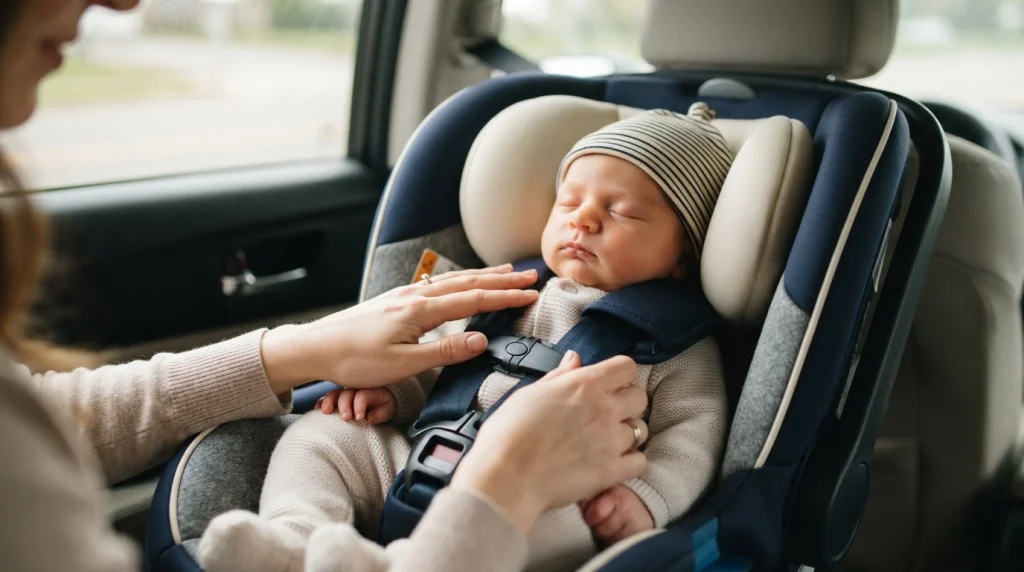
Many child-safety organizations recommend limiting uninterrupted car-seat use to approximately two hours. However, newborns may benefit from considerably shorter journeys, particularly during their first few weeks.
There is no single scientifically established time limit that guarantees safety for every baby. Your child’s age, health, positioning, and medical history all matter.
What Is the Two-Hour Car Seat Rule?
The two-hour rule is a precaution recommending that babies spend no more than approximately two consecutive hours in a car seat. Parents should stop regularly and remove the baby from the seat.
This recommendation is not a guarantee that two hours is safe for every infant. It also doesn’t mean every baby must remain outside the seat for a scientifically established number of minutes.
The American Academy of Pediatrics provides separate road-trip advice, emphasizing proper installation and regular stops. Its recommendations can differ from the commonly cited two-hour precaution.
Is 30 Minutes Safer for a Newborn?
Some maternity services advise keeping initial newborn journeys to approximately 30 minutes. This conservative approach is especially relevant during the first weeks of life.
However, 30 minutes is not a universal medical cutoff. If your baby needs a longer journey, ask your healthcare professional about appropriate precautions.
For example, the trip home from the hospital might take 45 minutes. That does not automatically make the journey unsafe, but it deserves careful planning.
Car Seat Time Recommendations Compared
The following table provides practical planning guidance rather than guaranteed medical safety thresholds.
| Situation | Practical Approach | Key Consideration |
|---|---|---|
| First few weeks | Prefer short trips; some services suggest around 30 minutes. | Follow individual medical advice. |
| Older, healthy infant | Plan regular breaks, using two hours as a precautionary maximum. | A correct fit and recline remain essential. |
| Journey exceeding two hours | Stop safely and remove the baby at regular intervals. | Allow extra time for feeding and care. |
| Premature or medically vulnerable baby | Follow a personalized hospital or pediatrician plan. | Additional assessment may be necessary. |
Key takeaway: Treat time recommendations as precautions, not permission to leave a baby unattended or incorrectly positioned.
Why Does Spending Too Long in a Car Seat Matter?
Newborns have limited head and neck control. Their developing anatomy makes correct positioning especially important during travel.
A car seat protects babies during vehicle crashes, but it holds them in a semi-reclined position. That position requires careful attention to their breathing and posture.
Positional Asphyxia and Airway Concerns
Positional asphyxia occurs when body positioning interferes with breathing. For a newborn, an unsupported head falling forward can narrow the airway.
A chin-to-chest position is particularly concerning. Proper installation helps reduce the chance of this dangerous posture.
Parents should watch for these warning signs:
- The baby’s head falls forward with their chin pressed against their chest.
- Breathing becomes difficult, unusually noisy, or irregular.
- The baby develops bluish or gray coloring around the lips or face.
- The baby appears limp or becomes unusually difficult to wake.
- The baby repeatedly slides into an unsafe position.
If your baby slumps forward, stop somewhere safe and correct their position. Never try to adjust the baby while driving.
If your baby has abnormal breathing, becomes limp, or develops blue or gray coloring, seek emergency medical help immediately. Do not simply reposition the child and continue driving.
Why Movement Breaks Are Important
Regular breaks provide an opportunity to remove the baby from the semi-reclined position. They also allow parents to check comfort, feeding needs, and temperature.
A break should involve more than simply switching off the engine. Take the baby out of the seat in a safe place.
During a suitable stop, you can:
- Hold your baby while fully supporting their head and neck.
- Change their diaper if necessary.
- Feed them according to their usual needs.
- Allow gentle movement outside the car seat.
- Check for overheating or uncomfortable clothing.
There is no universally established minimum break duration. Give your baby enough time for care and movement, and follow individual medical guidance.
How Should a Newborn Be Positioned in a Car Seat?
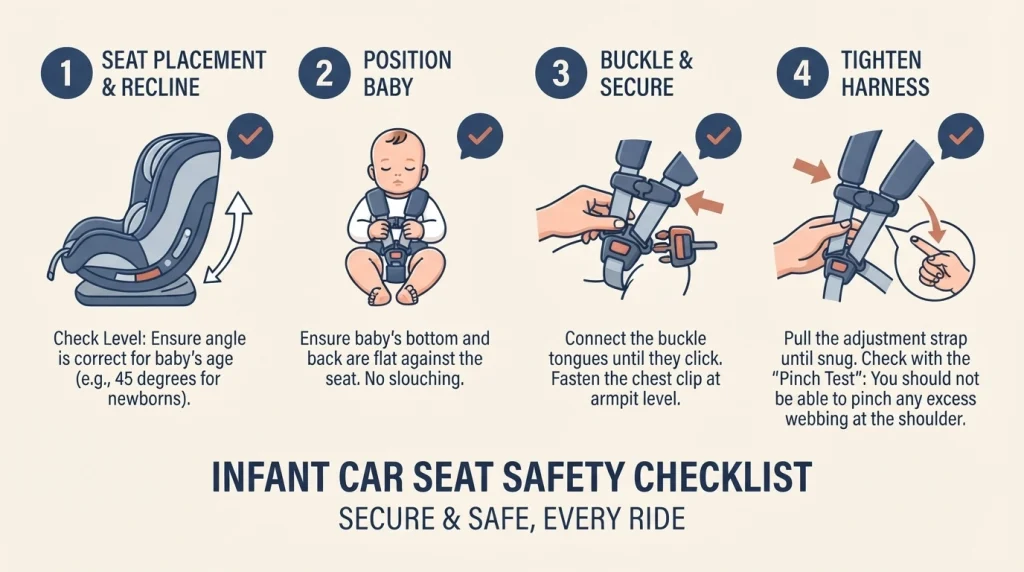
A newborn should travel rear-facing in an appropriately sized, properly installed car seat. The harness and recline angle must match the manufacturer’s instructions.
A rear-facing infant car seat is a child restraint designed to protect babies by supporting their head, neck, and body during a crash.
Check the Recline Angle
Infant car seats have manufacturer-specified recline settings to support a young baby’s airway. Many models include a built-in bubble level or angle indicator.
Do not assume every seat requires exactly 45 degrees. Use the correct newborn setting specified for your model.
The NHTSA rear-facing installation guide explains how to check the installation and harness fit.
Secure the Five-Point Harness
A five-point harness secures the baby at both shoulders, both hips, and between the legs. Proper adjustment helps keep your child correctly positioned.
Before driving, check the following:
- Place the baby’s back and bottom against the car seat.
- Position rear-facing shoulder straps at or below shoulder height.
- Make sure every harness strap lies flat without twisting.
- Tighten until you cannot pinch excess harness webbing at the shoulder.
- Position the chest clip at armpit level, where the seat uses one.
- Confirm the seat is locked securely into its base when applicable.
Avoid thick jackets or padded snowsuits underneath the harness. They can prevent the straps from fitting snugly.
Should You Use a Newborn Head Support?
Use only the infant inserts and positioning accessories approved by your car seat manufacturer. Aftermarket pillows and padding may change the harness fit or head position.
If the baby’s head keeps falling forward, check the recline angle and installation. Seek professional car-seat fitting assistance if the problem continues.
Pro tip: Check both the car seat manual and your vehicle owner’s manual. A certified Child Passenger Safety Technician can help identify installation problems.
How Can You Plan a Long Car Journey With a Newborn?
Long trips require more preparation than everyday driving. Plan your route around safe stopping places rather than the fastest possible arrival time.
My preferred planning approach is simple: build the journey around the baby’s needs. A flexible schedule is more useful than a strict arrival deadline.
Before Starting Your Trip
Check the car seat before departure, not after the baby starts crying. This helps reduce distractions once you’re moving.
- Confirm the seat is installed at the correct angle.
- Check the harness and approved infant inserts.
- Identify safe rest stops along the route.
- Pack diapers, wipes, feeding supplies, and spare clothes.
- Arrange for another adult to sit beside the baby when possible.
- Prepare an appropriate sleep space at your destination.
A Practical Two-Hour Journey Example
Imagine your family needs to drive approximately 100 miles. The navigation app estimates a journey of two hours.
For a healthy older infant, you might plan an earlier break rather than drive the entire distance continuously. With a very young newborn, discuss the journey with your healthcare professional first.
A flexible example could look like this:
- Before departure: Feed and change the baby as needed, then secure them correctly.
- After approximately 30–60 minutes: Consider a safe stop if your newborn needs a break or your medical guidance recommends one.
- During the break: Remove your baby from the seat and attend to their needs.
- Before restarting: Recheck the harness, head position, and recline.
- At your destination: Remove the baby from the seat promptly.
These times illustrate trip planning, not a clinically validated schedule. Stop earlier whenever your baby needs attention.
Can You Feed a Baby During a Car Ride?
Always stop the vehicle before taking your baby out for feeding. Never breastfeed or hold an unrestrained newborn while the car is moving.
After feeding, make sure your baby is comfortable before securing the harness again. Take extra time if your baby needs burping or a diaper change.
The American Academy of Pediatrics’ road-trip advice also recommends planning regular breaks and keeping essential supplies accessible.
Temperature and Car Seat Covers
Car seat covers can help shield a baby from some weather conditions. However, bulky or poorly ventilated covers can contribute to overheating.
Never place a blanket or cover tightly across the entire seat opening. Keep the baby’s face visible and allow adequate airflow.
Use lightweight clothing appropriate for the vehicle’s temperature. Check your baby’s neck or chest for signs of excessive warmth.
What About Premature or Medically Vulnerable Newborns?
Premature babies and newborns with certain medical conditions may face additional breathing or positioning difficulties. These infants need individualized travel guidance.
A baby born before 37 weeks of pregnancy may have less mature breathing regulation. Some infants also have additional respiratory or muscle-tone concerns.
What Is a Car Seat Tolerance Assessment?
A car seat tolerance assessment monitors an infant in a car seat to evaluate how they tolerate the position. Some hospitals use this assessment for babies with specific medical risks.
Policies vary between hospitals and clinical systems. Not every newborn requires this assessment, and a successful test doesn’t eliminate every travel risk.
The AAP car seat information for families discusses special travel considerations for premature babies.
When Should Parents Ask a Pediatrician?
Speak with your baby’s healthcare team before longer journeys if any of these circumstances apply:
- Your baby was born prematurely.
- Your baby has a diagnosed breathing or heart condition.
- Your child needs supplemental oxygen or medical monitoring.
- Your baby has difficulty maintaining a safe head position.
- Your newborn received special car-seat discharge instructions.
In unusual cases, a clinician may recommend a specialized restraint such as an approved car bed. Never substitute an ordinary carrycot for a certified vehicle restraint.
Pro tip: Follow the hospital discharge plan rather than relying solely on general online time recommendations.
Can a Newborn Sleep in a Car Seat?
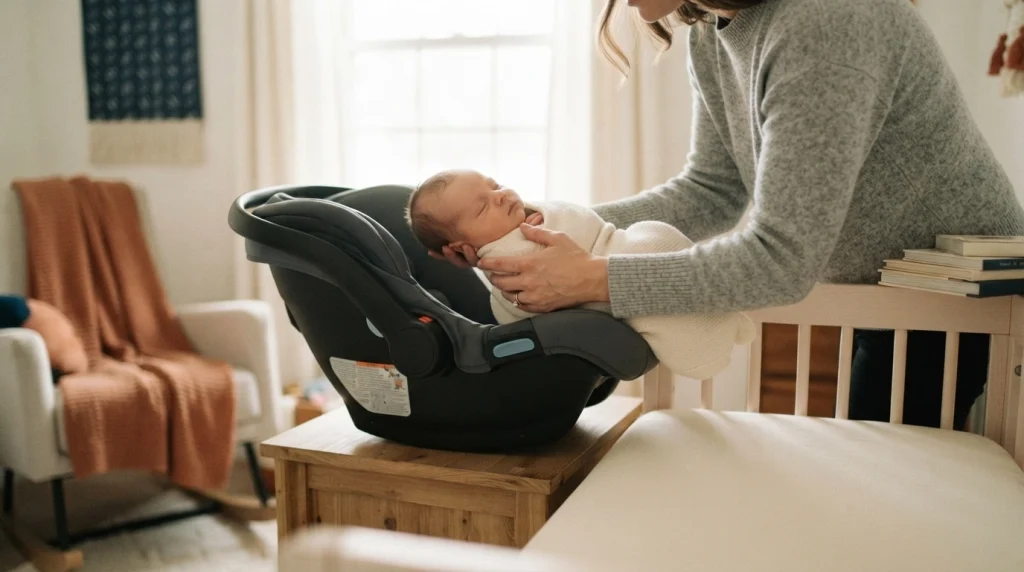
A baby may fall asleep while properly secured in a correctly installed car seat during travel. However, a car seat should never replace a crib or bassinet for routine sleep.
The distinction matters because the car seat’s primary function is crash protection. It is not designed as a general sleeping space outside the vehicle.
What If Your Baby Falls Asleep During Driving?
You do not need to wake a comfortably sleeping baby simply because they doze off during a necessary journey. Continue monitoring their position and follow your planned break schedule.
Make sure the harness remains secured and the baby’s head does not slump forward. Stop promptly if you notice any unsafe positioning.
Should You Let a Baby Finish a Nap in the Carrier?
No. Once you reach your destination, remove the baby from the car seat and transfer them to a suitable sleep space.
The recommended sleep environment includes:
- A firm, flat, non-inclined mattress.
- A crib, bassinet, or approved infant sleep space.
- Placing the baby on their back.
- No loose blankets, pillows, or stuffed toys.
- A comfortable temperature without overheating.
The Lullaby Trust car seat safety factsheet emphasizes moving sleeping babies to a firm, flat surface after traveling.
Does a Stroller Travel System Change the Rules?
A travel system lets an infant car seat attach to a compatible stroller frame. This convenience doesn’t turn the car seat into an unrestricted sleeping space.
Time spent in the seat while attached to a stroller still matters. Remove your baby for appropriate breaks and use a suitable flat sleep space when needed.
Key takeaway: Car seats are essential for vehicle travel, but they are not substitutes for safe sleeping spaces.
Frequently Asked Questions
1. Can a newborn stay in a car seat for three hours?
Three continuous hours exceeds the commonly recommended two-hour precaution. Plan breaks that allow you to remove your baby from the seat, and stop sooner when needed. For babies in their first weeks or those with medical concerns, ask your pediatrician about longer journeys before traveling.
2. Is the two-hour car seat rule per day or per journey?
The commonly cited precaution refers to uninterrupted time in the car seat, rather than a universally established two-hour daily allowance. Some organizations give more conservative advice. Follow your car seat manufacturer’s instructions and your baby’s medical recommendations rather than treating either interpretation as an absolute medical rule.
3. Can I drive home from the hospital with my newborn?
Yes. Newborns should travel in an appropriate rear-facing car seat, including during the journey home from the hospital. Install the seat before discharge and check the baby’s positioning. Ask your medical team for specific guidance if your newborn was premature or has additional health needs.
4. How long should a car seat break last?
There is no universally established minimum break duration that guarantees safety. Remove your baby from the seat and allow time for feeding, changing, and comfortable movement. Follow any more specific advice from your pediatrician, particularly during the first weeks after birth.
5. Can a newborn sleep in a car seat overnight?
A car seat should not be used as an overnight sleeping location outside travel. When you reach your destination, transfer your baby onto their back in a firm, flat, approved sleep space. Even a deeply sleeping baby should not remain in the carrier to finish an overnight sleep.
6. Are convertible car seats safe for newborns?
Many convertible car seats are suitable from birth when the manufacturer specifies an appropriate newborn weight and height range. The seat must fit your baby correctly and be installed rear-facing. Always check harness height, recline settings, and any infant insert requirements before using it.
7. When can babies tolerate longer car journeys?
There is no specific age when all babies can safely tolerate unlimited car-seat time. As infants grow, their head control improves, but regular breaks and correct positioning remain important. Longer travel should still account for feeding needs, individual development, and any medical concerns.
Final Takeaway: Keep Newborn Car Journeys Short and Safe
When asking how long a newborn can stay in a car seat, remember that two hours is a commonly recommended precaution, not a guaranteed safe limit. Shorter trips are sensible during the earliest weeks, especially when healthcare professionals recommend them.
Choose a correctly fitting rear-facing seat, monitor your baby’s position, and make regular stops. Never compromise restraint safety to shorten the journey.
Before your next trip, check the car seat manual and plan suitable rest stops. If your baby was premature or has medical concerns, ask your pediatrician for personalized travel guidance.

Daniel Brooks is an automotive writer and product researcher focused on car accessories, car tech, maintenance, and practical driving guides. At Plug-in Car World, he helps drivers make smarter automotive decisions through honest reviews and research-driven content.
